Showing posts with label Vogue Knitting. Show all posts

Wednesday, 15 March 2017

Lace Yoke Cardigan

Here's what I'm knitting just now.


It's going to be a cardigan.  The design is by Norah Gaughan, from the Holiday 2016 issue of Vogue Knitting.  (The magazine appears in the U.K. as Designer Knitting, with a different cover, and the equivalent issue was Early Winter 2016.)

From Vogue Knitting, Holiday 2016 issue


It is going to look exactly like this, only denim blue.  

As you can see from my work-in-progress, it's knitted top-down, with no seams.  I have got past the complicated yoke, which took a lot of concentration because almost  every row is different - after the yoke it's very straightforward, and I have nearly finished the body.  

The yarn is Aire Valley Aran, spun by West Yorkshire Spinners ("reared, sheared and spun in Britain").  The pattern calls for an Aran weight yarn, though I think the specified yarn must be relatively lightweight to give the specified gauge (21 stitches and 30 rows to 10 cm in stocking stitch on 4mm needles ).  But Aire Valley Aran is also quite lightweight for an Aran yarn, and my gauge is spot on.

I did have a crisis of confidence part way through, though.  One of the advantages of knitting top-down is that you can try on as you go, and I did that, once I had finished the yoke and reached the point where you divide the sleeves from the body.  At that point the yoke looked extremely bulky and much too large.   It doesn't naturally lie flat - especially the cables at the top.   So at that point I pressed it gently under a damp cloth, which was an improvement.  But it was still too large around the neck edge.  The ribbed neckband is supposed to be added as a finishing step, but I decided to pause knitting the body and add the neckband at that point, and that has improved the fit around the neck a lot.  I now believe that it's going to fit me when it's finished, which is a great relief.

Without the neckband, the neck edge was much looser, and was sitting much lower when I tried on my knitting - it would have been difficult to judge the finished length of the cardigan.  So I'd advise anyone else knitting this pattern to add the neckband early, not at the end.

Thursday, 26 January 2017

A Stole of Many Colours

I associate granny squares with the 1970s, when crochet was popular, and so were granny squares.  I'm not really a crocheter, but in 1972 or thereabouts I made a long waistcoat of granny squares in camel and cream - it was a favourite garment.  

 But making things out of crocheted squares evidently goes back further than the 1970s.   There is a very nice example in the Knitting & Crochet Guild collection - a stole with fringed ends.

1950s vintage crochet; stole in small granny squares with fringe; Knitting & Crochet Guild
Add caption

We didn't have a date for it, but then just last week we identified it in Vogue Knitting No. 47, published in Autumn 1955.   The magazine give this description: "Tile motif in bright hues brings crochet up-to-date for a heavenly stole-of-many-colours."  Garments made from granny squares often have a folksy, hippy look, but this one is very elegant.

1950s vintage crochet pattern; Vogue Knitting; stole in multi-coloured granny squares with fringe

The pattern specifies 3-ply wool, so that it's quite delicate - the squares are only 1¾ inches wide (about 4.5  cm.)   You might expect a Vogue Knitting pattern to suggest the colours to use, but it just lists 8 oz. (225g.) of a background colour and about 9 oz. (255g.) of  'various colours for the medallions'.  As you can see from the detail,  our example is very well-made - the squares are joined together very neatly.  And it has a long plaited fringe, following the pattern instructions.  (The fringe takes 7 oz. (200g.) of wool by itself.)

1950s vintage crochet; stole in small granny squares with fringe

 It's very satisfying when we can match up a piece in the collection and a pattern - even more so when the pattern is from Vogue Knitting, and gives us a slightly unexpected date for the piece.

One other question:  I'm sure that we didn't call them granny squares in the 1970s, at least not in this country.  When did we start using that name?  And where did it come from?

Saturday, 27 February 2016

A Yarn Story

Last week I bought a copy of Designer Knitting - that's the international edition of Vogue Knitting.  It was the Winter 2015/16 issue, and has some very nice updated Bohus knits, which was what attracted me.  The magazine has taken a while to get to this country - it had not been on the shelves in W H Smiths for very long when I bought it, yet Orange Swan reviewed it on her blog The Knitting Needle and the Damage Done last December.

One small news feature caught my eye, because it mentions the Knitting & Crochet Guild.  Yarn Stories is a yarn brand based in a mill at Slaithwaite, near Huddersfield.  Last year they ran a competition to design a blanket square inspired by the Guild's collection.  The finalists' designs have been used to create a pattern for a blanket.


It's an amazingly rich design, incorporating stranded knitting, cables, crochet, lace,....   The square with the KCG initials is inspired by a Sanquhar glove pattern.   Yarn Stories are selling the pattern, or the pattern + yarn,  here, and very generously donating the profits from the pattern to the Guild.

The item in Designer Knitting has a brief description of the Guild collection - and I should take the opportunity to update one piece of information.  It says that we have 31,000 patterns in the collection.   In fact, we have at least 38,500 pattern leaflets - those are the ones that we have sorted and recorded so far.  I've been estimating for quite a while that we have about 50,000 pattern leaflets altogether, and I think that's about right.  But if you want to count all the patterns, you would have to include the ones that have appeared in books, booklets and magazines  - I wouldn't even like to estimate how many of those there are.  Let's just say a lot.   We're just beginning to catalogue the pattern leaflets, which is a daunting task.  It'll take a while.      

Thursday, 3 October 2013

Vogue Knitting visit

There is a knitting tour of England & Wales in progress right now, under the auspices of Vogue Knitting magazine,  that started Tuesday morning at Manchester Airport.  (The people on the tour are all from the U.S., I think.)  Tuesday afternoon, the tour visited  Scholes to see a selection of the choicest items from the Knitting & Crochet Guild's collection.  We hired the clubhouse at Scholes Cricket Club for the day, which proved to be an ideal venue.  It is mainly one big room, with windows all along one side, looking over the cricket  pitch and to the hills beyond, so there was plenty of space and light. 


We went one weekend a few weeks ago to check on  a few details, and I took a photo of the view while a cricket match was in progress - it was drizzling at the time, so the view wasn't at its best.  (Not ideal weather for cricket either.)      


There were about 40 in the Vogue Knitting party, and we wanted to give them all the chance to get close to the things we were showing them.  We had chosen five sets of items (Irish crochet,  traditional knitting,  etc.) , with one or two volunteers for each set (I was showing a selection of magazines and pattern leaflets).  We divided the visitors into five groups, too, and over the course of the afternoon, each group progressed around all five sets of items.   The scheme worked very well, though it did mean that we volunteers were talking about our set of items five times, over about two hours.  But I found that each repetition worked out differently, because each group picked up on different things in what I was showing, and asked different questions.   I'll write something about the things that I showed  in the next few posts.

And at the end of the afternoon, we all had tea (very important in cricket, I understand).   I had bought cakes from ProperMaid in Huddersfield who supply a lot of local cafes.  We had Beetroot & Chocolate, Courgette & Lime and Lemon & Poppyseed Drizzle - all really delicious I'm told, and the Beetroot & Chocolate certainly was.  (There was a lot of discussion with the visitors about what courgettes are, though.)  I had also bought parkin, made by a local company, to give them a taste of traditional Yorkshire food.

ProperMaid Courgette & Lime cake

It was an exhilarating afternoon for all of us.  For those of us from the Guild, it reminded us what an amazing collection we have, and the visitors saw some really wonderful things.  Exhausting though - it took a lot of organising and preparation on our side, and several people had come a long way to help. 

And after we had cleared everything up and put the furniture back approximately where it was before, I got home at about 6.45 and then went out for a meeting of the Huddersfield KCG local group.  The meeting was on the theme of lace,  and several people had brought along beautiful lace shawls and scarves that they had made, including a silk stole knitted in the Shetland print o' the wave pattern, which was just lovely.  Ann Kingstone showed the sample knits for some of her lace patterns (knitted by her sister Marie, who was also there), including Hartfield - even finer and more delicate and gorgeous in reality than it looks in photos.  Three of the Guild members who were staying in the area to help with the Vogue Knitting visit came along to the meeting.  Jane, who had been showing some of the Irish crochet in the collection, had brought with her an Irish crochet shawl that she had made, and so was able to show that at the Guild meeting as well - a beautiful piece of work.  I took along one of the knitted lace samplers from the collection, in amazingly fine cotton.  And also (although it wasn't really up to the standard of anything else on show) I took along the honeycomb lace infinity scarf I have made for my daughter - mainly so that I could talk about how tricky it was to keep track of the stitch pattern. 

And then I went home and fell into bed.  I wish I could say that I slept like a log, but I didn't - it was such an exciting, busy day, it was difficult to wind down.  I am so glad that after all our preparation and planning (and several hiccups along the way, up until the last minute)  it all worked out just right.       
  

Thursday, 15 September 2011

A Local Spinning Company?

Greenwoods ad in Vogue Knitting, 1946
We have a set of Vogue Knitting Books in the Knitting & Crochet Guild's collections at Lee Mills, and I have noticed ads from a Huddersfield company in the issues dating from the later 1930s to 1950s.  I live in Huddersfield so I was particularly interested in these ads - although many of the well-known  British spinners of knitting yarns were, and still are, based in West Yorkshire, and Huddersfield is an important producer of woollen cloth, I don't know of any existing knitting yarn spinners based in Huddersfield.

Greenwoods (of Victoria Street, Huddersfield) initially advertised a mail order service:
"Greenwoods can supply you with all the Wools and other threads mentioned in this and other Vogue issues.  ... In addition, any of the garments can be supplied COMPLETELY HAND-KNITTED & READY TO WEAR at reasonable prices from 12/6 upwards. Ask for a quotation for your favourite garment made to measure."
It seems a bit odd to read a knitting magazine and then pay someone else to do the knitting for you, but the ad appeared for several years, so I assume that it was a successful service.

The Victoria Street business appeared in a 1937 Huddersfield trade directory as "Miss Greenwood, Wool and Handicraft Depot".  So it appears that at that time, the company was only supplying yarns made elsewhere - interesting that it was owned by a woman.  Towards the end of the war, Greenwoods started advertising their own yarns, and then from 1946 the Vogue Knitting ads featured their own designs as well. In 1946 (between the two issues of Vogue Knitting) the company changed its name to Wakefield, Greenwood, and moved to Railway Street.  I wonder what had happened?  Was Miss Greenwood still involved in the business?  Had she got married to Mr Wakefield?

W.G. pattern leaflet 119, early 1950s

Back of W.G. leaflet 119

Wakefield, Greenwood continued to advertise into the 1950s, and I hoped to find one of their patterns at Lee Mills. One eventually appeared a couple of weeks ago - from the early 1950s, I guess.  But it was still a bit mysterious.  They claim to manufacture the yarns they are selling, but there cannot possibly have been a spinning mill on Railway Street, or even a warehouse - there is nowhere to put one.  So either they were actually buying in yarn from other companies, or their mill was somewhere else - but then why wasn't their office at the mill?

Then this week, I found a whole box of W.G. patterns.  The styles appear to date from the 1950s and early 1960s.  By sorting them into numerical order, and looking at the ads in Vogue Knitting too, it's possible to follow the development of the company.  At some time in the late 1950s, the company was renamed W.G. Spinners Ltd, but remained at Railway Street. And then a little later, in the early 1960s, the address changed to "Wakefield Mills, Thornhill Beck Lane, Brighouse".  
Ad for W.G. Spinners, 1962
Brighouse isn't far away, but it's not Huddersfield.  I felt quite proud that Wakefield, Greenwood were a Huddersfield company, but it turns out that they decamped to Brighouse - or maybe the spinning was done in Brighouse all along.  A bit disappointing.  Still, Miss Greenwood's original business was definitely Huddersfield based - I like to think of all those posh Vogue Knitting readers who couldn't knit paying to have their knitting done in Huddersfield.

Saturday, 18 September 2010

Matchy Matchy

"The Match Game"
One of the early 60s American Vogue Knitting magazines that I bought earlier this year on our Oregon trip included the sweater in the picture. The caption reads: "For separates with real color harmony, you can buy sweater yarn and  matching skirt fabric in a kit by Munrospun."  It reminded me that my sister Margaret bought a Munrospun pack in 1969, or thereabouts.  That should be quite surprising -  Munrospun packs were the sort of thing that my mother's generation aspired to, whereas  M was about 18 and very fashion conscious, and it was the era of the miniskirt.

But she found a Munrospun pack in a sale in Cole Brothers, very cheap, in a beautiful blue, and persuaded Mother to make it up for her.  (Historical note: Cole Brothers is now called John Lewis Sheffield.  This was a few years after it had moved to its present building from Coles Corner, famed in song and story.) 


Instead of a skirt, M wanted a pinafore dress - inspired by this photo.  (Look! A slightly chubby model!)  It was a Vogue dress pattern featured in the Spring/Summer 1969 Vogue Knitting described in an earlier post.

A dress out of a skirt length was quite a tricky proposition.  A Munrospun skirt length was, I think, 45 inches of 54 inch wide fabric (i.e. about 115cm. x 138 cm.) So it was just as well that Mother was a very clever dressmaker and the dress was supposed to be short. She made up a pattern that didn't have very much to do with the original inspiration - it had a yoke, and a zip up the back, and she had to make a seam in the centre front as well.  She made a feature of all the separate pieces with top-stitching.  There was no spare fabric for facings, or even much of a hem.   

   
Mother knit the matching jumper too - I still have the pattern, though it is rather battered. It had the cable up the front (though it didn't show under the pinafore dress) and she added a polo neck.

The result was a very successful outfit,  that M wore a lot.  Unfortunately, the only photo I can find only shows part of it.


M in Munrospun

In those days, it was very smart to match all the separate parts of your outfit - an exact match of plain colours, or a plain colour matching one of the colours in a check or tartan fabric, and the Munrospun packs were designed to make it easy.  Now that rule has been relaxed, and I think people are better (or braver) at putting together colours that don't match.  (Though I do tend to work on the principle that black goes with everything, which isn't very sophisticated.)  In fact, too much matching looks wrong now - I saw an elderly woman earlier this year wearing jacket, skirt, blouse, hat, gloves, handbag and shoes all in matching or toning shades of olive green.  She clearly felt very smart, but it looked a bit odd, if not obsessive.  Much too matchy matchy.

Saturday, 24 July 2010

Late 60s Knitting

I borrowed The Best of Vogue Knitting Magazine again from my local library this week, and realised that the history of the magazine, in the US and the UK is more complicated than I had thought.  In the US, it first appeared (as the Vogue Knitting Book) in 1932, but then publication stopped in the late 60s, though I can't find out exactly when.  Maybe this explains why the issues that I bought in Cottage Grove in May, dating from the early 60s,  seem so uninspiring - it was a magazine in decline.  It restarted in 1982, and  The Best of Vogue Knitting Magazine  was published to mark its 25th anniversary in 2007. 

What was happening in the UK?  A British version of the Vogue Knitting Book was also published  - the Skiff Vintage Knitting Patterns site  lists several issues from the 50s and 60s, up to issue 68 in Spring/Summer 1966. (At two issues a year, that would also correspond to a first issue in 1932).  But then...  it re-started publication in Spring/Summer 1967 with issue number 1 (again).  It seems that, in this country at least, knitting was still popular enough to warrant a re-launch.   I have two issues of the new series that I bought in 1969  (numbers 7 and 8), but I'm not sure that it survived into the 70s.  The Spring/Summer 1969 issue contains some wonderful patterns,  and consequently my copy is very dog-eared, with the cover in two pieces.

Kaffe Fassett's Moroccan jacket
It is particularly notable for a Kaffe Fassett waistcoat.   I think this was the first knitting pattern that he published.  An article in Let's Knit magazine in March 2008,  reprinted on Kaffe Fassett's web site, says  "I discovered knitting yarns in a mill in Inverness and got a fellow passenger to teach me to knit on the train ride back to London. I put all 20 colours of Shetland yarns I had purchased in the same sweater and took it straight to Vogue Magazine to ask them if they would be interested in featuring it. Reticent English, I wasn't!! That was about 1969 and all the colour in a very landscape Stripe attracted the attention of Judy Brittain the Editor of Vogue Knitting Magazine. She commissioned me to knit a waistcoat in Fair Isle for her next issue."   The waistcoat is knitted in William Fuller's Silver Cloud Shetland wool, though 10 colours rather than 20.


This is also the earliest knitting pattern in a magazine that I have seen which names the designer. Now the practice is almost universal, but not then. The designer is not credited for any of the other patterns in either of the 1969 issues.  I think that naming the designer became more common in the 1970s, when designers like Patricia Roberts were becoming well known.  For instance, the Over 21 Fashion Workshop  magazine, published in 1973, has designs by Bill Gibb, Zandra Rhodes, Patricia Roberts and Susan Duckworth, although several others are anonymous.

I never knitted the Kaffe Fassett waistcost, though it was very tempting.  The fact that it was designed for a man was a bit off-putting.  I did knit one of the designs from that issue. It has lots of  moss stitch ( I still love moss stitch)  - cuffs, waist band and a square neck.  It looked good, but didn't get as much wear as it should have.  I knitted in it nylon yarn  - a mistake - and the neckline was perhaps a bit too high at the front so that the edge rubbed and was uncomfortable.  Pity.  Maybe I should knit it again in better quality yarn.
A lean-look sweater with square neck and moss stitch bands outlining the waist
 (The linen trousers in the photo are from Jaeger - £7.25.  That's inflation for you.)

Thursday, 20 May 2010

The Sixties before Miniskirts

On the drive from Ashland to Portland up the I5, we stopped at a little town called Cottage Grove for lunch - we knew from a previous stop that there is a historic district around the Main Street, with a nice cafe attached to a second-hand bookstore (thus combining two of our favourite occupations).  

 This time, further along Main Street, we found a craft shop called Past 45  (next to the machine-gun store, oddly).  It is an outlet for a wide range of craft goods made by Cottage Grove seniors (knitted dishcloths and baby clothes,  crocheted items, some very well-made wooden furniture, and much more).  But the reason we were there is that evidently some seniors were selling off their old knitting and crochet magazines and pattern books, for 10 cents each.  10 cents!!  I could have bought a selection of Vogue Knitting magazines from the 80s and 90s for a dollar - except that I already have some, as I described in a previous post.

Vogue Knitting 1962

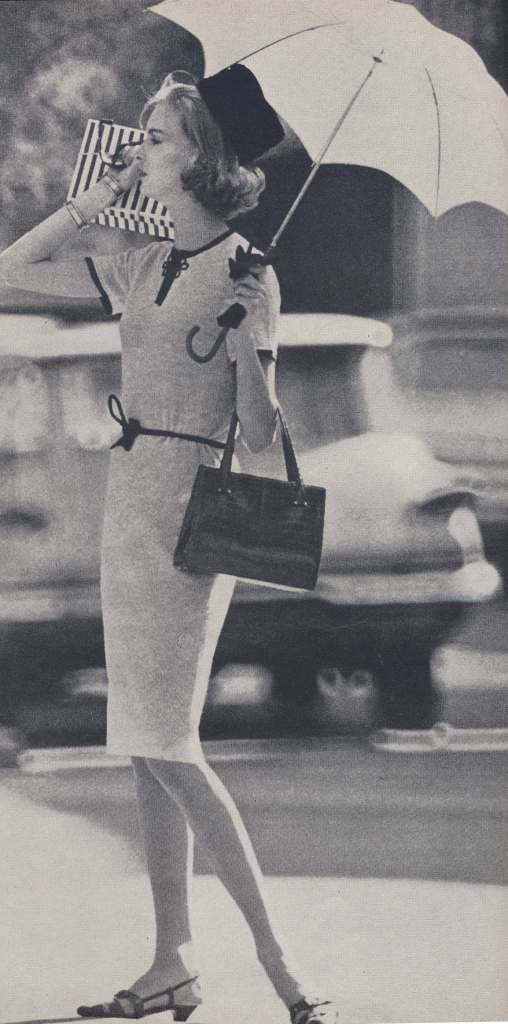
So instead, I bought a few older issues of Vogue Knitting from the early 60s.  They don't contain any patterns that I would want to knit, but I'm interested in how knitting has developed and changed - and on this evidence,  the early 60s were not a good time to be a knitter.  I think it's probably that high fashion at that time (as represented by Vogue)  was unsympathetic to knitting - I'm sure that ordinary knitters like my mother carried on making the kind of clothes (jumpers, cardigans, pullovers, ...) that they always had.   Although there are some casual sweaters, the majority of patterns for women in these issues are for dresses, coats, jackets, skirt suits, and similar smart ensembles.  The knitting is unambitious and to me looks uninteresting - the skirts are invariably straight or very slightly flared and there is a lot of plain stocking stitch or other simple patterns.  Any interesting detail, like the contrast trim on the dress in the photo, is often applied after the knitting is finished.  The simplest skirts are just a cylindrical tube, with some narrowing at the top and an elasticated waist - boring to make and boring to wear.  All these dresses and skirts are completely impractical too - they would  stretch out of shape the instant you sat down in them.  From looking at the photos, I can't help thinking that the ideal was to make something that didn't actually look knitted.


And then....  miniskirts, tights, skinny rib sweaters and all the rest of what we think of as Sixties fashion came along.  Everything changed - mostly for the better.  At least we were saved from having to look elegant.

Tuesday, 23 March 2010

Booktown

Last weekend,  John and I went to Glasgow for a wedding.  We stopped on the way at Sedbergh, a little town on the western edge of the Yorkshire Dales National Park, although nowadays it is in Cumbria.  It is in beautiful countryside and surrounded by hills and has been designated England's Book Town, which was the point of the visit.  (Who chooses England's Book Town?  I've no idea.)

There are several secondhand bookshops in the centre of the old part of the town, which consists of two streets, Main Street and Back Lane, and not much else.  We had been to Sedbergh once before, and I spent most of that visit in the Sleepy Elephant bookshop on Main Street, which has a good selection of knitting books, as well as clothes and other crafts.  Last time, I bought a copy of Kaffe Fassett's Glorious Knitting and a very nice handbag.  They also sell a range of soaps and other toiletries, and there is a strong (pleasant) smell of lemon from that around the knitting bookshelf.

Vogue Knitting 1993
This time, I found several copies of Vogue Knitting magazine, from various dates between 1987 and 2001, priced at £1.50 or £2.50.  Many of the patterns in the earlier issues are BIG jumpers with REALLY BIG dropped shoulders, which would not be wearable without adaptation now.  But even when there are not many enticing designs, there are interesting articles.  For instance, in the Autumn 1993 issue, there is a piece by Elizabeth Zimmermann on the history of i-cord, which I had never heard of before I started knitting again, but seems to appear quite often in knitwear designs these days.  Idiot cord is what we English call French knitting (don't know what the French call it), which we used to make when we were children on a wooden cotton reel with four nails in the top.  Elizabeth Zimmermann  figured out how to knit it on double pointed needles and then developed various ways to use it.  She says that she renamed it i-cord because she thought that the name "idiot cord" was rather rude.

So that was a very successful bookshop visit.  We also went to Westwood Books at the far end of Main Street, which also has a section of knitting books.  More useful still, since it's a very large shop and John spent a long time there, it has coffee and very comfortable sofas.

Thursday, 21 January 2010

Casting On

I recently found a copy of The Handknitter's Handbook by Montse Stanley in our local Oxfam shop (£3.99 - a bargain). I hadn't heard of it, but it is an excellent book,  that covers everything you can think of in amazing detail, and is also entertaining. (Not sure if it's still in print - it was first published in 1986, and later reissued as just The Knitter's Handbook. There is a book that seems to be doing a similar job by the same author called Simply Fabulous Knitting  - much shorter (164 pages v. 318), but definitely in print (and cheap too).)  Now that I am knitting again, I thought that I should go back to basics and make sure that I am doing things properly.

 I've been casting on for years and years in the way I was originally taught, although at some time I adopted a variant of that method, and I have always considered that my method was just the way to do casting on. It turns out that there are dozens of casting-on methods listed in the Handbook - the method I use is called (by Montse Stanley anyway) cable cast-on, and she says of it: "A firm, cord-like edge. Not very elastic." Hmmm. She makes still more disparaging remarks about using cable cast-on with single rib: "It would be acceptable on aesthetic grounds if a definite edge was required, but functionally it is a disaster." I have been using a disastrous cast-on all this time! I didn't read this in time to use a different method for the back and fronts of my cardigan, but I have tried one for the sleeves. She says that alternate cable cast-on is better for single rib (and I think for moss stitch for the same reasons) and it does indeed give a neat and elastic edge. Essentially, while with cable cast-on you create a new stitch by knitting into the last stitch, with alternate cable you alternately knit and purl (and then on the first row, you knit where you created a stitch by knitting and purl otherwise).

Alternate cable with single rib:
 

Cable cast-on with single rib:

As she says, cable makes a very definite edge of both sides of the work (though the two sides are different), and it is relatively inelastic;  with single rib, alternate cable is much less obvious and both sides look the same.  (For the samples, I used some nasty cheap acrylic yarn I bought at the yarn stall in the local covered market - £1.20 for 100 g./300m.  I bought it specifically for knitting samples and  I will never ever knit a garment in it.)

Montse Stanley is not entirely dismissive of cable cast-on - she lists it as a method for "ordinary edges".  My next project (a shoulder bag) has a cast-on edge to stocking stitch, so it will be fine for that, I think.

I've also been reading The Best of Vogue Knitting (borrrowed from the local library), a fascinating collection of articles from Vogue Knitting (American edition), published in 2007 to celebrate its 25th anniversary.


There are several articles on casting on, including one by Meg Swansen that describes both methods that I have used in the past as the two versions of Knitted-On Cast On. And I learnt something new from that article too. She says: "When you have achieved the wanted number of stitches, you may be displeased with the way the final cast-on stitch slants to the right on the needle and how the bottom of it merges with the penultimate stitch." Well frankly, I had never thought about it, but she's quite right: where you start casting on creates a nice right angled corner eventually, but the other end is rounded off rather than square. She suggests a simple remedy. Just before you put the last stitch that you cast on onto the left needle, you bring the yarn to the front (so that it emerges between the last two stitches). And it works! It's amazing how much there can be to learn about the simplest things.
Related Posts Plugin for WordPress, Blogger...