Showing posts with label excursions. Show all posts

Saturday, 19 October 2019

Jamieson's

While I was in Shetland for Wool Week, I went on a tour of Jamieson's Mill at Sandness. It's about 30 miles from Lerwick, on the west side of Mainland.  A coach picked us up in Lerwick, for a 50 minute drive across the island.

Garry Jamieson gave us a tour of the mill (in two groups, so that there was plenty of time to look around the shop, too).  It was fascinating to see all the processes involved in converted the raw fleece into balls of knitting wool, all in one building (as well as weaving and knitting, too). Garry showed us one of the fleeces, in the state that they arrive in, and talked about the quality of the wool.


After washing, the wool is dyed. The dyepot looked like an enormous pressure cooker, gently steaming.


Bales of dyed wool
Later, it goes through a carding machine...


... and out the other end.

And then gets spun. I think this is what's going on here:


And after two strands of the spun yarn are plied together (Jamieson's Spindrift is 2-ply), it's ready to be wound into balls.


(The blur in the middle is the wool moving very fast.)

Finally, each ball gets a ball band, and 10 balls make a pack of wool...
 
... all ready to be sold.


Apologies for any inaccuracies - all due to me, and not to Garry's tour.

A couple of eye-catching things around the mill. 


And as I said, there was a shopping opportunity.  I had already bought the Shetland Wool Week Annual, which is mainly a book of patterns, beautifully illustrated with scenes of Shetland, and decided that I'd like to knit the Seaweed Slipover, designed by Wilma Malcolmson.


The background colour is pale grey, which I like a lot, but I decided that I wanted the other colours to be slightly lighter and brighter versions of the ones in the Album.  These are the ones I picked from the Jamieson's shop:


It's hard to get an accurate rendering of the colours, especially the pink (Lipstick).  These are from Jamieson's website:


I have knitted three Fair Isle jumpers or pullovers before, though a long time ago, but this will be the first one knitted properly, i.e. in the round, with steeks.  It will be my next project, after my current one.

I forgot to mention in my last post that while I was in Shetland, I realised that I had somehow missed one of Ann Cleeves' Shetland novels.  (Not the last one, so I don't know how I missed it.)  I bought a copy in the Shetland Times Bookshop in Lerwick, and read it on the way home. And now I'm re-reading the other seven.  Many of the places mentioned in the books are real places, and so it is lovely to read about places I went to.  There is a scene, for instance, where two people have a drink in the bar of the Mareel, the arts centre in Lerwick, near the Shetland Museum. I did that too!   I'd really like to watch the TV programmes again, as well, because I know that they show wonderful scenery, and now I've seen some of it.  The programmes don't seem to be available just now, but I'll keep looking.


Thursday, 10 October 2019

Shetland Wool Week

Last week I was in Shetland, staying in Lerwick, for the 10th Shetland Wool Week. I had never been to Shetland before (or in fact anywhere that far north), so it was a fascinating week, quite apart from all the knitting-related activities. And we were extremely lucky with the weather, which was mostly dry and often very sunny, while back home in England it was raining for most of the week - a lot.

Walking along the Esplanade at Lerwick every day, there were wonderful views of boats anchored, and the sound beyond, dividing the mainland from Bressay island. This was the view over Hay's Dock, in front of the Shetland Museum, on a beautiful evening. 


I arrived on Saturday, and my first Wool Week event was the Welcome on Sunday evening.  500 people were there - so as there were 1,000 people attending Wool Week, a lot were disappointed.  I wrote here about knitting my Wool Week beanie, in this year's design.  At the Welcome, almost everyone was wearing their beanie, and there was a group photo at the end of the evening.


A photo of the Wool Week Welcome evening from BBC News.  I was there, wearing my Roadside beanie, though I can't see myself in this photo.

I spotted a couple of beanies that had substituted an image of something else for the fishing boats. A bicycle:


or a plane. Actually, I was told, a Bristol Blenheim, which has a WW2 Shetland connection.


Most people attending Wool Week wore their beanies whenever they were outdoors (and it was cool enough that you wanted to be wearing a hat anyway).  It was a useful way of identifying fellow knitters too, and starting a conversation.

I hadn't booked any of the classes, partly because John had intended to come with me, but couldn't in the end.  So we had planned to see Shetland together.  One Wool Week event I had booked for both of us was a bus tour west to Vementry, and to Ollaberry and Islesburgh in North Mainland. It was a (mostly) fine day, and a good opportunity to see more of the Shetland landscape.  You never seem to be far from a loch or the sea on Shetland.
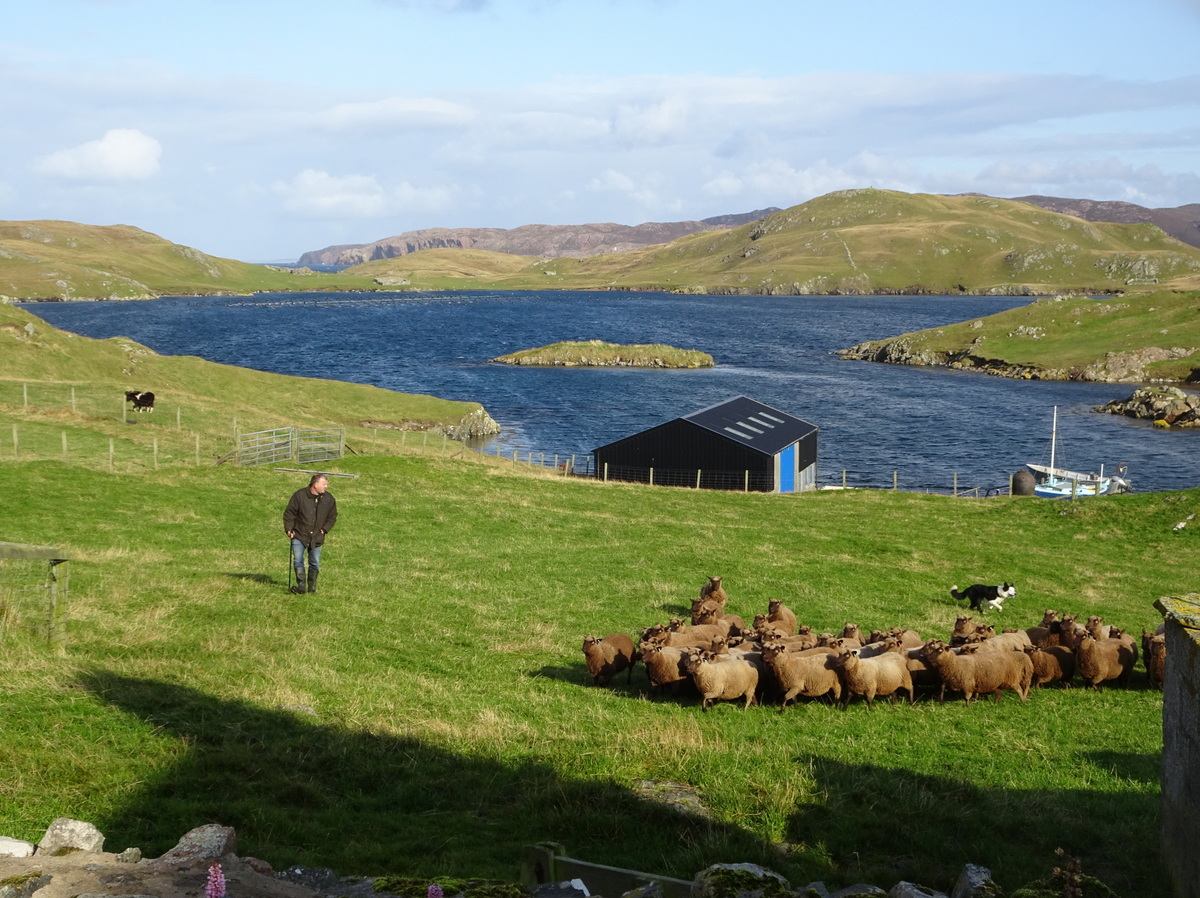
Gathering sheep at Vementry
At Vementry, we saw their prize-winning Shetland sheep, mostly moorit (i.e brown), and Shetland ponies. It's a beautiful spot, overlooking the shore, and (I think) Vementry Island in the distance.

We had lunch at Ollaberry Community Hall - a lavish spread of homebakes laid on by local women. There was an exhibition of knitwear - some new, some that had been kept carefully, for many years in some cases.  I was very taken with the large lampshade in Print o' the Wave (one of my favourite lace stitch patterns):


I also liked an outfit from the late 1960s, mainly because of its story.  Its owner said that her mother had knitted it for her when she went off to college in Aberdeen. There was a photo of her with friends, about to get the ferry, and wearing the outfit with a much shorter skirt - though actually, she said, she never wore it much because it wasn't really in fashion at the time. And her mother thought it was much too short, and added a piece to make it longer. A very 1960s teenage experience.


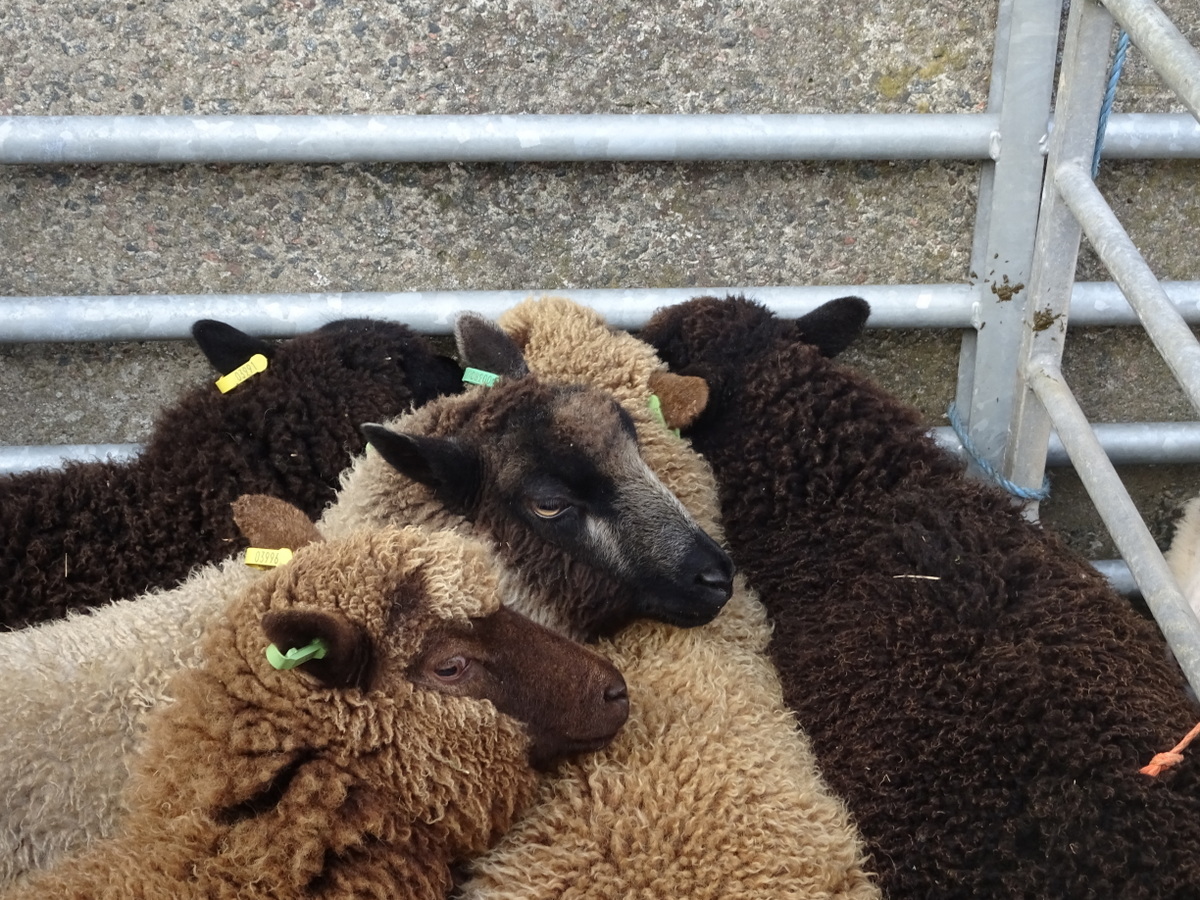
We ended the day at Islesburgh Farm, where we saw more prize-winning Shetland sheep, of several colours. (Some sheep evidently think that if they can't see you, you can't see them. They were mostly trying to hide their heads underneath another sheep.)


Another day, I went on a tour of Chris Dyer's croft on Bressay, a short ferry ride from Lerwick.  We saw more sheep - here Chris and his dog are driving them:


Chris has pigs and piglets, too.  And tomatoes, courgettes and peppers growing in a Polycrub, a specially strong version of a polytunnel, designed to withstand Shetland winds. He talked to us about his approach to running the croft, alongside his main job as an archaeologist.

Chris took us to the Speldiburn cafe on Bressay for lunch, where there was another exhibition of knitwear.  Again, some new, some old.  I particularly liked a couple of children's pullovers from the 1950s, both mainly pastel colours on a dark brown background. I don't think I know enough to judge, but that kind of colour combination seems to me to be different from  modern Fair Isle designs.


.


One day when I had no Wool Week events booked, I went for a walk around Lerwick, first past a group of old houses built almost in the sea, the lodberries, one of which is Jimmy Perez's house in the TV version of the Shetland books by Ann Cleeves.

 
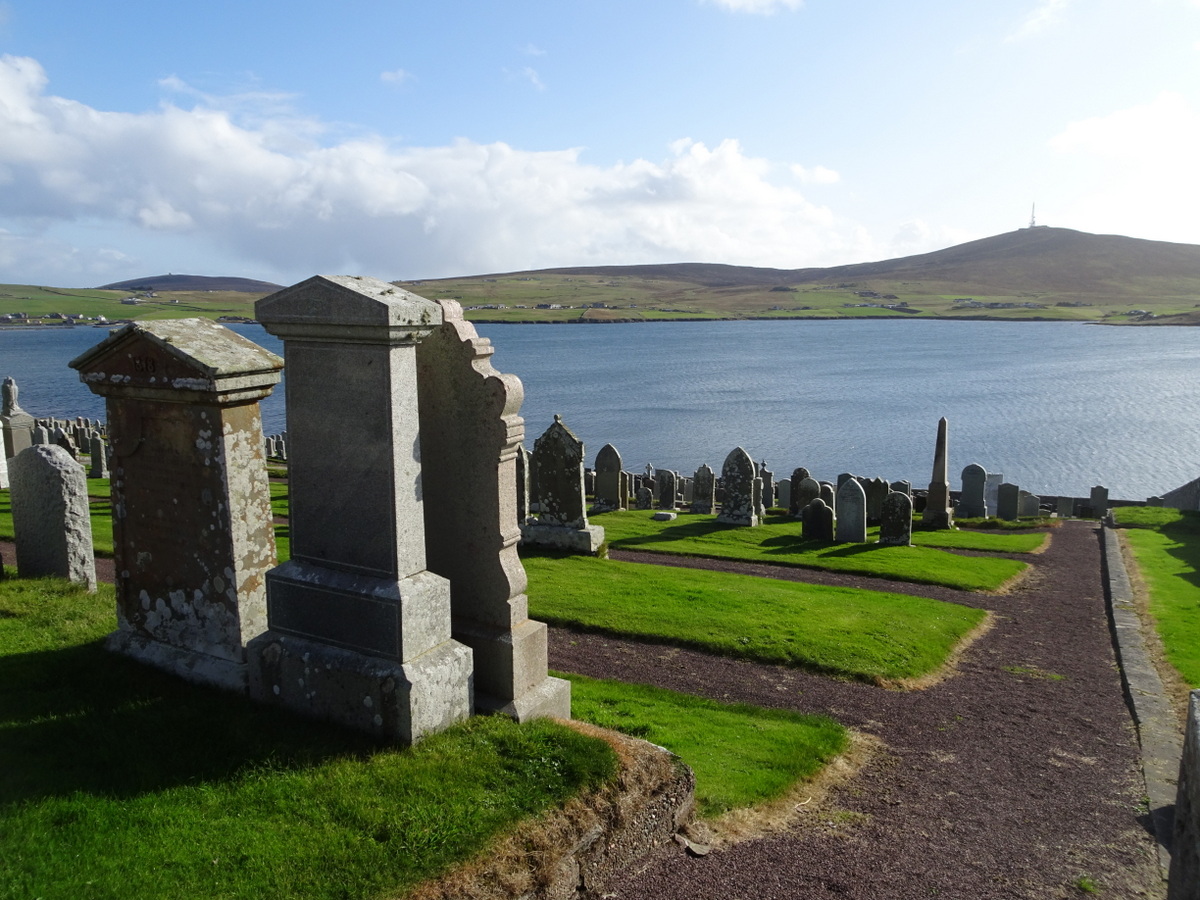
 On towards the Knab, the headland at the end of the road, where there is a cemetery with I think the best view of any cemetery I have seen.


There are a number of war graves in the cemetery, of men who were stationed on Shetland. So they were not necessarily Shetlanders - some were in fact Norwegian.


Here's the Knab, and the view south towards the open sea.


The path follows the shore from there (towards Tesco).  I hoped to see some seals on the rocks, but there weren't any, though I did see a lot of birds including a group of oystercatchers (called shalders in Shetland).


Another day, I got the bus to Scalloway, a fishing port about 6 miles from Lerwick, with an interesting museum, a castle, and some very picturesque houses along the harbour. 

.
The base for Wool Week was the Shetland Museum in Lerwick, which is excellent. It has displays on the archaeology and history of the islands, including Gunnister Man, who died about 1700.  His body was found in a peat bog, and his clothes have survived, including some knitted articles.  There is a reconstruction in the museum (hard to photograph because of reflections in the glass of the case). 

There are also displays on Shetland knitting, with many beautiful examples of both lace and Fair Isle.  I recognised one straightaway from Susan Crawford's Vintage Knitting Project book - Jeannie Jarmson's sleeveless rayon pullover, which is one of the patterns Susan re-recreated for the book. (Again, I couldn't get a good photo of it.)

 The Hub, where Wool Week visitors could sit to knit and chat, was in the Museum, as was the auditorium where I gave a talk on the Knitting & Crochet Guild collection on Wednesday evening - I'll say a bit about my talk in another post.

Shetland Museum
And on Fair Isle Friday, two Shetland ponies who have often been photographed in Fair Isle cardigans, were stationed in front of the museum. (Their owner said that they don't really like the cardigans, because they can't walk easily in them.  And they have such thick coats of their own that they don't need to wear woollies.) 


I'll also write in another post about the trip to the Jamieson's Mill at Sandness, where (guess what?) I bought some wool.   But that's enough for now.  I didn't do any of the many classes on offer, but there was plenty to see and do without that.  I enjoyed the week very much (though it would have been more fun if John had been there).  I'm very glad I went.

Sunday, 5 May 2013

No knitting is left on this van overnight


Seen in Uppermill, Greater Manchester.

Saturday, 28 July 2012

Barton-on-Humber

It's been a busy week and I'm behindhand with posting.  Apologies.

Last Saturday we went with some friends on an expedition to Barton-on-Humber.  It was a beautiful day, sunny, warm and dry - the first nice day for weeks. Barton is a little town at the southern end of the Humber Bridge, with an important Saxon church, now in the care of English Heritage. (The town also has a medieval church only a couple of hundred yards away - more churches than it can use these days, but at the time that the later church was built, Barton was an important port and presumably needed another to cope with the population.)    There is also a string of nature reserves along the Humber bank, on the edge of the town, with several ponds in the clay pits of the former brick works. We saw a lot of birds there - mostly ducks, but some more interesting birds too, including a grebe which was fishing very successfully.  

The town itself is very pleasant to wander around.  There are many independent little shops, still - and there were evidently many more at one time.  A knitting connection:  one of the former shops was a yarn shop, with advertising stickers for Lister Lavenda wool in windows either side of the door.


 I think that the ad must date to the 1960s or earlier - although Lister & Co. were producing knitting yarn long after that, the Lavenda brand name was dropped around then.  (I'm glad to say that Bartonians still knit - there is a long-established yarn shop elsewhere in Barton, The Knitting Box.   It looked enticing, but I resisted the temptation.  I do not need more yarn.)   

Sunday, 29 April 2012

Port Sunlight and Balaclavas

Last week we had a trip to the Wirral peninsula, between the Rivers Dee and Mersey, and Port Sunlight, on the Mersey. Port Sunlight is a garden village built in the late 19th and early 20th centuries to house workers at the nearby Lever Brothers factory.  The factory made Sunlight soap, amongst other products, and is still operational - now part of Unilever.  The village is very open and spacious, and the houses are built in  a wide range of Arts and Crafts designs.  It's all very attractive.


The war memorial occupies a prominent position in the village. It was built to commemorate the hundreds of people from Port Sunlight and other Lever Brothers sites around the world who were killed in the First World War.   (As you can see from the photos, it was a very gray day, with frequent heavy showers. And it was cold.)

Around the plinth of the memorial there are four bronze panels with scenes of men in action. One shows a machine gun crew, with a spotter (with binoculars),  the man handling the Lewis gun (who also has a revolver rather than a rifle), and an ammunition carrier.

The panels are carefully modelled to show a lot of detail, and I noticed that the third man in the team is wearing a Balaclava under his helmet.  A Balaclava must have been recognised as something that a lot of soldiers wore in the trenches.  No wonder that so many knitters made Balaclavas again at the start of World War II.  (And then the Army decided that they didn't want them - see here.)  


In between the panels of men in action, representing those commemorated, are smaller panels showing children, representing those who lost their fathers, presumably.  One of them shows a boy wearing a (knitted) cricket sweater.  


It was interesting to see these examples, though it seems a bit frivolous to focus on the knitting shown in a war memorial.   The details of what the men and children are wearing are presumably included to suggest that these are depictions of real people in real situations.  The scenes of men in action don't really convey the realities of the war, of course - the impression is very calm, quiet and clean.  And in the scene of a wounded soldier being carried off the battlefield, he seems to be undamaged apart from a small tear in his trousers.  Even so, it's an impressive memorial to an enormous tragedy. 

Tuesday, 29 November 2011

Henderson's Relish


Last week, my sister was visiting and we went to Sheffield, our home town, to do some shopping, including a trip to the headquarters of Henderson's Relish to buy an apron.  Henderson's Relish is a Sheffield speciality - a spicy sauce based on vinegar and tamarind, amongst other things.  I remember it from my childhood when a favourite meal was hash with relish.  (Those were simpler days when 'hash' just meant 'stew'.)


The headquarters  is in an old house, now surrounded by university buildings. The 'shop', which sells aprons and similar merchandise,  is just a corner of the office, next to a display of old relish bottles - I think most of the sales are over the internet and they don't really expect people to arrive on the doorstep.   (You have to ring the doorbell to be let in, for one thing.)  


Henderson's Relish marginally appeared in the national press a few years ago when The Guardian recommended it as a vegetarian substitute for Worcestershire sauce (which contains anchovies).  Even so, most people who don't come from Sheffield have never heard of it.  So a Henderson's Relish apron tells people in the know that you have Sheffield connections.

A table decoration in a Sheffield bar

Tuesday, 29 March 2011

Day Out in Calderdale

On Friday I took a day off from sorting knitting & crochet magazines and we went over the hill to Calderdale, first to the antique centre in Mytholmroyd where I bought a bundle of old knitting needles last year.  This time I found several good buys, including:
  • a Poole Pottery mustard pot from the early 1930s (£9).  I have a small collection of Poole preserve pots (usually the same shape but larger), arranged on a mantelpiece, to add this one to. 
  • a quarter ounce and a half ounce brass weight.  We have a set of kitchen scales of the balance type, and two sets of weights, imperial and metric.  The tiniest weights are liable to get lost and are expensive to replace, but these were only 50p each, so I bought them as spares.
  • a 5g weight, to replace the one we have lost from the metric set. The vendor had a set of scales and metric weights from a chemist's shop in York, and when I said that I was looking for a replacement 5g weight as well, he said that he would sell me one if he had a spare.  Luckily, he did and I got that for 50p as well. 
We went on to Todmorden, a very characterful little town, with a good secondhand bookshop amongst other assets. We had coffee and cake in the cafe above the former Co-operative store. I had a beetroot and chocolate brownie.  J said the idea was disgusting, but it was very good - very rich and moist, not tasting of beetroot at all.  


The Rochdale Canal runs through the middle of Todmorden. The valley is very narrow, so the houses cling to the valley sides with some very steep little lanes winding through them. It could all be very picturesque, though Todmorden is a bit too down-to-earth to be called that.

Locally, Todmorden is known as "Tod" - hence, the shop name "Sweeney's at Tod".  A hairdresser's, of course.  I don't know why hairdressers like to choose awful puns for the names of their salons, but that is one of the best (or worst) I have seen.

Here is another Tod shop front. I have no idea what green tripe is - not sure I want to find out.
Related Posts Plugin for WordPress, Blogger...