I have mentioned that the Knitting & Crochet Guild collection has moved to a new home - we have now been based in Slaithwaite for two months. You might like to see some photos of the village.
First, a photo of Britannia Mill, where the collection is now housed.
Like many other buildings in Slaithwaite, it is built from the local sandstone, and (as the name suggests) it was originally an industrial workplace.
Slaithwaite is in the Colne Valley, about 5 miles from Huddersfield. The River Colne runs from Marsden, at the head of the valley, and on to Huddersfield and eventually joins the River Calder. At Slaithwaite, it is not a very big river, only a few yards wide.
But in the distant past, it made a steep valley, and in the Industrial Revolution provided enough water power for mills to be established along the river. There are several huge mill buildings remaining, like the one in the centre of the photo above. Some have been converted to other uses, some are awaiting renovation, and a few are still used as mills. The most notable example in Slaithwaite, for knitters, is Spa Mills, the home of Stylecraft yarns and of Yarn Stories. Spa Mills, built in 1907, is the huge building in the centre of the photo below. (Notice the fine array of sheds in the foreground.) The centre of Slaithwaite, including Britannia Mill, is off to the left of the photo, which also shows houses high up on the side of the valley opposite. Historically, in this area, mills occupied the land in the valley bottoms, and the mill workers lived on the valley sides, which are often very steep.
A few yards away from the River Colne in the centre of Slaithwaite is the Huddersfield Narrow Canal - you can see how narrow it is in places from the photo below.
The canal runs from Huddersfield, up the Colne Valley to Marsden, where it goes under the summit of the Pennines by way of Standedge Tunnel, more than 3 miles (nearly 5 km.) long. The canal continues to Ashton-under-Lyne where it links with the rest of the canal network.
The canal was built to transport goods, of course, and several of the Slaithwaite mills were built next to it, but its use for commercial traffic declined until it closed in 1944. It was re-opened in 2001, and now it only sees leisure traffic.
Here's another view the canal, showing one of the canal locks, and Spa Mills in the background.
The re-opening of the canal has made a huge difference to Slaithwaite, I think. There are many independent shops and cafes in the centre, a favourite being the Handmade Bakery and Cafe - it's alongside the canal and sells delicious bread, baked on site.
It's an exciting place to work. I'm still exploring it - this week I found Spa Park, across the canal and river from Spa Mills. Slaithwaite did at one time have a mineral spring whose water was claimed to be good for you (presumably the spring still exists somewhere, in fact) and a spa based on the spring. The River Colne runs alongside Spa Park, looking very rural, although it is so close to the village centre. According to an information board in the park, kingfishers can be seen on the river near there. I hope that's true - I have never seen a kingfisher, so it would be thrilling to catch even a glimpse of one. I'll report back if I do.
PS I forgot to mention that Slaithwaite has a train station. The Colne Valley has been on several important cross-Pennine routes at various times, including the canal and the A62 Manchester-Leeds road (though that is now superseded by the M62). And the Manchester-Leeds railway line runs through Huddersfield, up the valley to Slaithwaite and Marsden. There are trains from Slaithwaite to Manchester and Leeds, and from there connections to the rest of the rail network. For most people, the collection is now more accessible than it was at our old site.
The railway line runs high above the centre of the village on a viaduct, visible in the first photo of Spa Mills. Here's a photo of a train on the line, well above the Colne Valley Leisure Centre below.
Mostly about knitting history. Sometimes about what I'm knitting. Sometimes about other things too.
Showing posts with label Yorkshire. Show all posts
Thursday, 25 April 2019
Friday, 19 April 2019
A Fascinating Check
I haven't posted anything here for a while, so I'll try to catch up a bit in the next week or so. I have been busy over on Instagram, though, where I have been showing some of my favourite patterns from the Knitting & Crochet Guild collection. There's a lot of choice - over 50,000 pattern leaflets, not to mention booklets, magazines, etc. So I don't think I need to restrict myself to just one favourite or just a few - I can have lots, why not.
Yesterday's Instagram post showed a Copley's pattern from the 1930s.
![]() |
| Copley's leaflet 331 |
I wrote an earlier post about similar Copley's leaflets here - the designs are quite appealing, but what I really like is the fashion advice on the front of the leaflet from one of two "fashion advisers", Lady Georgiana Curzon and later the Countess of Chester. In leaflet 331, Lady Georgiana tells you why you should knit this cardigan:
COPLEY'S FASHION ADVISER says : "Our old and tried friend the cardigan .. how could we live without it ? On the golf course or the moors, in the car or on foot, smart women still cling to that classic style. It modifies slightly with fashion; it raises or lowers its vague indication of a waistline, it alters the number of its buttons, or its length. And it still remains the smartest and most comfortable sports woollie of all. Here is to-day's version; simple, subtle, in a stitch that gives a fascinating check and a Copley wool that will stand up to endless wear and washing. No matter what colour your skirt, you'll find the most perfect match or the smartest contrast among the superlative range of Copley colours."All of which still applies, though I suspect that even then golf was a minority interest for women - but it had the right upper class ring to it. And I think that when Lady Georgiana mentions the moors, she has in mind grouse shooting.
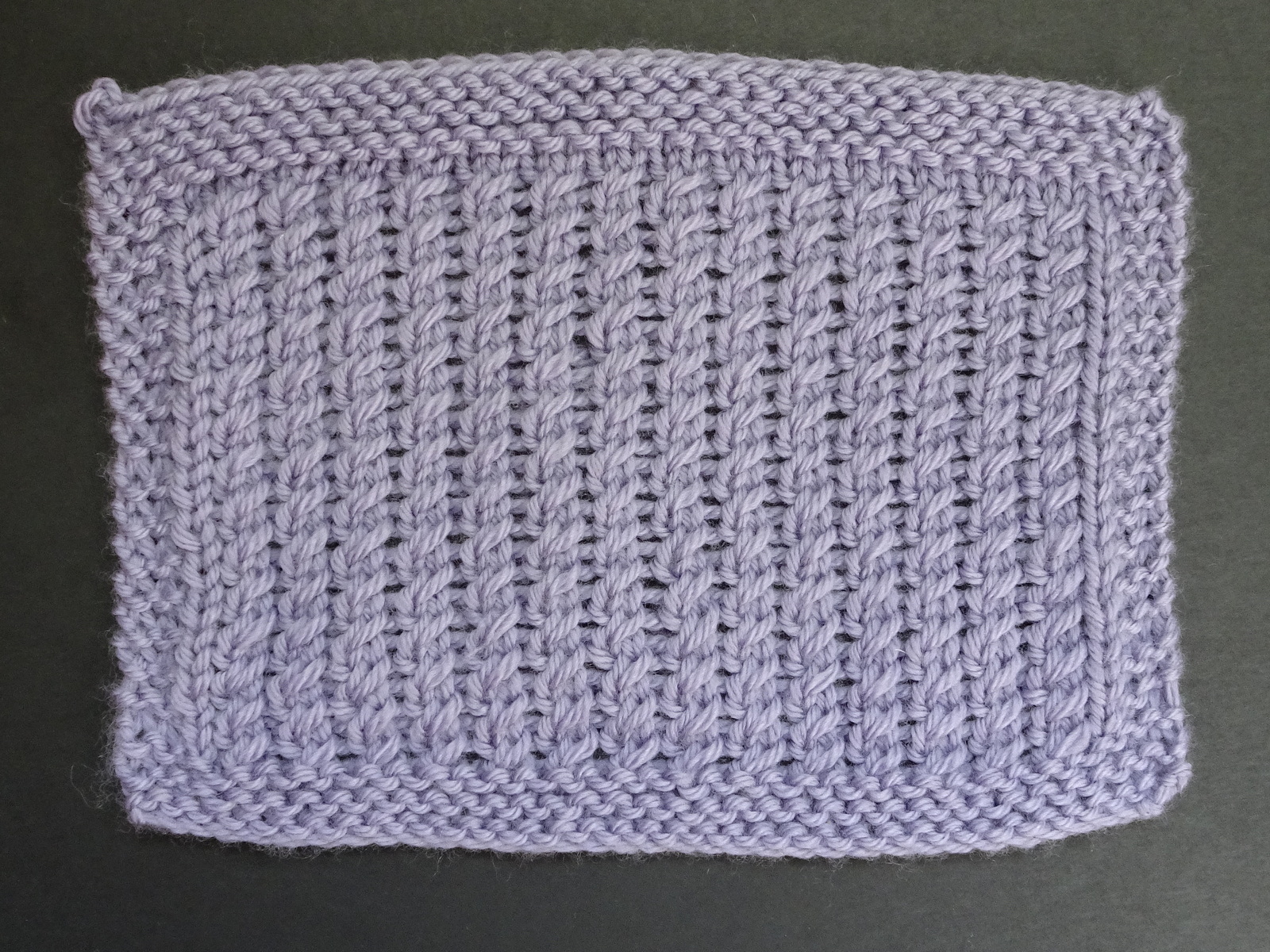
I was intrigued by her description of "a stitch that gives a fascinating check", because in the photo of the cardigan, it looks like some sort of rib. So I looked at the instructions, and it's not any sort of rib, or any stitch pattern I have met before. I knitted a swatch to see what it looks like:
Here are the instructions (not exactly as they appeared in the pattern - I've rewritten them in a way that makes more sense to me).
On an even number of stitches:
Row 1: K1, (yarn over, K2) to last stitch, yarn over, K1.
Row 2: P1, (drop the yarn over of the previous row, purl the 2nd stitch on the left needle but leave it on the needle, then purl the first stitch, drop both stitches off the needles together) to last 2 stitches, drop the yarn over of the previous row, P1.
So it's much more like stocking stitch than a rib. The yarn-overs make little ladders separating the columns of pairs of stitches twisted together.
I found it a bit tricky to knit, especially at first. The knit rows are easy, but purling the second stitch on the left needle was quite difficult, especially as I was knitting with my vintage Double Century needles which have rounded tips. I switched to a sharper KnitPro needle for the purl rows part way through, and that was much easier. I also found that I needed a lot of left-elbow room for that step, so it wouldn't be suitable knitting for a train journey. (I never need much right-elbow room when I'm knitting with straight needles, because I have the right needle tucked under my arm.)
I wouldn't describe it as a check pattern, but it gives a very nice effect. It's quite loose - for me, it's looser than stocking stitch, so you would have to be careful of gauge.
The swatch also gave me an opportunity to try out a ball of Yarn Stories 100% merino DK. It's a worsted-spun yarn, spun in Yorkshire (in fact, in Slaithwaite, where the Knitting & Crochet Guild collection is now based). So it's very smooth and gives great stitch definition, ideal for a swatch like this. And it feels gorgeously soft. I'll be planning a project to use it some time soon, I'm sure.
Labels:
1930s,
stitch patterns,
vintage knitting patterns,
Yorkshire
Monday, 10 September 2018
Strengthening Tonic
The first weekend of Heritage Open Days has just ended, and it's a great opportunity to see places that are not normally open. Yesterday we went to see the church at Ripponden, not far from here in Calderdale. It's mainly 19th century, but has a medieval window, surviving from an earlier church on the site, that was restored by the York Glaziers Trust in the 1970s.
Next to the church is a packhorse bridge leading into the centre of the village. The other side looks very rural, with the River Ryburn running alongside the churchyard, in a wooded valley. It wasn't a good day to appreciate the surroundings though - grey and rainy, and not very warm.
Some interesting documents had been put on display for the occasion - registers, minute books, programmes for the unveiling of the First World War memorial, and so on. One of them was a booklet of recipes contributed by women of the parish in 1933 to raise funds. They mostly seemed to be cake and biscuit recipes, but I was intrigued by one for 'Strengthening Tonic'.
We were also in Ripponden a week ago, when we walked from Ripponden up the Ryburn valley, round the Ryburn reservoir and back again. It was a warm and sunny day then, and we enjoyed our walk. It also happened to coincide with the Sowerby Bridge Rushbearing Festival, when a tall cart laden with rushes (originally to strew on the floor of the church) is pulled around the area by a team of men, with a young woman seated on the top of the cart. Over the course of the weekend, the cart visits several churches and (very important) several pubs, and ending up on Sunday afternoon at the church in Ripponden. The rushcart arrived at Ripponden not long after we got back from our walk, so we had a good view of the final stretch when the men run with the cart down the slope from the main road and through a 90 degree turn into the area in front of the church. (If that sounds alarming, it looked it.)
At the point where they need to turn towards the church, the man at the front puts his right arm out to signal that this is where they should turn left. (That sounds wrong, but I suppose he is indicating that each pole (with a pair of men) behind him should turn at that angle at that point. Maybe.)
Here's the first pair of men just starting the turn.
And here's the rushcart as it goes down the slope towards the church, with the young woman perched on top of the rushes.
A lot of people had turned up to watch, there were various stalls outside the church, and a fair amount of beer being drunk. There were Morris men and mummers accompanying the cart, and a good time was had by all. (Though we didn't stay for the Morris dancing and mummers, but left for the pub up the road.)
| St Bartholomew's Church, Ripponden |
Some interesting documents had been put on display for the occasion - registers, minute books, programmes for the unveiling of the First World War memorial, and so on. One of them was a booklet of recipes contributed by women of the parish in 1933 to raise funds. They mostly seemed to be cake and biscuit recipes, but I was intrigued by one for 'Strengthening Tonic'.
STRENGTHENING TONIC.
5 lemons, 5 eggs. Put the eggs whole into the lemon juice for 5 days.A gill is a quarter of a pint, or 5 fluid ounces (in the U.K. - British pints are larger than American pints). That's about 140 ml. I'm not sure of the point of steeping the eggs in the lemon juice for 5 days. Would that help to preserve them? It sounds a bit like the Dutch advocaat (my Grandma's favourite tipple at Christmas) but that doesn't include lemon, and I think advocaat has more alcohol. It sounds as though it should taste good - I like the idea of drinking something delicious because it's good for you. If anyone feels inclined to try it, I'd love to know how it turns out.
Then beat them up with ½ lb. brown sugar, 1 gill rum, 1 gill of cream (or new milk), and strain.
One wineglass to be taken between meals.
We were also in Ripponden a week ago, when we walked from Ripponden up the Ryburn valley, round the Ryburn reservoir and back again. It was a warm and sunny day then, and we enjoyed our walk. It also happened to coincide with the Sowerby Bridge Rushbearing Festival, when a tall cart laden with rushes (originally to strew on the floor of the church) is pulled around the area by a team of men, with a young woman seated on the top of the cart. Over the course of the weekend, the cart visits several churches and (very important) several pubs, and ending up on Sunday afternoon at the church in Ripponden. The rushcart arrived at Ripponden not long after we got back from our walk, so we had a good view of the final stretch when the men run with the cart down the slope from the main road and through a 90 degree turn into the area in front of the church. (If that sounds alarming, it looked it.)
At the point where they need to turn towards the church, the man at the front puts his right arm out to signal that this is where they should turn left. (That sounds wrong, but I suppose he is indicating that each pole (with a pair of men) behind him should turn at that angle at that point. Maybe.)
Here's the first pair of men just starting the turn.
And here's the rushcart as it goes down the slope towards the church, with the young woman perched on top of the rushes.
A lot of people had turned up to watch, there were various stalls outside the church, and a fair amount of beer being drunk. There were Morris men and mummers accompanying the cart, and a good time was had by all. (Though we didn't stay for the Morris dancing and mummers, but left for the pub up the road.)
Saturday, 28 July 2018
Yorkshire Sculpture Park
It was my birthday earlier this month, and we went to the Yorkshire Sculpture Park - one of my favourite places. It was a hot, sunny day - as most days have been this summer. (Though today it's raining - the first serious rain we have had in weeks.)
One of the current exhibitions (until April next year) is of work by Giuseppe Penone. There are bronze trees around the park, some in the open, some in the wood, surrounded by other trees.
Albero folgorato is a bronze cast of a tree trunk, split in two by a bolt of lightning. The split in the tree is covered in gold leaf - a beautiful sight in the sun.
Idee di petra - olmo is in next to the path through the woods, around the upper lake at the Sculpture Park. It is a bronze tree, with a water-worn boulder caught in its branches, positioned between two of the natural trees of the wood.
The bright sunshine showed off the sculptures in the open areas of the park very well . Here's Nigel Hall's huge Crossing (Horizontal), one of the long-term exhibits.
Even without the sculptures, the park would be a good place to be. In a clearing in the woods, the teasels were coming into flower.
They flower very oddly, starting usually with a band of florets round the middle of the head. Insects love them, evidently.
We ended our visit with James Turrell's Skyspace - a peaceful place to sit and watch the sky for a while.
One of the current exhibitions (until April next year) is of work by Giuseppe Penone. There are bronze trees around the park, some in the open, some in the wood, surrounded by other trees.
| Giuseppe Penone - "Tree struck by lightning" |
Idee di petra - olmo is in next to the path through the woods, around the upper lake at the Sculpture Park. It is a bronze tree, with a water-worn boulder caught in its branches, positioned between two of the natural trees of the wood.
The bright sunshine showed off the sculptures in the open areas of the park very well . Here's Nigel Hall's huge Crossing (Horizontal), one of the long-term exhibits.
Even without the sculptures, the park would be a good place to be. In a clearing in the woods, the teasels were coming into flower.
They flower very oddly, starting usually with a band of florets round the middle of the head. Insects love them, evidently.
| The upper lake |
| Landscape with sculpture |
We ended our visit with James Turrell's Skyspace - a peaceful place to sit and watch the sky for a while.
Saturday, 31 December 2016
Advent Calendars
In November, a group of knitters from the Huddersfield Knitting & Crochet Guild branch decided to share two Opal advent calendars - these calendars have 24 doors for the days of Advent, like other Advent calendars, but behind each door is a 15g. ball of Opal sock yarn. There were 8 members of the calendar syndicate and 48 balls of wool, so 6 balls each - sounds simple, doesn't it? No. They devised an extremely complicated scheme - before any of the doors were opened, the ball behind each door was pre-allocated to a syndicate member. Then each member had custody of one of the calendars for 6 days. Every day she opened the appropriate door and posted a photo of the ball door could see what she was getting. Here's one of the photos, posted by Ann Kingstone.
And after six days, the keeper of the cube met the next keeper, to hand it over.
Yesterday was the grand finale, when the syndicate met to distribute the balls of wool to their owners. I wasn't a member of the syndicate, just a fascinated observer, but I went along to see how it all worked out. They met in Salt's Diner in Salts Mill in Saltaire, the other side of Bradford.
Every member of the syndicate was given a pair of socks with their balls of wool stuffed inside. Then there was some swapping, so that people could get a selection of colours that they liked. There was even some discussion of what they might knit with the yarn - the 6 balls will make a pair of (very multi-coloured) socks, though you could mix them with a plain background colour and make something bigger like a shawl. And as far as I could see, everyone was happy with their share, and keen to do it all again next year.
By then it was dark, and we went into the village to see the Saltaire Advent windows, which are lit up every evening until January 5th. Like any other Advent calendar, a new window was 'opened' every day in December until Christmas Eve, though they started with 10 windows on December 1st, so now there are 33 windows to see. The windows are scattered all over the village, and I didn't have time to see many of them, but I did see some very well-designed and executed displays. And the very first that we found was this:
It's all knitted or crocheted - poinsettias in pots, snowmen, paper chains, a gingerbread house,...
Knitted robins wearing woolly hats on a knitted snow-covered log:
Alpacas wearing woolly scarves (both crocheted, I think) under knitted mistletoe:
(Alpacas are important in the history of Saltaire because Titus Salt, who built the village for his mill workers, made his money out of spinning alpaca yarn.)
So window no. 7 was a very good start for a party of knitters.
Another favourite: window 19, showing Father Christmas in his sleigh flying over the village.
And here's window 9, a display about Titus Salt's rules for the people living in Saltaire:
No pubs; No drinking alcohol; No hanging out washing; No animals in Saltaire.
You can read more about the rules here. As far as I remember from a guided walk around Saltaire, the prohibition on hanging out washing was because Salt had provided a wash-house and he wanted the villagers to pay to do their washing there, but it wasn't popular. Some villagers got around the rule by hanging out their washing on vacant land just outside the village. And he wasn't against alcohol as such - the rules was really against being drunk, and he didn't want pubs where workers might meet and combine against him. Philanthropic, but only up to a point.
The windows were worth seeing. The Saltaire Living Calendar has been happening every Christmas since 2006, though I had not heard of it before this year - I'll go again next year, with enough time to see them all.
Monday, 10 August 2015
Wild Leeds
On Saturday, we went for a wander around part of Holbeck, the area of Leeds just south of the railway station. Our main objective was to see the Temple Mill, a 19th century flax mill built to look like an ancient Egyptian temple. It's an amazing place.
The office building (above) appears to be in good repair and is currently occupied, I think. The main mill building next door is not. From the outside, it appears to be mainly held up by scaffolding, but there are occasional open days when you can go inside, so it must be in a better state than it looks. (See here.)
Originally, the main mill building was designed to have grass growing on the roof (a green roof in 1838!), grazed by sheep, and there are large conical roof lights at intervals. So perhaps it's not too worrying that there are plants growing on the roof now. And it's perfectly OK that you can see through the roof from the outside of the building - that's just one of the roof lights.
Behind Temple Mill, there is a large area than evidently was once covered by buildings (and probably will be again). Meanwhile, the buildings have been demolished, and plants have taken over. It was sometimes a bit surreal - for instance, the parking sign saying "Pay here at machine. Display ticket." next to a stretch of cobbled road that was completely inaccessible by car. (Just as well, as the ticket machine had been removed.)
Round the corner, it was like walking along a country lane - no traffic, no buildings, hedges at the side of the road. But in fact, the 'hedges' were chain-link fences covered in rampant bindweed, and the shrubs were mostly buddleia - typical of urban scrub.
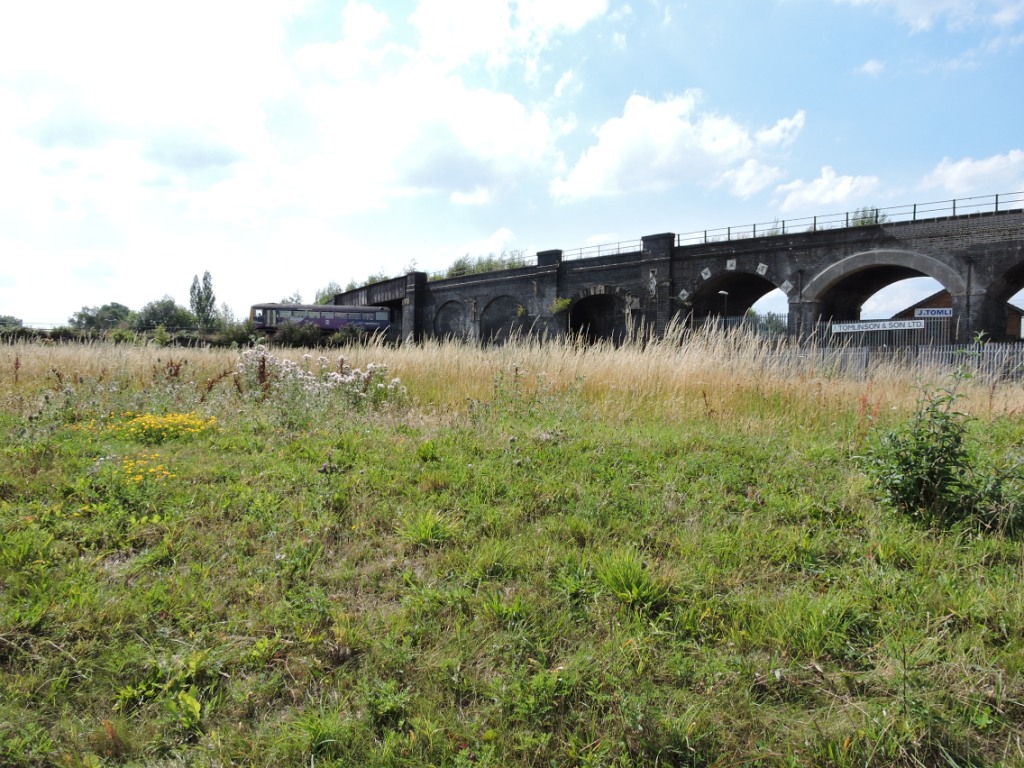
There is a tangle of railway lines in that area, running into Leeds City Square station. here's two of the lines, at different levels, crossing each other, with a train on the lower level, and what looks almost like a wild-flower meadow in the foreground.
And all this was just a few minutes' walk from the centre of Leeds. We walked back along the canal towpath - the Leeds-Liverpool canal runs into the River Aire near the railway station. The canal runs parallel to the river for a stretch, with the towpath between the two, and giant hogweed, Himalayan balsam and rosebay willow-herb growing on the river bank.
The area around the junction of the river and the canal has been redeveloped over the past few years, and is perhaps what the rest of Holbeck will look like in a few years - a mixture of new buildings and renovated old buildings. And on a fine sunny Saturday, it was full of people sitting outside the cafes and bars, enjoying themselves.
The office building (above) appears to be in good repair and is currently occupied, I think. The main mill building next door is not. From the outside, it appears to be mainly held up by scaffolding, but there are occasional open days when you can go inside, so it must be in a better state than it looks. (See here.)
| The plaque on the office building. |
Behind Temple Mill, there is a large area than evidently was once covered by buildings (and probably will be again). Meanwhile, the buildings have been demolished, and plants have taken over. It was sometimes a bit surreal - for instance, the parking sign saying "Pay here at machine. Display ticket." next to a stretch of cobbled road that was completely inaccessible by car. (Just as well, as the ticket machine had been removed.)
![]() |
| Parking sign and cobbled road |
Round the corner, it was like walking along a country lane - no traffic, no buildings, hedges at the side of the road. But in fact, the 'hedges' were chain-link fences covered in rampant bindweed, and the shrubs were mostly buddleia - typical of urban scrub.
There is a tangle of railway lines in that area, running into Leeds City Square station. here's two of the lines, at different levels, crossing each other, with a train on the lower level, and what looks almost like a wild-flower meadow in the foreground.
And all this was just a few minutes' walk from the centre of Leeds. We walked back along the canal towpath - the Leeds-Liverpool canal runs into the River Aire near the railway station. The canal runs parallel to the river for a stretch, with the towpath between the two, and giant hogweed, Himalayan balsam and rosebay willow-herb growing on the river bank.
The area around the junction of the river and the canal has been redeveloped over the past few years, and is perhaps what the rest of Holbeck will look like in a few years - a mixture of new buildings and renovated old buildings. And on a fine sunny Saturday, it was full of people sitting outside the cafes and bars, enjoying themselves.
Tuesday, 8 July 2014
Les Maillots Jaunes
Two of our weekend visitors who went to Leeds on Saturday for the Tour de France Grand Depart brought back photos of knitting and crochet they had seen. The lass in the yellow woolly is one of eight nymphs in Leeds City Square, holding lamps. There are two different models, Morn and Even, (that's poetic for Morning and Evening, I suppose). I think this one is Even, because some of the others look a bit more awake. They often seem a bit chilly and under-dressed for the weather, and so she looks as though a warm jersey would be welcome, though frankly, the rest of her needs a bit of covering up too.
The Black Prince is also in City Square in Leeds (though I have no idea what connection he had with Leeds, if any).
And finally: I know that there was a lot of knitted bunting in Harrogate, in the shape of little Tour de France jerseys, but there was also at least one stretch of it in Huddersfield too.
The Black Prince is also in City Square in Leeds (though I have no idea what connection he had with Leeds, if any).
And finally: I know that there was a lot of knitted bunting in Harrogate, in the shape of little Tour de France jerseys, but there was also at least one stretch of it in Huddersfield too.
Monday, 7 July 2014
The Tour de France in Huddersfield
Yesterday we carried our garden chairs to the nearest point of the Tour de France route and sat on the pavement (which would normally be a very odd thing to do) to wait for the race to pass by. It was not a prime position, compared with the climbs, such as Holme Moss, so there was plenty of room for everyone.
We had quite a long wait before anything much happened (although every police motorbike or police car going past got a wave and a cheer), and then the publicity caravane came through.
And finally the cyclists arrived. At this point, there was a small breakaway group at the front and a couple of stragglers at the back, so it took a bit longer for them to pass than it might have.
Earlier, before anything happened, I walked along the route a little way to chat to friends and neighbours and to take a photo of our historic tram shelter (now a bus shelter) which has been refurbished for the Tour.
And after the cyclists had gone, we went home and watched the live broadcast of the rest of the stage - over Holme Moss, and on to Sheffield.
After the stage was over, we went to a soiree at the house of some friends, Margaret and John, who are keen followers of the Tour de France. They were thrilled that today's route went past the end of their road, and held the party to celebrate it. There was French-Yorkshire fusion food (boeuf bourguignon and Yorkshire pudding), French wine and Yorkshire beer, and appropriate condiments (Dijon mustard and Henderson's Relish).
Margaret and John have a collection of Tour de France memorabilia (i.e., the freebies distributed by the publicity vehicles in the caravane) that they have acquired over the years, and had put them on display for the occasion.
The mantelpiece arrangement featured the highly-prized green foam hands (acquired 2008), handed out by PMU, sponsors of the green jersey.
Another gem of the collection is a model of the Astra satellite, from 2002.
A hat from Champion supermarkets was acquired in 2008 - at that time Champion were sponsors of the polka dot jersey. They have since been taken over by Carrefour, who now sponsor it.
Credit Lyonnais sponsor the yellow jersey; the musette, or cloth lunch bag, is also from 2008.
It is a unique collection, of incalculable value I am sure, and was displayed to very high standards (says my household museum curator).
So that's the end of a really good weekend: the weather was kind, the Tour was exciting, and the Yorkshire countryside looked wonderful. And there had been such a lot of effort put into arranging other events and displays before and during the Tour - it was all worthwhile and made it even more special.
We had quite a long wait before anything much happened (although every police motorbike or police car going past got a wave and a cheer), and then the publicity caravane came through.
![]() |
| The head of the caravanne - Y for Yorkshire |
![]() |
| The breakaway group |
![]() |
| The peloton |
Earlier, before anything happened, I walked along the route a little way to chat to friends and neighbours and to take a photo of our historic tram shelter (now a bus shelter) which has been refurbished for the Tour.
And after the cyclists had gone, we went home and watched the live broadcast of the rest of the stage - over Holme Moss, and on to Sheffield.
After the stage was over, we went to a soiree at the house of some friends, Margaret and John, who are keen followers of the Tour de France. They were thrilled that today's route went past the end of their road, and held the party to celebrate it. There was French-Yorkshire fusion food (boeuf bourguignon and Yorkshire pudding), French wine and Yorkshire beer, and appropriate condiments (Dijon mustard and Henderson's Relish).
Margaret and John have a collection of Tour de France memorabilia (i.e., the freebies distributed by the publicity vehicles in the caravane) that they have acquired over the years, and had put them on display for the occasion.
The mantelpiece arrangement featured the highly-prized green foam hands (acquired 2008), handed out by PMU, sponsors of the green jersey.
![]() |
| (Click to enlarge) |
A hat from Champion supermarkets was acquired in 2008 - at that time Champion were sponsors of the polka dot jersey. They have since been taken over by Carrefour, who now sponsor it.
Credit Lyonnais sponsor the yellow jersey; the musette, or cloth lunch bag, is also from 2008.
It is a unique collection, of incalculable value I am sure, and was displayed to very high standards (says my household museum curator).
So that's the end of a really good weekend: the weather was kind, the Tour was exciting, and the Yorkshire countryside looked wonderful. And there had been such a lot of effort put into arranging other events and displays before and during the Tour - it was all worthwhile and made it even more special.
Subscribe to:
Posts (Atom)