Showing posts with label stitch patterns. Show all posts

Friday, 19 April 2019

A Fascinating Check

I haven't posted anything here for a while, so I'll try to catch up a bit in the next week or so.  I have been busy over on Instagram, though, where I have been showing some of my favourite patterns from the Knitting & Crochet Guild collection.  There's a lot of choice - over 50,000 pattern leaflets, not to mention booklets, magazines, etc.   So I don't think I need to restrict myself to just one favourite or just a few - I can have lots, why not.  

Yesterday's Instagram post showed a Copley's pattern from the 1930s.

1930s vintage knitting
Copley's leaflet 331


I wrote an earlier post about similar Copley's leaflets here - the designs are quite appealing, but what I really like is the fashion advice on the front of the leaflet from one of two "fashion advisers", Lady Georgiana Curzon and later the Countess of Chester. In leaflet 331, Lady Georgiana tells you why you should knit this cardigan:   

COPLEY'S FASHION ADVISER says : "Our old and tried friend the cardigan .. how could we live without it ? On the golf course or the moors, in the car or on foot, smart women still cling to that classic style. It modifies slightly with fashion; it raises or lowers its vague indication of a waistline, it alters the number of its buttons, or its length. And it still remains the smartest and most comfortable sports woollie of all. Here is to-day's version; simple, subtle, in a stitch that gives a fascinating check and a Copley wool that will stand up to endless wear and washing. No matter what colour your skirt, you'll find the most perfect match or the smartest contrast among the superlative range of Copley colours." 
All of which still applies, though I suspect that even then golf was a minority interest for women - but it had the right upper class ring to it.  And I think that when Lady Georgiana mentions the moors, she has in mind grouse shooting.

I was intrigued by her description of  "a stitch that gives a fascinating check", because in the photo of the cardigan, it looks like some sort of rib.  So I looked at the instructions, and it's not any sort of rib, or any stitch pattern I have met before.  I knitted a swatch to see what it looks like:
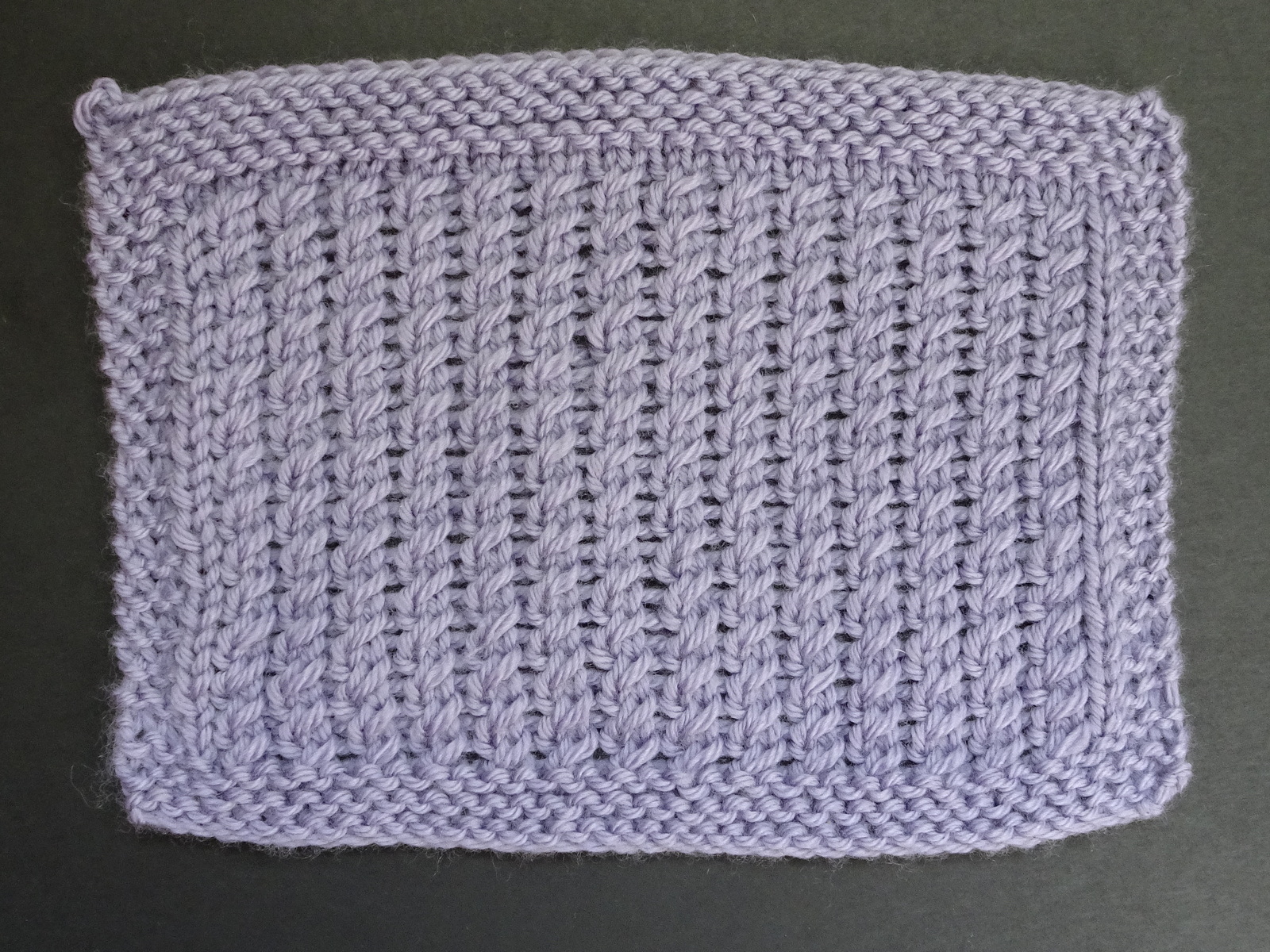


Here are the instructions (not exactly as they appeared in the pattern - I've rewritten them in a way that makes more sense to me).

On an even number of stitches:
Row 1: K1, (yarn over, K2) to last stitch, yarn over, K1.
Row 2:  P1, (drop the yarn over of the previous row, purl the 2nd stitch on the left needle but leave it on the needle, then purl the first stitch, drop both stitches off the needles together) to last 2 stitches, drop the yarn over of the previous row, P1. 

So it's much more like stocking stitch than a rib. The yarn-overs make little ladders separating the columns of pairs of stitches twisted together.

I found it a bit tricky to knit, especially at first. The knit rows are easy, but purling the second stitch on the left needle was quite difficult, especially as I was knitting with my vintage Double Century needles which have rounded tips.  I switched to a sharper KnitPro needle for the purl rows part way through, and that was much easier. I also found that I needed a lot of left-elbow room for that step, so it wouldn't be suitable knitting for a train journey.  (I never need much right-elbow room when I'm knitting with straight needles, because I have the right needle tucked under my arm.)

I wouldn't describe it as a check pattern, but it gives a very nice effect.  It's quite loose - for me, it's looser than stocking stitch, so you would have to be careful of gauge. 

The swatch also gave me an opportunity to try out a ball of Yarn Stories 100% merino DK.  It's a worsted-spun yarn, spun in Yorkshire (in fact, in Slaithwaite, where the Knitting & Crochet Guild collection is now based).  So it's very smooth and gives great stitch definition, ideal for a swatch like this.  And it feels gorgeously soft.  I'll be planning a project to use it some time soon, I'm sure.

Monday, 11 February 2019

Vandyke Check Socks


I have been knitting a pair of socks for my sister - just finished them.  My New Year's knitting resolution was to knit both socks of a pair at the same time (to avoid mismatches, not to mention second sock syndrome), starting with this pair.  I tried knitting with two circular needles, but found it too awkward - too much cable to contend with - and so used magic loop with a single circular needle instead. 

The yarn is Regia Graphics Color sock wool.  My sister wanted a pair of socks to wear with her Joules printed rubber ankle boots - I haven't seen them, but here is the matching handbag.


I think the yarn is a pretty good match to the colours in the handbag, especially as I didn't go looking for it, but found it more or less by accident - after my knitting friend Cath Harris died, her family had a coffee morning in aid of the charity Myeloma UK to find homes for some of her extensive stash of wool and other craft materials, and I found it there.

I knitted the socks toe-up, using the same basic construction (German short-row heel, with a gusset) that I have been using recently, because I know it fits me very well. It turns out that my socks fit my sister very well too.

I didn't want to use a complicated design with this variegated yarn, so I chose the Vandyke Check stitch pattern from Barbara Walker's A Treasury of Knitting Patterns.  I have used it before - for the first pair of toe-up socks I ever knitted, made for my daughter in 2011.


The pattern really doesn't show up very well, but I do like the texture given by the blocks of knit and purl stitches, so I'm happy with the choice.

I hope you enjoy wearing your socks, Margaret.  I have enough yarn left to knit a pair of socks for me, too, but I think I'll have a break from socks for a while.

Thursday, 13 October 2016

Print o' the Wave

Swatch of Print o' the Wave, from The Lady's Assistant by Mrs Gaugain

I'm doing a workshop on the Shetland lace pattern, Print o' the Wave, next week, and so I've been looking into its history.  I first saw the pattern at the In the Loop conference  in Winchester in 2012, when someone showed a photo of a garden fence on Shetland knitted in garden twine, I think, in Print o' the Wave - it looked wonderful.  (I wanted to buy some twine immediately to knit one too.)

I wrote earlier about the Shetland Museum's Study Day on “Authenticity in 'Shetland'Lace Knitting”. Part of the project looked at 19th century knitting patterns that claimed to be based on Shetland lace patterns.  The online material on the project says “Edinburgh-based Jane Gaugain published the earliest knitting books in Victorian Britain.  Her patterns are also the most authentically Shetland.”  

The Print o’ the Wave pattern appears in Mrs Gaugain’s 1842 book, The Lady’s Assistant in Knitting, Netting, and Crochet Work, 2nd vol. in “Pattern XXIV, Handsome Square Knit Shawl, of a Thin Lace-Like Fabric”.  The book is available online from the Winchester School of Art library here, 

Mrs Gaugain says of this pattern “This Shawl is exactly in appearance like the Shetland Shawls, only the centre stitch is more novel than any of them I have ever seen” - the centre stitch is Print o’ the Wave.  Her instructions specify that alternate (wrong side) rows are purled, but she goes on to say “all the pearl rows, like the Shetland Shawls, may be worked as plain rows”, i.e. you can knit the wrong side rows rather than purling them.  It’s not clear whether the version with knit rows instead of purl rows already existed as a Shetland lace pattern - she claims that the version she is presenting is novel, but there may already have been a similar stitch used by Shetland knitters.   

When I first looked at her pattern, I could not understand how anyone could look at it and identify Print o' the Wave - there is no illustration in the book.  But then I found another volume in the Winchester School of Art library, an Accompaniment to The Lady's Assistant, published in 1845, with illustrations of the patterns.  It had an illustration of the shawl that shows the Print o' the Wave pattern clearly (even though it's printed upside-down).


The shawl has a 52-row border to begin with (shown at the top of the illustration), and Print o' the Wave then starts in row 53, with a different pattern at each side. 


It's not easy to disentangle Print o' the Wave pattern from these instructions.  The abbreviations are not the problem, though they look a bit intimidating - you just have to translate P (for Plain) as knit, T (for Take in) as knit 2 together, and O (for Over) as yarn over.  But you have to figure out which are the edge stitches and where Print o' the Wave begins (and ends).  After some puzzling, I managed to extract the relevant part of the pattern and knit a swatch (see above).

The only difference between Mrs Gaugain's Print o' the Wave and modern versions is that all her decreases are done by 'T' or knit 2 together, i.e. a right-leaning decrease.  These days, the pattern is made more symmetrical by using right- or left-leaning decreases as appropriate.  (Though actually the difference is not as obvious as I expected.)    It must have been her deliberate choice to use the same decrease throughout the pattern, because else where in the book she uses  both kinds of decrease. Probably she just used knit 2 together because that was what Shetland knitters were doing at the time.

I found a later published version of Print o' the Wave from the 1880s in Mrs Leach's Fancy Work Basket.  (We have a copy in the Knitting & Crochet Guild collection, though it's also available online.)   The pattern there is called "Leaf and Trellis Pattern for Curtains".  Like Mrs Gaugain's pattern, all the decreases are done by knitting 2 together, so quite possibly, it was based directly on her book.  (Though it doesn't of course credit her, or mention Shetland.) 


Again, the illustration is upside down. But what's especially notable about it is that the sample is full of mistakes.  It's recognisably Print o' the Wave, but with extra holes added.  I think the instructions might be correct (I haven't checked) because the mistakes are random. It's atrocious.  You'd think that someone could knit a small swatch for publication without mistakes - it wouldn't encourage a reader to knit a whole curtain otherwise.  But Mrs Leach obviously needed a lot of material to fill her magazine, and this pattern is only a few column inches, so  perhaps there wasn't time to worry too much about accuracy.    

Mrs Gaugain did not call the pattern Print o' the Wave. (She didn't call it anything.)  But I guess that the pattern continued to be used by Shetland knitters, and it acquired the name at some time.  I don't know when, but certainly it was certainly before 1938, when it was named and illustrated in Mary Thomas’s Knitting Book.  It is claimed there to be one of only ten ‘truly native’ Shetland patterns.  (The others include Old Shale.) 

I've now knitted several swatches of different versions of Print o' the Wave for the workshop, and I still think it is a beautiful pattern.  I'll have to knit something larger than a swatch next. 

Friday, 16 September 2016

Multi-coloured Argyll

A couple of months ago, I was recording the Argyll leaflets in the Knitting & Crochet Guild collection, and noticed a small batch of very appealing leaflets.  In this context, Argyll has nothing to do with Argyle-pattern socks: it was a brand of knitting wool, made by a Bradford spinner, Arthur Mortimer & Co. We have several hundred Argyll pattern leaflets in the collection, ranging in date from the 1950s to the 1980s.

The 1950s Argyll leaflets are mostly in black-and-white, and small (about A5 size).  But the three earliest leaflets that we have are larger, and in colour.  They were issued in about 1950, as near as I can tell.

Argyll leaflet 104

Leaflet 103 is a twin-set in stranded knitting - the design on the cardigan is almost an Argyle pattern.  I wonder if that was deliberate?


Argyll leaflet 104

Leaflet 104 is a girl's twin set, with rather odd-looking squirrels holding green acorns.  I think it would be easier to knit the design using intarsia rather than stranded knitting, but the leaflet doesn't give any guidance about how to do the colour-work  It just gives row-by-row details of what colour to use for each stitch, as in "14th row. -- 38R., 8 B., 1 R., 9 B., 2 R., 2 G., 40R."   Why didn't they give a chart?  So much easier to follow.    

Finally, leaflet 108 is in some ways the most interesting.

Argyll leaflet 108

It is a cardigan knitted in plain yellow wool and Argyll Multi-tone - evidently a random-dyed yarn.  I found an ad in a 1951 newspaper for a yarn shop selling Multi-tone. The shop sold three colourways:  natural/rust/green (illustrated in leaflet 108), blue/white/pink and blue/yellow/white - price 1s. 6d. an ounce (7½p).

The front of the cardigan has what the leaflet calls 'bobbles' of the multi-tone wool.  It is basically stripes of two rows of yellow and 6 rows of multi-tone, but the instructions for the first row of the 2nd yellow stripe read: "Knit 1, * drop the next stitch down 6 rows to the yellow stitch and knit through the yellow stitch and the loops of multi-tone wool, knit 5, * repeat from * to * to the last 2 stitches, drop 1, knit 1".   (The last 'drop 1' must mean to drop it down 6 rows, as just described, rather than just dropping it altogether.)  So the yellow stitch that you pick up from 6 rows below is stretched over those 6 rows, while the multi-tone stitches form the bobble in between, in a kind of seersucker effect.

You do the same thing on the 4th, 6th, 8th, ... yellow stripe.  Then on the 3rd, 5th, 7th, ...  yellow stripe, the instructions are the same, except that you start the row by knitting 4 stitches instead of 1, so that the dropped stitches are 3 stitches further on than they were before.

This is what it looks like, from the leaflet.


I had not met a stitch pattern like this until I saw this leaflet, but then PixieMum commented on my post last month on knitting sampler squares, "Any idea what Gladys meant by "B1 Thus = . wool back  drop next st. 4 rows down, then knit Dropped st. and 4 horizontal loops above tog. as one stitch. Have you come across this before?"   And so I was able to say that yes I had, and that presumably the intention was to create a bobbly effect.
  
I think that Argyll did not produce many of these colour leaflets  - I suspect that the first pattern leaflet they produced was number 100 (several spinners started counting at 100).  The next leaflet number in the collection is 138, which is smaller and black-and-white, so I think there were at most 37 of them and probably far fewer.  But the three we have are so attractive that it would be nice to have some of the missing ones.

In the 1980s and 1990s, when many British manufacturers of hand-knitting yarns were in difficulties, the Argyll brand was struggling, and the business was acquired by Thomas B Ramsden & Co.  (See here.)   We have permission from Thomas B Ramsden to copy their vintage patterns for the personal use of Guild members, so if any member would like to knit one of these (in 2-ply!) please ask, via collections@kcguild.org.uk.  

Friday, 26 August 2016

Swatching for a Scarf

I have been trying out stitch patterns for a scarf I'm planning to knit for my sister.   I bought the yarn at Ribbon Circus in Hebden Bridge, at the Crafternoon Tea at the beginning off this month.  And I knitted a swatch of a possible pattern, Different Breeze, some time ago - the first thing I knitted when I was able to hold knitting needles again after breaking my wrists.  But although it's a very pretty lace pattern, there are no easy rows - you need to concentrate on every one.  It's going  to be a long scarf,  and so I'd like some rows in every pattern repeat where I can knit without thinking.

For other possibilities, I've swatched a couple of stitch patterns from Barbara Walker's Treasury of Knitting Patterns.  The first is Lace Rib.  It meets my criterion - every other row is a repeat of p3, k2, so doesn't need much thought.

Lace Rib

So that was a strong candidate.  But being based on rib, it naturally concertinas inward - the swatch has been pressed to flatten it out, and even then it is perhaps not as drapy as I would like.

I have also knitted a swatch of Dewdrop Pattern.  It's an 8 row pattern with 6 rows of k3, p3.  The lacy increases and decreases all happen on the 4th and 8th rows.  So it will be quite fast to knit, I think.  

Dewdrop Pattern

(By the way, if you look at Dewdrop Pattern in A Treasury of Knitting Patterns, you'll see that my swatch doesn't look very like Barbara Walker's.  Hers seems a bit more stretched out, vertically.)  

On the 4th and 8th rows of the pattern, you do a three-into-one decrease, which according to the instructions should be done as slip one, knit 2 together, pass slipped stitch over.  But I found that the slipped stitch gets quite stretched when is passed over, and that stitch becomes a prominent part of the pattern, so that it isn't symmetrical.  You might be able to see that in the bottom half of the swatch. (Again, Barbara Walker's doesn't seem to look like that.)

So I tried a different 3-into-1 decrease, where the centre stitch is on top.  That's also easy to do.  First, slip the first two stitches together, knitwise,   That puts them on the right needle in reverse order.  Then knit the 3rd stitch, and pass the first two stitches over it, either one at a time or both together.  The result is that the 2nd stitch, i.e. the middle one of the three, ends up on top, with the other two tucked underneath it.   I've done that in the top half of the swatch.

So I think dewdrop stitch will be my choice for the scarf.   It's easy to knit, it lies flat, it drapes nicely, it's pretty.  And another plus: although the pattern isn't reversible, and the wrong side looks completely different to the right side, it's quite presentable.

Dewdrop Pattern, reverse
 
.  

Tuesday, 16 August 2016

Knitting Sampler Squares

I wrote here in January about a hugely long sampler that we have in the Guild collection, made by a knitter called Gladys.  There are about 940 stitch patterns in it.  Gladys intended to reach 1,000 but had to give it up because of arthritis in her hands - she never cast it off, though, and when it was given to the Guild after she died, it was still on the needles, so perhaps she had hoped to finish it.

The London branch of the Guild has been studying the sampler and is planning a couple  of projects based around it.  One is to add another 60 or so stitch patterns, to reach Gladys' target.  Another, which is under way, is to re-knit some of the most interesting stitch patterns and maybe publish them.  I volunteered to knit two of the patterns, and have just finished and posted them.  We were asked to knit 20cm. squares, with a garter stitch border. They are all in the same wool - 4-ply merino in cream.

My first square, pattern no. 491, is a very pretty pattern of cables separated by open-work panels.


The other (pattern 370) is not as successful, I think.  It has bands of reverse stocking stitch, knitted on size 10 (3.25mm.) needles, separated by two rows of a more open stitch knitted on size 7 (4.5mm.)  needles. But the two fancy rows don't show up as much as I think they should, partly because of the tendency of the stocking stitch to curl - even after I stretched the swatch quite a lot.  All you get is a general impression of horizontal channels between the bands of reverse stocking stitch, punctuated by little holes.  It seems to have looked better in Gladys's original, so perhaps it doesn't work well in this yarn.  


Imagine knitting swatches of over 900 different stitches! Would you be able to remember them all, even if you could find that many in the first place?

Saturday, 6 August 2016

Not Mistake Rib

Not long after I wrote the post on Mistake Rib, I was looking in another stitch dictionary and saw something that looked very like Mistake Rib, but called Mock Fisherman's Rib.  The dictionary was in Creative Knitting, a part work published in the 1970s or 1980s.

Here's a swatch of Mock Fisherman's Rib.


And for comparison, here is my Mistake Rib swatch on the same background:


I thought at first that Mock Fisherman's Rib was just another name for Mistake Rib, until I read the instructions.   Both are worked over a multiple of 4 stitches, plus 1, but Mistake Rib is K2, P2 on every row.  Mock Fisherman's Rib is K3, P1 on every row.  Who would have thought that two such different sequences would give such similar results?

Of course, if you look closely, the differences show up.  In Mock Fisherman' s Rib, the purl bumps either side of the knit ribs are in the same row, and in Mistake Rib they are in alternate rows.  The charts below make the differences very clear, but also show the knit ribs and purl ribs which are the strongest feature of both. (As before, a blank square means knit on odd rows, purl on even rows; ● means purl on odd  rows, knit on even rows.) 

Chart; knitting stitch; mistake rib; mock fisherman's rib

But in the large, the two stitch patterns are pretty much interchangeable, it seems to me.  On the other hand, worked over a multiple of 4 stitches, K3, P1 would look nothing at all like K2, P2.  Knitting is fascinating!

Wednesday, 6 July 2016

At the Guild Convention

I'm just catching up after last weekend away at the Knitting & Crochet Guild's annual Convention.  As last year, we were in Sheffield at Endcliffe Village.  This week is also busy, so I don't have time for a very detailed account, but I must mention a couple of the highlights.  On Friday evening, Susan Crawford gave the after-dinner talk, about The Vintage Shetland Project, her new book (due mid August).  She has recreated hand-knitted pieces in the Shetland Museum collection, and the patterns will be published in the book.  On Friday, she brought several of the recreated knits, and they are wonderful.  All in fine yarn - mostly wool, but there is also a pullover in fine silk which is especially beautiful.   I am so looking forward to seeing the finished book.

We had two workshop sessions during the weekend, led by Guild members.  On Saturday afternoon, I went to one on Victorian knitting patterns, led by Lesley O'Connell Edwards.  She had brought copies of several patterns that she had knitted herself, including a very pretty bag in many different shades of green and red/orange/yellow/cream.  (The colour in the photo is not very accurate, I'm afraid.)  

   
The pattern is "Shell Knitting for  Bag, in German Wool", from Exercises in Knitting by Cornelia Mee (1847).  Lesley went through the pattern with us, to show that Victorian knitting patterns have to be used with caution, because they are often wrong.   In this case, the  number of stitches to cast on is wrong - not easy to correct, because the instructions for the first round are also wrong, so it's hard to figure out how many stitches there are in each pattern repeat and she doesn't say how many pattern repeat there are.   And the number of stitches in a pattern repeat changes in every round, for the five rows of the pattern.  And to make it still more difficult, there is no illustration to go with the pattern, so you have can't go by what it's meant to look like.  So I'm amazed that Lesley managed to work out what Cornelia Mee meant to say, and knit a very pretty little bag.  (It's in very fine wool, on tiny needles.)  


Lesley also brought a pence jug and a rather strange fingerless mitten, knitted on two needles, sideways.

  
She provided us with three colours of fine wool, and we had brought 2mm needles, so that we could try one of the patterns.


I chose Cornelia Mee's (corrected) shell pattern, but only did three pattern repeats instead of the eight needed for the bag.  And one of the other workshop participants gave me one of her skeins of Appletons crewel wool, because she was knitting the pence jug and so only needed two of hers.  Now I have a very pretty little wristlet in four colours.

    
Really, it's a swatch knitted in the round, but I'm knitting a lot of wristlets lately, and it fits my wrist, so I'm thinking of it as a wristlet.

It was fascinating to see how the patterns turned out in practice.  We did wonder how ladies in 1847 managed to understand Cornelia Mee's pattern and correct her mistakes.  Perhaps they got together in knit-and-natter groups to pool their ideas?

Monday, 27 June 2016

Mistake Rib

I just discovered mistake rib!  It's obviously not new, as it already has a name, but it's new to me.

The discovery came about because I've ordered a copy of Sequence Knitting by Cecelia Campochiaro.  I've been hearing about the book since it was published, e.g. in Tom of Holland's blog, here.  It's not easy to buy it in the U.K., so I have finally ordered a copy from the U.S., and it is now making its way slowly over the Atlantic (I hope).   After I ordered it, I started thinking about the kind of sequences that I think she's talking about.  One idea is to choose a sequence of knit and purl stitches and repeat them over and over on every row, so every row starts at the beginning of the sequence.  You get different stitch patterns depending on the number of stitches you have.  So for instance, the simplest sequence would be K1, P1.  If you have an even number of stitches, you get single rib, and an odd number of stitches gives moss stitch.  It's fascinating that two stitch patterns which look and behave so differently should be so closely related.

Then I started thinking about the sequence K2, P2.  If the number of stitches is a multiple of 4, you get double rib, and if it's a multiple of 4, plus 2, you get what's sometimes called double moss stitch.  And if it's a multiple of 4, plus 1 or 3, I discovered that you get an interesting stitch pattern that's a mixture of single rib and moss stitch.

Chart; knitting stitch; mistake rib

Looking at the swatch, there is a column of the knit stitches of single rib, then a column of moss stitch, then a column of the purl stitches of single rib, and another column of moss stitch, and that sequence repeats.  Here's a chart, which might make it clearer.  A blank square means knit on odd rows, purl on even rows; ● means purl on odd  rows, knit on even rows.  (It's reversible, so there aren't 'right' and 'wrong' sides.)

Chart; knitting stitch; mistake rib

The resulting fabric is deeply corrugated and quite stretchy, but doesn't pull in like double rib.

I thought that such a simple but good-looking stitch pattern must be already known, and not a new invention.  And a few days later, in the way that coincidences happen, I found a knitting pattern that uses it.

1930s vintage knitting pattern; Penelope; Wm Briggs; mistake rib; jacket; Kwiknit
Penelope 1084
It's a smart jacket, from about 1940, and would be very warm, I think.  The leaflet doesn't give a name to the stitch pattern, but it prompted me to look in Barbara Walker's Treasury of Knitting Patterns.  And there I found it, called Mistake Stitch Ribbing.  She says 'This handsome ribbing may very well have been discovered by an accident. The "mistake" consists of working Knit-Two Purl-Two ribbing on one less stitch than required.'   It doesn't seem very plausible to me that it should have been the result of a mistake - as she also says, it would have been obvious very quickly that it wasn't double rib.  I think any knitter intending to knit double rib would have corrected the mistake before realising that it is a worthwhile stitch pattern in its own right.   But the rather unfortunate name seems to be firmly attached.

It would be nice to knit something more than a swatch in mistake rib.  It would make a nice scarf, and there are lots of examples in Ravelry.  (It is reversible of course - every row is the same.)   But I have plenty of scarves - something different would be good.

Wednesday, 25 May 2016

Knitting Again


The casts were taken off my wrists on Monday, hurray.  So now I can use my hands again and not just my fingers.  The wrists are very stiff and achy, but there's already some improvement since Monday.  I still have a brace on my knee - this one allows for some bending.  It's currently set to a maximum of 30°, and that will be increased in stages.  (That's the summary - non-knitters can stop reading now.)

The next question is: can I knit?  I already have a knitting project on the needles since before my accident, but I didn't want to go straight back to that.  I didn't know how easily I would be able to knit, and my tension might be different at first.  And you don't want a change of tension in the middle of a piece of knitting.   So instead, today I knitted a swatch.  It's a lacy scarf pattern, Different Breeze - a free pattern on Ravelry designed by Sachiko Uemura, and a candidate for the Juniper Moon yarn I saw in Ribbon Circus.

It's knitted in 4-ply (fingering) yarn, on 5mm needles, and as you can see, I managed it - with no difficulty, in fact.  I've shown the swatch straight off the needles - it's supposed to be blocked so that it is more open.  But it's useful to see that there's very little tendency to curl, even though it's based on stocking stitch.

And while knitting the swatch, I didn't feel that my knitting style was any different at all - so I think I can go back to my work-in-progress and carry on.

Saturday, 23 January 2016

Twisted Stitches

On Thursday, we had the first Huddersfield KCG branch meeting of 2016.  The plan for the year is to tour the world in knitting, and we began the tour with a workshop on Bavarian Twisted Stitch patterns.  Marie had devised several small projects for us to try, from fairly simple to quite complicated - the end result of each is a phone case.

I had already knitted something using Bavarian Twisted Stitches, it turned out - the Baht 'At mittens from Ann Kingstone's Born and Bred book.   So I decided I should try the most complicated project - which was a bit daft.  I should know by now that in a workshop I'm not usually at my best - I'm not as careful as I should be, I make mistakes.  I should choose something simple. But I've done some more work since the workshop (corrected a couple of mistakes) and now I'm making better progress.


I did at least make the sensible decision not to attempt Judy's magic cast on - I've done it before, but I can't remember how to do it, and it would have taken most of the evening by itself.  So the bottom of the case is open, and I'll need to sew it up to finish it.

My stitches aren't as neat as they should be (having to correct mistakes doesn't help), but they are getting better, and twisting the stitches does have a remarkably neatening effect anyway.   Many of the Bavarian Twisted Stitch motifs have evocative names like "Clover Leaf" or "Ear of Wheat", but this one is apparently called "Large Chain with Twisted Bands".  So far I've done one pattern repeat, and I think it's looking good.

Next month's meeting is on British Ganseys, and further ahead I am doing a workshop on Swedish twined knitting.  At the time this was planned, I knew almost nothing about Swedish twined knitting, but some progress has been made - a friend has lent me a book on it, and I'm going to start practising.      

Thursday, 21 January 2016

A Really Long Sampler

One of the more unusual items we have in the Knitting & Crochet Guild collection is an enormously long sampler of knitting stitches, in a pink synthetic yarn.  There are about 950 stitch patterns in it, and it was knitted over several decades from the 1940s on.  Gladys, the knitter, intended to get to 1000 stitch patterns, but sadly she had to give up knitting due to arthritis and so never reached her goal.  After she died, her family gave the sampler to the  Guild, along with the 17 spiral-bound Woolworths notebooks that Gladys used to record the patterns.

When the sampler came to the Guild, it still had the needles and final ball of yarn attached.  It has since been cast off and washed (not easy!).  It was brought to the Guild weekend in Sheringham two weeks ago - now mounted on a garden hose reel and trolley, so that it can be easily unrolled and re-rolled - a very clever idea, that makes it much more manageable.    

The sampler on its hose reel

The sampler as Gladys left it

I had slip stitch patterns on my mind at the time, because of the slip stitch workshop I did at Sheringham, so on looking through one of Gladys's notebooks, I noticed a slip-stitch pattern.  


None of the patterns in the note-books are named, as far as I know, but I recognised this one: it's slip-stitch honeycomb, which I used for the cushion I made last year,  It's odd that Gladys didn't record the names - the numbers are not very memorable by themselves. Did she remember all the names, so that she didn't need to write them down?  The information from her family is that she invented some of the patterns, and some of them are marked M.U. in the notebooks, which could be 'Made Up' - you would think that she might have named the new patterns as well.

All a bit mysterious - but fascinating.

Thursday, 31 December 2015

Woven stitch mitts

Unlike some writers of knitting blogs, I don't make many knitted Christmas presents. (Too much pressure!)  But this year, I made a pair of fingerless mitts for my daughter - not quite in time for Christmas, but nearly.  Here they are.


I made her a pair a few years ago which she still wears (see here), but she keeps those 'for best' and wanted a pair that she could wear every day and not worry about.  She wanted a very dark purple, and I found just the right colour in Wendy Merino DK, which I use a lot.  It's called Sloe - the colour of sloe gin.

I knitted them in woven stitch, a slip-stitch pattern that does look like woven fabric on the right side. It has a four-row (or four-round) repeat.  If you are knitting in rounds, on an even number of stitches, it goes like this:
Rounds 1 & 3: Knit.
Round 2: (Knit 1, Slip 1 with yarn in front) to end.
Round 4: (Slip 1 with yarn in front, Knit 1) to end.  

It is somewhat similar to linen stitch, though much less dense.


The mitts fit well (we kept trying them on as I was knitting) and are reported to be very warm.


Wednesday, 30 December 2015

Petal Cowl

I wrote in November here that I had been browsing around for patterns like the flame stitch I had seen on a shawl in the Chanel to Westwood exhibition, and found Xandy Peters' Petal Cowl pattern. I finished it a while ago, so it's about time I wrote about it.

The pattern is designed to show off a self-striping yarn (4-ply), and Lydia at my local yarn shop in Huddersfield stocks some very nice ones.  I chose Louisa Harding's Amitola, a delectable wool/silk mix.  The colour is called Gothic, don't know why, and it's not turned out as stripy as I expected - it's more a blend of shades of grey and dark purple, with an occasional flash of red.  But never mind - I love the effect.


I reduced the diameter by a third.   This was my first attempt at a cowl and I thought I would feel more comfortable wearing something smaller. Also, the pattern tells you to cast on 300 stitches, increasing to 550, and I didn't feel up to tackling a complicated pattern over that many stitches.   So I reduced the starting number of stitches to 180.

I should also point out that I wear it upside down - the cast-on edge is at the top.  That's because I think it looks better with a red stripe close to the lower edge, rather than a lot of grey.  

It is a complicated pattern, and there were a couple of rows in the pattern repeat when I just had to plod through the instructions over and over.  But towards the end I felt I understood more what was going on.  It took me that long because I didn't do a test swatch - I decided that tension wasn't going to be that crucial, and knitting a test swatch in the round just to try out the pattern seemed like a waste of time.  I may have been wrong about that - it did feel when I had finished that really the whole cowl had been a test swatch, and I ought to knit it again now that I understand how it works.  And I must confess that there are a few mistakes in the knitting. Once or twice I purled a round instead of knitting, through misreading the pattern, and decided to live with it rather than going back.  (On reflection, it's ridiculous that the mistakes are on the plain rounds where you just knit every stitch, rather than on the really complicated rounds, where you have to keep counting stitches.)    

Now it's finished, I love it. It's warm, it's soft, the colours work really well with the design, the stitch pattern is absolutely fascinating.   I'm quite converted to wearing a cowl - I shall have to knit some more.   And it was, in spite of the trickiness of the stitch pattern, a quick knit - I finished it in two or three weeks.


I have thought about knitting Xandy Peters' Fox Paws pattern  ('recommended for the adventurous') as a follow up, but I'm not sure I'm feeling adventurous enough.  And I've read Yarn Harlot's blog posts about knitting Fox Paws, particularly this one, and I'm not sure I want to have to concentrate      that much on what I'm knitting. Not just now.

Sunday, 6 December 2015

A Cosy Cushion

I wrote in October about a cushion cover I was knitting for my daughter, using a slip-stitch pattern.  I knitted a miniature trial version first, before starting the full-size one.  I knitted most of the patterned side on the KnitAway weekend in Blackpool, and now the whole thing is finished.


I've used a slip-stitch honey comb pattern.  Mary Thomas gave directions for it (under the name Honeycomb Slip Stitch) in her 1934 Book of Knitting Patterns, and it must be much older than that.  For the middle square of the cushion, I have used it wrong side out, because I think that side looks more interesting in two colours.


The outer border is done in the same stitch pattern, right side out.


I picked up stitches all round the centre square, and knitted in rounds until the square was big enough to fit the cushion.  Slip-stitch honeycomb lends itself to a neat mitre at the corners.


I cast off the square using an i-cord bind-off, so that it looks like piping around the edge of the cushion, and then picked up stitches along two sides to knit two stocking stitch flaps for the back. The buttonholes are not at all neat, I'm sorry to say, but as they are at the back of the cushion you can't see them, and they are very rarely going to be used.  So I don't care.


It's a very soft and cosy cushion, and my daughter likes it.  (She doesn't care about the button-holes either, or more likely hasn't noticed.)   And the colours look good as a contrast to the navy throw and grey-blue cushion on her sofa.  My own design, and I'm proud of it.


Wednesday, 25 November 2015

Flame Knit

At the "Chanel to Westwood" exhibition in Barnsley, there was a wonderful shawl in a fine silky knit,  worn over a dress with Art Nouveau-style embroidery, in a display of garments from the 1910s.


The label said this about the shawl:
"The shawl in fine knit rayon is knitted in a 'flame knit' pattern which is a traditional design.  This stole is the oldest example we have of this pattern but the flame knit remains popular up to the present day having a particular association with the Italian knitwear company Missoni where it became one of their signature designs." 
It was hard to see the stitch pattern on the shawl very well - the close-up below is the best I could do.


I would love to know how the stitch is done - I assume that at that date, it would have to be hand-knitted.  There were knitting machine in the 1910s, but not I think sophisticated enough to knit such a complex stitch pattern.  So if it's traditional hand-knitting stitch pattern, you would think it would be documented in stitch dictionaries - but I haven't been able to find it.

The nearest thing to a flame-like stitch pattern that I could find, searching on Ravelry, were some patterns by Xandy Peters - she has a pattern called the Petal Cowl, which you can buy through Ravelry.  (The image is taken from her blog post about it.)  I have bought the pattern and have started knitting - I'll write about it later.  It's quite a tricky knit, though doable.  She has an even more complicated-looking pattern called Fox Paws, which looks wonderful and more like the shawl, but she says it's "recommended for the adventurous" and slightly more complex than the Petal Cowl, so I'll leave that one for later.  But these stitches are her own invention, so not the 'traditional design' used in the rayon shawl.


If anyone can put me on the trail of the traditional 'flame knit' pattern, I should be very grateful.

Tuesday, 4 August 2015

Embossed Knitting

I was in John Lewis Sheffield on Saturday, looking for a pair of smart trousers, and saw a very nice crew neck jumper in the John Lewis Collection.


It has an all-over design in reverse stocking stitch on stocking stitch - the reverse stocking stitch areas are raised, so that you get an embossed effect.  The jumper I saw was cream, but the John Lewis web site shows it in red, too.  (But what about the half-tucked-in look?  I read about that in The Guardian fashion column a while ago, and didn't really believe it.)

Here's a close-up of the jumper, showing the stitch pattern.


I don't know what this kind of stitch pattern should be called - I thought that it was brocade knitting, and looked in Mary Thomas's Book of Knitting Patterns to confirm.  But in the brocade patterns she shows, the raised areas are alternately knit and purl. i.e. moss stitch, not reverse stocking stitch.   And many of the stitch patterns used in ganseys are of this 'brocade' type.

So I'm going to call it embossed knitting. until I find out that it already has a name.  It seems worth experimenting with - a easy way to get a lot of texture without making the fabric thicker, unlike cables for instance.  And in fact, I did knit a thick jacket for myself three years ago with what I'm now going to call an embossed stitch pattern, for exactly that reason - I wanted some texture without the extra thickness of cables.  There seems potentially a lot of scope for interesting new designs, as in this John Lewis jumper. I should do some swatches.

And I did find some smart trousers too - a successful trip all round.

(Attentive readers may remember that this has happened before - last year, shopping in John Lewis Sheffield for a pair of jeans led to experiments with two-colour moss stitch.)
Related Posts Plugin for WordPress, Blogger...