Showing posts with label 1960s. Show all posts

Sunday, 2 February 2020

Mary Quant at the V&A

Last week we were in London for a few days and I took the opportunity to go to the Mary Quant exhibition at the Victoria and Albert museum, before it closes on 16th February. (It's then going to the V&A Dundee, I believe.)


The exhibition was busy, with many visitors who were old enough to remember the 60s, and who were reminiscing about the styles.  I was a teenager in the 60s myself, though I also remember that stockings were only replaced by tights quite late in the 60s, and stockings were horrible garments — for me, that made some of the early designs look less free and easy than they might.  If you were already grown up in the early 60s, I'm sure that in comparison with 1950s styles, they were much less constrained.

Apart from the spectre of stockings, I enjoyed it very much and thought it was an excellent exhibition.  Many of the garments on show had been given or lent by the women who had worn them when they were new, and had treasured them ever since.  Often there was a photo of the owner, wearing the garment, perhaps for a special occasion, and often a page from Vogue or Harper's Bazaar, showing how it was originally portrayed in the fashion press.  It was helpful that the prices were translated into modern values— in the early 60s, when Mary Quant was designing clothes for her Bazaar shop in Chelsea, the clothes were made in small quantities and were expensive.  It was only later, when her designs were mass-produced, that they became more accessible.

I was, of course, on the lookout for knitting. I know that in 1965 and 1966 Mary Quant produced  two collections of designs for hand knitters (and crocheters) that were published as knitting pattern leaflets — we have many of the leaflets in the Knitting & Crochet Guild collection.  I wrote here about the Patons pattern leaflets with Mary Quant designs, and I knitted a Mary Quant short-sleeved jumper from a Lee Target leaflet myself a few years ago, which I showed here.   The exhibition had a case devoted to the knitting patterns, and to the dress patterns for Butterick also designed by Mary Quant.  (My mother made a dress for me from one of the Butterick patterns, in the mid 60s, but the dress is long gone, and I don't have any photos of it, sadly.)

Several of the knitting patterns were on show, and an actual dress, knitted to a Sirdar pattern. It's one of the 1966 collection, with Mary Quant's daisy motif in the background, and also on the pocket of the dress.  (The exhibition label gives  'Candytwist' as the name of the design, but that is actually the name of the Sirdar yarn that the leaflet specifies — unlike Mary Quant's other designs, those in the knitting patterns don't have names.)

Sirdar leaflet 2353

The model on the pattern leaflet is Jill Kennington (now a photographer), who appears on several of the other Quant knitting patterns too — I liked the fact that exhibition names the model in many of the photos that publicised Mary Quant's designs.  There are several models that appear over and over again in knitting pattern leaflets, so you recognise their faces, but usually you don't know their names — it seems a great pity to me that they aren't better known.   As well as modelling for the 1960s leaflets, Jill Kennington appears in a video made for the exhibition, talking about the experience of being a model for Mary Quant, and the contrast with the 1950s, when models were elegant, stately and aloof.
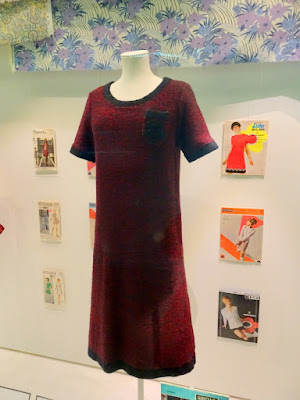


Here's the dress in the exhibition that was knitted to the Sirdar pattern.  (I'm sorry it's not a very good photo, through the glass of the case.)  The dress has been given to the V&A and was knitted by the donor's mother, for the donor, who described it as "a labour of love". 

I looked for knitwear elsewhere in the exhibition, too, but the only knitting I spotted was part of a dress, designed by Mary Quant in 1964.  Most of the dress is made of checked flannel, but the sleeves, collar and belt are hand-knitted in cream wool.


It was featured in Harper's Bazaar magazine in August 1964, where it was described as "Tattersall check flannel shirt dress with knitted sleeves, collar and skinny belt by Mary Quant, 15gns. at Bazaar."  In the magazine, it was modelled by Grace Coddington (now creative director at American Vogue), and there's also a photo of Mary Quant wearing the dress, posed with Vidal Sassoon trimming her fringe.  15 gns. (guineas) is equivalent to £15.75, which doesn't sound a lot, but its value today would be over £320.  As the exhibition notes, it was not a suitable design for mass-production.

But of course, there is plenty of other material in the exhibition, from underwear and make-up to quite formal evening wear.  Some of the early designs, made in small quantities, are beautifully made, with details that would be impossible, I think, to mass produce.  Well worth seeing.  And there's a very well-illustrated book to go with the exhibition, too.  (See top photo. Yes, I bought a copy.)

Sunday, 3 March 2019

Mary Quant knitting patterns

The lack of posts recently is due to The Move - the Knitting & Crochet Guild collection's move to new premises in Slaithwaite.  It happened the week before last, and all went well, though there is still a lot of sorting out to do - lots of boxes stacked on the floor, waiting to be put on shelves.  I'll say more about our new location another time. 

Meanwhile, over on Instagram, I have been working through my #50yearsofPatonspatterns series of posts, starting in 1979 and working backwards.  We are nearly through the 1960s, and I picked two Mary Quant patterns to represent 1965 and 1966.  In both years, she designed a collection of knitting and crochet patterns in Courtelle yarns, for several of the spinning companies, including Patons.  There were nine Patons patterns in all, six in 1965 and three in 1966.  I'll show them all here.

First the 1965 leaflets. The yarn for all six is Patons Flair, a wool-Courtelle blend, which was DK weight, to judge by the tension.

Patons 9526, below,  is a skinny-rib sleeveless polo-neck sweater - perhaps not as distinctive now as it was in 1965. 

Patons 9526

Patons leaflet 9527 is a ribbed sweater, with crocheted collar and cuff, and matching knee-socks, also with a crochet trim for the turnover.

Patons 9527

Next is a ribbed cardigan, with a small collar, knitted in reverse stocking stitch, folded in half and stitched down.  You were clearly not intended to wear it as an extra layer, so it's more a button-up sweater than a cardigan. 

Patons 9528

Patons 9529 is a dress, with ribbed bodice, little stand-up collar, and knitted belt.  More knee-socks, this time in a wide rib to match the dress bodice. 

Patons 9529

Then another dress, mostly ribbed, with cable panels in the skirt, a big roll collar, also ribbed, and a knitted tie belt.  There is a matching cabled hat, with pompom, and a pair of matching mitts. I like the dress, though I generally feel that knitted dresses won't keep their shape. 

Patons 9530

And finally, an ensemble of jumper and skirt, with a bonnet and stockings.  The body of the jumper is ribbed.  The skirt looks as though it is in the same rib, knitted sideways, but in fact it's knitted top down. The sleeves, stockings and bonnet are all crocheted.

Patons 9531

It's notable that wide ribbing is a feature of all these 1965 designs, so the jumpers and dresses fit closely. 

It's easy to distinguish the 1966 leaflets from the 1965 designs, across all the spinners that had these Mary Quant designs in Courtelle.  The leaflets in the 1966 collection all have the Mary Quant daisy as part of the background, and the models have the Vidal Sassoon geometric hairstyle that she had adopted herself and made famous.  The 1966 Patons designs are all in a pure Courtelle yarn, also a DK weight by the tension.

The first of the 1966 Patons designs is leaflet 9700 - a cardigan and stockings outfit. They are both worked in rib. The front of the cardigan has a smocked yoke, worked afterwards by using a contrast thread to bind adjacent ribs together.  (The instructions for the smocking are a bit skimpy, I have to say.)  There are also bands of smocking in the stockings, just below the knee - which looks a bit strange.

Patons 9700

Patons 9701 is a short-sleeved jumper and skirt outfit.  The jumper has narrow stripes of a contrast colour across the yoke, back and front, and there is a crochet trim in both colours around the neck and bottom of the sleeves.  The belt is also knitted, in the contrast colour.  Of all these Mary Quant designs for Patons, this one is my favourite.

Patons 9701

And the final pattern in this collection is Patons 9702, a ribbed jumper and matching stockings.  The contrast band on the sleeves is worked by using two balls of the main colour and one of the contrast, and then using just the contrast colour to knit a saddle shoulder.  Finally, the polo collar is added after the jumper is sewn up.  The stockings are also in two colours, as you can see from the illustration, which gives an odd knee-sock effect.  (And the model is wearing white sling-back shoes too, not to mention the shorts over stockings - altogether a bizarre outfit.)

Patons 9702

The dresses and skirts in these leaflets are shown finishing above the knee, but they aren't as extremely short as they became later - just as well, because in 1966 women were still wearing stockings rather than tights.  So Mary Quant designed knitted and crocheted stockings, not principally to avoid all the extra work in making tights, but because women didn't wear tights at that time - though that changed only a year or two later.

A Mary Quant exhibition is opening at the V&A  next month, which I hope to get to.  And there is an exhibition at the Fashion & Textile Museum on "Swinging London: A Lifestyle Revolution", until June, which features the work of Mary Quant and Terence Conran.  It seems that there is a resurgence of interest in the 1960s, and Mary Quant in particular - so I'll offer this post as a knitting and crochet contribution to that.   

Saturday, 19 January 2019

A Few More Patterns

Last weekend, I was knitting at Sheringham, on the north Norfolk coast - the Leighton Buzzard branch of the Knitting & Crochet Guild hold an annual weekend at the Youth Hostel there.  A busy weekend, with a yarn swap, a quiz, talks and workshops.  Alongside the workshops, I did a couple of sessions on tools and gadgets from the Guild collection which were innovations in their time, and have a patent number attached - such as the Double Century needles.  I took a few knitting patterns with patent numbers too. (You might not think that you could patent a sock pattern, but it has been done - I'll write about it some time.)  There was time to look around Sheringham and visit the shops, including the two yarn shops.  And of course a lot of knitting was done (or crochet, for those that are that way inclined).

During the weekend, a Guild member gave me some pattern leaflets and booklets from a friend of hers, as a donation to the collection - a mix of styles and dates, from the 1930s to the 1970s or 80s.  It's exciting to look through the very old patterns - there's often something fascinating that we don't already have in the collection.

The two oldest patterns in the new donation are Scotch Wool & Hosiery Stores leaflets from the early 1930s. Their leaflets at that time were 'given free' - presumably if you bought the wool.   The first is for a 'Gentleman's Pullover', with or without sleeves.   It has a band of stranded knitting above the welt, and another around the V neck - in a rather boring colour combination of brown on fawn.

Scotch Wool & Hosiery Stores B 4

The other is a children's pattern, size 24 in. (61 cm.) chest. There is a boy's pullover, with a V neck, and a girl's pullover with a square neck, buttoned on the shoulder.

Scotch Wool & Hosiery Stores B 38
We have some of the Scotch Wool Stores pattern leaflets from the 1930s in the collection already, but there are a lot of gaps, so it's good to be able to fill in two of them.

I'll show a few of the later leaflets too.  From the 1950s is this elegant double-breasted jacket.

Lister 299 6d
And this leaflet is from the 1960s: 

Prismar 1024

It's aimed at teenagers - the girls on the cover are evidently fans of jazz and the Beatles. There was a time in the 1960s when every teenage girl wanted a ribbed sleeveless sweater with a polo neck, just like the one here.

And representing the 1970s is a 'poncho style shawl', crocheted in dishcloth cotton.

Twilleys 1024

Some very nice additions to the collection.  I bought another myself, in the Salvation Army shop - a Bestway pattern from the 1940s that I thought we didn't already have, and I was right.  (I could actually have checked the list of Bestway patterns in the collection on my phone, but it's more fun to wing it, and see if I'm right later.)  And a pair of Barnet knitting needles in a junk shop - not a make I had heard of.

Bestway 624

I mentioned that there was plenty of time during the weekend for knitting and crochet.  I was knitting a pair of socks for my sister - both socks at once, in line with my New Year's knitting resolution. They are progressing nicely - this is how much I had done by Sunday evening:


It was a very good weekend - and Sheringham 2020 is already planned.

Sunday, 16 September 2018

The Guild collection at In the Loop

I'm told that work is still in progress on the recordings of the talks at the In the Loop conference in July, so in the meantime, I will write a post based on my talk.

It was a short talk (20 minutes) on a huge collection, so I could only give an outline of what there is. Brief summary: knitted and crocheted items, tools and gadgets, yarn samples and shade cards, publications of all kinds (books, magazines, pattern leaflets and booklets).  Lots of everything.  At the conference, after outlining what's in the collection I talked about how we choose what to present in a trunk show - a suitcase full of selected highlights.  We have been doing trunk shows for a few years as a way of making the collection accessible to groups around the country - the first one was at Sheffield in 2014.  (I wrote about it here.)

When we choose a piece for a trunk show, we have to be able to say something interesting about it.  Ideally, we would like to be able to tell its story: who made it, when, what pattern did they use, who was it made for, and so on.  We no longer accept new donations of knitted or crocheted items unless they come with a story like this, but many of the items already in the collection have no story of that kind.

Sometimes, lack of a story doesn't matter - some of the pieces in the collection are such fine examples of craft that they speak for themselves.

Leaf-and-trellis pincushion cover 
Here is a Victorian pincushion cover that I have shown before on this blog, because it's an example of my favourite leaf and trellis pattern (aka print o' the wave) - I showed it here. Like many of the older items in the collection, it was bought at an antique textiles fair, and had no provenance.  We have no idea who made it and no way of finding out.  But it's a beautiful piece of work.  We don't know when it was made, but I'm sure it's Victorian.   It's possible that it was made to a specific pattern for a pincushion, in which case we might find the pattern one day, but the knitter might equally well have put together the leaf and trellis stitch pattern, and a pattern for a knitted edging (of which there were lots).   Either way, it's a very fine piece of work.

A theme of my talk was that we can sometimes identify the pattern that was used to make a piece, and that this can either provide a 'story' for it, or add to the story that we already have.  And the fact that the collection has so many publications alongside all the knitted and crocheted items helps us match pieces with patterns.

Occasionally, finding the pattern that was used to make an item casts some doubt on its story.  A piece that has often featured in a trunk show is a tea-cloth with a filet crochet edging, which has 'Welcome Home' worked into each side.


As the collection got more organised, it eventually turned out that there are three 'Welcome Home' tea-cloths, one of them with a detailed story.  It had been donated, along with a note of its history, by the daughter of the woman who made it.  The maker, Ethel Booth, was born in 1897, learnt to crochet at the age of 12, and made the tea-cloth for her father who was in the Army during the Boer War, "little knowing there would be the Great War".  That implied that the tea-cloth was made before the First World War (i.e. the Great War), but when I first saw it, before knowing this story, I was sure that it was a First World War design.  And in fact the story doesn't really hang together - the Boer War, or South African War, ended in 1902, before Ethel learnt to crochet.  And the First World War origin was confirmed when we found the pattern for the edging, in a magazine published in 1915.

Fancy Needlework Illustrated no. 33, March 1915.

 The design is called 'L'Entente', and was presumably intended to celebrate the alliance between Britain and France, shown by the British and French flags in the corners.  (Though I must say that filet crochet in white cotton is really not ideal for representing red, white and blue flags.)  The design was evidently a popular one, and I'm sure that the appeal was nothing to do with the alliance, but rather the 'Welcome Home' message.  Someone at home could make it in the hope that their father, brother, sweetheart,.... would come home from the war.

After we had identified the pattern for the 'Welcome Home' tea-cloth, we assumed that Ethel Booth's father had still been in the Army during the First World War, and she made it for him then.  But I've recently managed to trace Ethel Booth's family in census records and so on, and in fact her father had died by 1911.  So the story that she made it for her father is wrong, and I think that probably she made it for her future husband - they married in 1919.

All this happened before Ethel's daughter was born, and family stories often get slightly garbled in transmission, but she knew the final part of the story at first-hand, and I'm sure it's true: the last time the cloth was used was for Ethel's 90th birthday. 


Another item I talked about at In The Loop came with no story at all - it was bought from a charity shop.


It is a remarkably short crocheted dress.  When I first saw it, I mentally labelled it as a beach dress, on the grounds that a beach would be the only possible place to wear it.  But then we found the pattern:

Patons leaflet 6249

And it is not a beach dress at all.  The leaflets describes it thus: "Swingy little discotheque dress which longs to go dancing.  Prettily crocheted in a trendy yarn, with a short flirty skirt and a mini top."  (Did you know that 'disco' was originally short for 'discotheque'?  It's true.)

Because it’s a Patons pattern, and we have the Patons pattern leaflet archive in the collection, we have the master copy of this leaflet, that gives the original date of publication: October 1969.  The one I have shown is a later reissue from the early 1970s.


I'm not sure what you were supposed to wear underneath the dress.  The pattern calls for a pair of 'bra cups' to sew into the dress as a final stage in making up.  (Our dress doesn't have them.)  So you wouldn't need a separate bra.  But as the skirt is see-through (as well as very short) you would need underwear of some kind.  In fact, our dress is even shorter than the one shown in the leaflet - it has 5 fewer pattern repeats in the skirt.  Hopefully, the person who wore it was much shorter than the model.  Or else extremely daring.

Finding the published pattern to match our dress allows us to say a lot more about it than we could just from looking at it - we now have a story to go with it.  I finished my 'In the Loop' talk by showing a piece from the collection that is still in need of a story.


Like the pink disco dress, it was bought for the collection in a charity shop.  It is beautifully made in fine cotton.  But we don't know any more about it - it's difficult even to estimate when it was made.  If pushed, I would guess 1930s, but it seems too long for that date, or for the 1940s or 1950s.  And the work seems too fine for the 1960s or later.  It was very probably made to a published pattern and if so, we can hope to find the pattern one day - and then we will be able to give it an approximate date, and maybe say what it was intended for (a tennis shirt, I would guess).  So if you see a pattern for a shirt like this, please let us know - we would love to be able to include it in a trunk show and tell a story about it.

I'll say more about the Guild collection in future posts. 

Wednesday, 7 February 2018

More Knitting Needles

As part of the Big Clear Up at Lee Mills last week, we did a lot of work sorting out knitting needles. They were left over from Hook and Needle Week in 2014, when we did a lot of sorting out of not just crochet hooks and knitting needles, but all kinds of tools and gadgets, such as yarn holders.

We must have had thousands of knitting needles at Lee Mills before Hook and Needle week, donated over the years.  Many weren't paired up, so a lot of the work in 2014 was putting pairs together and identifying the odd ones.  Quite a lot of different makes of knitting needles were extracted for he collection at that stage.   At the end of Hook and Needle Week, I think everyone was tired of sorting knitting needles, and so the rest got put aside.

Last week, we returned to them and sorted through a crate of mostly grey needles - mostly enamelled metal, some plastic.  A lot were the very common Aero and Milward needles, but occasionally there were other brands in the crate, so we were picking those out.  We are disposing of all the duplicates, but we found several dozen pairs that should go in the collection.

Some of them were branded with the names of spinners that I know from pattern leaflets - Copley, Vyella, Don Maid, Jester, Cronit.  They are mostly represented by just one pair of needles, but a couple are more common:  Robin (and Robinoid),  and Beehive Brand (Patons & Baldwins). 

Robin knitting needles
 
There are a lot more brands that I never heard of before - and to be honest, they are are pretty similar grey enamelled metal needles, with only the brand name to distinguish them: Bienna, Ibex, Fearnside, Poppy, Pixilite, Bouquet, ....

Poppy knitting needles 

One name I knew already is Stratnoid: in the 1920s, Stratnoid needles were made of duralumin, an aluminium/manganese alloy.  They are very nice to knit with - light and strong.  And shiny, a pleasant change from grey. But last week, I found needles of a much later Stratnoid design, which are the usual grey enamel, sadly.

Stratnoid knitting needles

But at least this design is different from most of the others because I can approximately date it, from an ad in 1968.


We have now worked through all the assorted metal needles.  A lot (the duplicates) will be re-homed, and we have expanded the knitting needle collection with the rest. 

All week, I was hoping to find a knitting needle brand not listed in Susan Webster's mammoth list of knitting needle brands, that you'll find here.  But whenever I looked in her list for some strange name I had never heard of, I found that Susan was there before me.  With just two possible exceptions: AKE and Vulcan. But I quite expect to find that they are just variations of brands that she already knows.... 

Monday, 7 August 2017

1963

I love old magazines, so when I saw a 1963 copy of Flair magazine in an Oxfam bookshop, I bought it.  Flair was a monthly fashion magazine launched in 1960, and I remember reading it occasionally as a teenager.  (Sadly it died in 1970, merged into Woman's Journal).

Flair magazine, June 1963
It's fascinating, especially the ads.  We think of 1960s fashion as revolutionary - the era of miniskirts, Mary Quant, Vidal Sassoon hair cuts, shift dresses, skinny rib jumpers,...  But really that was the later 60s, and it had barely started in 1963.

Many of the clothes shown look very formal, like the suit worn with long gloves, an organdie scarf  and a big hat (modelled by Grace Coddington?)


Admittedly that's from an article How to Stand Out in a Crowd and deals with  "important social events" such as weddings, race meeting, regattas and committee meetings.  (Committee meetings?? No committee I've ever been on had meetings that were important social events.)  But elsewhere in the magazine, too, the clothes look rather stiff by today's standards, and although the possibility of wearing 'slacks' is mentioned occasionally, none are actually shown.

A feature "Underneath it all" suggests one reason why the clothes look more stiff and formal than we are used to - you were supposed to wear a corset.  And perhaps they were more comfortable than earlier corsets, because "in these days of miraculous man-made fibres, a featherweight corselette or pantie girdle will exert real control for all figure types".    Even under slacks - the feature shows a "pantie girdle that gives a really smooth line under slacks",  reaching to just above the knee.  And they were made for slim women as well as "the most ample figure" (size 40 in. bust, that is).

There are several ads for different brands of corset in the magazine, including the famous Silhouette ads, showing corsets worn over a  kind of black body stocking.


As the suspenders attached to the Silhouette corsets show, women still wore stockings, not tights.


The magazine has a surprising number of ads for perfumes and perfumed products like talcum powder. (What happened to talcum powder?) Some of the French perfume brands still exist, and there's an ad for Chanel No. 5, already 40 years old in 1963.  But other names like Morny have gone, I think.


I was too young to be affected by most of this, though I did wear stockings for a short while . (Hated them.)  Women's clothes are so much freer and more comfortable now than in 1963 - a huge improvement.

 And... knitting.  There is a knitting pattern in the magazine, although perhaps you shouldn't really expect much woolly knitwear in a June issue.  It's a collarless cardigan knitted in two colours.


It's really not too bad - it wouldn't look too extraordinary if someone wore it now. The yarn is Lee Target Gaelic Floss, so I imagine something like a Shetland wool.  It's knitted mainly on 4.5mm needles, so possibly a DK weight.  For me, it's the most forward-looking thing in the magazine.  (But then, I'm a knitter.)

Wednesday, 18 January 2017

A Pink Tie Event

1960s vintage knitting pattern; pink mini dress with collar & tie.
Patons 9887
Yesterday I was going through a parcel of pattern leaflets donated to the Knitting & Crochet Guild collection, when this one caught my eye.  As it would - it is very eye-catching.  The description says "This modern dress with 'kipper' tie is right up to the minute!", the minute in question being 1967, or possibly 1966.  

The dress has some nice features, if you can get yourself into a 1960s mindset - shirt-style collar and cuffs to go with the tie, and the wide point of the tie standing out against the paler pink.  And notice that it's worn with white tights, which had a moment back then.

It shows the influence of Mary Quant on 1960s fashions.  Here, for instance, is a pattern of hers issued by Patons in 1966:

1960s vintage knitting pattern; Mary Quant design; Short-sleeved jumper & skirt, grey with blue stripes.
Patons 9701
I browsed through other Patons patterns published about the same time, to see of there were other 'trendy' designs.  There weren't many - as always, many of the patterns were for babies and children.  And there were a lot of Aran designs - Aran jumpers were popular in the late 1960s.  And also this was a young fashion - most older women wouldn't have dreamed of wearing a minidress in 1967.    But I did find a few examples.

1960s vintage knitting pattern; Patons; short-sleeved blue dress
Patons 9943
"Twisted rib and lace patterning make this dress a winner."  I like the three different stitch patterns used in bands so that the fabric gets less dense moving from the hem to the neck.  The plain round neck is another influence from Mary Quant, I think.  (I also think that that hair isn't all her own...)

1960s vintage crochet pattern; sleeveless green dress
Patons 9928
You could also crochet yourself a dress - "This attractive yet easy-to-crochet dress has a lace patterned skirt and a contrasting yoke."

And you should wear your minidress with a beret.

1960s vintage knitting pattern; short sleeved dress.
Patons 9808
I think this dress is very nice (although again you've got a warm dress with short sleeves).  There is no waist shaping - it's just done by the change from stocking stitch to a wide rib.  Patons Bracken was a flecked wool, giving the oatmeal-y effect, which I think is really attractive.  

And to top off the outfit, you could knit the beret.  To emphasise that this was a young fashion, the pattern says that the largest size is for a girl of up to 16 years, though in fact a beret that fits a 16 year old should also fit an adult.

1960s vintage knitting pattern; berets for girls & teenagers
Patons 9881


My sister, who was a fashion-conscious teenager at the time, had a pink angora dress (short, but with long sleeves) and a matching pink beret, both knitted by our mother.  It was very warm and cosy, I'm sure, though it probably shed fibres everywhere.  The dress is long gone, but I think I may still have the beret.   I shall look.

Saturday, 16 July 2016

At the Fashion Museum

A bit late, but still...  Last Saturday, I did a trunk show for the Bath branch of the Knitting & Crochet Guild, which meets at the Fashion Museum in Bath.  John came with me, and we spent a few days in Somerset, staying near Bath and visiting Wells, Frome, several lovely little villages, an exciting cemetery in Bristol (Arnos Vale), as well as Bath itself.

A trunk show is an excuse to get out some of my favourite things from the Guild collection.  Here is a one that I have only recently linked up with its pattern - a beautiful crochet blouse designed in the early 1950s.  The original blouse won a first prize in the 1951 Daily Mail Knitting Contest, and the pattern was published in a supplement presenting the winners in the various categories.   I am really not a crocheter, but when I see such fine work as this, I want  to try it myself.  I'm sure it would end in tears, though.


And here is Rosemary, Fashion Museum manager, helping to display the 1950s waistcoat I wrote about in an earlier post.


Since I wrote that post, we know a little more about the waistcoat. The knitter made it for her husband-to-be in 1953.  He wore it at work, over a coloured shirt - very unusual for the 1950s.

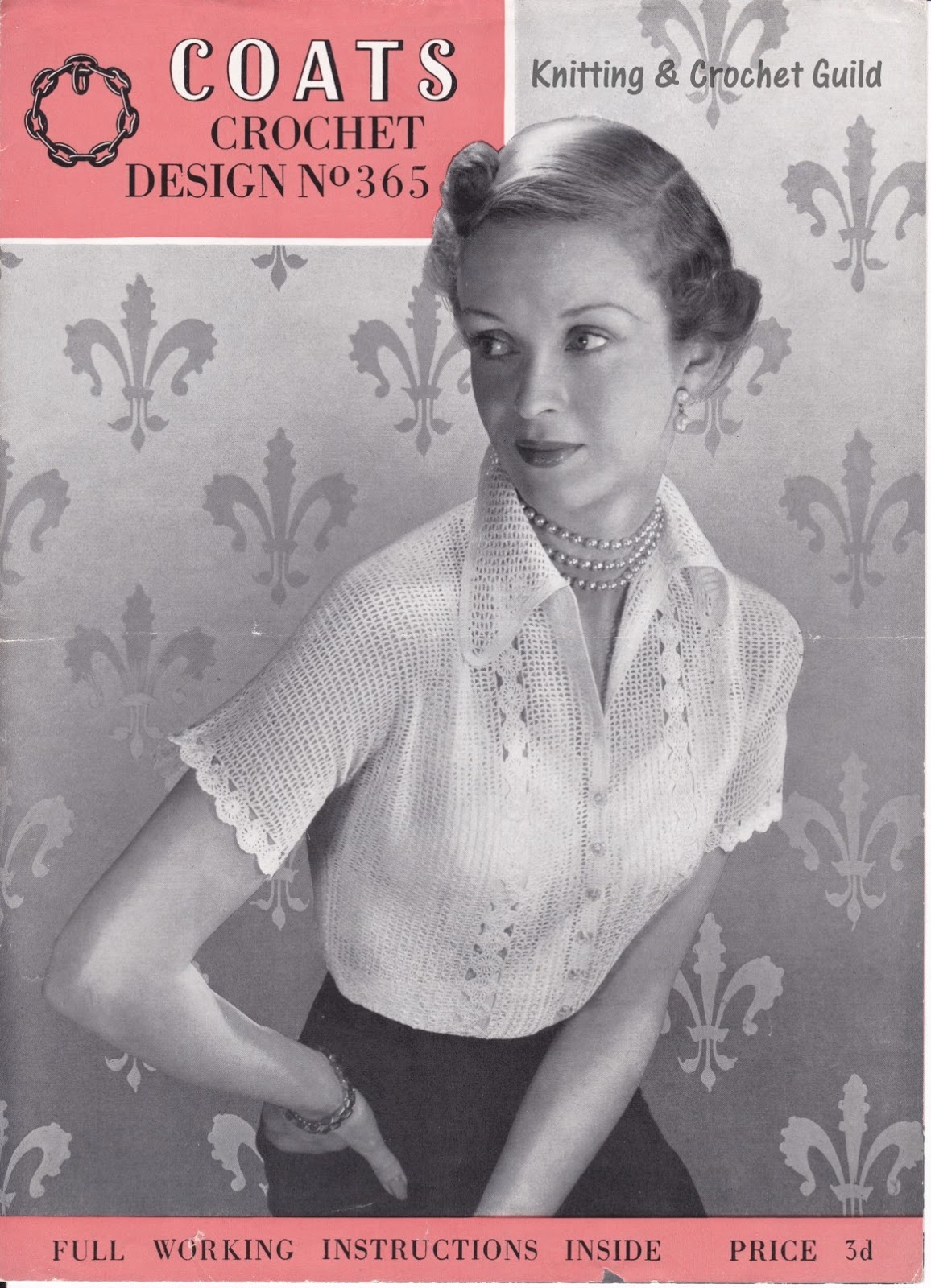
On Saturday afternoon, after the trunk show, we visited the current exhibition at the Fashion Museum, A History of Fashion in 100 Objects.  As well as showing the developments of fashions through time, the exhibition showed some wonderful garments. I was on the look-out, too, for  knitting and crochet, and there were three examples on show.  One was a white crochet blouse, made in the 1950s to a Coats pattern.


Coats 365

The model is Patricia Squires, looking even more elegant than she usually did.

The only knitting that I saw was a jumper in red, white and navy, that I also recognised - partly because it was knitted in the same colours as in the pattern.


SC11 Fair Isles for All
It's  a striking design, though a very long way from traditional Fair Isles.

Finally, there was a crocheted beach outfit from the late 1960s.


The label said that the original outfit had been shown in Nova magazine, and was copied from the photo for the woman who wore it (and eventually gave it to the museum) by a woman in Athens.  Hopefully, it was worn over a bikini top, though then the outfit might have been too hot for a Greek beach in summer. (See-through tops weren't new in the 1960s, in fact - as you can see from the Coats crochet blouse pattern.)

We had a very good short break in Somerset - but no more knitting or crochet was involved after the Fashion Museum, and I shan't report on all the not-knitting we did.  
Related Posts Plugin for WordPress, Blogger...