Showing posts with label crochet. Show all posts

Sunday, 23 February 2020

A Prize Winning Jumper

When we were in London two weeks ago, I spent a few hours in the British Library (one of my favourite places).  I had ordered some periodicals in advance, including Leach's Sixpenny Knitting series from 1923, partly to help with dating some issues of the Sixpenny Knitting Series that we have in the Knitting & Crochet Guild collection. Now I know that numbers 25 to 38 were published in 1923.  But, much more exciting, I also recognised a jumper shown on the front cover of number 38. 


The jumper on the right is clearly the original of a jumper in art silk (or rayon) that we have in the KCG collection.


What's more, it was "The Jumper That Won £100".  The pattern instructions inside give more information: 'This lovely model won the first prize in a recent competition. You can copy it for less than twenty four shillings!'   The competition was organised by the manufacturers of Celanese artificial silk (rayon).  In an earlier issue of the Sixpenny Knitting Series, there was an ad for the competition:
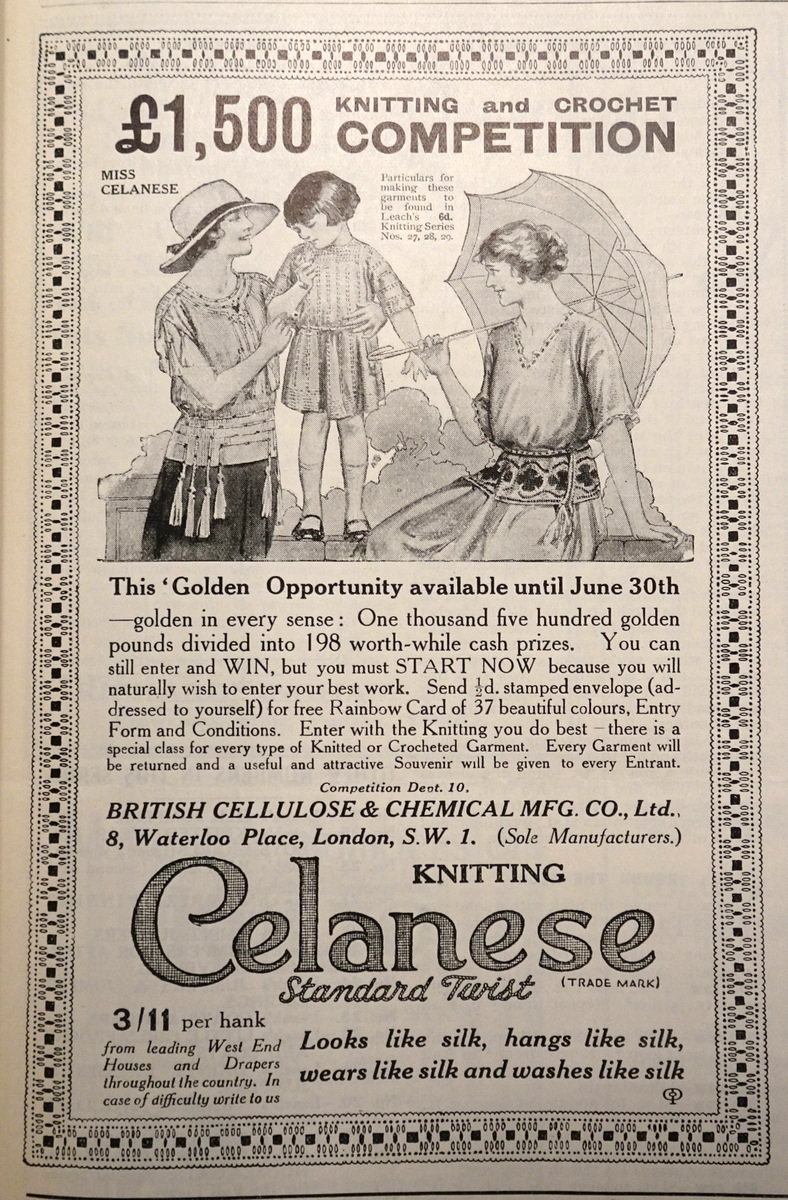

The ad shows three garments, with references to where the patterns could be found (in the Sixpenny Knitting Series, again).  So it appears that the entries to the competition were to be judged on the quality of the knitting and crochet, not the originality of the design.  But printing the pattern for a prize-winning jumper does suggest that the winner might have designed the jumper, as well as making it to a very high standard.  Either way, the prize of £100 is an astonishing amount of money, worth over £6000 now.  The total prize money on offer would be worth over £90,000, and the ad promises that "Every Garment will be returned, and a useful and attractive Souvenir will be given to every Entrant" - the costs of sending the garments back would also be borne by the company, I assume.  Of course, all entries had to be made in Celanese art silk, so the manufacturers must have been confident that the additional sales resulting from knitters wanting to enter the competition would be worth more than the prize money.

The ad for the competition doesn't give full details, but I did find an ad in the Falkirk Herald newspaper, for the Falkirk & District Co-op Stores, which told me a bit more.  (The competition obviously benefitted retailers, as well as the manufacturers of Celanese.)  They mention four classes, three with first prizes of £100, second prizes of £50, third prizes of £25, and 40 consolation prizes of £5. The fourth class had smaller prizes, though still very worthwhile.   Even the consolation prizes of £5 would be worth £300 each today.

I also found a piece in the Sevenoaks Chronicle in August 1923, announcing a local winner:
£50 KNITTING PRIZE
Mrs Shoveller, of Boxmoor, Weald View-road, Tonbridge, is to be congratulated on having won the first prize in Class "D" of the Celanese Knitting Competition, the results of which were published on Tuesday.  Mrs. Shoveller, who was most surprised at this unexpected good fortune, entered a set of baby clothing, comprising coat, bonnet and gloves.  These were made with the loop stitch, one of her own invention.  The value of the prize was £50, and considering the enormous number of entries, which came from all parts of the United Kingdom, it was undoubtedly a well-earned reward......   Miss Ethel M. Curtis, of the Royal School of Needlework, acted as the judge.
I guess that Class "D" was for a baby outfit, and it appears that Mrs. Shoveller designed her prize-winning outfit herself.

Back to the pattern.  Alongside the instructions are photographs of a model wearing the jumper, which give a much better idea of what it should look like.  (Thought the lighting wasn't very good for taking photos, I'm afraid.)


It is partly knitted, in stocking stitch, and partly crocheted.  It is a very simple construction, with no shaping at all: it's made in 11 rectangular pieces, 7 crocheted and 4 knitted, which are then sewn together.  One crocheted piece is the basque, which goes around the hips, below the belt.  Here's a diagram showing how the other pieces fit together, with the opening for the neck in the middle.


Once the 10 pieces are sewn together as shown, the result is folded in half, top to bottom, and the side seams are sewn up, and the sleeve seams, which are just 2 inch seams in the crochet strips at the sides. Then the basque is attached to the body.  The final steps are to crochet around the square neck and to make the tasseled belt.

The jumper is intended to be very loosely fitting: the circumference of the body of the jumper is 50 inches (127cm.).  The cover drawing and the photograph show the jumper with sleeves ending just above the elbow, but actually most of the 'sleeve' is a dropped shoulder.  The loose fit is not unusual for early 1920s jumpers, for instance, the 'Egyptian' jumper, which appeared in Woman's Weekly, also in 1923,  is 46 inches (117cm.) around the body.  (And it has a similar construction, being a rectangle of knitting, with a neck opening in the middle, and a rectangle for each sleeve.)

The basque of the prize jumper, however, is only 40in. (102cm.) around.  The instructions for joining it to a much wider body are: "Pleat the wide strips of knitting [at the sides] towards the side seams both at front and back (these pleats can be plainly seen in the illustrations) and gather the rest of the jumper edge. Then sew jumper and basque together, putting seam of basque to one of the side seams."  Evidently, the jumper was intended to fit someone much slimmer than the 50 inch bust measurement suggests. The 40 inch hip measurement has to allow for skirt, petticoat, etc., so the person inside would have had to be perhaps a modern UK size 8, or 10 at most.

Let's look at the jumper in the collection again.  Although I'm confident that the maker followed this pattern, she did not make it as loose, or as long, as intended. (I'm assuming a woman made it.) The central crocheted panel is narrower, the jumper is shorter from shoulder to waist, and the basque is not as deep.  A bigger change is in the side panels of stocking stitch; instead of having a rectangle which extends part way down the upper arm, she has made this piece much narrower in the body, and added on extra stitches to make a well-defined sleeve.  Consequently, the upper body and the basque have the same circumference - there is no need for pleats and gathers as described in the pattern.

We have no provenance for this jumper, so we have no idea why she made these changes.  We don't even know when the jumper was made, except that we now know it must have been in 1923 or later.  Maybe she made it several years later, when the fashionable silhouette was more close fitting.  Maybe she just didn't like very loose jumpers.  Or she might have been influenced by another photo, showing a back view of the jumper:


This appears to show the jumper with a proper sleeve - in fact, since it doesn't have a sleeve, I don't know how the photo could have been staged.  I think it's possible that our maker saw this photo and liked that shape, and then found that she had to modify the pattern to achieve it.  That's pure speculation, of course.  But I'm very pleased that I have found the pattern - and that the original jumper won a very large prize in a national competition.  I think our jumper inherits some of that glory.       

Friday, 31 January 2020

The Wristlet Crochet Ball Holder

The volunteers working on the Knitting & Crochet Guild Collection have selected 100 objects to show the range of the collection — including knitted and crocheted garments, books, pattern leaflets, gadgets, and many other things. Currently, the objects are being posted on social media (the Guild website, the KCG Facebook group here,  and on Instagram, user name @kcguild), one each day.  Today's 'object' (number 10) is a group of holders for knitting wool or crochet cotton, that hang from the wrist on a bracelet, including a crochet ball holder like the one in the photo below; here's some more information about it.

We have several in the collection of the same design, some in their original cardboard box, saying either 'The "Ownlee" Practical Crochet Ball Holder',  or 'The Wristlet Crochet Ball Holder' on the lid. The holders have a patent number (on the base of the flat circular disc) and some of the boxes, like the one on the photo, still contain printed booklets, so it's possible to find out quite a lot about their history.

The "Ownlee" Practical Crochet Ball Holder in its box, with booklet

In case it's not obvious, here's a drawing showing how it's to be used.


The idea was patented in 1912, by George Garratt Kent, who lived in East Finchley (London).  Crochet cotton, then as now, was sold ready wound into balls.  The crochet ball sits on the metal disk, with the bent wire going through centre of the ball.  The holder can swivel freely, hanging from the bangle.  An improvement, patented in 1913, that the disc is not rigidly fixed to the bent wire, but hinged.  George Garrett Kent was born in 1875, and in the 1901 census, he is listed as a wood engraver.  In 1911 and 1939 he is listed as a commercial clerk and then an estimating clerk, but with a mention of illustrating and engraving, so his occupation would have given him the practical skills to design the ball holder and make a prototype.

The crochet ball holder was sold through the Practical Novelty Company of Hatton Garden, London (centre of the UK's diamond trade, though I'm sure the Practical Novelty Company didn't deal in diamonds).  Someone in the company, I imagine, must have written the little booklet in the box, which tells a story of how the holder was invented:


The history of the “Practical" Crochet Ball Holders begins like a fairy tale, with "Once upon a time", but the "time" which this "once" was upon, was only a year or so ago, and this is not a fairy tale, but a true story. A man and his wife went to the seaside for a holiday. "Little drops of water, little grains of sand" got all mixed up with the lady's ball of crochet cotton because, like Humpty Dumpty, it "had a great fall" and rolled about on the beach. Along came Old Mother Hubbard's dog, which had "none" (meaning bones) and playfully attempted to carry the ball home to his empty cupboard. When a big "spider sat down beside her" and frightened the lady away, the man could stand it no longer. He dived into the recesses of his productive British brain, and Jack-Horner-like, pulled out a "plum" which was the original idea of the Practical Wristlet Crochet Ball Holders.
Naturally, the lady was pleased with the clever little contrivance which kept her ball just where she wanted it, and she showed it to her friends. So, like a snowball, which is formed with a handful of snow, and then set rolling down-hill, moving faster and growing bigger every moment, so the "Practical" Crochet Ball Holder started, gaining popularity every day, each sale resulting in the sale of many more, until it has become necessity to everyone who does crochet or knitting work, and is sold in nearly every country on the globe. 
Presumably, it was George Garratt Kent who was at the seaside with his wife, and inspired to invent the crochet ball holder. The booklet goes on to show two related gadgets that were patented jointly by George Garratt Kent and The Practical Novelty Company.


The "Practical Wool" Holder is the result of a demand for something to hold a ball of wool, as wound from the skein. The Table Stand is also an evolution, and appeals to ladies who prefer to keep their ball in place on the table, instead of on the wrist.

I don't think we have either of those in the KCG collection, which suggests that they weren't as successful as the Wristlet Crochet Ball Holder.  The booklet goes on to give prices for the Wristlet Crochet Ball Holder in various materials, from an Electro Plate Bangle with a Nickel Plated Base, at one shilling (5p) — 'quite good enough for ordinary use, at home or at the seaside or country, where one works a great deal out of doors, and the damp air is fatal to ornaments.'   The most expensive is either a Sterling Silver bangle with silver plated base, or Rolled Gold, both at 5 shillings (25p) — for 'those who wish to give a pretty present to those near and dear. Young men find them just the thing for the "dearest girl" and fond parents present one or the other to the young lady daughter who likes all the appointments of her work basket to be dainty and attractive.'   Finally, the booklet mentions the "Ownlee" crochet ball holder, shown in the photo above, which is the cheapest option, at 6½d  (about 3p).  I think that all the ones that we have in the collection are the cheaper ones.  (For comparison with prices of modern gadgets, 5 shillings in 1913 would be worth about £30 today.)

The gadgets were widely advertised in needlecraft magazines, with a warning to beware of inferior imitations.  But I don't think it was advertised after the First World War — a pity, because it's an ingenious idea which would still be useful now for anyone who uses crochet cotton.


Finally, we have a photo in the KCG collection which shows someone using a Wristlet Crochet Ball Holder, or something very like it.  It's a charming portrait.


Thursday, 31 October 2019

1919

I'm still catching up on writing about Shetland Wool Week, and this post is about the talk I gave at the Shetland Museum as part of the Wool Week programme.  My talk was on the Knitting & Crochet Guild, but mostly about the Guild's collection. I talked about a few selected pieces from the collection, and we had a display of the actual items at the front of the auditorium, so that the audience could have a close look, before and after the talk.

I picked some things that had a particular connection to Wool Week, including a few that originated in Shetland.  But this post is about one of the pieces on display that has nothing to do with Shetland, or wool, for that matter.  I chose it because it's relevant to 2019 - it was made exactly 100 years ago, in 1919.

Cloth with 'Peace 1919' filet crochet border 


It's a tea cloth with a filet crochet border, and a linen or cotton centre with drawn thread work.  There are doves with sprigs of olive in their beaks along the sides, and 'Peace 1919' in each corner.

We know that the First World War ended on November 11th 1918, but strictly speaking that was the day of the Armistice between the Allies and Germany.  Formally, the war ended with the Peace Treaty signed in 1919 - so that many war memorials in Britain give the dates of the war as 1914 to 1919. (The Shetland war memorial in Lerwick does, in fact.)

There were peace celebrations in the summer of 1919, and someone must have made the 'Peace 1919' tea cloth then, and perhaps used it at a celebration tea party. Before I went to Shetland, John and I set up a tea party setting, with the tea cloth, and a filet crochet tea cosy that was also made in 1919, with the slogan '1914 1919 Victorious Peace'.   You can also see a set of First World War medals on the table, that belonged to one of John's grandfathers.  The cloth only fits a very small table, as you can see, so it must have been an intimate, rather low-key tea party.


Here's a better view of the 'Victorious Peace' tea cosy:


I wrote about the tea cosy here, after I had found the pattern for its other side (which shows a very decorative, slightly Art Nouveau teapot) in a 1918 issue of Woman's Weekly magazine.

I hoped then to find the pattern for the 'Victorious Peace' side of the tea cosy in a 1919 issue of Woman's Weekly, and on a later visit to the British Library I looked through all the 1919 issues.  I didn't find the tea cosy, but I did find the pattern for the 'Peace 1919' table cloth, on the front cover of the April 19th issue.


The magazine gave instructions for a corner, and for one of the doves along the side of the border. So you could make your table cloth as large as you wanted, just by adding more doves.   For comparison, here are a corner and a dove from the edge of our tea cloth. 


And I did eventually find the pattern for the 'Victorious Peace' tea cosy - not in Woman's Weekly, but in another weekly magazine for women, Home Companion, in the August 2nd issue.


(Home Companion is long gone - it ceased publication in 1956 - but Woman's Weekly is flourishing, and still publishes knitting and crochet patterns. )

The Peace 1919 tea cloth is a really excellent piece of work.  The crochet is very even, and the border fits the centre cloth exactly.  I'm not sure how that was done: it would be very difficult to make the border to a precise size, I think, so perhaps the cloth was made afterwards.  Not sure. And though I know almost nothing about drawn thread work, I am very impressed by the quality of the work in the centre of the cloth.  Here's a corner of the drawn thread work, and a close-up of a detail - so painstaking, to weave the fine cotton around the threads to make something quite solid again.


Making the cloth must have taken many hours.  And I wonder how often it was actually used - perhaps a few times in 1919, but maybe not much after that?   It has survived in very good condition, which suggests that it might have spent most of the last hundred years in a drawer.  Now it commemorates not just the end of a dreadful war but the skill of its unknown maker, too.

PS Apologies for the quality of the photos. The cloth is actually quite white, even though it looks grey-ish in the photos.  Flash washes out the detail, and increasing the contrast after taking the photos looks artificial.  Ignore the grey, and just imagine that it's white. 

Monday, 29 July 2019

Crochet Gloves

On Saturday, I went to Lincoln with a suitcase of some of my favourite pieces from the Knitting & Crochet Guild collection, to show them to the local Guild branch. I shan't write about most of them here, though one that has already had a post to itself is the "Victorious Peace" tea cosy -
an obvious choice as it has the date 1919 worked into the filet crochet, so this is its centenary year.

I also took a few crocheted gloves, which I think are fascinating.  I don't ever want to wear a pair, but they represent the way that women once wanted to look.  Once upon a time, ladies were not properly dressed out of doors without a hat and gloves.  In winter, gloves had an additional function in keeping hands warm, but in summer, they had to be cool and preferably light coloured.  In the 1940s and 50s, patterns appeared for summer gloves crocheted in cotton. We have many of the patterns, and at least a dozen pairs of the gloves, in the collection. 

Here are two pairs I showed on Saturday: a white pair with a very open pattern of ovals on the back of the hand and the fingers, and around the cuffs. 


 And a pale blue pair with a pattern of trefoils around the cuffs, and crochet buttons to fasten them - I think these are delightful.


In a few cases, we have managed to match a pair of gloves to a pattern.  Here's a late 1940s Bestway pattern, and a pair of gloves to the same pattern.

Bestway 2014


My favourite patterns for these gloves show the ideal look that the gloves were intended to complement.  Coats leaflet 298 is an example - it shows a sketch of a lady in a sort of New Look outfit, wearing the gloves that you could make from the pattern.

Coats 298
 
Inside are further sketches of various ladylike activities which would be enhanced by the gloves - drinking champagne, smoking a cigarette (in a holder, of course),....  All with a smartly dressed (no doubt rich and handsome) escort.


And Coats Book No. 405, with several patterns for crochet gloves, sets out what a pair of crochet gloves would offer: "Paris or Penrith, country or town, feminine fancy dictates crochet gloves for summer chic.  The 'finger tip-top' smartness of fashionable gloves in crochet gives that groomed, well dressed, finish to spring suit or summer ensemble.  Elegance, daintiness, delicacy, youthfulness -- take your choice from these inexpensive 'made-to-treasure' gloves."

Coats Book No. 405

They would certainly be inexpensive to make (if you are skilled with a crochet hook, which I'm not).  They are totally impractical for everyday activities, but they could look very pretty with a floaty dress at a summer wedding.  (Again, not for me.) 

If you'd like to try making a pair, and you are a member of the Knitting & Crochet Guild, the Coats booklet is available to download from the Membership area of the Guild website. (And if you're not a member, you could join - membership is open to anyone.)

From Coats Book No. 405


Sunday, 16 September 2018

The Guild collection at In the Loop

I'm told that work is still in progress on the recordings of the talks at the In the Loop conference in July, so in the meantime, I will write a post based on my talk.

It was a short talk (20 minutes) on a huge collection, so I could only give an outline of what there is. Brief summary: knitted and crocheted items, tools and gadgets, yarn samples and shade cards, publications of all kinds (books, magazines, pattern leaflets and booklets).  Lots of everything.  At the conference, after outlining what's in the collection I talked about how we choose what to present in a trunk show - a suitcase full of selected highlights.  We have been doing trunk shows for a few years as a way of making the collection accessible to groups around the country - the first one was at Sheffield in 2014.  (I wrote about it here.)

When we choose a piece for a trunk show, we have to be able to say something interesting about it.  Ideally, we would like to be able to tell its story: who made it, when, what pattern did they use, who was it made for, and so on.  We no longer accept new donations of knitted or crocheted items unless they come with a story like this, but many of the items already in the collection have no story of that kind.

Sometimes, lack of a story doesn't matter - some of the pieces in the collection are such fine examples of craft that they speak for themselves.

Leaf-and-trellis pincushion cover 
Here is a Victorian pincushion cover that I have shown before on this blog, because it's an example of my favourite leaf and trellis pattern (aka print o' the wave) - I showed it here. Like many of the older items in the collection, it was bought at an antique textiles fair, and had no provenance.  We have no idea who made it and no way of finding out.  But it's a beautiful piece of work.  We don't know when it was made, but I'm sure it's Victorian.   It's possible that it was made to a specific pattern for a pincushion, in which case we might find the pattern one day, but the knitter might equally well have put together the leaf and trellis stitch pattern, and a pattern for a knitted edging (of which there were lots).   Either way, it's a very fine piece of work.

A theme of my talk was that we can sometimes identify the pattern that was used to make a piece, and that this can either provide a 'story' for it, or add to the story that we already have.  And the fact that the collection has so many publications alongside all the knitted and crocheted items helps us match pieces with patterns.

Occasionally, finding the pattern that was used to make an item casts some doubt on its story.  A piece that has often featured in a trunk show is a tea-cloth with a filet crochet edging, which has 'Welcome Home' worked into each side.


As the collection got more organised, it eventually turned out that there are three 'Welcome Home' tea-cloths, one of them with a detailed story.  It had been donated, along with a note of its history, by the daughter of the woman who made it.  The maker, Ethel Booth, was born in 1897, learnt to crochet at the age of 12, and made the tea-cloth for her father who was in the Army during the Boer War, "little knowing there would be the Great War".  That implied that the tea-cloth was made before the First World War (i.e. the Great War), but when I first saw it, before knowing this story, I was sure that it was a First World War design.  And in fact the story doesn't really hang together - the Boer War, or South African War, ended in 1902, before Ethel learnt to crochet.  And the First World War origin was confirmed when we found the pattern for the edging, in a magazine published in 1915.

Fancy Needlework Illustrated no. 33, March 1915.

 The design is called 'L'Entente', and was presumably intended to celebrate the alliance between Britain and France, shown by the British and French flags in the corners.  (Though I must say that filet crochet in white cotton is really not ideal for representing red, white and blue flags.)  The design was evidently a popular one, and I'm sure that the appeal was nothing to do with the alliance, but rather the 'Welcome Home' message.  Someone at home could make it in the hope that their father, brother, sweetheart,.... would come home from the war.

After we had identified the pattern for the 'Welcome Home' tea-cloth, we assumed that Ethel Booth's father had still been in the Army during the First World War, and she made it for him then.  But I've recently managed to trace Ethel Booth's family in census records and so on, and in fact her father had died by 1911.  So the story that she made it for her father is wrong, and I think that probably she made it for her future husband - they married in 1919.

All this happened before Ethel's daughter was born, and family stories often get slightly garbled in transmission, but she knew the final part of the story at first-hand, and I'm sure it's true: the last time the cloth was used was for Ethel's 90th birthday. 


Another item I talked about at In The Loop came with no story at all - it was bought from a charity shop.


It is a remarkably short crocheted dress.  When I first saw it, I mentally labelled it as a beach dress, on the grounds that a beach would be the only possible place to wear it.  But then we found the pattern:

Patons leaflet 6249

And it is not a beach dress at all.  The leaflets describes it thus: "Swingy little discotheque dress which longs to go dancing.  Prettily crocheted in a trendy yarn, with a short flirty skirt and a mini top."  (Did you know that 'disco' was originally short for 'discotheque'?  It's true.)

Because it’s a Patons pattern, and we have the Patons pattern leaflet archive in the collection, we have the master copy of this leaflet, that gives the original date of publication: October 1969.  The one I have shown is a later reissue from the early 1970s.


I'm not sure what you were supposed to wear underneath the dress.  The pattern calls for a pair of 'bra cups' to sew into the dress as a final stage in making up.  (Our dress doesn't have them.)  So you wouldn't need a separate bra.  But as the skirt is see-through (as well as very short) you would need underwear of some kind.  In fact, our dress is even shorter than the one shown in the leaflet - it has 5 fewer pattern repeats in the skirt.  Hopefully, the person who wore it was much shorter than the model.  Or else extremely daring.

Finding the published pattern to match our dress allows us to say a lot more about it than we could just from looking at it - we now have a story to go with it.  I finished my 'In the Loop' talk by showing a piece from the collection that is still in need of a story.


Like the pink disco dress, it was bought for the collection in a charity shop.  It is beautifully made in fine cotton.  But we don't know any more about it - it's difficult even to estimate when it was made.  If pushed, I would guess 1930s, but it seems too long for that date, or for the 1940s or 1950s.  And the work seems too fine for the 1960s or later.  It was very probably made to a published pattern and if so, we can hope to find the pattern one day - and then we will be able to give it an approximate date, and maybe say what it was intended for (a tennis shirt, I would guess).  So if you see a pattern for a shirt like this, please let us know - we would love to be able to include it in a trunk show and tell a story about it.

I'll say more about the Guild collection in future posts. 

Monday, 30 April 2018

Fascinating Crochet Hooks

I know that for most people, the words "fascinating" and "crochet hooks" don't naturally go together, but bear with me. Early crochet hook designs are very varied - the handle gives a lot of potential for decoration, and there are some ingenious methods of combining two (or more) hooks with only one handle, and ways to protect the ends of very fine hooks.  I am not a crocheter, except very occasionally, and I'm especially not a crocheter with the size of hook that you can barely see, used with thread no thicker than sewing thread. But even so, I do find many of the crochet hooks in the Knitting & Crochet Guild collection fascinating.

And last week, at our usual Thursday morning knitting session, a friend brought several things to give to the collection, including these 15 crochet hooks.  In case you think they look interesting too, I've written about some of them below.


Many of these hooks are late 19th or early 20th century - I've been looking at Nancy Nehring's website here, which gives a lot of information on the history of crochet hooks.

First is a 19th century hook (rather rusty, as early steel hooks are liable to be).  It has a patent number (4439) on the sheath.  I can't trace the patent, though Nancy Nehring dates it to 1888.  I imagine that the patent was for the idea of including a tubular sheath (top) that can fit over the hook to protect it, when it is not being used, and otherwise can fit over the other end to form a handle.


Another early hook also has a tubular sheath - brass in this case.  There are two hooks of different sizes, and the sheath can fit over either to form a handle.  Nehring attributes this hook to John Shrimpton and Son (here).


In the next one, the hook is attached to a flower-shaped slider so that it can be retracted into the handle.  (But there is nothing to hold the slider in place, when the hook is in use, so this may not have been a very successful design in practice.)


The next, with a handle made from a loop of wire, is hook by another Shrimpton, Z Shrimpton & Co.  It has two hooks of different sizes, that can pivot in the middle.  The brass slider can be moved (to the left, in the photo) to hold the hook that's not being used within the handle.


And here are two later hooks - the design was patented in 1911.  They look identical, but one is called the "Evelyne" and the other the "Eclipse".  They are like a flattened version of the first hook I described - there is a sheath that either fits over the hook (top), or can form a handle (bottom).  By this time, the idea of having a flattened grip had been introduced, and very quickly seems to have become almost universal for metal crochet hooks.


There are three hooks in the donation that aren't steel.   Two are bone, and the same design. One of them is marked 'Bates' - an American company that still makes crochet hooks.  I think the different coloured ends are to show at a glance the size of the hook (at least once you know that dark blue means size 1 and light blue means size 5).


And finally, I think that the hook below might be ivory.  It is a very uniform colour, whereas bone tends to develop brown marks with age, and it feels much smoother and denser than the bone hooks.


Altogether, it's a diverse and fascinating collection, just by itself.  Thanks very much, Debbie.

Monday, 27 November 2017

Spending a Day in 1918

When we were in London a week ago, for the Knitting History Forum, I spent a happy day at the British Library, looking at magazines from 1918. I was gathering material for my blog about the First World War, One Hundred Years Ago. It's been through a very thin patch since I broke my wrists last year, and I almost decided not to add any more posts, but then I thought that I should at least post the material I had already collected, and now I'm planning to revive it and keep it going. The war won't last much longer, after all.  (I'm sure that's what people hoped in 1917, too.)

So I ordered Woman's Weekly, Home Chat and Home Notes for 1918.  They were all weekly magazines for women, and all survived until the 1950s - Woman's Weekly is still with us, of course.  Woman's Weekly was a good read (though of course I didn't have time to properly read very much of it).  There was lots of interesting material about how to train for some of the new job opportunities available to women.  Mary Marryat, who still nominally wrote the advice column in the 1950s (but I'm sure wasn't the same woman - if indeed she ever existed) was issuing good advice to young women getting into relationships with men in the armed forces.  (Some of it extremely practical - e.g. you can tell from his pay-book if he's already married.)  And Cecile, who I think also survived as the Woman's Weekly cookery writer until the 1950s, provided recipes and meal plans for the meagre rations.

And as I was looking through the issues of the magazine, week by week, I saw a pattern I recognised.

Woman's Weekly magazine, 23rd March 1918

The 23rd March issue has an illustration of a tea cosy on the cover - and I recognised it, because there is a tea cosy made to the same pattern in the Knitting & Crochet Guild collection.   (Strictly speaking, it's a tea cosy cover, not a tea cosy -  it wouldn't do anything to keep a pot of tea warm by itself.)


The cosy in the collection is identical to the Woman's Weekly illustration, except that our example has a decorative frill around the edge - but the pattern just says that when you have made the two halves of the cosy, you should finish off "with any little edging round the top".

I probably wouldn't recognise all the filet crochet tea cosies in the collection, but I know this one, because of its other side.  I'm sure that the designer intended that both sides of the cosy should be the same, but the maker of ours used different designs.  The other side has a "VICTORIOUS PEACE 1914-1919" design, and it's very familiar because I show an illustration of it in my talk on knitting & crochet in World War I.


It was surprising and exciting to recognise an image from 1918 so unexpectedly.  Next time I visit the British Library, I'll look through Woman's Weekly for 1919, to see if our maker found the 'Victorious Peace' design there too. 

I'm afraid that Home Chat and Home Notes were nowhere near as interesting as Woman's Weekly - Home Notes in particular was very dull.  Clearly, enough readers went on buying them to keep them both going for another 40 years, but personally I'd have bought Woman's Weekly instead.
Related Posts Plugin for WordPress, Blogger...