Showing posts with label Fancy Needlework Illustrated. Show all posts

Sunday, 10 March 2019

Fair Isle in Cotton

I have written a few posts about Fancy Needlework Illustrated, and an article in Piecework magazine that I wrote about here.  It's one of my favourite magazines in the Knitting & Crochet Guild collection, even though it emphasised crochet and embroidery at the expense of knitting.  It was associated with a consortium of cotton spinners, so everything in the magazine is about making things with cotton. It never published patterns for woolly jumpers, for instance (until Weldon's took over the magazine in 1937).  So when Fair Isle knits became popular in the 1920s, they didn't appear in Fancy Needlework Illustrated.  But I have seen the cover of issue 132 (below) many times while working on the collection, and the disembodied cardigan is clearly done in stranded knitting.   Inside, it is described as a Fair Isle design, though it is of course knitted in cotton.  I posted it on Instagram (tagged #fairislefriday) and decided to share it here too, where I can go into more detail.

Fancy Needlework Illustrated, No.132, March 1936
The cover illustration of the cardigan shows the colours listed in the instructions - Dark Jade, Black, Ecru and Dark Tango (red, presumably).  The intro to the pattern says: "This lovely cardigan has been designed on the same lines as the well known and much admired Fair Isle Jumpers, which our Scotch friends are so expert at making.  In this case, however, the design has been very much simplified so that the most timid worker need not be afraid to attempt it.  Worked in bright colours of Ardern's Florentine Twist, it will answer many purposes — for skating, golf, etc."  (Ardern's was a cotton spinning company in Hazel Grove near Stockport.)   It doesn't look very much like a traditional Fair Isle, but it's very attractive.  The large buttons and the belt are the most obvious elements of 1930s style, I think, and it would be easier to wear today than most 1930s styles, because of its length - most sweaters of that era stop at the waist.  (Though it's only a size 32 in. (81cm.) so the pattern would have to be adapted to larger sizes these days.)


The other disembodied garment shown on the front cover is an embroidered gardening smock - completely impractical, unless you're picking flowers, or perhaps deadheading roses.  Nothing more strenuous than that.  As the cover suggests, there is rather a lot of embroidery in this issue.  Too much for me, certainly - I'm not a fan of embroidery if I'm expected to do it myself.

But there are more knitted and crocheted garments inside, including a nice knitted jumper with a buttoned front and a little collar.  It takes only 300g. of Ardern's Star Sylko size 5 (a mercerised cotton thread) - but then it only fits a size 34 in. bust (86cm.) and is only 17 in, (34cm.) long. 


There's also a pattern for a crocheted collar and cuff set with a matching powder puff case.  "This collar and cuff set with be found invaluable for the business girl.  It will add a bright spot of colour to her smart business frock, and as it is made of Ardern's crochet cotton there will not be any accidents in the wash."  The colours suggested are Spring Green, Amber, Heliotrope and Sapphire, which would certainly be bright.  (I didn't know what colour Heliotrope is, but according to Wikipedia it's pink-purple.)  The stitches used are Rice Stitch and Solomon's Knots, which doesn't mean anything to me, but probably will to a crocheter.


Finally, there is a pattern for "Foundation Garments in Crochet" - a "well-fitting set of suspender belt and brassière", also in Ardern's Star Sylko size 5.  To call it well-fitting is wishful thinking - the fit of the bra is entirely due to lengths of elastic, sewn to the bra to crossover at the back.  The crocheted part would only fit someone small enough not to need to wear a bra at all, it seems to me.  As for the suspender belt, the less said the better.


Wednesday, 17 October 2018

Fancy Needlework Illustrated in Piecework

Yesterday, a packet arrived through the post with three copies of the current (Winter 2018) issue of Piecework magazine.  If you don't know it, Piecework is an American magazine, published by Interweave, that covers the history of needlecrafts.

Piecework, Winter 2018

I was sent the copies because I have an article in this issue.  Earlier this year there was a call for articles on needlecraft magazines, so I decided to write about Fancy Needlework Illustrated.  It is one of the magazines in the collection of the Knitting & Crochet Guild, and a favourite of mine (I have written posts about it several times, e.g. here).  I especially like the covers of the 1920s issues which have charming colour illustrations.

Fancy Needlework Illustrated, September 1927


As well as the magazines themselves, we have several pieces of filet crochet in the Guild collection that were made to FNI designs, so there was plenty to write about.  I have written a few times in this blog about the "Welcome Home" tea-cloth pattern appeared in 1915 - evidently a design that appealed strongly to women left at home when their men joined the armed forces.  We also have several examples of the "Dresden" tea-cloth, a very popular design from FNI that is featured in the article - and appearing here in an ad for Ardern's Crochet Cotton that shows a guest at afternoon tea admiring her hostess's handiwork:


There is also a project to accompany the article, to knit a very pretty 'Tea Rose Scarf', designed by Katrina King.

I sent photos of several pretty jumper designs from 1920s issues of Fancy Needlework Illustrated as possible sources for projects, and this is the one that inspired Katrina:

The "Tennis" Knitted Jumper

I think the jumper itself is pretty, if a bit shapeless.  In the usual 1920s knitted jumper style, the sleeves are made in one piece with the front and back.  Often in 1920s patterns the whole jumper is knitted in one piece, but in this case because the lace pattern has a definite direction, the back and front are knitted separately in two T shapes, finishing with several rows of moss stitch (to match the panels of moss stitch between the rose leaf panels).  Then the moss stitch edges are grafted together on the shoulders.   Katrina's scarf also has a graft in the middle, for the same reason - so that the lace pattern is going in the same direction at both ends of the scarf.  All the designs in Fancy Needlework Illustrated are for cotton yarns, as I explain in the article, and the tea rose scarf is also knitted in cotton, so it represents the magazine very well. 

There are some fascinating articles elsewhere in the issue, including several others on needlecraft magazines. or on novels featuring needlecrafts (including a knitted fichu inspired by illustrations to Louisa M. Alcott's Little Women).  Another knitting project that I like very much is a pair of lace fingerless mitts in cotton, based on traditional Russian festival costume.  (Do I have a suitable festival coming up where I could wear white cotton lacy mitts?)  I'm proud of my article and very pleased that the issue is full of other interesting content too. 

Monday, 16 October 2017

Dating Fancy Needlework Illustrated


Over 150 numbers of the Fancy Needlework Illustrated magazine were published before the Second World War.  The Knitting & Crochet Guild collection has about 75% of them, including the very first number (though it's a bit tatty).

Fancy Needlework Illustrated no. 1

I've been assigning a date to each number - they don't have publication dates on them, but fortunately there is enough other evidence to work out when they were published. (And if you want to get straight to the dates, there's a table at the bottom of this post.)

One helpful clue is that the magazine ran regular needlework competitions, and many of our copies still have an entry coupon inside.  The closing date for entries to the competition gives a rough idea of when the coupon (and so the magazine) was printed.  That was all the information I had for a long time.  But then I noticed that the early numbers have a "To Our Readers" introductory piece that sometimes said when the next number would be published.   (Yes, I do occasionally read some of the publications in the collection, as well as sorting and listing them.)

From these introductions, I found that no. 3 was published on  February 1st 1907 and no. 5 on February 1st 1908.  I don't know definitely when numbers 1 and 2 were published, but I guess that they both appeared in 1906.

From June 1908, the magazine was published quarterly, on February March 1st, June 1st, September 1st and December 1st.   It seems that the first few numbers were published less frequently, to test the market, but they must have sold well enough to commit to publishing more often. 

Although the first number listed knitting as one of the crafts covered by Fancy Needlework Illustrated, the early numbers focus mainly on embroidery and crochet, with very little knitting. But fashions were changing, with sports coats for women becoming popular around 1910.  Fancy Needlework Illustrated followed the trend, and showed a sports coat on the cover of number 24 in December 1912.
Fancy Needlework lllustrated no. 24
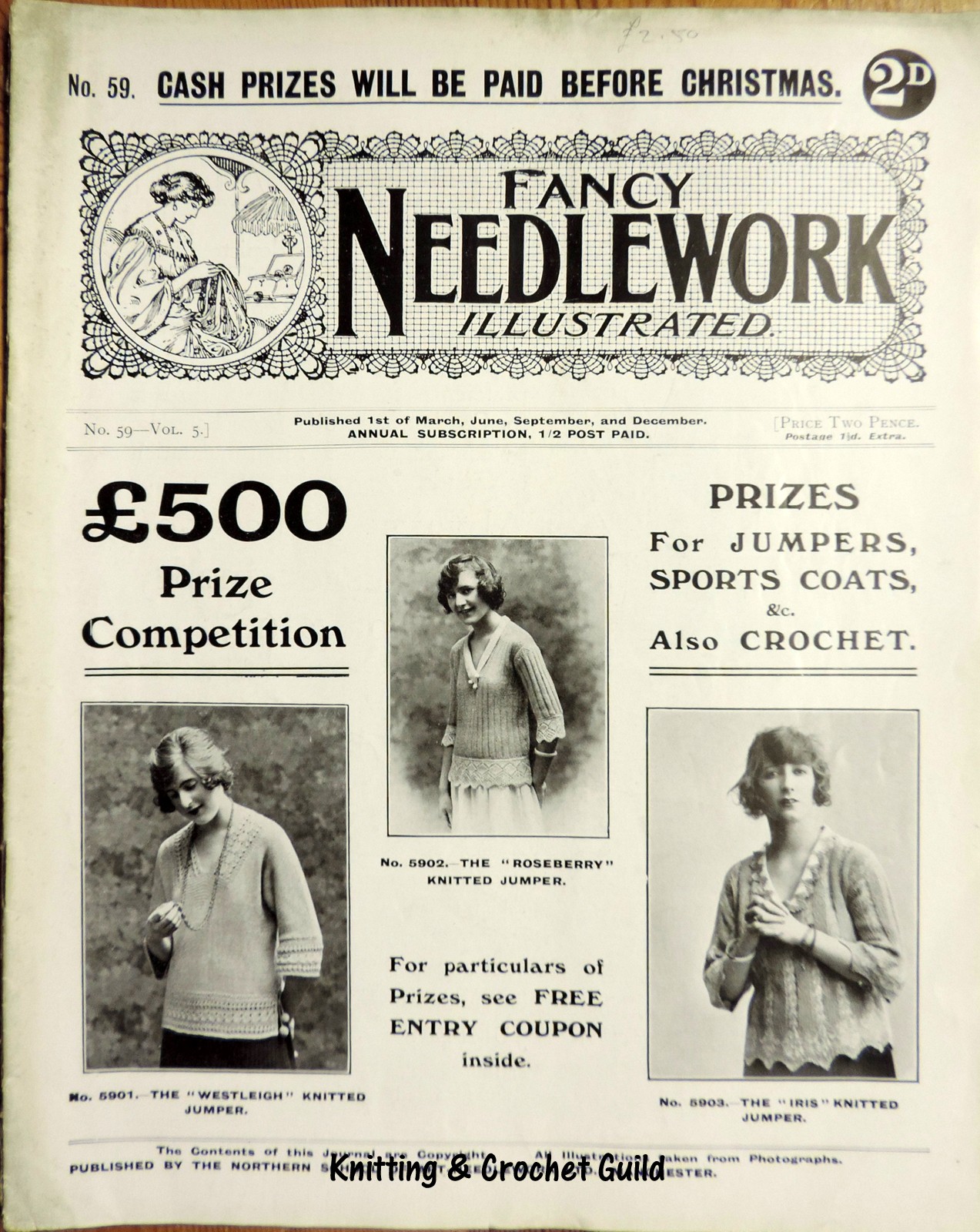
In the 1920s, jumpers for women became very fashionable, and the covers of the magazine often showed several jumper designs, like number 59, published in September 1921.

Fancy Needlework Illustrated no. 59
One of the cover jumpers from no. 59 appeared in a newspaper ad the following month (so confirming the date).  The ad promoted the competition run by the magazine: "Every needlewoman in the country should put her skill to the test by entering for this Great Competition. It is open to all, and has appeal for those practically minded as well as for those of more artistic ideas. For your Jumper, or for your Embroidery, you may receive a prize of £20."  The ad was apparently placed by Ardern's, a cotton spinning company that seems to have been one of the backers of Fancy Needlework Illustrated.


In 1923, colour was introduced for the cover of the magazine.  The first colour number was either 65 (which we don't have) or 66.


The colour covers are very attractive - they show an idealised view of some of the designs featured inside. The patterns themselves are illustrated with black-and-white photographs, so the models are real women and not the attenuated creatures on the cover.  (As with the Bexhill jumper from no. 75.)

From 1929, the magazine was published 6 times a year, in January, March, May, July, September and November.  The new dates in fact began with no. 88, which was published on 1st November 1928, rather than 1st December. 

In the 1930s, the magazine focused much more on embroidery, with little crochet and less knitting, so the contents are less interesting for the Guild, and quite a few of the numbers are missing from the collection.  No. 134 (from July 1936) is unusual for that period in having knitted and crocheted garments pictured on the cover, below.  Fancy Needlework Illustrated was still backed by cotton spinning companies, and so the 1930s fashion for knitted woollies was passing it by.  No. 134 is headed "Smart Designs for Knitted & Crocheted Summer Garments" - clearly cotton is more suited to summer than winter clothes.


Fancy Needlework Illustrated No. 134

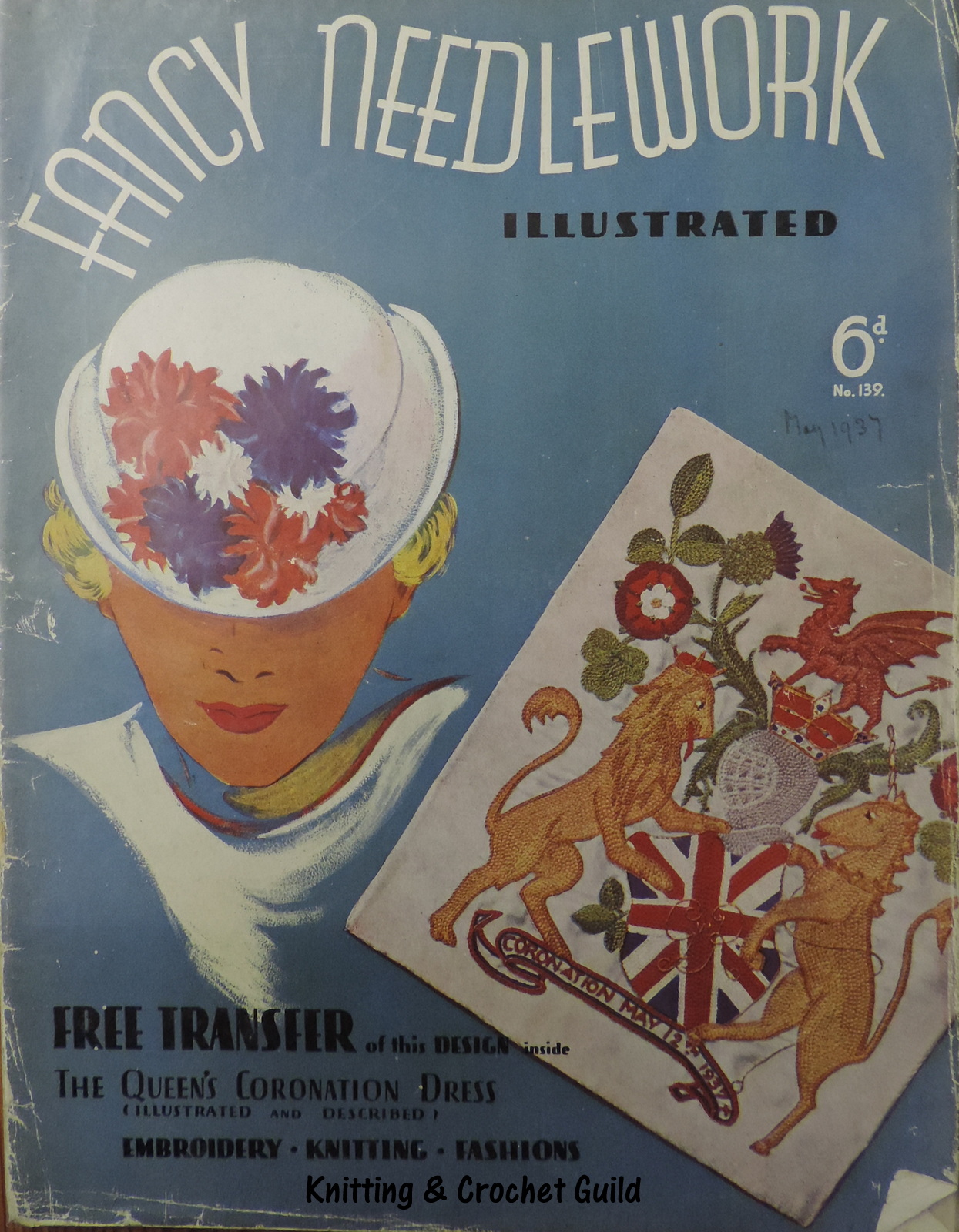
The restriction to cotton changed shortly afterwards when Weldon's took over the magazine.  They changed the design of the cover and started to include designs for other fibres, particularly wool.  No. 139 (below) is a Weldon's number, published in May 1937 at the time of George VI's coronation.

Fancy Needlework Illustrated no. 139

After the end of 1939, the title of the magazine changed to Needlework Illustrated. Numbers continued to appear 6 times a year, and the numbering continued too: no. 154 of Fancy Needlework Illustrated appeared in November 1939, and no. 155 of Needlework Illustrated in January 1940.  I've found another blogger who has dated the issues of Needlework Illustrated here, so I don't need to do that.

So now, if you have a copy of Fancy Needlework Illustrated, you can date it exactly - except for numbers 1, 2 and 4 where I'm sure of the year of publication but not the month.  The table below lists the numbers published in each year.  You're welcome.

1906
1,2

1923
65-68
1907
3,4
1924
69-72
1908
5-8
1925
73-76
1909
9-12
1926
77-80
1910
13-16
1927
81-84
1911
17-20
1928
85-88
1912
21-24
1929
89-94
1913
25-28
1930
95-100
1914
29-32
1931
101-106
1915
33-36
1932
107-112
1916
37-40
1933
113-118
1917
41-44
1934
119-124
1918
45-48
1935
125-130
1919
49-52
1936
131-136
1920
53-56
1937
137-142
1921
57-60
1938
143-148
1922
61-64
1939
149-154

Monday, 9 October 2017

The Bexhill Jumper

I have been working on dating issues of Fancy Needlework Illustrated magazine, which was published from about 1906 until the Second World War.  We have copies of most numbers in the Knitting & Crochet Guild collection, and it would be useful to know when each one was published - information that you might have thought that the publishers would have provided.  But they didn't.  Even so, I have managed to find enough evidence to date almost all of them - a post on  that will follow shortly.

One of the quirks of Fancy Needlework Illustrated is that many of the jumper designs in the 1920s numbers are named after British towns - like the Bexhill jumper, on the cover of no. 75, published in September 1925.  (The Bexhill jumper is the one worn by the lady on the right, sitting under the tree).

1920s vintage magazine
Fancy Needlework Illustrated No. 75

As far as I can see, the names were assigned at random - there's nothing about the Bexhill jumper, for instance, that suggests a seaside town on the south coast.  But a columnist on the local newspaper, the Bexhill-on-Sea Observer, felt that the design somehow represented the town and that the women of Bexhill might want to make the jumper for themselves:
 A compliment, which is also an advertisement, and is all the more welcome because it is unsolicited, has been paid Bexhill from an unexpected quarter. That is the naming of a new pattern for a ladies' jumper, in knitting and crochet, as the Bexhill jumper. It looks exceedingly nice as worn by a young lady whose photograph appears in "Fancy Needlework Illustrated," published by the Northern School of Art Needlework, Ltd., of Manchester. For the benefit of lady readers, who will naturally want to make Bexhill jumpers for themselves and lead the local fashion, I may state that the garment is made in light sky blue, and is composed of strips of knitting, joined together with crochet. A deep crochet belt completes the bottom, and the same pattern is worked for sleeve bands. ... For further instructions how to make the Bexhill jumper I must refer my knitting readers to Mrs. Harris, Western-road, who has kindly drawn my attention to this latest distinction that has been conferred on Bexhill.
The Bexhill jumper from Fancy Needlework Illustrated no. 75

It is rather pretty, combining lacy knitting with open-work crochet.  The loose fit, too, would make it  cool to wear on a hot day.

The Bexhill jumper is very similar in construction to the apricot rayon top I showed in my last post: the deep crochet band below a draw-string belt, alternating strips of knitting and crochet and a square neckline are the same in both.  And the other young woman on the front cover of no. 75 is also wearing a T-shaped jumper with square neck and a deep bands of crochet below the waist and around the sleeves.  This was a very common style for jumpers in rayon and cotton at the time.  Other styles were also popular in the 1920s, of course - "Fair Isle" jumpers, for instance,  But they didn't appear in  Fancy Needlework Illustrated, because it only published patterns suitable for cotton.  I'll discuss why later.

Sunday, 19 March 2017

Listening to the Wireless

I've cracked the dating of Weldon's Practical Needlework series (by relying on the dates given by Richard Rutt in his History of Hand Knitting - see here).   So now I'm looking at Fancy Needlework Illustrated - similarly undated,  so you have to work out the dates from other clues.

Vintage crochet cotton ad, 1920s
Ad from Fancy Needlework Illustrated  No. 73

And while doing that, I spotted this very charming ad for Ardern's crochet cotton, in an issue from 1925.  "Could there be any more delightful way to spend the evening hours than to make dainty crochet work while you listen in?"  Four pretty young women are sitting around a wireless set, with a huge trumpet, all busy with their crochet.  The British Broadcasting Company (forerunner of the BBC)  had been set up in 1922.  A BBC website says, 'The first broadcast came from London on 14 November [1922], and "listening-in" quickly became a popular pastime.'  So although the scene seems quaintly old-fashioned now, at the time it was exciting and new.

Two of the 'listeners in' seem to be working on handkerchiefs, making lacy edgings, and the other two are making strips of crochet lace, to go around a tablecloth or something similar.  Fancy Needlework Illustrated and other needlecraft magazines had been publishing patterns for this kind of fancy household crochet for decades.  And perhaps young women such as these did spend their leisure time making household linen for their 'bottom drawer', anticipating getting married.    But by 1925, the magazine was also publishing patterns for jumpers and dresses - knitted and/or crocheted.    The cover of the same issue illustrates the mix of patterns.

Vintage knitting & crochet magazine, 1920s
Fancy Needlework Illustrated  No. 73

The magazine gives patterns for the tops worn by the two women in the cover picture, and for the crocheted table cloth border that forms its frame.

And Ardern's themselves have another ad in the same issue promoting their Star Sylko yarn for making 'Beautiful Frocks'.

Vintage 1920s crochet cotton ad
Ad from Fancy Needlework Illustrated No. 73

Going back to the first ad:  I can't tell exactly what the four young women are making.  But I do recognise the pattern for the edging of the tablecloth that the wireless is sitting on.  It was called the 'Dresden' pattern (presumably for Dresden china - the design shows a tea service) and it was published in Fancy Needlework Illustrated No. 26 in (I think) 1913.  

Vintage knitting & crochet magazine, 1910s
Fancy Needlework Illustrated  No. 26
It's in filet crochet, which was very popular in the 1910s - it is easy to produce quite complicated pictorial designs in filet crochet.  (In the Dresden design, I like the corner motif of crossed teaspoons and a pair of sugar tongs.)

Dresden was evidently a very successful design - it was re-published in a later issue of the magazine, in 1920.  The cover says: 'This number contains a reprint of the "Dresden" crochet lace.  The most Popular Pattern ever published.'

Vintage knitting & crochet magazine, 1920s
Fancy Needlework Illustrated  No. 52
  And you could have a matching tea cosy.


Vintage crochet design, 1910s
'Dresden' Tea Cosy Design
I think we have a 'Dresden' tablecloth in the Guild collection - there must certainly be many survivors.   It's nice to imagine some of the filet crochet in the collection in a 1920s setting like the one in the ad.

More on dating Fancy Needlework Illustrated in a later post.

Wednesday, 25 September 2013

"Welcome Home" Pattern

I wrote last December here about some pieces of filet crochet in the Knitting & Crochet Guild's collection that date from World War I.  One of the items is a small tablecloth with a filet crochet border:  the border has a design of battleships, anchors with crossed French and U.K. flags in the corners, and "Welcome Home" along each side.  It was clear that there must have been a published pattern for the filet crochet border, because there are actually two almost identical tablecloths in the collection. There is another example of the crocheted border, though it was never used,  on the Australian War Memorial site. So I have been hoping to find the pattern one day, and this week it happened.  I was looking through a box of Fancy Needlework Illustrated, a quarterly magazine, and there was the design for the border on the front cover of one of them. 

Fancy Needlework Illustrated No. 33
 The border design of our tablecloths is called "L'Entente" lace, and has an accompanying triangle saying "UNITED" - neither of our tablecloths has the triangle, but I have seen a tablecloth with both border and triangle on eBay. 

This issue was published in 1915, it appears.  (There is no date of publication given in the magazine, but there is often a competition entry form, and you can roughly work it out from the competition closing date.)  I am surprised that it was so early - I had thought that the "Welcome Home" message would date from the end of the war.  The design is an odd mixture altogether - the French and U.K. flags, the "UNITED" slogan, and the name "L'Entente"  all seem to be celebrating the alliance with France.  But I suspect that for many people who made the border, it was the "Welcome Home" message that was more significant. 

 There is also a matching tea cosy design (possibly fewer of those were made, or fewer have survived, though one or two examples have appeared on eBay).  


Filet crochet was very popular at the time of the First World War, with several designs in every issue of magazines like Fancy Needlework Illustrated.  The patterns make depressing reading, I find, because it doesn't seem to have occurred to anyone that a chart would be the best way to convey the information.  Instead, you get pages and pages of tedious row by row instructions.  The tablecloth border takes 224 rows, and every one is something like:

       Hundred-and-seventy-second row: 11 spaces, 4 tr., 3 spaces 4 tr., 10 spaces.

(And that's a relatively simple row.)  So much counting!   I don't know how anyone had the patience to make any of these designs.  

I am very pleased that we have found the pattern for our two tablecloths, and so have another piece of their story.  One of the tablecloths has an accompanying letter saying that it was made for her father by a girl who was born in the 1890s, and it was used again at her own 90th birthday party.   We can imagine her reading the magazine as a teenager and slogging through the pages of instructions to make the tablecloth border.  If she recalled all that work, looking back at the age of 90, she must have thought that it had been worthwhile - the outcome was a memento that she kept and used over all the intervening years. 

Wednesday, 26 January 2011

Five 1920s Jumpers

As promised, I describe here the five jumpers from the 1920s Fancy Needlework Illustrated mentioned in the last post.

The "Hendon" knitted jumper with crocheted
shoulders and crochet sleeve trimmings.
The "Dieppe" crochet jumper.


They are all quite simple shapes, but use a mixture of stitch patterns, and both knitting and crochet in the same jumper, to give different textures.   The crocheted jumper, Dieppe, is pretty (though it looks fairly shapeless in the photo), but crochet isn't my area of expertise, so I'm not going to say any more about that one.

I like the Hendon jumper too. I am sure I have seen recent designs with a drawstring waist and different stitch patterns above and below it, so I think that it could be easily be adapted for today. The mixture of crochet and knitting is perhaps uncommon now, but I have seen it used in early Rowan magazines, for instance.

(The model's pose, in Hendon and Hurlingham, nonchalantly toying with a long necklace, seems very characteristic of the period. I have seen it before in knitting patterns from the 20s, I'm sure.)


The jumpers are put together from simple rectangular shapes, for the most part. The knitted part of Hendon consists of two T-shapes for the front and back, except for neck shaping. A basket-weave stitch is used below the waist, and a lacy leaf pattern for the rest of the knitted pieces. The sleeve edging and the shoulder insert are crocheted separately before the whole thing is assembled.

The "Hurlingham" knitted jumper
with crochet edgings.
The other jumpers are not so appealing now, I think, but to me it is still interesting to see the jumpers that women were knitting, and the techniques they were using.

The Hurlingham jumper, in Peacock Green, is mostly moss stitch with a central panel back and front of stocking stitch (I think - some of the instructions are not legible). I think that the back, front and sleeves are knit in one piece.  There are 4 rows of single rib at the waist and then a peplum of moss stitch, with a scalloped edge (a nice idea). There is similar scalloped frill at each elbow. Finally, quite a deep crocheted edge is worked around the edge of the scallops, and a narrow edging around the neck. To finish it, two cords are made of crochet chains, and threaded through the jumper at the waist, and four crocheted balls stuffed with cotton wool are attached to the ends of the cords. The finished jumper looks a bit matronly to me, though perhaps that's just the model.


The "Leda" knitted jumper with crocheted trimming.


Leda is described as "very suitable for full figures".   It must have been a difficult time for women with "full figures" - Edwardian fashion was all about big bosoms and tiny waists, and then only 10 or 15 years later, the fashionable shape was very slim and straight. As with Hurlingham, the back, front and sleeves are knit in one piece, in moss stitch.  The waist band is knitted separately, sideways and in finer thread.   All the jumper patterns in the magazine use size 3 Star Sylko, except for this waist band which usesr size 5 and is knit on size 16 needles. If needle sizes are really the same as the current British sizes, size 16 is 1.625 mm. The waist band is only 30 stitches wide, but it must take a lot of rows (of garter stitch) on such tiny needles. The body of the jumper is sewn onto the waistband and gathered slightly to fit.

The "Cambridge" knitted jumper.
Finally, the Cambridge jumper is the only one that does not involve crochet. It is a much more close-fitting jumper too. The cuffs and hem (in Raspberry) are in rib, and the rest (in Lilac Grey) is in reverse stocking stitch with every 7th stitch in moss stitch. The back and front are worked separately, and as far as I can follow the instructions, short row shaping is used for the shoulders! (The instructions are legible, but very unclear.) And then there are detailed instructions for grafting the shoulders, though they would be hard to follow, I think, with no diagrams or photos. It appears to be what we now call Kitchener stitch. The sleeves are worked from the top down, with a straight top.

Apart from the usual seams, several of these jumpers also require various bits of trimming to be sewn on. Like many knitters I hate sewing up, so I am on the alert for any signs of excessive sewing, and there are lots here.  The Cambridge jumper has a separate edging, knit on 5 stitches in a pattern that I haven't figured out, that is knitted first and then sewn on to the neck, the bottom of the jumper, the cuffs and the ends of the belt.  The Hendon jumper, too, has an edging for the neck that is made first and then sewn on;  three strips of stocking stitch on three stitches are knitted and then plaited. All very fiddly. It is as though a plain cast-on or cast-off edge was unacceptable, and it had to be covered up with a crocheted edge or some sort of braid.

It is 90 years since the magazine was published, but reading through the instructions and following them mentally makes that period seem more accessible. The model for the Hendon and Cambridge jumpers looks a little bit like my Grandma (my father's mother) who had masses of curly auburn hair, in her prime. So I imagine her knitting and wearing one of these jumpers as a young woman.

Sunday, 23 January 2011

The One That Got Away

I wrote in a previous post about the early 20th century knitting and crochet magazines I had found following the burst pipe at the Knitting and Crochet Guild store, that I brought home. Most of them did dry out successfully, but the pages of one were stuck together across the bottom, and I could not find any way to separate them.  The paper is slightly glossy, and I think there is a coating that became sticky when it got wet.  In fact, when I was drying out magazines and patterns in the bathroom, there was a distinct smell of wallpaper paste in the air, so it's not surprising that some things got stuck together.


It is an issue of Fancy Needlework Illustrated that dates from the early 1920s.  There are patterns for several jumpers in it and one or two are really very pretty - they could be worn now without very much alteration, given the fashion for vintage clothes.  Fortunately the illustrations are all in the centre of a page, where the paper is not stuck, and enough of each pattern is readable to be able to understand how it works.  I will describe them in the next post, so that some of the information survives even though the magazine itself is not intact.

The magazine front cover says that it is published by the Northern School of Needlework Ltd., Manchester.  But all the patterns use Ardern's Star Sylko and it seems that it was published in association, somehow, with Ardern's (just as Patons and Baldwins  published Stitchcraft).  I have seen a 1930s advert for Star Sylko that also advertises Fancy Needlework Illustrated, so there was evidently a close relationship.   Ardern's was a cotton spinning mill near Manchester that produced several types of cotton yarn, especially for crochet. Star Sylko was a mercerised yarn, produced in several thicknesses. The coarsest, size 3, is used  in most of the knitting patterns. 
   

The patterns in this and other issues of the magazine are a bit casual about specifying tension (or sizing, for that matter) but occasionally they do, and it seems that the size 3 thread gave 7 stitches to the inch on size 10 needles, or 6 stitches to the inch on size 9.  Are these the same as the current standard British size 9 and 10  (3.75 to 3.25 mm.), I wonder?  Anyway, I guess that size 3 is approximately equivalent to 4-ply (sport or fingering). That's not outrageously fine; I vaguely  imagined that women back then knitted in very fine yarn, but probably they were in just as much of a hurry to get their jumpers finished as I am.
Related Posts Plugin for WordPress, Blogger...