I have mentioned that the Knitting & Crochet Guild collection has moved to a new home - we have now been based in Slaithwaite for two months. You might like to see some photos of the village.
First, a photo of Britannia Mill, where the collection is now housed.
Like many other buildings in Slaithwaite, it is built from the local sandstone, and (as the name suggests) it was originally an industrial workplace.
Slaithwaite is in the Colne Valley, about 5 miles from Huddersfield. The River Colne runs from Marsden, at the head of the valley, and on to Huddersfield and eventually joins the River Calder. At Slaithwaite, it is not a very big river, only a few yards wide.
But in the distant past, it made a steep valley, and in the Industrial Revolution provided enough water power for mills to be established along the river. There are several huge mill buildings remaining, like the one in the centre of the photo above. Some have been converted to other uses, some are awaiting renovation, and a few are still used as mills. The most notable example in Slaithwaite, for knitters, is Spa Mills, the home of Stylecraft yarns and of Yarn Stories. Spa Mills, built in 1907, is the huge building in the centre of the photo below. (Notice the fine array of sheds in the foreground.) The centre of Slaithwaite, including Britannia Mill, is off to the left of the photo, which also shows houses high up on the side of the valley opposite. Historically, in this area, mills occupied the land in the valley bottoms, and the mill workers lived on the valley sides, which are often very steep.
A few yards away from the River Colne in the centre of Slaithwaite is the Huddersfield Narrow Canal - you can see how narrow it is in places from the photo below.
The canal runs from Huddersfield, up the Colne Valley to Marsden, where it goes under the summit of the Pennines by way of Standedge Tunnel, more than 3 miles (nearly 5 km.) long. The canal continues to Ashton-under-Lyne where it links with the rest of the canal network.
The canal was built to transport goods, of course, and several of the Slaithwaite mills were built next to it, but its use for commercial traffic declined until it closed in 1944. It was re-opened in 2001, and now it only sees leisure traffic.
Here's another view the canal, showing one of the canal locks, and Spa Mills in the background.
The re-opening of the canal has made a huge difference to Slaithwaite, I think. There are many independent shops and cafes in the centre, a favourite being the Handmade Bakery and Cafe - it's alongside the canal and sells delicious bread, baked on site.
It's an exciting place to work. I'm still exploring it - this week I found Spa Park, across the canal and river from Spa Mills. Slaithwaite did at one time have a mineral spring whose water was claimed to be good for you (presumably the spring still exists somewhere, in fact) and a spa based on the spring. The River Colne runs alongside Spa Park, looking very rural, although it is so close to the village centre. According to an information board in the park, kingfishers can be seen on the river near there. I hope that's true - I have never seen a kingfisher, so it would be thrilling to catch even a glimpse of one. I'll report back if I do.
PS I forgot to mention that Slaithwaite has a train station. The Colne Valley has been on several important cross-Pennine routes at various times, including the canal and the A62 Manchester-Leeds road (though that is now superseded by the M62). And the Manchester-Leeds railway line runs through Huddersfield, up the valley to Slaithwaite and Marsden. There are trains from Slaithwaite to Manchester and Leeds, and from there connections to the rest of the rail network. For most people, the collection is now more accessible than it was at our old site.
The railway line runs high above the centre of the village on a viaduct, visible in the first photo of Spa Mills. Here's a photo of a train on the line, well above the Colne Valley Leisure Centre below.
Mostly about knitting history. Sometimes about what I'm knitting. Sometimes about other things too.
Thursday, 25 April 2019
Monday, 22 April 2019
Woollen Stockings
I was looking through some Stitchcraft magazines in the Knitting & Crochet guild collection and came across this striking image of disembodied legs walking downstairs.
Very surreal. (The apparent tear in the bottom left corner is actually part of the image.)
Model legs like these are still used in shops selling tights and stockings (e.g. John Lewis) so the only question is how the legs were positioned like that. It is a very bizarre illustration for a knitting pattern though.
The legs appeared in the January 1941 issue of Stitchcraft, more than a year after the start of World War 2 as far as Britain was concerned. There were bombing raids against British cities every night that winter, though there is little mention of that in the magazine. But the bombing must have exacerbated fuel shortages (through damage to gas mains, for instance) so keeping warm must have been difficult. Hence Stitchcraft's pattern for knitted stockings.
The introduction to the the pattern says:
Back to the pattern. The stockings are knitted on two needles, except for the toe, which is knitted in the round and then grafted. The leg and top of the foot are knitted in one piece, with a seam up the back of the leg. The heel, sole and toe are in a different colour in the illustration and are knitted afterwards, with a seam along each side of the instep. The construction means that it would be easy to replace the foot part of the stocking when it wore out.
The diamonds on the legs of the grey stockings are knitted in a combination of intarsia and stranded knitting. The blue pair have embroidered clocks either side of the ankle.
There are several other knitting patterns in the magazine, including the jacket on the cover.
There are patterns for two "Service Woollies", a sleeveless pullover for a woman, and a polo-neck jumper for a man.
There are a few other 'civilian' knits too, including this pretty jumper in a openwork design.
Although Stitchcraft was a Patons & Baldwins magazine, so its main focus was on patterns using P&B wools, it had a cookery page at that time as well. And in January 1941, the cookery editor addressed air raids directly, giving recipes for fillings for sandwiches to take into the shelter:
There is an edited version of the magazine on the Knitting & Crochet Guild website (only the pages with the knitting patterns - if you'd like to try the liver and parsley sandwich filling, I'm afraid you'll be disappointed). Guild members can access it by going to Membership, then Pattern Downloads, then Stitchcraft Magazines and Booklets.
Very surreal. (The apparent tear in the bottom left corner is actually part of the image.)
Model legs like these are still used in shops selling tights and stockings (e.g. John Lewis) so the only question is how the legs were positioned like that. It is a very bizarre illustration for a knitting pattern though.
The legs appeared in the January 1941 issue of Stitchcraft, more than a year after the start of World War 2 as far as Britain was concerned. There were bombing raids against British cities every night that winter, though there is little mention of that in the magazine. But the bombing must have exacerbated fuel shortages (through damage to gas mains, for instance) so keeping warm must have been difficult. Hence Stitchcraft's pattern for knitted stockings.
The introduction to the the pattern says:
"Who would ever have thought that in the year 1941 we should be wearing good warm woollen stockings? Yet so it is, and what fun they are—as dotty and amusing as can be. Gather up all the bright odds and ends of wool you can lay hands on and set to work. By this time you will have had good practice at turning heels after knitting all those socks for the forces, so you should have no qualms about making a good job of these."This implies that before the war, women didn't wear woollen stockings. So what did they wear? There were silk stockings, but they were expensive and not very warm, I should think, so what did ordinary women for everyday wear in the winter?
Back to the pattern. The stockings are knitted on two needles, except for the toe, which is knitted in the round and then grafted. The leg and top of the foot are knitted in one piece, with a seam up the back of the leg. The heel, sole and toe are in a different colour in the illustration and are knitted afterwards, with a seam along each side of the instep. The construction means that it would be easy to replace the foot part of the stocking when it wore out.
The diamonds on the legs of the grey stockings are knitted in a combination of intarsia and stranded knitting. The blue pair have embroidered clocks either side of the ankle.
There are several other knitting patterns in the magazine, including the jacket on the cover.
![]() |
| Stitchcraft magazine, January 1941. |
There are patterns for two "Service Woollies", a sleeveless pullover for a woman, and a polo-neck jumper for a man.
![]() |
| Woman's WW2 Service Woollie |
![]() |
| Man's WW2 Service Woollie |
Although Stitchcraft was a Patons & Baldwins magazine, so its main focus was on patterns using P&B wools, it had a cookery page at that time as well. And in January 1941, the cookery editor addressed air raids directly, giving recipes for fillings for sandwiches to take into the shelter:
Air raids, unpleasant as they are, offer a good opportunity for an enterprising and valiant woman to show the stuff she is made of. For there is no doubt about it that a little light refreshment does help to pass the time while a raid is going on. Some people are spending a considerable time in shelters, and the packing of a provision basket may need a little thought. There is not only one's own family to be considered, for it is surprising how soon one gets to know people in a shelter, and the offer of a sandwich may prove to be the start of a pleasant friendship. Even in the lower regions of your own house, you will find yourself popular if you can produce something unexpected in the food line. Speaking for myself, I try to see that there is always soup ready in the larder, for this is a great restorative when one has gone through a time of strain. In our cellar we have a shelf on which I keep two small saucepans, a spirit stove, bottle of methylated spirit, matches, tin opener, cardboard plates, unbreakable cups, Oxo cubes, Ovaltine, and so on, and it is only a matter of moments to heat soup or milk. We find time goes much more quickly if we have a little meal to take our attention off the sound of planes or bombs. Another tin holds bars of chocolate, and every morning I make a thermos full of coffee, and this we drink, raid or no raid. So here are a few suggestions, some suitable for a picnic meal in an outside shelter, others for use in one's own house. Some good sandwich fillings to start with, as the useful sandwich certainly leads the way in popularity.It was a terrible time, we shouldn't forget.
There is an edited version of the magazine on the Knitting & Crochet Guild website (only the pages with the knitting patterns - if you'd like to try the liver and parsley sandwich filling, I'm afraid you'll be disappointed). Guild members can access it by going to Membership, then Pattern Downloads, then Stitchcraft Magazines and Booklets.
Labels:
1940s,
Stitchcraft,
vintage knitting patterns,
World War 2
Friday, 19 April 2019
A Fascinating Check
I haven't posted anything here for a while, so I'll try to catch up a bit in the next week or so. I have been busy over on Instagram, though, where I have been showing some of my favourite patterns from the Knitting & Crochet Guild collection. There's a lot of choice - over 50,000 pattern leaflets, not to mention booklets, magazines, etc. So I don't think I need to restrict myself to just one favourite or just a few - I can have lots, why not.
Yesterday's Instagram post showed a Copley's pattern from the 1930s.
![]() |
| Copley's leaflet 331 |
I wrote an earlier post about similar Copley's leaflets here - the designs are quite appealing, but what I really like is the fashion advice on the front of the leaflet from one of two "fashion advisers", Lady Georgiana Curzon and later the Countess of Chester. In leaflet 331, Lady Georgiana tells you why you should knit this cardigan:
COPLEY'S FASHION ADVISER says : "Our old and tried friend the cardigan .. how could we live without it ? On the golf course or the moors, in the car or on foot, smart women still cling to that classic style. It modifies slightly with fashion; it raises or lowers its vague indication of a waistline, it alters the number of its buttons, or its length. And it still remains the smartest and most comfortable sports woollie of all. Here is to-day's version; simple, subtle, in a stitch that gives a fascinating check and a Copley wool that will stand up to endless wear and washing. No matter what colour your skirt, you'll find the most perfect match or the smartest contrast among the superlative range of Copley colours."All of which still applies, though I suspect that even then golf was a minority interest for women - but it had the right upper class ring to it. And I think that when Lady Georgiana mentions the moors, she has in mind grouse shooting.
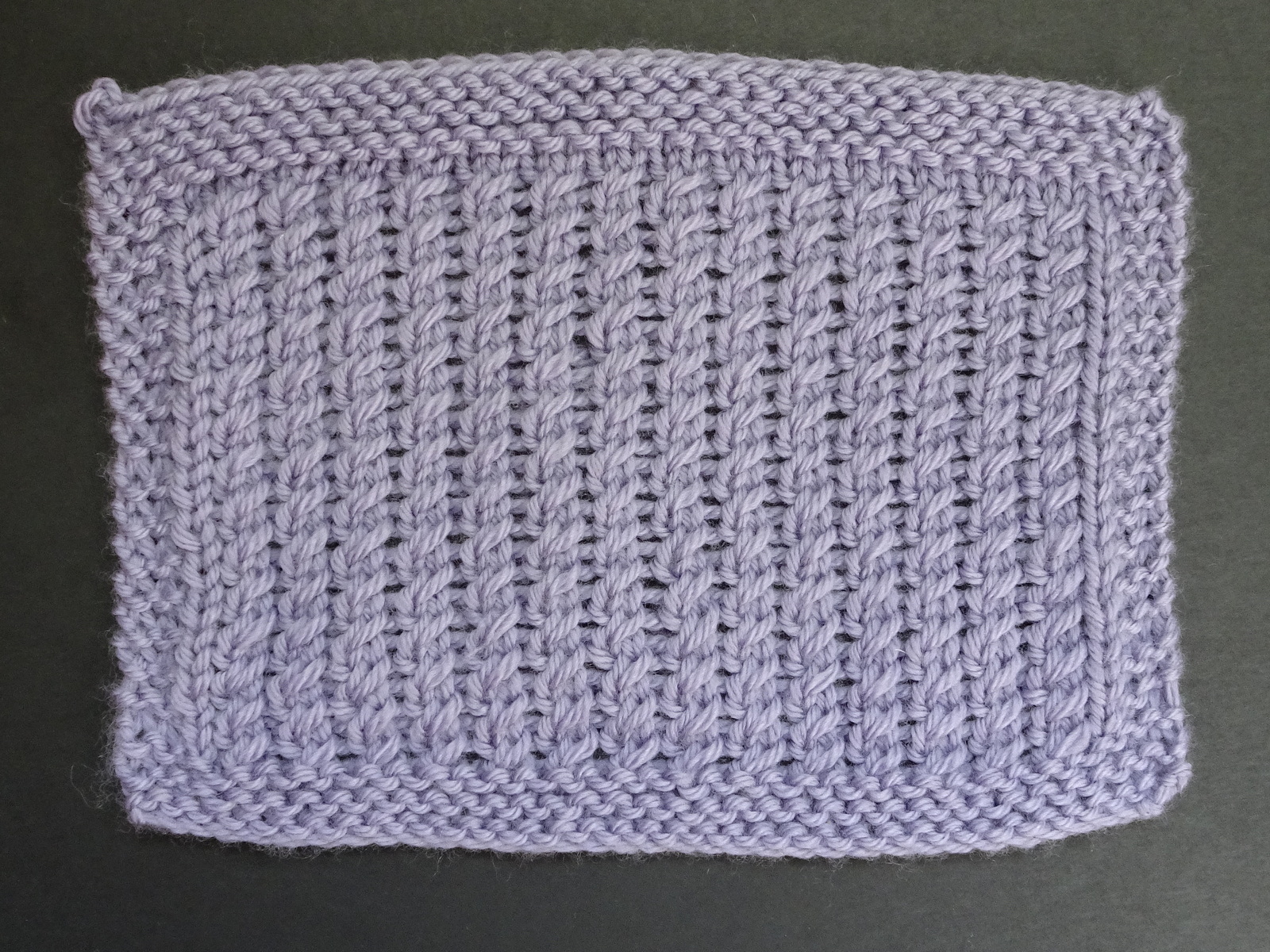
I was intrigued by her description of "a stitch that gives a fascinating check", because in the photo of the cardigan, it looks like some sort of rib. So I looked at the instructions, and it's not any sort of rib, or any stitch pattern I have met before. I knitted a swatch to see what it looks like:
Here are the instructions (not exactly as they appeared in the pattern - I've rewritten them in a way that makes more sense to me).
On an even number of stitches:
Row 1: K1, (yarn over, K2) to last stitch, yarn over, K1.
Row 2: P1, (drop the yarn over of the previous row, purl the 2nd stitch on the left needle but leave it on the needle, then purl the first stitch, drop both stitches off the needles together) to last 2 stitches, drop the yarn over of the previous row, P1.
So it's much more like stocking stitch than a rib. The yarn-overs make little ladders separating the columns of pairs of stitches twisted together.
I found it a bit tricky to knit, especially at first. The knit rows are easy, but purling the second stitch on the left needle was quite difficult, especially as I was knitting with my vintage Double Century needles which have rounded tips. I switched to a sharper KnitPro needle for the purl rows part way through, and that was much easier. I also found that I needed a lot of left-elbow room for that step, so it wouldn't be suitable knitting for a train journey. (I never need much right-elbow room when I'm knitting with straight needles, because I have the right needle tucked under my arm.)
I wouldn't describe it as a check pattern, but it gives a very nice effect. It's quite loose - for me, it's looser than stocking stitch, so you would have to be careful of gauge.
The swatch also gave me an opportunity to try out a ball of Yarn Stories 100% merino DK. It's a worsted-spun yarn, spun in Yorkshire (in fact, in Slaithwaite, where the Knitting & Crochet Guild collection is now based). So it's very smooth and gives great stitch definition, ideal for a swatch like this. And it feels gorgeously soft. I'll be planning a project to use it some time soon, I'm sure.
Labels:
1930s,
stitch patterns,
vintage knitting patterns,
Yorkshire
Sunday, 24 March 2019
A Cashmere Lace Scarf
I have just finished (well, actually a couple of weeks ago now) a beautiful scarf in Yarntelier Cashmere Lace.
I got the yarn from Louisa Harding's studio in the Byram Arcade in Huddersfield, along with the pattern. The design is Olena, and it makes a scarf so light and airy that one 50g. ball of yarn makes a good sized scarf (mine is about 135cm. x 25cm.).
Louisa intended the scarf to have beads in the lace for the first few pattern repeats at each end of the scarf:
But I'm not a beaded scarf sort of person, so I left those off. I also didn't do the picot cast on, though I did try it - I couldn't make it look neat, so just did a regular cast on.
The lace pattern is really beautiful. It's not one that I know, but could well supplant Print o' the Wave as my favourite lace stitch.
I did a lot of the knitting in public, i.e. in the various knitting groups that I go to, but that wasn't a very good idea. I made a few mistakes in the lace. the worst being near the beginning when I had to unravel about 15cm., which at that point was more than half of what I had already done. I did think about leaving it, because I thought that no-one else would see the mistake, which is probably true. But I am very glad that corrected it, because now it's perfect. I made a few more mistakes, but I made sure to check more often, so correcting them wasn't such a big deal.
Louisa promised that washing the finished knit, to get the spinning oil out, would make a huge difference - the cashmere would 'bloom'. And she was right - it felt quite soft while I was knitting it, but now it is delightful. Very soft, warm, and light, and the colour is gorgeous too - not quite solid, a lovely grey-blue. I love my scarf.
I got the yarn from Louisa Harding's studio in the Byram Arcade in Huddersfield, along with the pattern. The design is Olena, and it makes a scarf so light and airy that one 50g. ball of yarn makes a good sized scarf (mine is about 135cm. x 25cm.).
Louisa intended the scarf to have beads in the lace for the first few pattern repeats at each end of the scarf:
But I'm not a beaded scarf sort of person, so I left those off. I also didn't do the picot cast on, though I did try it - I couldn't make it look neat, so just did a regular cast on.
The lace pattern is really beautiful. It's not one that I know, but could well supplant Print o' the Wave as my favourite lace stitch.
I did a lot of the knitting in public, i.e. in the various knitting groups that I go to, but that wasn't a very good idea. I made a few mistakes in the lace. the worst being near the beginning when I had to unravel about 15cm., which at that point was more than half of what I had already done. I did think about leaving it, because I thought that no-one else would see the mistake, which is probably true. But I am very glad that corrected it, because now it's perfect. I made a few more mistakes, but I made sure to check more often, so correcting them wasn't such a big deal.
Louisa promised that washing the finished knit, to get the spinning oil out, would make a huge difference - the cashmere would 'bloom'. And she was right - it felt quite soft while I was knitting it, but now it is delightful. Very soft, warm, and light, and the colour is gorgeous too - not quite solid, a lovely grey-blue. I love my scarf.
Sunday, 10 March 2019
Fair Isle in Cotton
I have written a few posts about Fancy Needlework Illustrated, and an article in Piecework magazine that I wrote about here. It's one of my favourite magazines in the Knitting & Crochet Guild collection, even though it emphasised crochet and embroidery at the expense of knitting. It was associated with a consortium of cotton spinners, so everything in the magazine is about making things with cotton. It never published patterns for woolly jumpers, for instance (until Weldon's took over the magazine in 1937). So when Fair Isle knits became popular in the 1920s, they didn't appear in Fancy Needlework Illustrated. But I have seen the cover of issue 132 (below) many times while working on the collection, and the disembodied cardigan is clearly done in stranded knitting. Inside, it is described as a Fair Isle design, though it is of course knitted in cotton. I posted it on Instagram (tagged #fairislefriday) and decided to share it here too, where I can go into more detail.
The cover illustration of the cardigan shows the colours listed in the instructions - Dark Jade, Black, Ecru and Dark Tango (red, presumably). The intro to the pattern says: "This lovely cardigan has been designed on the same lines as the well known and much admired Fair Isle Jumpers, which our Scotch friends are so expert at making. In this case, however, the design has been very much simplified so that the most timid worker need not be afraid to attempt it. Worked in bright colours of Ardern's Florentine Twist, it will answer many purposes — for skating, golf, etc." (Ardern's was a cotton spinning company in Hazel Grove near Stockport.) It doesn't look very much like a traditional Fair Isle, but it's very attractive. The large buttons and the belt are the most obvious elements of 1930s style, I think, and it would be easier to wear today than most 1930s styles, because of its length - most sweaters of that era stop at the waist. (Though it's only a size 32 in. (81cm.) so the pattern would have to be adapted to larger sizes these days.)
The other disembodied garment shown on the front cover is an embroidered gardening smock - completely impractical, unless you're picking flowers, or perhaps deadheading roses. Nothing more strenuous than that. As the cover suggests, there is rather a lot of embroidery in this issue. Too much for me, certainly - I'm not a fan of embroidery if I'm expected to do it myself.
But there are more knitted and crocheted garments inside, including a nice knitted jumper with a buttoned front and a little collar. It takes only 300g. of Ardern's Star Sylko size 5 (a mercerised cotton thread) - but then it only fits a size 34 in. bust (86cm.) and is only 17 in, (34cm.) long.
There's also a pattern for a crocheted collar and cuff set with a matching powder puff case. "This collar and cuff set with be found invaluable for the business girl. It will add a bright spot of colour to her smart business frock, and as it is made of Ardern's crochet cotton there will not be any accidents in the wash." The colours suggested are Spring Green, Amber, Heliotrope and Sapphire, which would certainly be bright. (I didn't know what colour Heliotrope is, but according to Wikipedia it's pink-purple.) The stitches used are Rice Stitch and Solomon's Knots, which doesn't mean anything to me, but probably will to a crocheter.
Finally, there is a pattern for "Foundation Garments in Crochet" - a "well-fitting set of suspender belt and brassière", also in Ardern's Star Sylko size 5. To call it well-fitting is wishful thinking - the fit of the bra is entirely due to lengths of elastic, sewn to the bra to crossover at the back. The crocheted part would only fit someone small enough not to need to wear a bra at all, it seems to me. As for the suspender belt, the less said the better.
![]() |
| Fancy Needlework Illustrated, No.132, March 1936 |
The other disembodied garment shown on the front cover is an embroidered gardening smock - completely impractical, unless you're picking flowers, or perhaps deadheading roses. Nothing more strenuous than that. As the cover suggests, there is rather a lot of embroidery in this issue. Too much for me, certainly - I'm not a fan of embroidery if I'm expected to do it myself.
But there are more knitted and crocheted garments inside, including a nice knitted jumper with a buttoned front and a little collar. It takes only 300g. of Ardern's Star Sylko size 5 (a mercerised cotton thread) - but then it only fits a size 34 in. bust (86cm.) and is only 17 in, (34cm.) long.
There's also a pattern for a crocheted collar and cuff set with a matching powder puff case. "This collar and cuff set with be found invaluable for the business girl. It will add a bright spot of colour to her smart business frock, and as it is made of Ardern's crochet cotton there will not be any accidents in the wash." The colours suggested are Spring Green, Amber, Heliotrope and Sapphire, which would certainly be bright. (I didn't know what colour Heliotrope is, but according to Wikipedia it's pink-purple.) The stitches used are Rice Stitch and Solomon's Knots, which doesn't mean anything to me, but probably will to a crocheter.
Finally, there is a pattern for "Foundation Garments in Crochet" - a "well-fitting set of suspender belt and brassière", also in Ardern's Star Sylko size 5. To call it well-fitting is wishful thinking - the fit of the bra is entirely due to lengths of elastic, sewn to the bra to crossover at the back. The crocheted part would only fit someone small enough not to need to wear a bra at all, it seems to me. As for the suspender belt, the less said the better.
Sunday, 3 March 2019
Mary Quant knitting patterns
The lack of posts recently is due to The Move - the Knitting & Crochet Guild collection's move to new premises in Slaithwaite. It happened the week before last, and all went well, though there is still a lot of sorting out to do - lots of boxes stacked on the floor, waiting to be put on shelves. I'll say more about our new location another time.
Meanwhile, over on Instagram, I have been working through my #50yearsofPatonspatterns series of posts, starting in 1979 and working backwards. We are nearly through the 1960s, and I picked two Mary Quant patterns to represent 1965 and 1966. In both years, she designed a collection of knitting and crochet patterns in Courtelle yarns, for several of the spinning companies, including Patons. There were nine Patons patterns in all, six in 1965 and three in 1966. I'll show them all here.
First the 1965 leaflets. The yarn for all six is Patons Flair, a wool-Courtelle blend, which was DK weight, to judge by the tension.
Patons 9526, below, is a skinny-rib sleeveless polo-neck sweater - perhaps not as distinctive now as it was in 1965.
Meanwhile, over on Instagram, I have been working through my #50yearsofPatonspatterns series of posts, starting in 1979 and working backwards. We are nearly through the 1960s, and I picked two Mary Quant patterns to represent 1965 and 1966. In both years, she designed a collection of knitting and crochet patterns in Courtelle yarns, for several of the spinning companies, including Patons. There were nine Patons patterns in all, six in 1965 and three in 1966. I'll show them all here.
First the 1965 leaflets. The yarn for all six is Patons Flair, a wool-Courtelle blend, which was DK weight, to judge by the tension.
Patons 9526, below, is a skinny-rib sleeveless polo-neck sweater - perhaps not as distinctive now as it was in 1965.
![]() |
| Patons 9526 |
Patons leaflet 9527 is a ribbed sweater, with crocheted collar and cuff, and matching knee-socks, also with a crochet trim for the turnover.
Next is a ribbed cardigan, with a small collar, knitted in reverse stocking stitch, folded in half and stitched down. You were clearly not intended to wear it as an extra layer, so it's more a button-up sweater than a cardigan.
![]() |
| Patons 9527 |
Next is a ribbed cardigan, with a small collar, knitted in reverse stocking stitch, folded in half and stitched down. You were clearly not intended to wear it as an extra layer, so it's more a button-up sweater than a cardigan.
![]() |
| Patons 9528 |
Patons 9529 is a dress, with ribbed bodice, little stand-up collar, and knitted belt. More knee-socks, this time in a wide rib to match the dress bodice.
![]() |
| Patons 9529 |
Then another dress, mostly ribbed, with cable panels in the skirt, a big roll collar, also ribbed, and a knitted tie belt. There is a matching cabled hat, with pompom, and a pair of matching mitts. I like the dress, though I generally feel that knitted dresses won't keep their shape.
And finally, an ensemble of jumper and skirt, with a bonnet and stockings. The body of the jumper is ribbed. The skirt looks as though it is in the same rib, knitted sideways, but in fact it's knitted top down. The sleeves, stockings and bonnet are all crocheted.
It's notable that wide ribbing is a feature of all these 1965 designs, so the jumpers and dresses fit closely.
It's easy to distinguish the 1966 leaflets from the 1965 designs, across all the spinners that had these Mary Quant designs in Courtelle. The leaflets in the 1966 collection all have the Mary Quant daisy as part of the background, and the models have the Vidal Sassoon geometric hairstyle that she had adopted herself and made famous. The 1966 Patons designs are all in a pure Courtelle yarn, also a DK weight by the tension.
The first of the 1966 Patons designs is leaflet 9700 - a cardigan and stockings outfit. They are both worked in rib. The front of the cardigan has a smocked yoke, worked afterwards by using a contrast thread to bind adjacent ribs together. (The instructions for the smocking are a bit skimpy, I have to say.) There are also bands of smocking in the stockings, just below the knee - which looks a bit strange.
![]() |
| Patons 9530 |
And finally, an ensemble of jumper and skirt, with a bonnet and stockings. The body of the jumper is ribbed. The skirt looks as though it is in the same rib, knitted sideways, but in fact it's knitted top down. The sleeves, stockings and bonnet are all crocheted.
![]() |
| Patons 9531 |
It's notable that wide ribbing is a feature of all these 1965 designs, so the jumpers and dresses fit closely.
It's easy to distinguish the 1966 leaflets from the 1965 designs, across all the spinners that had these Mary Quant designs in Courtelle. The leaflets in the 1966 collection all have the Mary Quant daisy as part of the background, and the models have the Vidal Sassoon geometric hairstyle that she had adopted herself and made famous. The 1966 Patons designs are all in a pure Courtelle yarn, also a DK weight by the tension.
The first of the 1966 Patons designs is leaflet 9700 - a cardigan and stockings outfit. They are both worked in rib. The front of the cardigan has a smocked yoke, worked afterwards by using a contrast thread to bind adjacent ribs together. (The instructions for the smocking are a bit skimpy, I have to say.) There are also bands of smocking in the stockings, just below the knee - which looks a bit strange.
![]() |
| Patons 9700 |
Patons 9701 is a short-sleeved jumper and skirt outfit. The jumper has narrow stripes of a contrast colour across the yoke, back and front, and there is a crochet trim in both colours around the neck and bottom of the sleeves. The belt is also knitted, in the contrast colour. Of all these Mary Quant designs for Patons, this one is my favourite.
![]() |
| Patons 9701 |
And the final pattern in this collection is Patons 9702, a ribbed jumper and matching stockings. The contrast band on the sleeves is worked by using two balls of the main colour and one of the contrast, and then using just the contrast colour to knit a saddle shoulder. Finally, the polo collar is added after the jumper is sewn up. The stockings are also in two colours, as you can see from the illustration, which gives an odd knee-sock effect. (And the model is wearing white sling-back shoes too, not to mention the shorts over stockings - altogether a bizarre outfit.)
![]() |
| Patons 9702 |
The dresses and skirts in these leaflets are shown finishing above the knee, but they aren't as extremely short as they became later - just as well, because in 1966 women were still wearing stockings rather than tights. So Mary Quant designed knitted and crocheted stockings, not principally to avoid all the extra work in making tights, but because women didn't wear tights at that time - though that changed only a year or two later.
A Mary Quant exhibition is opening at the V&A next month, which I hope to get to. And there is an exhibition at the Fashion & Textile Museum on "Swinging London: A Lifestyle Revolution", until June, which features the work of Mary Quant and Terence Conran. It seems that there is a resurgence of interest in the 1960s, and Mary Quant in particular - so I'll offer this post as a knitting and crochet contribution to that.
Labels:
1960s,
KCG collection,
Mary Quant,
vintage knitting patterns
Tuesday, 12 February 2019
50 Years of Patons patterns
It's Tuesday and up to now (for the past few years) I have usually been at Lee Mills on a Tuesday, working on the Knitting & Crochet Guild collection. But, as I've mentioned in an earlier post, the collection is moving. The move is scheduled for next week, and everything is all packed up ready to go, so we are having this week off. (Next week, on the other hand, is likely to be very busy.)
I've decided to use my unexpected free time to showcase the Patons pattern archive, which was given to the Guild a few years ago. I have picked out a pattern from each of 50 years covered by the archive, starting in 1979 (because it's 40 years ago, a nice round number), and working backwards to 1930. I'll post them over on Instagram (where I am @barbaraknitsagain), starting today with the 1979 pattern, also shown here:
The pattern describes it as "Casual good looks for this shawl-collared jacket in a sporty yarn. Garter stitch ridges for an interesting background to the broken cables, and the shawl collar and edgings are in simple garter stitch." It's knitted in Patons Capstan, "a rugged sports yarn, originally designed for Aran knitting, but now available in bold striking colours as well." Still a good-looking jacket, I think.
Assigning dates to the patterns is sometimes a bit tricky. The later 1970s pattern leaflets have copyright dates, so that's easy. Because we have the archive, we have the master copies, and in the 1960s and 1970s, those often have the date of issue written on. In the 1950s, the company had a club for its customers, with a quarterly newsletter, Knitters Circle News, that usually mentioned a few of the latest leaflets. Otherwise, I have relied on ads in magazines - the magazines are dated, and I assume that companies would only advertise their newest patterns.
There are two periods when it's been particularly difficult to find a representative leaflet for a year. The first is during World War 2, when for several years Patons did not advertise their leaflets. They may have produced catalogues for yarn shops, but if so, we don't have any in the collection. So assigning a year of publication involves some guesswork. The other is in the early 1930s, when there are gaps in the archive. The earliest leaflet in the archive is number 170, published in the late 1920s. (The company was then called Patons & Baldwins - it had been formed by a merger of Patons of Alloa and Baldwins of Halifax in 1920.)
The leaflets numbered 211 to 290 are missing from the archive, and these may include the leaflets published in 1930. So my choice to represent that year may have actually been published in 1929 - apologies in advance.
But I hope that Instagram users who like vintage knitting patterns will enjoy seeing the changing styles as we go back in time from 1979. If it proves popular, I might repeat the exercise, maybe with patterns for men or children.
And as I've said before, members of the Knitting & Crochet Guild can have copies of vintage Patons patterns, for personal use, on request - just email collections@kcguild.org.uk.
I've decided to use my unexpected free time to showcase the Patons pattern archive, which was given to the Guild a few years ago. I have picked out a pattern from each of 50 years covered by the archive, starting in 1979 (because it's 40 years ago, a nice round number), and working backwards to 1930. I'll post them over on Instagram (where I am @barbaraknitsagain), starting today with the 1979 pattern, also shown here:
![]() |
| Patons 1702 |
Assigning dates to the patterns is sometimes a bit tricky. The later 1970s pattern leaflets have copyright dates, so that's easy. Because we have the archive, we have the master copies, and in the 1960s and 1970s, those often have the date of issue written on. In the 1950s, the company had a club for its customers, with a quarterly newsletter, Knitters Circle News, that usually mentioned a few of the latest leaflets. Otherwise, I have relied on ads in magazines - the magazines are dated, and I assume that companies would only advertise their newest patterns.
There are two periods when it's been particularly difficult to find a representative leaflet for a year. The first is during World War 2, when for several years Patons did not advertise their leaflets. They may have produced catalogues for yarn shops, but if so, we don't have any in the collection. So assigning a year of publication involves some guesswork. The other is in the early 1930s, when there are gaps in the archive. The earliest leaflet in the archive is number 170, published in the late 1920s. (The company was then called Patons & Baldwins - it had been formed by a merger of Patons of Alloa and Baldwins of Halifax in 1920.)
![]() |
| Patons & Baldwins Helps to Knitters No. 170 |
But I hope that Instagram users who like vintage knitting patterns will enjoy seeing the changing styles as we go back in time from 1979. If it proves popular, I might repeat the exercise, maybe with patterns for men or children.
And as I've said before, members of the Knitting & Crochet Guild can have copies of vintage Patons patterns, for personal use, on request - just email collections@kcguild.org.uk.
Subscribe to:
Posts (Atom)