Monday, 9 October 2017

The Bexhill Jumper

I have been working on dating issues of Fancy Needlework Illustrated magazine, which was published from about 1906 until the Second World War.  We have copies of most numbers in the Knitting & Crochet Guild collection, and it would be useful to know when each one was published - information that you might have thought that the publishers would have provided.  But they didn't.  Even so, I have managed to find enough evidence to date almost all of them - a post on  that will follow shortly.

One of the quirks of Fancy Needlework Illustrated is that many of the jumper designs in the 1920s numbers are named after British towns - like the Bexhill jumper, on the cover of no. 75, published in September 1925.  (The Bexhill jumper is the one worn by the lady on the right, sitting under the tree).

1920s vintage magazine
Fancy Needlework Illustrated No. 75

As far as I can see, the names were assigned at random - there's nothing about the Bexhill jumper, for instance, that suggests a seaside town on the south coast.  But a columnist on the local newspaper, the Bexhill-on-Sea Observer, felt that the design somehow represented the town and that the women of Bexhill might want to make the jumper for themselves:
 A compliment, which is also an advertisement, and is all the more welcome because it is unsolicited, has been paid Bexhill from an unexpected quarter. That is the naming of a new pattern for a ladies' jumper, in knitting and crochet, as the Bexhill jumper. It looks exceedingly nice as worn by a young lady whose photograph appears in "Fancy Needlework Illustrated," published by the Northern School of Art Needlework, Ltd., of Manchester. For the benefit of lady readers, who will naturally want to make Bexhill jumpers for themselves and lead the local fashion, I may state that the garment is made in light sky blue, and is composed of strips of knitting, joined together with crochet. A deep crochet belt completes the bottom, and the same pattern is worked for sleeve bands. ... For further instructions how to make the Bexhill jumper I must refer my knitting readers to Mrs. Harris, Western-road, who has kindly drawn my attention to this latest distinction that has been conferred on Bexhill.
The Bexhill jumper from Fancy Needlework Illustrated no. 75

It is rather pretty, combining lacy knitting with open-work crochet.  The loose fit, too, would make it  cool to wear on a hot day.

The Bexhill jumper is very similar in construction to the apricot rayon top I showed in my last post: the deep crochet band below a draw-string belt, alternating strips of knitting and crochet and a square neckline are the same in both.  And the other young woman on the front cover of no. 75 is also wearing a T-shaped jumper with square neck and a deep bands of crochet below the waist and around the sleeves.  This was a very common style for jumpers in rayon and cotton at the time.  Other styles were also popular in the 1920s, of course - "Fair Isle" jumpers, for instance,  But they didn't appear in  Fancy Needlework Illustrated, because it only published patterns suitable for cotton.  I'll discuss why later.

Saturday, 30 September 2017

Trunk Shows in Harrogate

Last weekend, and the one before, I went to Harrogate with another of the volunteers who work on the Knitting & Crochet Guild collection.  We had with us a suitcase full of items from the collection to show them to two groups of  knitters who were on a Yorkshire knitting holiday organised by Susan Wolcott of Trips for Knitters.   Julia Marsh, who was with me at the first trunk show, has posted photos of all the items on her Hand Knitted Things blog, here.  So I don't need to do that, but instead I'm just going to write about a few of them in more detail.

We started with some 19th century knitted items.  First, a charming little pence jug (photographed with a scale, so maybe you can see that it is only a few inches high).

Knitting & Crochet Guild collection
Victorian pence jug

For such a small piece, it has a lot of different colours: two greens, two shades of teal, and three reds/pinks.   Presumably it was knitted to a published pattern - there are many patterns for pence jugs in 19th century knitting books and magazines.  But we haven't matched this one to a pattern yet, and if anyone recognises it, I'd love to know.

I took along the pence jug I knitted from an 1840s pattern, that I wrote about here, and also some Victorian pennies (so much larger than modern pennies).


I could demonstrate on my little jug that it's perfectly possible to get even Victorian pennies through its neck, because it's ribbed and stretches.  I guess that's true of our original jug too,  but we don't want to try.

Next, I showed a lacy doiley that I think is also 19th century (though I haven't really any evidence for that.)  At the second Harrogate show, I had another doiley for comparison, in a very similar pattern, but knitted in a thicker cotton.
 
Knitting & Crochet Guild collection
Victorian knitted doileys

The thicker cotton makes the doiley a bit larger and of course a lot thicker, and I suppose that's more practical if you want it to protect a surface, but it does not show the lace pattern well.  Both doileys have a central roundel knitted working outwards from the middle.  The roundel is the same design in both doileys, but the edgings are different.  Each edging is knitted separately, as a strip to fit the circumference of the roundel, and then sewn on and the ends joined together.

I'm not a big fan of doileys, in general, but I like the lacier version of this one. Here's a larger photo.

Knitting & Crochet Guild collection
  
The central spiral star is a motif I have seen before in knitted doileys.  In this one, the triangular gaps between the points of the star are filled with my favourite Leaf and Trellis pattern (aka Print o' the Wave).

Again, if you know the pattern for these doileys, please let me know.

Moving on chronologically, we showed some Irish crochet and the First World War 'Welcome Home' tablecloth. And then we reached the 1920s, and what Richard Rutt  (in his History of Hand Knitting) called 'the jumper craze'.  Artificial silk, or 'art. silk', i.e. rayon, was very popular and we have several knitted and/or crocheted jumpers in rayon in the collection.  As well as being a favourite yarn at the time, it doesn't get moth-eaten and doesn't shrink, so has lasted very well.

 At Harrogate, I showed a jumper in apricot rayon that is partly knitted and partly crocheted.

Knitting & Crochet Guild collection
1920s jumper in 'artificial silk' 
I think it dates from the early 1920s. It has the typical straight up and down lines of a 20s jumper - although there is a drawstring belt, it probably wasn't at waist level, and the waist would not have been emphasised.  One of the knitters in Harrogate loved this jumper so much that she would like to make one.  We have many patterns for rayon jumpers from the 1920s, in magazines like Fancy Needlework Illustrated, but I have not yet found this one - I'm on the look-out for it. 

And from the 1920s, we went on to the 1930s, represented by a child's Fair Isle cardigan, a child's gansey from around 1948, some 1950s knitting and 1960s crochet, and eventually a Kaffe Fassett piece from the 1990s.   I'll say more about one of the 1950s knits in another post, but for now you can see photos of all of them in Julia's blog.

Friday, 29 September 2017

Roman Lusitania

I'm very behindhand with writing posts - since my last post at the beginning of the month, we have been on holiday in Spain and Portugal, and I've done two knitting & crochet trunk shows.  As well as all the usual business of life.  I'm trying to catch up a bit before September runs out on me.

Here is a very small selection of the things we saw on our holiday - a tour of Roman Lusitania with Andante Travels. The Roman province of Lusitania was mostly within present-day Portugal, but part of it is now Spain, including its capital, Merida.  So we flew to Lisbon, but spent a lot of the holiday in Spain.

We saw, of course, lots of Roman sites, including the theatres at Merida and Medellin, Roman country villas and town houses, and a fish processing site at Troia.  And two Roman dams (built to supply Merida with water) that are still functioning, although the aqueducts themselves are now ruined.  The aqueduct is still very impressive, though, as it crosses a valley on high arches.


The Museum of Roman Art in Merida houses a wonderful collection from the local area.  Here's the gravestone of a woman, Sentia Amarantis, who presumably kept a tavern.  It appears to show someone filling a jug from a barrel, and presumably the barrel contained beer and not wine.

 
/
There were some wonderful mosaics in the museum.  One huge mosaic featured two winning chariot-racing teams - here's a detail.


Another one that I liked very much had a geometric design in black and white. Here's the central motif.


We visited prehistoric sites too. The Cromeleque dos Almendres is collection of nearly 100 standing stones, arranged in  two concentric ellipses, and an older circle.  The stones are huge rounded granite boulders - very characterful.  Some of them allegedly have shallow carvings on them, but the light wasn't right to see them, and I think the smooth stones are beautiful without any additions.


The countryside around there has many cork oaks, which we had not seen before.  The number 1 on this tree signifies that the bark was removed in 2011  (and it will be ready to strip again in 2020). 


Here's a tree that was stripped much more recently (this year I think) showing the red/orange layer underneath.


We also saw many reminders of the Moorish occupation of the area in the Middle Ages, including several cisterns - this one is under the museum in Caceres.


And a couple of aqueducts built long after the Romans (and the Moors) had gone. This one is at Elvas (just on the Portuguese side of the border).  It was begun in 1498, and still carries water.  We couldn't understand why it took such a zigzag route - from left to right over the road, and then from right to left back again.  (Surely easier to re-route the road?)


\Here's the same aqueduct from the other side. It's about 30m. high at this point - and all that vast quantity of stone is to carry a small channel at the very top.


We saw storks' nests everywhere  on telephone poles, on electricity pylons, and on top of all kinds of buildings.  There are several on top of the Aqueduct at Merida.  The young birds have fledged and left the nest by now, but some of the nests had a stork on them - perhaps thinking ahead to next spring?  Here's one of the churches in Medellin, with a stork on its nest on the tower.


And evidently the storks don't mind being very close to their neighbours - another church tower in Medellin had four storks' nests, two right next to each other.


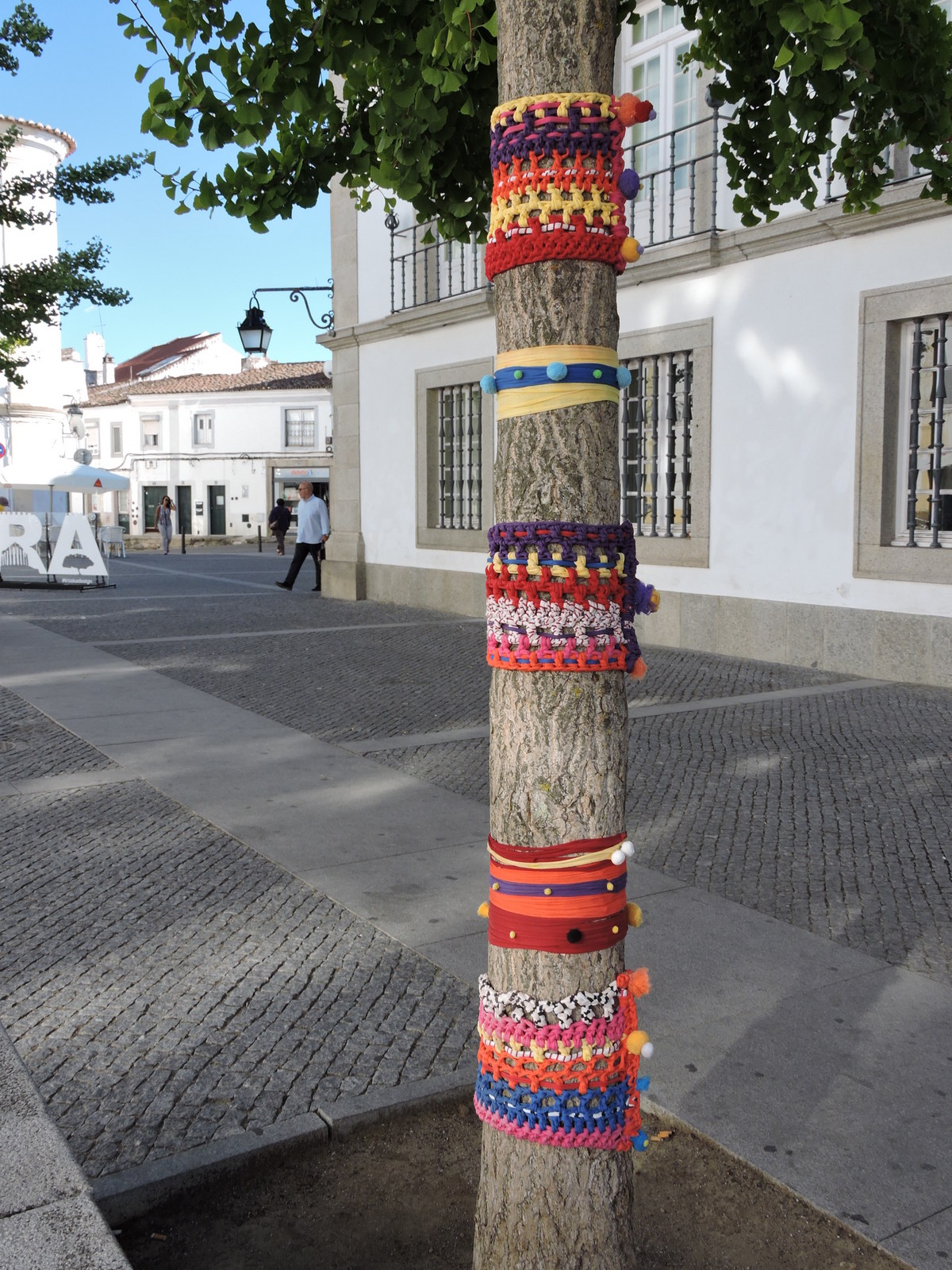
I didn't take any knitting with me (too busy) but we did see some yarn-bombed trees in Evora. (Though it's crochet, not knitting.


I was fascinated by the different styles of chimney that we saw.  Usually they are built like a little house, with a pitched roof. 


The street lamps were also very varied and stylish.


As you can see from the photos, it was generally sunny, and it was very hot too.  We were very well fed, in between visiting archaeological sites. (Delicious cheeses, in particular.  Pork and ham, too - I came home a few pounds heavier.) And wine was plentiful. It was a great holiday.

Saturday, 2 September 2017

December 1930

Last weekend, we were in Kent, staying with friends.  The weather was perfect  - hot (but not too hot) and sunny.  The men of the party went to the Military Odyssey, a multi-period re-enactment show - a fun day, allegedly.  Sue and I went instead to Sissinghurst instead.  It's one of my favourite gardens, but I have not been there for many years, so it was good to re-visit it.  And the following day we went to Knole, where Vita Sackville-West grew up.

Another day we went to a small book fair in Tenterden, a very pretty little town   I bought a couple of old magazines there,  including an issue of Britannia & Eve from December 1930.

Britannia & Eve, December 1930
As the cover says, it was "A Monthly Magazine for Men & Women".  The contents are an odd mixture.  There is a lot of fiction, and some non-fiction articles: on the early life of Prince Albert, the wife of Chiang Kai-Shek, "The Psychology of Dress", and several more.

There are two articles on Hollywood and the current films - it seems that the "Talkies" were just taking over from silent films, and so this is commented on in a couple of places.  There is a page of stills in a new film in which "Miss Evelyn Laye makes her talking debut".  (According to Wikipedia, Evelyn Laye was British and had appeared in plays and musical comedies.  In the new film, she plays a flower-seller in a cafe in Hungary, and also a famous singer who she agrees to impersonate, and a captive in a nobleman's castle. It was a Samuel Goldwyn film and, says Wikipedia, a huge flop.)  Elsewhere, one of the magazine's writers speculates, "I am not sure that we are not altering our voices and that the Talkies are not responsible for new intonations, new phrases".

There are are also several articles on fashion, and others on Christmas decor and cookery, that you would think would be aimed more at woman readers than men.

Because it's a Christmas issue, the fashion pages present evening gowns (though there is another article on what to wear for a winter sports holiday in Switzerland).  The fashions are all illustrated with drawings rather than photos, and women were evidently supposed to be tall, slim and willowy.

From Britannia & Eve magazine, December 1930
A Lovely Gown in which to Celebrate Christmas Festivities
This gown is in black velvet with a band of net above the hem, and a short jacket of net too.

 Of course, no real woman looks like the drawings - it would be grotesque if she did.  Elsewhere in the magazine is an article on women's golf, illustrated with several photos of real women looking far from slim and willowy - in fact, rather frumpy.


Women always wore a hat when out of doors, and a close-fitting beret was popular for golfers. An ad shows another style of hat favoured by some of the golfers, and that it could look attractive (but not if you sit slumped like a sack of potatoes, like one or two of the women in the photo above).

From Britannia & Eve magazine, December 1930
"An attractive small felt for all weathers"

The ads are fascinating, as usual in old magazines.  I was intrigued to see the range of electrical goods you could buy for your home, even in 1930s - a toaster, a vacuum cleaner, an iron, an electric kettle, a coffee percolator,...

From Britannia & Eve magazine, December 1930
Electrical Christmas Gifts 

Another ad shows a range of radios and gramophones (and a combination 'graphophone').
Columbia Radios and Gramophones

 I was astonished at the prices - the cheapest 'radio table model'  in the ad is 20 gns.  (A guinea was £1 1s, so 20 guineas was £21).  The equivalent today, from the Bank of England's historic inflation calculator, is over £1200.  That's partly because it's designed to be a smart piece of furniture, in a wooden cabinet, but even so, that's huge amount of money for a radio.  (And there weren't many programmes to listen to, anyway.)

There are several car ads in the magazine, and the cheapest is the Austin 7 at £122 10s. - only 6 times the cost of a radio.    

"The New Austin 7" 

But my favourite ad is this one for Dolcis shoes.  I love the Art Deco styling, and the shoes are very stylish - though the evening shoes in crepe de chine and velvet wouldn't last long.

"For Day or Evening - Dolcis"

Unfortunately, although the magazine is 170 pages long, there are some missing at the end, as I found when I tried reading one of the stories. So now I shall never know the ending of 'Shane of the Sorrowful Islands', by Beatrice Grimshaw, a 'drama of mutiny in the Solomons'.  Very disappointing.

Thursday, 31 August 2017

1940 Knitting Fashions

We are in the process of scanning the covers of the patterns in the Knitting & Crochet Guild collection, focusing for now on the earliest leaflets, from before 1950. Many of them are very attractive, and here's a batch of patterns from the 1940s that I particularly noticed. They are unusual, because instead of relying on the cover illustration to sell the design, there is a bit of description inside telling knitters why this was up-to-the-minute and fitted in with the fashions of the day. I find that helpful, because it's hard to judge the designs otherwise except by modern standards.

The designs are all knitted in 3-ply wool, to a tension of around 32 stitches and 42 rows to 10 cm. in stocking stitch. That's typical of 1940s clothes rationing, when a little knitting wool had to go a long way.

The first design is a neat blouse with bands of lace.    

1940s vintage knitting pattern
Lee Target 585
"In perfect accord with present-day simplicity, this model is knitted in wide bands of stocking web and lattice lace. The welts and borders are in twisted ribbing and a lace collar adds softness to the neckline."
The next design could be knitted with long sleeves, instead of the short sleeves shown, if you had enough wool.  The pattern also suggests the colours to use.

1940s vintage knitting pattern
Lee Target 572

"Diagonal lines are very much the vogue now and this little model is a happy example. It is knitted mainly in stocking web in a Dusky Pink with Wine-coloured diagonal stripes on yoke and sleeves, a rib welt and narrow rib roll at neck. It fastens on the shoulders. The stripes are simple to knit, a long strand being used for each with only one ball of main colour at a time."
The diagonal lines on the yoke and sleeves are really eye-catching, and quite simple to achieve.  All these patterns give quite detailed instructions, and so knitting the diagonal stripes is described very clearly:
"Each diagonal stripe is 2 sts. wide and moves over 1 st. every row from the centre to the sides, right and left. A separate strand of W [Wine] wool about a yard long is used for each stripe and the P [Pink] and W [Wine] wools are twisted round one another once at each change of colour to avoid gaps. The long ends of W [Wine] wool are easy to draw out when they become entangled and a fresh length can be joined on as needed."
I'm not sure I believe that  the lengths of Wine wool could be  easily untangled, but maybe it's true. 

We associate the 1940s with broad shoulders emphasised by shoulder pads, and  here's a waistcoat designed to be worn with that style. 

1940s vintage knitting pattern
Lee Target 573
"Designed for added warmth over the new wing-sleeved models, this Cardigan is knitted in stocking web, with double epaulettes slightly flaring round the upper sections of the deep armholes. Single ribbing is used for welts and border. The lower sections of the armholes are neatly faced for strength."
And finally, another blouse, knitted sideways in narrow stripes.

1940s vintage knitting pattern
Lee Target 565

"A cleverly designed model reflecting the mode of the moment is knitted with a raised red pin-stripe on a white ground. The entire garment is knitted sideways with a firm welt on smaller needles, and a neckline which can be buttoned high or worn with open revers. It is easy fitting, snug, and will make a delightful Summer as well as cooler weather blouse."
Lee Target pattern leaflets at that time often specified carefully how to make up the garment once you had knitted it.  The instructions for the striped blouse say:  "It is an excellent plan to tape the shoulder seams and back neck to prevent stretching." - another  reminder of clothes rationing.  Clothes had to last a long time, so it was worthwhile putting extra effort into the making up,  if it would help them to last longer.

I'm not tempted to knit any of these designs (and not just because 3 ply wool is so fine).  But it's fascinating to see how they fitted into 1940s fashion, as well as being so economical with wool. 

Thursday, 10 August 2017

Jersey Suits for Little Boys

We are gradually recording and cataloguing the pattern leaflets in the Knitting & Crochet Guild collection, of which there are a lot.  (I may have mentioned that before.)  Recording (i.e. listing the numbers) is nearly finished, cataloguing is only just starting.   We are focusing on the earlier ones, particularly the 1930s, and many of the designs could be adapted to wear now.  But some garments have gone out of use completely - including the hand-knitted shorts for little boys in this Bairns-wear booklet.  (I call them shorts, but actually the leaflet calls them knickers. Times change.)

Bairns-wear Booklet Number 16

The booklet has several designs for jerseys and jersey suits (jersey + shorts) for boys aged 18 months to 3 years.   They are very pretty, and feature embroidery.   The designs are named after characters in children's books and comics, though the names seem to be randomly assigned - a design doesn't show the character it is named after. For instance, the cover design is called "Mickey Mouse", but doesn't seem to have any connection to the cartoon beyond its name.

Two other designs are named after Brer Fox and Brer Rabbit.

"Brer Fox" suit
"Brer Rabbit" suit

The "Brer Fox" suit is embroidered with little flowers above the pockets on the jersey.  "Brer Rabbit" does have a family of rabbits embroidered above the welt , but they are Mr Rabbit, Mrs Rabbit and Master Rabbit, according to the booklet.  And not very realistic rabbits, especially as the embroidery on the sample has "blue rabbits with pink eyes and tongues".

There are two other jersey patterns in the booklet, without matching shorts.  Tiger Tim was a cartoon  character in the Daily Mirror.

"Tiger Tim" jersey
The embroidery on the jersey, disappointingly, is a rather crude dog, and not a tiger. It's described as a "ferocious animal", but saying it's ferocious doesn't make it look ferocious.  

"Teddy Tail" jersey
Teddy Tail was a cartoon mouse, from a comic strip in the Daily Mail.   Again, the jersey design doesn't feature a mouse, though it is a rather nice design with a zigzag pattern in garter stitch at the neck and hem, and a few embroidered crosses and dots.

Although the booklet is illustrated with black-and-white photos, the instructions specify the colours to use.  And some of the colours are surprising.  The Mickey Mouse design is to be knitted in sky blue and Tiger Tim should be mauve.  But Brer Fox and Teddy Tail are to be pink - pink is now so associated with girls that I doubt if anyone would knit something in pink for a boy.  And the Brer Rabbit suit is white - so impractical for an active toddler.

The jerseys, by themselves and without the unnecessary embroidery, are nicely designed - I like the ones with square necks particularly.  In a stronger, more practical colour they could work very well.  And I know that if I say that no-one nowadays would want to knit shorts for a little boy, some knitter out there will already be planning to do just that.  So I will only say that if you are a member of the Knitting & Crochet Guild, you can have a copy of the  booklet.

Monday, 7 August 2017

1963

I love old magazines, so when I saw a 1963 copy of Flair magazine in an Oxfam bookshop, I bought it.  Flair was a monthly fashion magazine launched in 1960, and I remember reading it occasionally as a teenager.  (Sadly it died in 1970, merged into Woman's Journal).

Flair magazine, June 1963
It's fascinating, especially the ads.  We think of 1960s fashion as revolutionary - the era of miniskirts, Mary Quant, Vidal Sassoon hair cuts, shift dresses, skinny rib jumpers,...  But really that was the later 60s, and it had barely started in 1963.

Many of the clothes shown look very formal, like the suit worn with long gloves, an organdie scarf  and a big hat (modelled by Grace Coddington?)


Admittedly that's from an article How to Stand Out in a Crowd and deals with  "important social events" such as weddings, race meeting, regattas and committee meetings.  (Committee meetings?? No committee I've ever been on had meetings that were important social events.)  But elsewhere in the magazine, too, the clothes look rather stiff by today's standards, and although the possibility of wearing 'slacks' is mentioned occasionally, none are actually shown.

A feature "Underneath it all" suggests one reason why the clothes look more stiff and formal than we are used to - you were supposed to wear a corset.  And perhaps they were more comfortable than earlier corsets, because "in these days of miraculous man-made fibres, a featherweight corselette or pantie girdle will exert real control for all figure types".    Even under slacks - the feature shows a "pantie girdle that gives a really smooth line under slacks",  reaching to just above the knee.  And they were made for slim women as well as "the most ample figure" (size 40 in. bust, that is).

There are several ads for different brands of corset in the magazine, including the famous Silhouette ads, showing corsets worn over a  kind of black body stocking.


As the suspenders attached to the Silhouette corsets show, women still wore stockings, not tights.


The magazine has a surprising number of ads for perfumes and perfumed products like talcum powder. (What happened to talcum powder?) Some of the French perfume brands still exist, and there's an ad for Chanel No. 5, already 40 years old in 1963.  But other names like Morny have gone, I think.


I was too young to be affected by most of this, though I did wear stockings for a short while . (Hated them.)  Women's clothes are so much freer and more comfortable now than in 1963 - a huge improvement.

 And... knitting.  There is a knitting pattern in the magazine, although perhaps you shouldn't really expect much woolly knitwear in a June issue.  It's a collarless cardigan knitted in two colours.


It's really not too bad - it wouldn't look too extraordinary if someone wore it now. The yarn is Lee Target Gaelic Floss, so I imagine something like a Shetland wool.  It's knitted mainly on 4.5mm needles, so possibly a DK weight.  For me, it's the most forward-looking thing in the magazine.  (But then, I'm a knitter.)
Related Posts Plugin for WordPress, Blogger...