I'm going to Shetland Wool Week at the end of September - the first time I've been to Wool Week, and the first time I've been to Shetland too. It's especially exciting, because I'm part of the programme - I'm giving an evening talk on the Knitting & Crochet Guild and its collection.
Every year, there is a special Wool Week hat, with a free pattern, and the idea is to wear it then so that fellow knitters can recognise you. This year's pattern (available here) is the Roadside Beanie, designed by the Wool Week patron Oliver Henry. I started mine at the end of April, and finished the knitting months ago, but only blocked it and sewed in the ends last week. I took it to the Huddersfield Guild meeting on Thursday for the show-and-tell session which we have at the start of every meeting, and a friend took a photo of it.
Here's another photo, posed on a mixing bowl, to show the band of sheep around it, and the corrugated rib:
Back in April, when I was planning my beanie, I looked through the suitable wool that I already had, and found these colours:
The three balls of Jamieson's Spindrift, in Chartreuse, Jade and Parma, I bought a few years ago, when a local yarn shop closed. I didn't then have any plans for them, but they were a bargain. And now I have found a use for them. The other five colours were left over from a pullover that I knitted for John more than 30 years ago. He posed in it for the very first post in this blog, in 2010.
The pullover is from Sarah Don's book, Fair Isle Knitting, which I bought in 1981. I used the colours she suggested: moorit, cream, blue, rust, yellow and grey. As far as I remember, I wrote to either Jamiesons or Jamieson and Smith, in Shetland, to order the wool. (No online shopping back then, of course.) When I was looking for wool for my beanie, I couldn't find any of the blue left over, and I didn't in the end use the rust. Being a conventional sort of person, I did feel that the grass should be green(ish), the sky should be blue(ish), and the sheep should be a possible sheep colour. I think it's worked out very well, and I particularly like the corrugated rib, with a moorit background and the ribs shading through parma, jade, chartreuse, yellow and cream. I'm looking forward to wearing it for Wool Week.
Mostly about knitting history. Sometimes about what I'm knitting. Sometimes about other things too.
Thursday, 22 August 2019
Monday, 19 August 2019
Esplen-d'or
Last Friday was Granny Square Day 2019 on Instagram. The idea was to make a virtual blanket, using Instagram's grid format to combine photos of granny squares posted by individual crocheters. I'm not a crocheter, so I didn't take part, but it did remind me of a pattern in the Knitting & Crochet Guild collection which is an early example of granny squares being used in a garment. (Not under that name of course - "granny squares" is much more recent term.)
Here's the pattern:
The leaflet is from the early 1920s, when loose, rather shapeless jumpers were in fashion. It's partly knitted and partly crocheted. The main part is knitted (in garter stitch) in a T shape, the front, back and sleeves all in one piece. Fourteen crochet squares are needed, a panel of four squares at the bottom of the front, the same at the back, one square set diagonally at the bottom of each side, and two squares on each sleeve. The leaflet also has instructions for making crochet balls stuffed with cotton wool - three are sewn to the points of the squares at each side of the jumper, and two more are attached to a crochet chain that is threaded through around the neckline. So although the basic shape is simple, it's a complicated make.
Esplen-d'or knitting yarn was art silk, or rayon, very popular in the 1920s. The ads claim that it was "The most Brilliant Article procurable for hand-knitted Jumpers, Coats, Scarves, etc." (But then they would, wouldn't they.)
I think the elaborate design is quite typical of early 1920s jumpers in art silk - their basic shape is a simple T, with side and sleeve seams, but they are often quite complicated overall, pieced together from bits of knitting and bits of crochet, and trimmed with balls, tassels, belts and cords.
Esplen-d'or knitting yarn was advertised in needlecraft magazines from about 1923, and one particular advantage claimed is that it "is now made up in 4-oz. Balls - wound in a special manner which prevents the threads from slipping." Rayon is a very smooth, shiny yarn - and very, very slippery. It was usually sold in hanks, but if you wound it from the hank into a ball in the usual way, it would soon collapse and tangle. Instead, knitters and crocheters wound the yarn onto special cross-shaped winders, made of plywood (or sometimes just cardboard). I've written before about these yarn winders - here are two of them from the Knitting & Crochet Guild collection.
If Esplen-d'or really was wound into balls that would be stable from start to finish, that would be a huge help to users. I assume that each wrap round the ball somehow fixed the previous wraps in place, though I can't really see how.
The ad above gives the price of Esplen-d'or - 3/3 for 4 ounces (100g.) in plain colours, more for "shaded, mingled and oriental colours". 3/3 means 3 shillings and 3 pence, and is equivalent to about £9.56 now, using the Bank of England's historic inflation calculator. Other brands of art silk advertised at the same time were, surprisingly, more expensive, even though they were sold in hanks and not ready-wound (and even though Esplen-d'or was the "most brilliant article procurable"). The prices of knitting wools seem to have been much lower. Art silk appears to have been a luxury product, though presumably cheaper than real silk.
There is little information in the ads or on the leaflets about the company that made Esplen-d'or, except for an address at 84 Queen Victoria Street, London E.C.4. The ads for Esplen-d'or products continued into the 1940s, although the later ads that I have seen are for embroidery silks, not knitting yarn. Art silk jumpers were mainly a 1920s fashion, and perhaps the company was thereafter reduced to producing only embroidery silks, and died during the war, though I really don't know.
There are very few Esplen-d'or pattern leaflets in the Guild collection. Here is one of the others, for a crocheted tam, in stripes of two colours, with a tassel. The model on this leaflet seems to have had her hair bobbed, so perhaps this is a later leaflet than the jumper pattern.
I think it looks rather fetching, though I think having a tassel hanging on your shoulder would get seriously annoying very quickly. And given the slipperiness of art silk, not to mention the weight of the tassel hanging off the side, I suspect this would need at least a hatpin or two to keep it on. It's not a hat for cold windy weather.
Here's the pattern:
![]() |
| Esplen-d'or Knitted & Crochet Jumper |
The leaflet is from the early 1920s, when loose, rather shapeless jumpers were in fashion. It's partly knitted and partly crocheted. The main part is knitted (in garter stitch) in a T shape, the front, back and sleeves all in one piece. Fourteen crochet squares are needed, a panel of four squares at the bottom of the front, the same at the back, one square set diagonally at the bottom of each side, and two squares on each sleeve. The leaflet also has instructions for making crochet balls stuffed with cotton wool - three are sewn to the points of the squares at each side of the jumper, and two more are attached to a crochet chain that is threaded through around the neckline. So although the basic shape is simple, it's a complicated make.
Esplen-d'or knitting yarn was art silk, or rayon, very popular in the 1920s. The ads claim that it was "The most Brilliant Article procurable for hand-knitted Jumpers, Coats, Scarves, etc." (But then they would, wouldn't they.)
![]() |
| Ad in Weldon's Practical Needlework, 1924 |
Esplen-d'or knitting yarn was advertised in needlecraft magazines from about 1923, and one particular advantage claimed is that it "is now made up in 4-oz. Balls - wound in a special manner which prevents the threads from slipping." Rayon is a very smooth, shiny yarn - and very, very slippery. It was usually sold in hanks, but if you wound it from the hank into a ball in the usual way, it would soon collapse and tangle. Instead, knitters and crocheters wound the yarn onto special cross-shaped winders, made of plywood (or sometimes just cardboard). I've written before about these yarn winders - here are two of them from the Knitting & Crochet Guild collection.
If Esplen-d'or really was wound into balls that would be stable from start to finish, that would be a huge help to users. I assume that each wrap round the ball somehow fixed the previous wraps in place, though I can't really see how.
The ad above gives the price of Esplen-d'or - 3/3 for 4 ounces (100g.) in plain colours, more for "shaded, mingled and oriental colours". 3/3 means 3 shillings and 3 pence, and is equivalent to about £9.56 now, using the Bank of England's historic inflation calculator. Other brands of art silk advertised at the same time were, surprisingly, more expensive, even though they were sold in hanks and not ready-wound (and even though Esplen-d'or was the "most brilliant article procurable"). The prices of knitting wools seem to have been much lower. Art silk appears to have been a luxury product, though presumably cheaper than real silk.
There is little information in the ads or on the leaflets about the company that made Esplen-d'or, except for an address at 84 Queen Victoria Street, London E.C.4. The ads for Esplen-d'or products continued into the 1940s, although the later ads that I have seen are for embroidery silks, not knitting yarn. Art silk jumpers were mainly a 1920s fashion, and perhaps the company was thereafter reduced to producing only embroidery silks, and died during the war, though I really don't know.
There are very few Esplen-d'or pattern leaflets in the Guild collection. Here is one of the others, for a crocheted tam, in stripes of two colours, with a tassel. The model on this leaflet seems to have had her hair bobbed, so perhaps this is a later leaflet than the jumper pattern.
I think it looks rather fetching, though I think having a tassel hanging on your shoulder would get seriously annoying very quickly. And given the slipperiness of art silk, not to mention the weight of the tassel hanging off the side, I suspect this would need at least a hatpin or two to keep it on. It's not a hat for cold windy weather.
Saturday, 10 August 2019
Beehive Recipe Cards
We are now very used to the idea that manufacturers of knitting yarns publish patterns to promote the use of their yarns. In Britain, this practice began just before World War I, when J. & J. Baldwin & Partners, of Halifax, published their first Beehive Booklets, closely followed by J. Paton, Son & Co. Ltd., of Alloa, with their "Helps to Knitters" booklets. (Other spinners did not adopt the idea until much later.)
In 1920, the two companies merged to form Patons & Baldwins, of Alloa and Halifax. But for several years afterwards, the component companies seem to have operated separately to some degree, placing separate ads for their products, sometimes in the same magazine, and they carried on publishing both Beehive Booklets and Helps to Knitters.
Also in the early 20s, Baldwins started to produce a series of "Beehive Recipe Cards".
While the booklets were at least four pages long, and often more, recipe cards were suitable for simpler patterns that would fit onto both sides of a single sheet of card, with a small photo.
There are only three of the cards in the Knitting & Crochet Guild collection: one has patterns for two crocheted hats, a sailor hat and a tam o' shanter. The others are dress patterns for little girls: the 'Nancy' design has a simple dress with knickers (a rather loose pair of knitted shorts), while the 'Isobel' design is a fancier dress, modelled by a glum-looking child wearing an enormous bow in her hair.
The cards were advertised alongside the Beehive booklets for a few years, using a drawing based on the photo on the card. Presumably that was cheaper than reproducing the photo, but sometimes the drawing is more attractive than the photo, to my mind.
The British Library has 86 of the recipe cards, which seems to be a complete set. They all have a British Museum stamp with dates between December 1921 and July 1924. (The British Library used to be housed in the British Museum.) So evidently the cards were short-lived - perhaps the company decided that it was too complicated to keep publishing patterns in two different formats. A recipe card could easily be expanded to a 4-page booklet - have a bigger photo to fill the first page, add a few washing hints perhaps, and if necessary use the last page to show illustrations of some of the other booklets available. Though from the knitter's point of view, it seems to me that a single sheet of card is more convenient than a flimsier 4-page booklet.
Here are a couple more photos from the cards, to show that they weren't all underwear or children's patterns.
Card No. 22 has room for a description of the garment:
The Rachael design from Card No. 84 is a crocheted jumper, in Kingfisher Lustre Wool, a wool-rayon mix. The front and back are identical T shapes, typical of early 20s jumpers - as is the cord belt with tassel.
The set of recipe cards give a comprehensive picture of what knitters and crocheters were being encouraged to make in the early 1920s. Possibly many of the cards only survive now in the British Library - it is a wonderful institution.
In 1920, the two companies merged to form Patons & Baldwins, of Alloa and Halifax. But for several years afterwards, the component companies seem to have operated separately to some degree, placing separate ads for their products, sometimes in the same magazine, and they carried on publishing both Beehive Booklets and Helps to Knitters.
Also in the early 20s, Baldwins started to produce a series of "Beehive Recipe Cards".
![]() |
| Beehive Card No. 34 |
While the booklets were at least four pages long, and often more, recipe cards were suitable for simpler patterns that would fit onto both sides of a single sheet of card, with a small photo.
There are only three of the cards in the Knitting & Crochet Guild collection: one has patterns for two crocheted hats, a sailor hat and a tam o' shanter. The others are dress patterns for little girls: the 'Nancy' design has a simple dress with knickers (a rather loose pair of knitted shorts), while the 'Isobel' design is a fancier dress, modelled by a glum-looking child wearing an enormous bow in her hair.
![]() |
| Beehive Card No. 54 |
The cards were advertised alongside the Beehive booklets for a few years, using a drawing based on the photo on the card. Presumably that was cheaper than reproducing the photo, but sometimes the drawing is more attractive than the photo, to my mind.
![]() |
| Beehive Card No. 71, advertised in 1924. |
| Photo from Beehive Card No. 71 (from the copy in the British Library) |
The British Library has 86 of the recipe cards, which seems to be a complete set. They all have a British Museum stamp with dates between December 1921 and July 1924. (The British Library used to be housed in the British Museum.) So evidently the cards were short-lived - perhaps the company decided that it was too complicated to keep publishing patterns in two different formats. A recipe card could easily be expanded to a 4-page booklet - have a bigger photo to fill the first page, add a few washing hints perhaps, and if necessary use the last page to show illustrations of some of the other booklets available. Though from the knitter's point of view, it seems to me that a single sheet of card is more convenient than a flimsier 4-page booklet.
Here are a couple more photos from the cards, to show that they weren't all underwear or children's patterns.
| Photo from Beehive Card No. 22 (from the copy in the British Library) |
Card No. 22 has room for a description of the garment:
The "Lady Hilda" Blouse Jumper is very light in weight and makes a dainty garment for wearing under a Coat or indoors. The lacey pattern introduced into the neck, cuffs and border, nicely worked, makes the garment a very stylish one.Later cards dropped the description, and the tinting of the photo, and used real models rather than dress stands.
| Photo from Beehive Card No. 84 (from the copy in the British Library) |
The Rachael design from Card No. 84 is a crocheted jumper, in Kingfisher Lustre Wool, a wool-rayon mix. The front and back are identical T shapes, typical of early 20s jumpers - as is the cord belt with tassel.
The set of recipe cards give a comprehensive picture of what knitters and crocheters were being encouraged to make in the early 1920s. Possibly many of the cards only survive now in the British Library - it is a wonderful institution.
Friday, 2 August 2019
Fair Isle Knitting Made Easy
I'm not suggesting that I am about to make Fair Isle knitting easy - the post title comes from a Weldon's Sixpenny Series booklet that I have been scanning to put on the Knitting & Crochet Guild website, for members to download.
Weldon's published over 300 titles in their Sixpenny Series, in the 1920s and 1930s. They aren't dated, so I might try to assign dates to them myself in a later post, as I did for Fancy Needlework Illustrated. I can at least date this issue, No. 217, fairly confidently to 1930 - it has an ad for a Patons & Baldwins pattern, which also appeared in another publication dated November 1930.
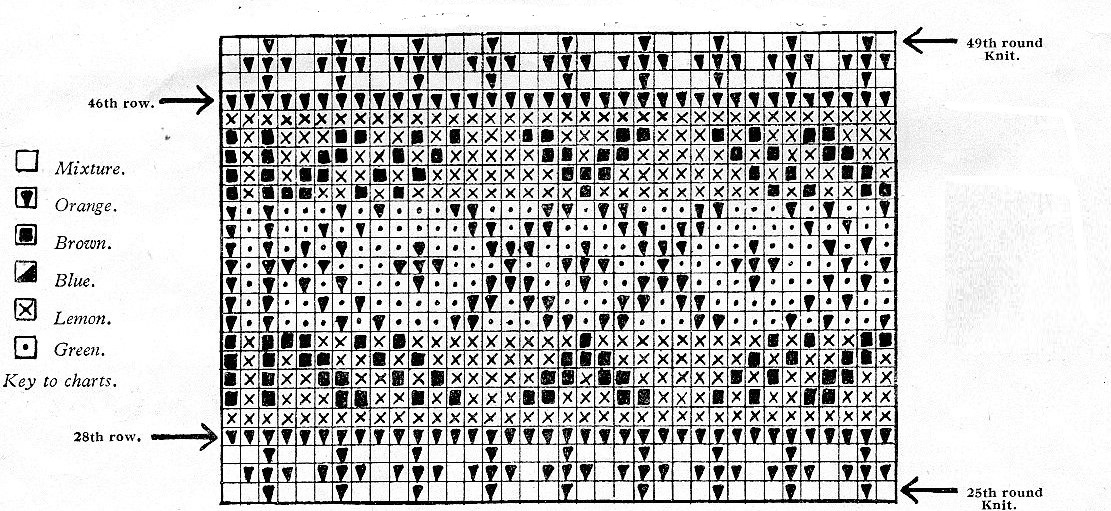
Why did Weldon's claim that the booklet made Fair Isle knitting easy? Largely because the colour patterns were charted, rather than being written out row by row, as was usual at that time (and still common much later, too). The introduction says :
But Weldon's had to explain using charts to knitters who had never used them before, and probably never seen them before. It was especially tricky here, because the designs in the booklets are knitted in the round up to the armholes, and then knitted flat up to the shoulders; the sleeves are knitted flat from the cuff upwards. So the booklet has to explain how to read the chart when working in the round ("the chart must always be read from right to left"), and then how to read them when working flat, with alternate rows of knit ("plain") and purl: "The plain rows, which are the uneven numbered rows, are read from right to left of the charts, and the purl rows, which are the even numbered rows, from left to right."
The charts also show the shaping for the neck, armholes and sleeves, which is also explained very carefully. (Of course, the patterns are all given in only one size, which simplifies showing the shaping on a chart.) There's also advice about using a "a piece of coloured thread knitted in with a stitch" to mark the start of each round - which sounds like a separate piece of thread for each round, rather than how we would use stitch markers now.
The booklet also explains how to hold one strand of wool in each hand when knitting Fair Isle patterns (though only when knitting in the round or on the knit rows in the flat sections). I was surprised to see this useful advice given so early. Many Fair Isle pattern leaflets published much later than this leave the knitter to work out for themselves how to work with two strands of wool at the same time.
Now for the designs. The two on the front cover are to "complete your sports outfit". There are only two different patterns in each, one wide band and one narrow, but "an elaborate effect is achieved by reversing the colours" on alternate wide bands, which is a clever idea. Here's another view of the man's sweater:
The instructions say that "this pullover can, if preferred, be worn tucked in, as shown on the cover, in which case a deep welt is worked in place of patterns at the lower edge." In my view, wearing it tucked in is very wrong indeed, so I am glad to see that there is a more sensible alternative.
There is another woman's sweater like the cover design, of a similar shape with patterned bands all over and a V neck (and also shown worn with a beret). It's suggested that this is to wear with a tweed suit, "for sports and general wear".
![]() |
| Weldon's Sixpenny Series No. 217 |
Weldon's published over 300 titles in their Sixpenny Series, in the 1920s and 1930s. They aren't dated, so I might try to assign dates to them myself in a later post, as I did for Fancy Needlework Illustrated. I can at least date this issue, No. 217, fairly confidently to 1930 - it has an ad for a Patons & Baldwins pattern, which also appeared in another publication dated November 1930.
Why did Weldon's claim that the booklet made Fair Isle knitting easy? Largely because the colour patterns were charted, rather than being written out row by row, as was usual at that time (and still common much later, too). The introduction says :
"In view of the enormous popularity of Fair Isle Woollies, the following "Easy-Way" method of knitting these designs has been devised. This method obviates the use of long and tiring directions which are substituted by simple charts, showing the pattern at a glance. These charts arc extremely clear as each square represents a stitch, and each sign a colour. A ruler laid across the chart above the row being worked, greatly helps in keeping the place."Here's one of the charts, which now seems perfectly ordinary to knitters:
But Weldon's had to explain using charts to knitters who had never used them before, and probably never seen them before. It was especially tricky here, because the designs in the booklets are knitted in the round up to the armholes, and then knitted flat up to the shoulders; the sleeves are knitted flat from the cuff upwards. So the booklet has to explain how to read the chart when working in the round ("the chart must always be read from right to left"), and then how to read them when working flat, with alternate rows of knit ("plain") and purl: "The plain rows, which are the uneven numbered rows, are read from right to left of the charts, and the purl rows, which are the even numbered rows, from left to right."
The charts also show the shaping for the neck, armholes and sleeves, which is also explained very carefully. (Of course, the patterns are all given in only one size, which simplifies showing the shaping on a chart.) There's also advice about using a "a piece of coloured thread knitted in with a stitch" to mark the start of each round - which sounds like a separate piece of thread for each round, rather than how we would use stitch markers now.
The booklet also explains how to hold one strand of wool in each hand when knitting Fair Isle patterns (though only when knitting in the round or on the knit rows in the flat sections). I was surprised to see this useful advice given so early. Many Fair Isle pattern leaflets published much later than this leave the knitter to work out for themselves how to work with two strands of wool at the same time.
Now for the designs. The two on the front cover are to "complete your sports outfit". There are only two different patterns in each, one wide band and one narrow, but "an elaborate effect is achieved by reversing the colours" on alternate wide bands, which is a clever idea. Here's another view of the man's sweater:
The instructions say that "this pullover can, if preferred, be worn tucked in, as shown on the cover, in which case a deep welt is worked in place of patterns at the lower edge." In my view, wearing it tucked in is very wrong indeed, so I am glad to see that there is a more sensible alternative.
There is another woman's sweater like the cover design, of a similar shape with patterned bands all over and a V neck (and also shown worn with a beret). It's suggested that this is to wear with a tweed suit, "for sports and general wear".
And the third jumper for women is the "Heath" design, with Fair Isle bands around the lower edge, around the cuffs, and bordering the V neck. I like this one a lot.
And finally, there is a sleeveless pullover, billed as 'a well-fitting "tuck-in"'. (Noooo! Don't tuck it in!)
Apart from the tuck-ins, the designs are very attractive. I think it's interesting, too, that the instructions are so technically advanced. Many "Fair Isle" patterns published in Britain, even decades later than this one, instructed knitters to work all the pieces flat, with front and back knitted separately. Recent Fair Isle sweater patterns are more likely to tell knitters to work in the round throughout, with steeks at the armholes and neck. I don't know when steeking instructions were first published in this country, but I would have been astonished if they had appeared in a 1930 booklet.
I would love to know whether any Shetland knitters were consulted about techniques, or designed any of the sweaters. But it was very rare to name the designers at that time, and this booklet is no exception.
Knitting & Crochet Guild members will find a pdf copy of the booklet on the Guild website under Membership and then Pattern Downloads. (If you aren't a member and are interested in vintage knitting and crochet publications, you might consider joining - Guild membership is open to anyone.)
Apart from the tuck-ins, the designs are very attractive. I think it's interesting, too, that the instructions are so technically advanced. Many "Fair Isle" patterns published in Britain, even decades later than this one, instructed knitters to work all the pieces flat, with front and back knitted separately. Recent Fair Isle sweater patterns are more likely to tell knitters to work in the round throughout, with steeks at the armholes and neck. I don't know when steeking instructions were first published in this country, but I would have been astonished if they had appeared in a 1930 booklet.
I would love to know whether any Shetland knitters were consulted about techniques, or designed any of the sweaters. But it was very rare to name the designers at that time, and this booklet is no exception.
Knitting & Crochet Guild members will find a pdf copy of the booklet on the Guild website under Membership and then Pattern Downloads. (If you aren't a member and are interested in vintage knitting and crochet publications, you might consider joining - Guild membership is open to anyone.)
Monday, 29 July 2019
Crochet Gloves
On Saturday, I went to Lincoln with a suitcase of some of my favourite pieces from the Knitting & Crochet Guild collection, to show them to the local Guild branch. I shan't write about most of them here, though one that has already had a post to itself is the "Victorious Peace" tea cosy -
an obvious choice as it has the date 1919 worked into the filet crochet, so this is its centenary year.
I also took a few crocheted gloves, which I think are fascinating. I don't ever want to wear a pair, but they represent the way that women once wanted to look. Once upon a time, ladies were not properly dressed out of doors without a hat and gloves. In winter, gloves had an additional function in keeping hands warm, but in summer, they had to be cool and preferably light coloured. In the 1940s and 50s, patterns appeared for summer gloves crocheted in cotton. We have many of the patterns, and at least a dozen pairs of the gloves, in the collection.
Here are two pairs I showed on Saturday: a white pair with a very open pattern of ovals on the back of the hand and the fingers, and around the cuffs.
And a pale blue pair with a pattern of trefoils around the cuffs, and crochet buttons to fasten them - I think these are delightful.
In a few cases, we have managed to match a pair of gloves to a pattern. Here's a late 1940s Bestway pattern, and a pair of gloves to the same pattern.
My favourite patterns for these gloves show the ideal look that the gloves were intended to complement. Coats leaflet 298 is an example - it shows a sketch of a lady in a sort of New Look outfit, wearing the gloves that you could make from the pattern.
Inside are further sketches of various ladylike activities which would be enhanced by the gloves - drinking champagne, smoking a cigarette (in a holder, of course),.... All with a smartly dressed (no doubt rich and handsome) escort.
And Coats Book No. 405, with several patterns for crochet gloves, sets out what a pair of crochet gloves would offer: "Paris or Penrith, country or town, feminine fancy dictates crochet gloves for summer chic. The 'finger tip-top' smartness of fashionable gloves in crochet gives that groomed, well dressed, finish to spring suit or summer ensemble. Elegance, daintiness, delicacy, youthfulness -- take your choice from these inexpensive 'made-to-treasure' gloves."
They would certainly be inexpensive to make (if you are skilled with a crochet hook, which I'm not). They are totally impractical for everyday activities, but they could look very pretty with a floaty dress at a summer wedding. (Again, not for me.)
If you'd like to try making a pair, and you are a member of the Knitting & Crochet Guild, the Coats booklet is available to download from the Membership area of the Guild website. (And if you're not a member, you could join - membership is open to anyone.)
an obvious choice as it has the date 1919 worked into the filet crochet, so this is its centenary year.
I also took a few crocheted gloves, which I think are fascinating. I don't ever want to wear a pair, but they represent the way that women once wanted to look. Once upon a time, ladies were not properly dressed out of doors without a hat and gloves. In winter, gloves had an additional function in keeping hands warm, but in summer, they had to be cool and preferably light coloured. In the 1940s and 50s, patterns appeared for summer gloves crocheted in cotton. We have many of the patterns, and at least a dozen pairs of the gloves, in the collection.
Here are two pairs I showed on Saturday: a white pair with a very open pattern of ovals on the back of the hand and the fingers, and around the cuffs.
And a pale blue pair with a pattern of trefoils around the cuffs, and crochet buttons to fasten them - I think these are delightful.
In a few cases, we have managed to match a pair of gloves to a pattern. Here's a late 1940s Bestway pattern, and a pair of gloves to the same pattern.
![]() |
| Bestway 2014 |
![]() |
| Coats 298 |
Inside are further sketches of various ladylike activities which would be enhanced by the gloves - drinking champagne, smoking a cigarette (in a holder, of course),.... All with a smartly dressed (no doubt rich and handsome) escort.
And Coats Book No. 405, with several patterns for crochet gloves, sets out what a pair of crochet gloves would offer: "Paris or Penrith, country or town, feminine fancy dictates crochet gloves for summer chic. The 'finger tip-top' smartness of fashionable gloves in crochet gives that groomed, well dressed, finish to spring suit or summer ensemble. Elegance, daintiness, delicacy, youthfulness -- take your choice from these inexpensive 'made-to-treasure' gloves."
![]() |
| Coats Book No. 405 |
They would certainly be inexpensive to make (if you are skilled with a crochet hook, which I'm not). They are totally impractical for everyday activities, but they could look very pretty with a floaty dress at a summer wedding. (Again, not for me.)
If you'd like to try making a pair, and you are a member of the Knitting & Crochet Guild, the Coats booklet is available to download from the Membership area of the Guild website. (And if you're not a member, you could join - membership is open to anyone.)
![]() |
| From Coats Book No. 405 |
Labels:
1940s,
1950s,
crochet,
gloves,
vintage knitting patterns
Monday, 8 July 2019
Home Journal
A few weeks ago, I was going through some knitting and crochet patterns in the Knitting & Crochet Guild collection that were free with newspapers or women's magazines when I came across a 1930s leaflet for an attractive cardigan with an interesting collar in garter stitch, and crocheted buttons. It was one of a series of six that were given away free with successive issues of Home Journal in October/November 1937, though this is the only one of the six that we have in the KCG collection.
It occurred to me that I didn't know anything about Home Journal, unlike more familiar titles such as Woman's Weekly, Home Chat, Home Notes. (There were probably dozens of women's magazines published in the 1930s, and there wasn't a lot of variety in the titles - which struck me when I first started sorting them out, and wrote a post about them here.)
We have two issues of the magazine itself in the collection, from March 1935, with the usual mixture of fiction, cooking, beauty, needle crafts, and articles about the lives of royalty and Hollywood stars. From these issues, I knew that Home Journal was published by the Amalgamated Press, one of the giants of magazine publishing.
For more information about Home Journal, I turned first to The Business of Women's Magazines, by Braithwaite and Barrell, which is my usually reliable source for 20th century women's magazine history. But no luck - Home Journal is not mentioned. The British Library catalogue was more helpful, and told me that it was published from 1934 to 1939, when it was incorporated into Woman's Pictorial, another Amalgamated Press weekly.
I also searched the newspapers in FindMyPast, and found an ad for the first issue of Home Journal, from March 1934:
The ad also describes it as "the NEW ALL PHOTOGRAVURE Weekly Magazine for women", 3d. every Wednesday. I went back to Braithwaite and Barrell at that point, because they have a section on photogravure, which they describe as a new standard of printing "that would almost overnight make the pulp weeklies look very drab". They say that photogravure is an expensive process to set up, but becomes more economical with very large print runs. Their account gives the credit for the first women's magazine to be completely produced by photogravure to Woman, launched in 1937. Though if the 1934 ad is correct, it seems that actually Home Journal was there first.
An article in the Sheffield Independent in March 1934 suggests that the Amalgamated Press were aiming at a very high circulation for Home Journal:
(This purports to be independent reporting, but I suspect it was based on a press release, or even paid for.) I don't know why the magazine was merged with Woman's Pictorial in 1939. Perhaps the circulation wasn't large enough to make it economical, or if the merger happened late in the year, it might be that Amalgamated Press decided to reduce the number of titles in anticipation of shortages of paper due to the war.
So what about knitting? There is a knitting pattern in both issues that we have. In the March 1935 issue, there is a jumper in stocking stitch, with chevrons back and front in garter stitch.
The other issue in the KCG collection has a knitting pattern illustrated on the front cover:
The jumper was knitted in a wool-rayon yarn called 'Sheenella', and has bands of moss stitch separated by double rib - though the main feature is the big bow, of course.
I think it's likely that there was a knitting or crochet pattern in every issue. But the magazine seems to have been lavish with free gifts, which sometimes, as in 1937, were knitting patterns in free leaflets or gift books. As well as the leaflet illustrated at the top, we have a gift book of "Quickly Knitted Designs", given free with an issue of Home Journal (undated). Like the magazines themselves, the pattern leaflet and the gift book are good quality publications. At the time, Patons & Baldwins leaflets, to a similar standard, cost 2d., so a free leaflet with a 3d. magazine was a bargain, a gift book with several patterns included even more so. And they are very stylish designs. If you like 1930s knitwear, they are very attractive - though the patterns would need adapting for most of us. The jumpers illustrated are all designed for a 34 in. bust, so a UK size 10. Worth the effort of adapting a pattern if you're a 1930s fan.
I'll write about the "Quickly Knitted Designs" gift book another time.
It occurred to me that I didn't know anything about Home Journal, unlike more familiar titles such as Woman's Weekly, Home Chat, Home Notes. (There were probably dozens of women's magazines published in the 1930s, and there wasn't a lot of variety in the titles - which struck me when I first started sorting them out, and wrote a post about them here.)
We have two issues of the magazine itself in the collection, from March 1935, with the usual mixture of fiction, cooking, beauty, needle crafts, and articles about the lives of royalty and Hollywood stars. From these issues, I knew that Home Journal was published by the Amalgamated Press, one of the giants of magazine publishing.
For more information about Home Journal, I turned first to The Business of Women's Magazines, by Braithwaite and Barrell, which is my usually reliable source for 20th century women's magazine history. But no luck - Home Journal is not mentioned. The British Library catalogue was more helpful, and told me that it was published from 1934 to 1939, when it was incorporated into Woman's Pictorial, another Amalgamated Press weekly.
I also searched the newspapers in FindMyPast, and found an ad for the first issue of Home Journal, from March 1934:
"What a beautiful paper!" That's the first comment of everyone privileged to see the first copies of the new HOME JOURNAL; it is a spontaneous tribute to the most artistically printed and produced paper for women yet published.
HOME JOURNAL is beautiful—and it is practical and entertaining, too. Absolutely in tune with all women's interests of to-day. Therefore it is up-to-the-minute in fashion, up-to-date in ideas, bright and refreshing to read; the ideal weekly magazine for women who appreciate the good things of this world in dress, beauty, health, fiction, films and knitting. No woman can afford to miss HOME JOURNAL.
Why not get a copy now, before the rush comes - for there will be a rush!
Frock pattern and 100 embroidery transfers free in every copy.Here's the front cover of Home Journal from March 23rd 1935. It doesn't make me say "What a beautiful paper!", but the quality of printing is very good, and the paper is much smoother than say Woman's Weekly at that date. (The photo is of Evelyn Laye and Frank Lawton, British stage and screen actors who were married to each other.)
![]() |
| Home Journal, March 23rd 1935. |
The ad also describes it as "the NEW ALL PHOTOGRAVURE Weekly Magazine for women", 3d. every Wednesday. I went back to Braithwaite and Barrell at that point, because they have a section on photogravure, which they describe as a new standard of printing "that would almost overnight make the pulp weeklies look very drab". They say that photogravure is an expensive process to set up, but becomes more economical with very large print runs. Their account gives the credit for the first women's magazine to be completely produced by photogravure to Woman, launched in 1937. Though if the 1934 ad is correct, it seems that actually Home Journal was there first.
An article in the Sheffield Independent in March 1934 suggests that the Amalgamated Press were aiming at a very high circulation for Home Journal:
"HOME JOURNAL" SUCCESS
The new weekly paper for women — "Home Journal"—has been welcomed everywhere. So great was the demand for copies that the first edition of 300,000 was sold out on the first day. A second edition of 100,000 was printed and distributed in record time for a magazine of such beauty and artistic merit.
This, too, was soon swapped up and within 48 hours of this magazine's first appearance practically every copy printed had been sold. It is, without doubt. a record in the history of publishing for 400,000 copies of a threepenny weekly magazine of the character of "Home Journal" to be sold in less than two days.
(This purports to be independent reporting, but I suspect it was based on a press release, or even paid for.) I don't know why the magazine was merged with Woman's Pictorial in 1939. Perhaps the circulation wasn't large enough to make it economical, or if the merger happened late in the year, it might be that Amalgamated Press decided to reduce the number of titles in anticipation of shortages of paper due to the war.
So what about knitting? There is a knitting pattern in both issues that we have. In the March 1935 issue, there is a jumper in stocking stitch, with chevrons back and front in garter stitch.
![]() |
| Knitted jumper pattern from Home Journal, March 23rd 1935. |
The other issue in the KCG collection has a knitting pattern illustrated on the front cover:
![]() |
| Home Journal, March 2nd, 1935 |
I think it's likely that there was a knitting or crochet pattern in every issue. But the magazine seems to have been lavish with free gifts, which sometimes, as in 1937, were knitting patterns in free leaflets or gift books. As well as the leaflet illustrated at the top, we have a gift book of "Quickly Knitted Designs", given free with an issue of Home Journal (undated). Like the magazines themselves, the pattern leaflet and the gift book are good quality publications. At the time, Patons & Baldwins leaflets, to a similar standard, cost 2d., so a free leaflet with a 3d. magazine was a bargain, a gift book with several patterns included even more so. And they are very stylish designs. If you like 1930s knitwear, they are very attractive - though the patterns would need adapting for most of us. The jumpers illustrated are all designed for a 34 in. bust, so a UK size 10. Worth the effort of adapting a pattern if you're a 1930s fan.
I'll write about the "Quickly Knitted Designs" gift book another time.
Wednesday, 3 July 2019
Improved Holder for a Ball of Wool
I was looking closely yesterday at a recent donation to the Knitting & Crochet Guild collection - a yarn holder.
(At least, we assumed it was a yarn holder - and you can indeed get a small ball of wool inside it. But I have never seen one like it, and if it wasn't anything to do with knitting or crochet, it might equally well have been some strange accoutrement for a medieval knight.)
It didn't at first sight have any markings on it, to indicate who had made it. But then I saw a patent number, engraved very small.
I do like a gadget with a patent. I found the patent on Espacenet, and yes, it is a yarn holder. The patent was granted in 1923 to John Blennerhassett, Manufacturer, of 60 Regent Place, Birmingham, for an "improved holder for a ball of wool or the like for use while knitting or crocheting." The patent has a drawing of a holder exactly like ours, although the patent suggests that it could be varied in several ways.
The patent describes a holder "embodying three or more hollow ball segments all but one of which are fixed, and the remaining one of which is diametrically pivoted upon the others to swing aside to open the holder" to allow the ball of wool to be placed inside.
No dimensions are specified in the patent, but ours is quite small - about 7cm. in diameter.
As the patent says, "It is of advantage to leave between each segment a space .. so that the wool ball may be seen." There are three openings in the top fixed segment - one for the wool, and two narrow slots for a strap, "by which the holder may hang from the arm of the user". The ribbon with the holder (shown in the first photo) may be the original: it has a metal tag at one end, which may be the 'stop bar' mentioned in the patent that could be applied to the strap. But if there ever was a tag at the other end, it is missing, and the tag is not in fact big enough to stop the ribbon going through the slot. Of course, it would be easy enough to thread a new thin ribbon through the slots and to tie the ends together, so the stop bars are not essential.
The patent didn't tell me anything about John Blennerhassett's business, but I have managed to find out a bit about him. He was born in 1888, the son of a bricklayer. By the 1911 census, he was prospering: he was a diemaker (so already working with metal), and an employer. (He was also doing well in his personal life: he was lodging with the Law family, and married their elder daughter the following year.) A short obituary of John Blennerhassett in the Birmingham Daily Post in 1969 says that he founded the firm of Hassett and Harper Ltd., described there as a metal pressing firm. The Regent Place address, given in the patent, is the company's. Before World War II, the company seems to have made small items exclusively, mainly in silver and pewter. The company name led to a lot more information here about John Blennerhassett, from a site about the Blennerhassett family tree.
Grace's Guide lists the company, and gives their entry in the exhibitors list at the 1929 British Industries Fair: "Manufacturers of Silver, Tortoiseshell and Enamel Brushware, Caskets, Cups, Cigarette Cases and Boxes, Flower Vases and Bowls, Military Sets, Manicures, Photo Frames, Tea Sets. Special Line in Tear-off match Cases. Birmingham Jewellers' and Silversmiths' Association Member." So our wool holder would have fitted into that list and would probably have been seen as a luxury item. It does look very striking, though to me it doesn't seem very useful by modern standards. It can only hold a small ball of wool - it wouldn't hold a 100g. ball, for instance - and I think that most knitters and crocheters now would prefer a yarn holder that sits on a table, rather than having to carry it hanging from the wrist. But it is an ingenious idea, and completely different from any other yarn holder in the Guild collection.
(At least, we assumed it was a yarn holder - and you can indeed get a small ball of wool inside it. But I have never seen one like it, and if it wasn't anything to do with knitting or crochet, it might equally well have been some strange accoutrement for a medieval knight.)
It didn't at first sight have any markings on it, to indicate who had made it. But then I saw a patent number, engraved very small.
I do like a gadget with a patent. I found the patent on Espacenet, and yes, it is a yarn holder. The patent was granted in 1923 to John Blennerhassett, Manufacturer, of 60 Regent Place, Birmingham, for an "improved holder for a ball of wool or the like for use while knitting or crocheting." The patent has a drawing of a holder exactly like ours, although the patent suggests that it could be varied in several ways.
The patent describes a holder "embodying three or more hollow ball segments all but one of which are fixed, and the remaining one of which is diametrically pivoted upon the others to swing aside to open the holder" to allow the ball of wool to be placed inside.
| Yarn holder closed |
| Yarn holder open |
No dimensions are specified in the patent, but ours is quite small - about 7cm. in diameter.
As the patent says, "It is of advantage to leave between each segment a space .. so that the wool ball may be seen." There are three openings in the top fixed segment - one for the wool, and two narrow slots for a strap, "by which the holder may hang from the arm of the user". The ribbon with the holder (shown in the first photo) may be the original: it has a metal tag at one end, which may be the 'stop bar' mentioned in the patent that could be applied to the strap. But if there ever was a tag at the other end, it is missing, and the tag is not in fact big enough to stop the ribbon going through the slot. Of course, it would be easy enough to thread a new thin ribbon through the slots and to tie the ends together, so the stop bars are not essential.
The patent didn't tell me anything about John Blennerhassett's business, but I have managed to find out a bit about him. He was born in 1888, the son of a bricklayer. By the 1911 census, he was prospering: he was a diemaker (so already working with metal), and an employer. (He was also doing well in his personal life: he was lodging with the Law family, and married their elder daughter the following year.) A short obituary of John Blennerhassett in the Birmingham Daily Post in 1969 says that he founded the firm of Hassett and Harper Ltd., described there as a metal pressing firm. The Regent Place address, given in the patent, is the company's. Before World War II, the company seems to have made small items exclusively, mainly in silver and pewter. The company name led to a lot more information here about John Blennerhassett, from a site about the Blennerhassett family tree.
Grace's Guide lists the company, and gives their entry in the exhibitors list at the 1929 British Industries Fair: "Manufacturers of Silver, Tortoiseshell and Enamel Brushware, Caskets, Cups, Cigarette Cases and Boxes, Flower Vases and Bowls, Military Sets, Manicures, Photo Frames, Tea Sets. Special Line in Tear-off match Cases. Birmingham Jewellers' and Silversmiths' Association Member." So our wool holder would have fitted into that list and would probably have been seen as a luxury item. It does look very striking, though to me it doesn't seem very useful by modern standards. It can only hold a small ball of wool - it wouldn't hold a 100g. ball, for instance - and I think that most knitters and crocheters now would prefer a yarn holder that sits on a table, rather than having to carry it hanging from the wrist. But it is an ingenious idea, and completely different from any other yarn holder in the Guild collection.
Subscribe to:
Posts (Atom)