Thursday, 15 March 2012

Spin Knitting

I don't usually write about my knitting projects until they are finished, because sometimes they don't work out.  Sometimes I have to unravel the whole lot and use the yarn for a different project entirely, and writing about that would be very disheartening.   So for instance,  I was knitting a cardigan for several months last year which has not gone well at all - I have knitted most of it twice and it looks like I shall have to abandon it.   I was following the pattern rather than tinkering with it as I usually do, so it is annoying that it hasn't worked.   And I don't want to write any more about it. 

But I think that maybe I should write more often about work in progress, when I am modifying a pattern or making it up as I go along.  So here's one I'm knitting now - though actually it's nearly finished and I'm confident that this one is going to work, because it's made top down and I can try it on as I go.

The yarn is some 1970s yarn, that we found at Lee Mills, called Twilleys Spin Knitting.  I had never heard of it until I was sorting the Twilleys pattern books, and found one for Spin Knitting which seemed intriguing.  Then the following week, I saw a pack of it in a pile of odd balls of unwanted yarn, and bought it. 

The pack contains 550g of yarn in a single length.  It is a single ply, and it gets twisted slightly as you knit it and that "completes the spinning process", it says, hence the name.  It's oiled wool (so makes your fingers soft but smelly) and a natural creamy colour. The pack label warns you to keep the plastic wrapper on, except for a hole in the top for the yarn to go through - otherwise there is a danger that the whole lot would fall out of the paper band into a horrendous tangle.  


The pack does not give the length of the yarn, except for saying that it is much longer than the same weight of other yarns of similar thickness, so it would have been difficult to estimate what I could knit with it, without the pattern book.  But there was a pattern for a long sleeved jumper in my size, that would use exactly one pack, so that's what I planned to make.


Diamond pattern jumper

Although the original plan was that I would knit something like the diamond pattern jumper in the pattern book, I wanted to knit it top down rather than bottom up (in case I ran out of yarn, which would be easier to cope with around the hem than around the neck) and in the round.  I based it on Barbara Walker's book Knitting from the Top, and followed her instructions for a raglan-sleeved pullover.  Except that she adds the neck band afterwards, by picking up stitches around the neck, and I do hate picking up stitches.  So I figured out a way to start with the neckband - tricky, because as well as doing short rows to make the front of the neck lower than the back, I had to decrease at the front after the neckband, because the front of the neckband is longer than the back.

That all worked fine, except that I had originally planned that the jumper would be in reverse stocking stitch, like the one in the pattern book, but then I decided that the knit side looked neater than the purl side, so I turned the whole thing inside out.  And then when I got to the diamond pattern, I thought that it would not show up so well against the knit background, so I switched back to reverse stocking stitch.


So far, the jumper has been knitted with a single continuous thread, although I shall have to break it to knit each sleeve.  And there will not be a single seam in the whole thing, yippee.  I guess it's a bit retro, really, though as I can remember the 1970s perfectly well it seems a bit strange to think of it that way. 

I don't think the Spin Knitting yarn can have been a great success - it's not very portable and not very economical either. If you wanted to knit a larger size of jumper, you would need to buy two packs of yarn and then have a lot left over - the pattern book is full of patterns for hats, scarves and mittens to use up the surplus.  But I think my jumper will turn out well - warm but light.  (I'm hoping that I can get rid of the oily smell when I wash it.)  I'll post about it again when it's finished.

By the way, someone has yarn-bombed Saltburn pier, with an Olympic-themed scarf, 50 yards long.  Do take a look - it's wonderful.

Thursday, 1 March 2012

Cold February, Warm Jacket


Yes, I know it is now March. But I finished knitting a jacket/cardigan about 2 weeks ago when the weather was still very cold, and have been wearing it a lot, and have only now got around to writing about it.  Even though there was the extra leap day in February.

I am pleased with it - it is warm and cosy and looks good, and it is the first thing I have knitted that I designed myself (though I have often tweaked a pattern rather than following it exactly).  I took the sizing and the shape from a favourite knitted cardigan that I bought years ago and wear a lot, though it is otherwise not very like the new jacket.

I used a thick, soft yarn - Wendy Chunky Merino, knit on 6mm needles.  I chose such a thick yarn because I wanted it to be very warm (and I wanted a quick knit, too).   The colour is called soot,  which is a misnomer.  Soot is black, no question, but this is a sort of slate blue - a very dark purply blue-grey.

I wanted some texture in the fabric, but a lacy stitch pattern would be unsuitable for this weight of yarn, and cables would make it too thick, so I added panels of a stitch pattern made purely from stocking stitch and reverse stocking stitch, as in fishermen's gansey patterns. Without the last stitch on either side, it could be extended to an overall trellis pattern, but having only one repeat gives a totally different effect.  The zigzags look almost like cables, but without the thickness.  The rest of the jacket is in plain stocking stitch, except for moss stitch for the cuffs, button band, neck band and  bottom edge.

The purply red buttons were not what I originally intended.  I went to the button shop to look for some sober black buttons, but couldn't find any I liked.  These are a better choice, I think - they brighten up the whole jacket.

Although February started cold, the last week has been very mild, and today was a beautiful spring day.  But if it stays too warm to wear my jacket again until the autumn, I shall not complain.

Sunday, 26 February 2012

Making Buttons

My friend Steph, who is one of the regulars at the Thursday Knit and Natter session at Spun, makes all kinds of craft-y things, including wonderful felted bags, slippers and scarves,  hand-dyed yarn,...  (You can find some of her things on Etsy here.)   A few weeks ago she showed us some buttons that she had made from Fimo.  Fimo is a polymer modelling clay, which is very easy to use - it's suitable for children, and my daughter used to use it a lot.  You can get very good results, though - Steph's buttons are much nicer than the usual plastic ones you can buy.  (And practical - you can machine-wash them, though not put them in the drier.)  Last week, Steph ran a button-making workshop for other members of the Thursday group.   It was a lot of fun, and very sociable too - and we all came home with a collection of buttons that we had made.  


We tried several different techniques during the workshop.  My favourites, I think, are the square-ish buttons with the spiral  patterns in white and beige.   They were made using a kind of Swiss roll technique.  I also like the ones where I mixed two or three colours of Fimo to give a marble effect, and then rolled out the Fimo and used one of Steph's cutters  - I like the combination of the randomness of the colour mixing and the regularity of the shape.   The small oval buttons are striped - Steph has made some very striking striped buttons, with very regular stripes, but mine are much less regular.  Need more practice. 

When I got home, I looked around for the things that my daughter made years ago with Fimo, and found some really intricate millefiori pendants and beads.  I was impressed at the time - now that I have tried it myself, I am even more impressed.

Wednesday, 22 February 2012

Busy as a Bee

I have been looking at some Patons and Baldwins patterns from the 1930s that use a thick wool called Totem.  The recommended tension is of course a guide to how thick the yarn is, but I wanted to check whether the needle sizes corresponded to modern sizes, so I have borrowed a Patons and Baldwins Beehive knitting gauge.  (The beehive was the Baldwins trademark before the two companies merged in 1920.)

It is actually made of shiny metal (steel, I assume) though that doesn't  show very much in the photo. I tested several pairs of needles that are marked with the standard British sizes (before we switched to millimeters) and the sizes on the gauge do seem to correspond exactly.   You'll see that the gauge goes as far as size 19.  Size 14 is 2 mm, size 16 is 1.5mm.  I don't have any needles beyond that where the size is marked, but the finest of my Eureka needles, which I think are 1mm diameter, are probably a 19 (don't fit in the 18 slot, fit comfortably in the 19 slot).   But that end of the scale is a bit ethereal and not for everyday knitting.

Back to Totem.  The front cover of the December 1935 Stitchcraft magazine shows a jumper in Totem, "an attractive affair in thick wool".
  

It is knitted on No. 3 (6.5mm) and No. 5 (5.5mm) needles, at a tension of 4 stitches to the inch. That seems to be between Aran and chunky, in modern terms.  I used to think that thick wool was introduced only in the 1950s, but in fact, it was re-introduced then.  As this pattern shows, knitters were using thick knitting wool in the 1930s, but during World War II it went out of production in Britain.  When clothes rationing was in force (between 1941 and 1949), a jumper like this would have used so many coupons that no-one could have afforded to buy the yarn.  Fine wool allowed you to knit a whole jumper for very few coupons.

Tuesday, 21 February 2012

Confusion confession

I have had to edit my previous post on my Aran bobble hat.  I discovered that I had confused two different Patons Aran pattern books from the 1960s, The Aran Book and The Aran Look.  When I wrote the post I inexplicably included the front cover of  The Aran Look, when the bobble hat is actually from The Aran Book.  Got that?  So now I have switched them round.  Here is the cover of The Aran Look, which some readers will already have seen in the original version of the earlier post:


And just to prove that The Aran Book was indeed very popular (and that I can now tell the difference between them), here is a later cover,  which says that the original edition sold over a million copies.  It's that first edition that turns up over and over again - I sometimes feel that I must have seen a significant proportion of the million copies.


The Aran Look is itself  notable for an amazing Aran outfit of "sweater, helmet, knickerbockers and oversocks". The sweater is a nice design and perfectly wearable. But Aran knickerbockers?  No.  One of those extraordinary designs where you wonder if anyone ever made it and wore it, apart from the sample knitter and model (who of course were paid to).


Sunday, 19 February 2012

Novel Knits


I have not been going much to the Tuesday Knit Night at the George Hotel recently, but I did go the week before last, and found Ann Kingstone and her sister Marie in the bar.   Ann has recently published a book of her designs - her first, though she has published designs in various knitting magazines.  It's called Novel Knits and the designs are inspired by her favourite authors - Jane Austen, J.R.R. Tolkien and J.R. Rowling.  She had a copy of the book with her and I borrowed it to take a look - and then she gave it to me!  So generous.  Ann  is an expert knitter and many of the designs are technically interesting as well as looking good, so it was a lovely gift. 
Pemberley


I think my favourite design from the book is Pemberley, which is intended to evoke the Regency interiors of Pride and Prejudice.  The neck opening has an i-cord edging, which gives a very neat finish - that's one of the techniques that seems to have been developed during the time I wasn't knitting and I have not caught up with it yet.  I must try it.


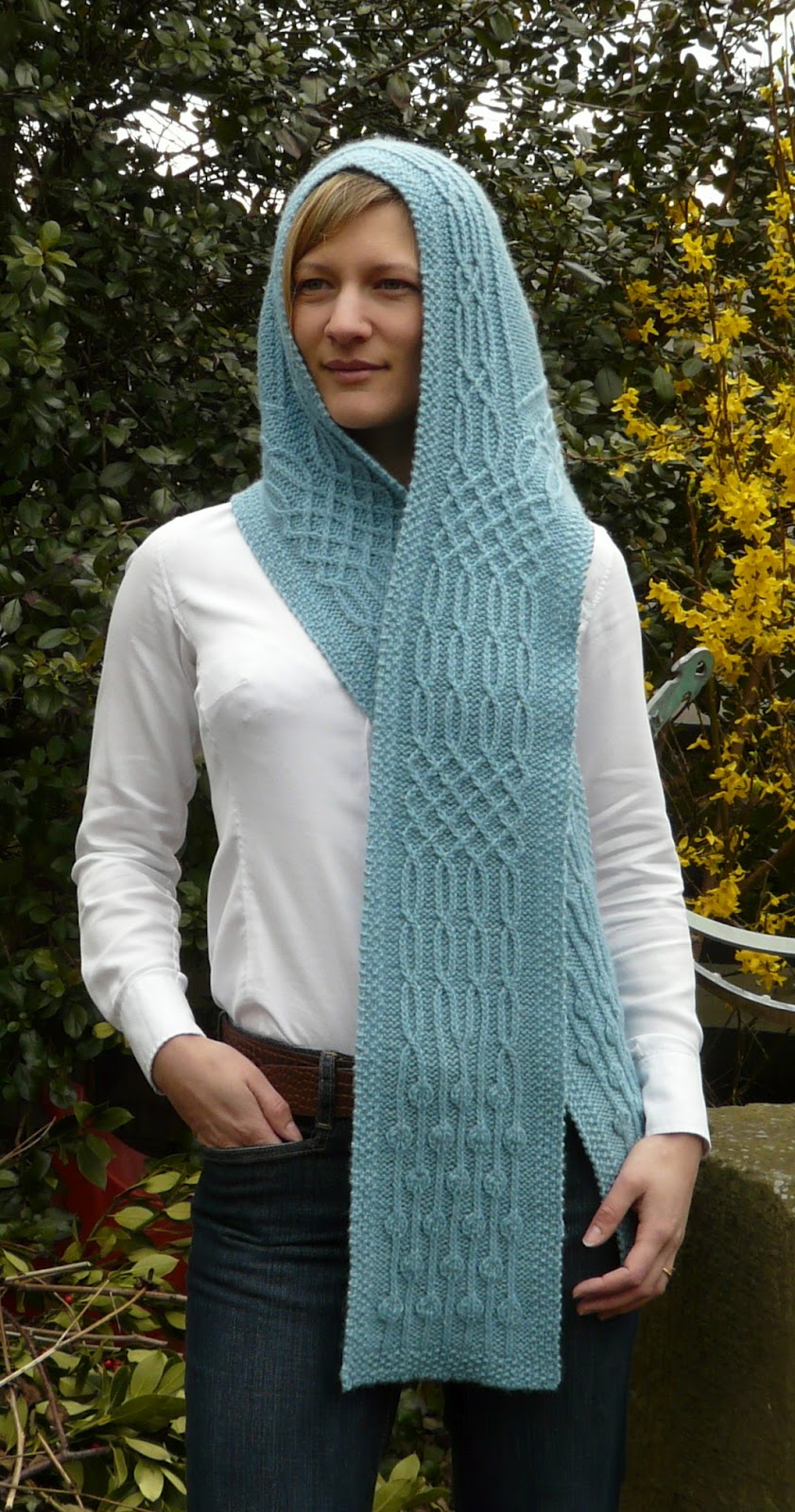
Lanthir Lamath
Some of the designs I had seen before because Ann or Marie were knitting the samples at the George.   One is the cover design, Lanthir Lamath, a hooded scarf.  I wrote about it in a previous post,   A Knitting Puzzle,  when Ann and Marie were both knitting it - Ann was running a knit-along and posting the instructions in weekly instalments via her web site, and Marie was testing the instructions to see if they made sense.

There are also smaller items - socks and fingerless mittens - as well as shawls. I might try one of the pairs of fingerless mittens first - they are extremely pretty. And there is another book to come - Ann was knitting a sample for her second book, and plans to get all the samples knitted by the end of March.  I look forward to seeing that one too - judging by the jumper she was knitting it will be full of really original ideas, again.     

You can find more details of Novel Knits (and buy it)  from Ann's web site.  All the photos in this post are taken from there, with Ann's permission.    

Thursday, 9 February 2012

Knitting for the Army

The "Knitting for Victory" group on Ravelry has been discussing what people knitted for the armed forces in Britain in World War II.  I have come across an official booklet published in 1940 that sets out what type of garment was needed for the Army, with knitting instructions - and also what were not needed.  I'm summarising the contents here partly for the benefit of that group.

1940 guide to knitting comforts for soldiers

The booklet was produced in preparation for the 1940-41 winter (i.e. the second winter of the war, in this country).  By this time, wool was in short supply although clothes rationing was not introduced until June 1941.  The booklet begins by explaining that "There is just enough wool for the knitted garments needed for the coming winter.  BUT THERE IS NOT ENOUGH WOOL TO ALLOW FOR ANY WASTE WHATEVER" and says that waste of wool "was widespread in last winter's knitting efforts".  Therefore knitting for the armed forces has to be carefully organized, to make sure that the garments produced are what's required, and of good quality.  

The booklet specifies four acceptable garments: a cap-muffler, a sleeveless pullover, fingerless mittens extending beyond the wrist, and gum-boot stockings in oiled wool.  The gum-boot stockings can be any colour, but the others should be khaki, or grey if that is unobtainable.


1940 Garments
An obvious omission is a Balaclava helmet.  You get the impression that every knitter in the country rushed into knitting those when war was declared -  but the Army did not want them.  The booklet explains why: the cap-muffler combines two different garments into one, and a soldier could not carry both a helmet and a cap.  It also says that Balaclava helmets don't allow ear-phones to be adjusted in a hurry (by radio operators, presumably) -  though the cap-muffler doesn't really solve that problem, it seems to me.  

The booklet shows a cap-muffler in use.  "A most useful two-in-one garment. Can be used as a cap and muffler, or a muffler alone. Comfortable to wear under steel helmet.  Very easily knitted." (The model looks as though he has grown a moustache to disguise the fact that he's under-age - but perhaps that's me being old.)

Cap-muffler
Gloves, ordinary socks and pullovers with sleeves were not required because they were already being supplied - perhaps machine-knitted?  Mittens, of the specified kind, were useful as well as gloves, for different purposes.  A sleeveless pullover was felt to be "excellent for extra warmth and, being sleeveless, not too bulky under battle dress."

The booklet finishes by describing the working of the Voluntary Knitting Industry.  A complex array of orgaizations had been set up to pass wool from the Wool Controller down to local working parties, and to collect together the knitted garments and eventually issue them to the troops. There was a huge clerical effort involved in recording everything, to ensure that the working parties could get wool at wholesale prices (and presumably also to ensure that all the wool issued was returned, knitted up.)  Since the Government seem to have been perfectly capable of providing soldiers with most of their kit, I do wonder how necessary it was to use volunteer knitters at all, when it required such a huge (voluntary) effort to organize it all. Maybe one advantage was just to off-load some of the cost of clothing the Army to the civilian population - though I'm sure that the knitters also benefited by feeling that they were making a contribution to the war effort.  
Related Posts Plugin for WordPress, Blogger...