On Thursday, we had the first Huddersfield KCG branch meeting of 2016. The plan for the year is to tour the world in knitting, and we began the tour with a workshop on Bavarian Twisted Stitch patterns. Marie had devised several small projects for us to try, from fairly simple to quite complicated - the end result of each is a phone case.
I had already knitted something using Bavarian Twisted Stitches, it turned out - the Baht 'At mittens from Ann Kingstone's Born and Bred book. So I decided I should try the most complicated project - which was a bit daft. I should know by now that in a workshop I'm not usually at my best - I'm not as careful as I should be, I make mistakes. I should choose something simple. But I've done some more work since the workshop (corrected a couple of mistakes) and now I'm making better progress.
I did at least make the sensible decision not to attempt Judy's magic cast on - I've done it before, but I can't remember how to do it, and it would have taken most of the evening by itself. So the bottom of the case is open, and I'll need to sew it up to finish it.
My stitches aren't as neat as they should be (having to correct mistakes doesn't help), but they are getting better, and twisting the stitches does have a remarkably neatening effect anyway. Many of the Bavarian Twisted Stitch motifs have evocative names like "Clover Leaf" or "Ear of Wheat", but this one is apparently called "Large Chain with Twisted Bands". So far I've done one pattern repeat, and I think it's looking good.
Next month's meeting is on British Ganseys, and further ahead I am doing a workshop on Swedish twined knitting. At the time this was planned, I knew almost nothing about Swedish twined knitting, but some progress has been made - a friend has lent me a book on it, and I'm going to start practising.
Mostly about knitting history. Sometimes about what I'm knitting. Sometimes about other things too.
Saturday, 23 January 2016
Thursday, 21 January 2016
A Really Long Sampler
One of the more unusual items we have in the Knitting & Crochet Guild collection is an enormously long sampler of knitting stitches, in a pink synthetic yarn. There are about 950 stitch patterns in it, and it was knitted over several decades from the 1940s on. Gladys, the knitter, intended to get to 1000 stitch patterns, but sadly she had to give up knitting due to arthritis and so never reached her goal. After she died, her family gave the sampler to the Guild, along with the 17 spiral-bound Woolworths notebooks that Gladys used to record the patterns.
When the sampler came to the Guild, it still had the needles and final ball of yarn attached. It has since been cast off and washed (not easy!). It was brought to the Guild weekend in Sheringham two weeks ago - now mounted on a garden hose reel and trolley, so that it can be easily unrolled and re-rolled - a very clever idea, that makes it much more manageable.
I had slip stitch patterns on my mind at the time, because of the slip stitch workshop I did at Sheringham, so on looking through one of Gladys's notebooks, I noticed a slip-stitch pattern.
None of the patterns in the note-books are named, as far as I know, but I recognised this one: it's slip-stitch honeycomb, which I used for the cushion I made last year, It's odd that Gladys didn't record the names - the numbers are not very memorable by themselves. Did she remember all the names, so that she didn't need to write them down? The information from her family is that she invented some of the patterns, and some of them are marked M.U. in the notebooks, which could be 'Made Up' - you would think that she might have named the new patterns as well.
All a bit mysterious - but fascinating.
When the sampler came to the Guild, it still had the needles and final ball of yarn attached. It has since been cast off and washed (not easy!). It was brought to the Guild weekend in Sheringham two weeks ago - now mounted on a garden hose reel and trolley, so that it can be easily unrolled and re-rolled - a very clever idea, that makes it much more manageable.
| The sampler on its hose reel |
| The sampler as Gladys left it |
I had slip stitch patterns on my mind at the time, because of the slip stitch workshop I did at Sheringham, so on looking through one of Gladys's notebooks, I noticed a slip-stitch pattern.
None of the patterns in the note-books are named, as far as I know, but I recognised this one: it's slip-stitch honeycomb, which I used for the cushion I made last year, It's odd that Gladys didn't record the names - the numbers are not very memorable by themselves. Did she remember all the names, so that she didn't need to write them down? The information from her family is that she invented some of the patterns, and some of them are marked M.U. in the notebooks, which could be 'Made Up' - you would think that she might have named the new patterns as well.
All a bit mysterious - but fascinating.
Saturday, 16 January 2016
Seascape Scarf
I said in my last post that I finished knitting a scarf at Sheringham. Here it is.
The pattern is the Spiral Staircase shawl by LizAnn Petch - a free pattern on Ravelry. On the smooth edge, you increase one stitch on every row, which creates a pretty edge, and the curve that you see in the finished scarf.
On the other edge, you cast off ten or so stitches at regular intervals, which controls the width of the scarf/shawl. I wanted it to be a scarf, not a shawl, so I cast off a few more stitches in each step as I went along, so that the width doesn't increase as much as it does in the pattern.
The yarn is Louisa Harding's Amitola (again - I finished Xandy Peters' Petal Cowl in the same yarn in December). It's colourway 106, which is called Seascape. The North Sea, not the Mediterranean, evidently - the colours are quite muted. And it didn't occur to me until I got to Sheringham that it was very appropriate to be knitting in a yarn called Seascape at the seaside. Here's a view of the sea at Sheringham, on Sunday morning when the sun was shining:
The pale browny-grey colour in the scarf, between the two dark grey stripes, seems to me very characteristic of the North Sea.
The self-striping yarn works very well with the pattern - I like the way that the stripes curve across the width of the scarf. I used one ball of Amitola, and the finished scarf goes right round my neck, with the two ends hanging in front. It looks very good - you see diagonal stripes of the different colours of the yarn, and the zigzags around the edge. (Yes, a photo would be a good idea. But I'm trying to find a suitable pin to fasten the two ends together, rather than tying them, or just leaving them to hang - I might get a photo taken when I've found one.) It's very soft and warm, too. And I think I'm getting better at knitting garter stitch - I don't find it easy to keep the stitches even (stocking stitch is much easier) but this is better than previous attempts.
P.S. One of the blogs I follow is Orange Swan's The Knitting Needle and the Damage Done. Many of her posts review knitting magazines, and her comments on the designs are very perceptive, caustic when they need to be, and often very funny. Sometimes I find myself laughing out loud, e.g at "Call me hidebound, but my rule is never to make any knitted garment that sleeps more than two" as a comment on a hugely voluminous top. Worth reading.
Monday, 11 January 2016
Knitting in Sheringham
I have just been to Sheringham, on the north Norfolk coast, for a knitting weekend. It was mainly for the Leighton Buzzard branch of the Knitting & Crochet Guild, but was open to other Guild members too. There were 26 of us altogether, and we took over Sheringham Youth Hostel. There were some talks and workshops, and in between we did a lot of talking and a lot of knitting. The hostel staff provided breakfast and dinner, and it was a really good weekend - thanks very much to Brigitte for organising it.
The theme of Saturday morning was knitting in World War 1, with talks from Rita Taylor and from Lesley Lougher of Sheringham Museum. Lesley talked about an exhibition this summer on Queen Mary's Needlework Guild, and the activities of local women during the war.
In the afternoon, there was a programme of workshops. Back in 2011, I did a workshop with Mary Graham on knitting with wire, and she led another in Sheringham, so it was a good opportunity to have another go. She provided wire, needles and beads, and I knew from my previous attempt that in a couple of hours it is possible to knit something interesting. Here's what I produced in Sheringham:
Being wire you can change its shape quite a lot, so I bent it into a flatter, swirly shape and wore it as brooch for the rest of the day. I was very pleased with my effort, though it's very crude compared to the pieces that Mary knits. She knits things that resemble seed pods and other organic shapes, and are clearly intended to look like that, rather than happening entirely accidentally like mine - her knitting is much more even than I can achieve in wire, too. But I'm happy with my strange little 3-d shape.
In the second workshop session of the afternoon, I repeated the workshop on slip-stitch patterns that I did at the Knitaway weekend in Blackpool last October. It was good to see people successfully knitting very neat samples of linen stitch - or in one case a blanket square in 3-in-1 stitch, in 2 colours.
The Youth Hostel in Sheringham is only about half a mile from the sea, and we had three days of no rain - even some sun on Sunday morning. (I think the first time I've experienced two days in succession without rain since November.) So I walked through the town to the shore a couple of times.
Sheringham is a nice little town - "twixt sea and pine" apparently, though I didn't spot any pine trees. It's now at the end of the railway line from Norwich, but before the Beeching cuts, the line continued and the station was the other side of the main street, beyond a level crossing.
It must have been highly inconvenient to have the traffic held up whenever there was a train, and so when the line was terminated at Sheringham, the station was moved. But the old station is still there, and is now the start of a heritage line to Holt.
Much more attractive than the new station, which has no buildings at all - just a sort of bus shelter. There aren't even any seats, just sloping ledges to rest on. (I'm not feeling very warm towards the operators of the Sheringham-Norwich line, because the train I should have got on my way home was cancelled, and the next one was late, so I was very late getting home.)
You can walk miles along the coast from Sheringham, in either direction, but I didn't have time for a long walk. But you should at least see the sea when you are at the seaside.
I started knitting a small scarf last week, to have something portable and straightforward to work on during the weekend, and I finished it on Saturday. I've wet-blocked it - I'll write about it when it's dry.
Wednesday, 6 January 2016
A Jolly Knitted Outfit for Skating
2016 already. Here's a suitably wintry outfit - though not for this winter, so far. It was the wettest December on record and there have been floods all across the north of England and in Scotland. We haven't been much affected here, but just over the hill in Calderdale, there has been serious flooding all along the valley, with homes and businesses devastated in Todmorden, Hebden Bridge, Mytholmroyd, Sowerby Bridge, Elland, Brighouse, Mirfield... And it's still raining.
Back in 1936, they were expecting a winter cold enough for skating. The illustration is from Home Notes, a weekly magazine. The captions reads: "If you're a skating "fan", you'll love this jolly knitted outfit to wear when you go on the ice." The jumper, skirt, gloves and beret are all in 4-ply (fingering) wool - a lot of work, especially for the skirt, which is below knee length and fuller than ordinary day-wear skirts were then.
Elsewhere in the magazine there is an article encouraging readers to "Try skating this winter" - either at an indoor rink or on open ice. I doubt if there's much skating in open ice in this country now, if any, and I don't know how many permanent ice-skating rinks there are - but I'm pretty confident that no-one knits themselves a special outfit for skating these days.
But I think in the 1930s, there wasn't so much overlap between sports wear and everyday wear as there is now - women then dressed much more smartly as a rule. You couldn't just find some casual clothes in your wardrobe to go skating in - ordinary skirts would be far too narrow, for one thing. The cover of the magazine shows what the skater might wear for every day - the magazine gives the knitting pattern for the puffed-sleeve jumper:
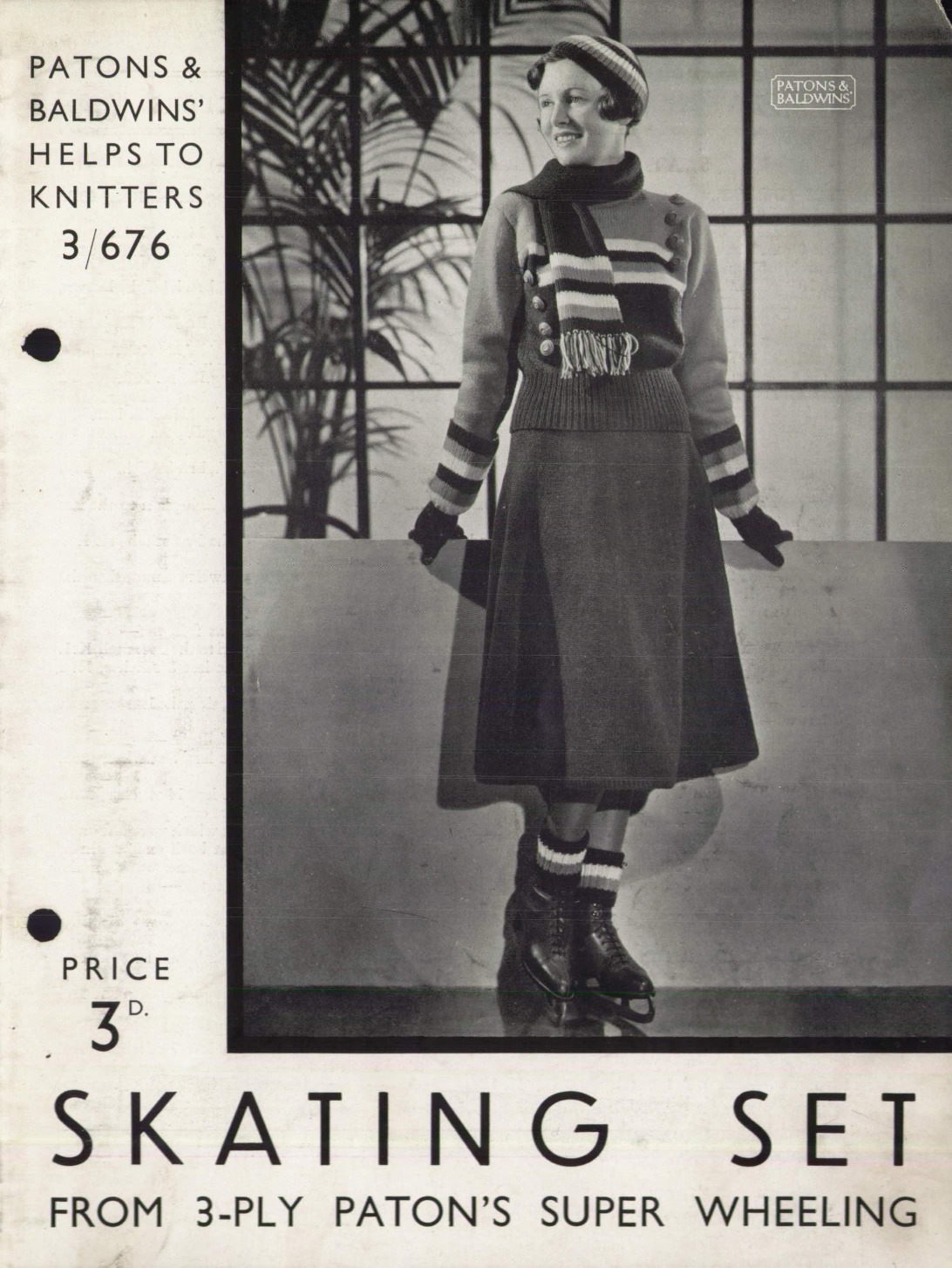
I have seen other 1930s knitting patterns for skating outfits too. The first is in the same colour scheme of brown, red and white as the Home Notes outfit, if you choose the colours suggested in the pattern:
The other was published a few years later, and the skirt is much shorter. The pattern gives instructions for jumper, skirt, knickers, hat, gloves and socks.
It looks much plainer at first sight than the other two, but in fact the hat brim, the sock tops and the gauntlets of the gloves are all in garter stitch stripes, of Mermaid (turquoise?), Rusty (rust-red, I assume), and Mustard, with the rest of the socks, hat and gloves, and I guess also the jumper and skirt, knitted in the Mermaid colour. So it would have been a colourful outfit. - the illustration doesn't do it justice.
And one of my very favourite Jester patterns, from the late 1940s/early 1950s is a winter sports outfit of a sweater with matching mittens and hat, shown with a pair of ice-skates.
.
So for anyone who wants to knit a skating outfit, there is quite a range to choose from. Personally, I'd choose the Jester pattern, but forget about the skating.
Thursday, 31 December 2015
Woven stitch mitts
Unlike some writers of knitting blogs, I don't make many knitted Christmas presents. (Too much pressure!) But this year, I made a pair of fingerless mitts for my daughter - not quite in time for Christmas, but nearly. Here they are.
I made her a pair a few years ago which she still wears (see here), but she keeps those 'for best' and wanted a pair that she could wear every day and not worry about. She wanted a very dark purple, and I found just the right colour in Wendy Merino DK, which I use a lot. It's called Sloe - the colour of sloe gin.
I knitted them in woven stitch, a slip-stitch pattern that does look like woven fabric on the right side. It has a four-row (or four-round) repeat. If you are knitting in rounds, on an even number of stitches, it goes like this:
It is somewhat similar to linen stitch, though much less dense.
The mitts fit well (we kept trying them on as I was knitting) and are reported to be very warm.
I made her a pair a few years ago which she still wears (see here), but she keeps those 'for best' and wanted a pair that she could wear every day and not worry about. She wanted a very dark purple, and I found just the right colour in Wendy Merino DK, which I use a lot. It's called Sloe - the colour of sloe gin.
I knitted them in woven stitch, a slip-stitch pattern that does look like woven fabric on the right side. It has a four-row (or four-round) repeat. If you are knitting in rounds, on an even number of stitches, it goes like this:
Rounds 1 & 3: Knit.
Round 2: (Knit 1, Slip 1 with yarn in front) to end.
Round 4: (Slip 1 with yarn in front, Knit 1) to end.
It is somewhat similar to linen stitch, though much less dense.
The mitts fit well (we kept trying them on as I was knitting) and are reported to be very warm.
Wednesday, 30 December 2015
Petal Cowl
I wrote in November here that I had been browsing around for patterns like the flame stitch I had seen on a shawl in the Chanel to Westwood exhibition, and found Xandy Peters' Petal Cowl pattern. I finished it a while ago, so it's about time I wrote about it.
The pattern is designed to show off a self-striping yarn (4-ply), and Lydia at my local yarn shop in Huddersfield stocks some very nice ones. I chose Louisa Harding's Amitola, a delectable wool/silk mix. The colour is called Gothic, don't know why, and it's not turned out as stripy as I expected - it's more a blend of shades of grey and dark purple, with an occasional flash of red. But never mind - I love the effect.
I reduced the diameter by a third. This was my first attempt at a cowl and I thought I would feel more comfortable wearing something smaller. Also, the pattern tells you to cast on 300 stitches, increasing to 550, and I didn't feel up to tackling a complicated pattern over that many stitches. So I reduced the starting number of stitches to 180.
I should also point out that I wear it upside down - the cast-on edge is at the top. That's because I think it looks better with a red stripe close to the lower edge, rather than a lot of grey.
It is a complicated pattern, and there were a couple of rows in the pattern repeat when I just had to plod through the instructions over and over. But towards the end I felt I understood more what was going on. It took me that long because I didn't do a test swatch - I decided that tension wasn't going to be that crucial, and knitting a test swatch in the round just to try out the pattern seemed like a waste of time. I may have been wrong about that - it did feel when I had finished that really the whole cowl had been a test swatch, and I ought to knit it again now that I understand how it works. And I must confess that there are a few mistakes in the knitting. Once or twice I purled a round instead of knitting, through misreading the pattern, and decided to live with it rather than going back. (On reflection, it's ridiculous that the mistakes are on the plain rounds where you just knit every stitch, rather than on the really complicated rounds, where you have to keep counting stitches.)
Now it's finished, I love it. It's warm, it's soft, the colours work really well with the design, the stitch pattern is absolutely fascinating. I'm quite converted to wearing a cowl - I shall have to knit some more. And it was, in spite of the trickiness of the stitch pattern, a quick knit - I finished it in two or three weeks.
I have thought about knitting Xandy Peters' Fox Paws pattern ('recommended for the adventurous') as a follow up, but I'm not sure I'm feeling adventurous enough. And I've read Yarn Harlot's blog posts about knitting Fox Paws, particularly this one, and I'm not sure I want to have to concentrate that much on what I'm knitting. Not just now.
Subscribe to:
Posts (Atom)