Monday, 20 July 2015

Roses, Pansies and Butterflies

Last Thursday evening, we had the monthly meeting of the Huddersfield branch of the Knitting & Crochet Guild. I had been scheduled to show some of the doileys in the KCG collection - I'm not sure how I had been persuaded to do that, because I am really not a fan of doileys.  Some of them are undoubtedly very pretty, though, and I picked a selection of those for Thursday's meeting.

Roses are a popular motif in doileys, and they often have several layers of petals, as in Irish crochet.   (Not very practical for a mat, whose main function is to be flat, but practicality is really not much of a concern in making doileys, it seems to me.)
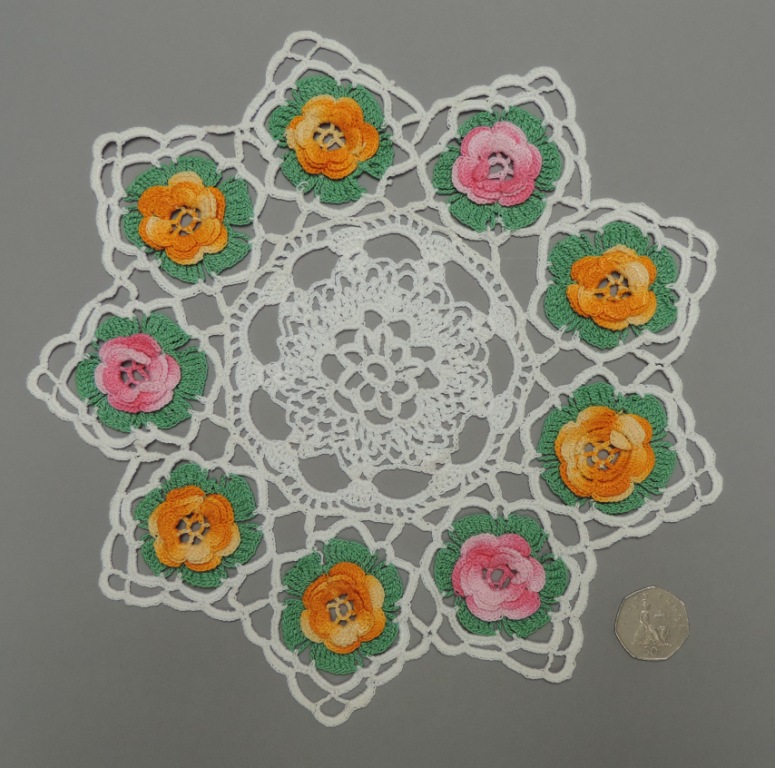


Other Irish crochet motifs also appear in doileys - I particularly like one which has pink daisies round the edge, a ring of leaf motifs and a rose in the middle.


It's possible to crochet quite an accurate pansy shape, and after someone figured that out, pansies became a popular element in doileys, too.  


And, as advertised, there was also a doiley with butterflies.


A doiley that I spent a lot of time on before the meeting was one with a ring of daffodils around the edge.  It had been stored with other doileys on top of it, so the daffodils had been squashed flat.  I washed it and then tweaked and primped it while it was still damp, to make the petals lie flat, and to open out the trumpets and make them stand up.


Most of the people who go to the Huddersfield KCG meetings are knitters, and don't do much crochet, so I also took a selection of knitted doileys.  I found some beautiful and delicate examples in the collection.  


The 3-dimensional crochet doileys, like the ones with daffodils and butterflies, are tricky to store and transport - any weight on top will flatten them.   Angharad had a brainwave and came up with a solution - pizza boxes.  So I went to a local pizza take-away, where they evidently didn't see anything out of the ordinary in selling empty pizza boxes, and now the daffodil and butterfly doileys are nestled in tissue paper, each in their own box  (with a picture of the Grand Canal in Venice on the top).

Monday, 13 July 2015

My Mary Quant Sweater

I finished sewing up a sweater just before the Knitting & Crochet Guild Convention, a couple of weeks ago.  In fact, I started it more than two years ago, in 2013.  I got most of it knitted that summer, and then put it away for the winter, because it's a summer sweater.  I didn't get it out again until this year, and then it sat for a while waiting to be sewn up.  But now it's done, and I've worn it, and it's turned out very well.


It's from a pattern leaflet designed by Mary Quant in 1965, in a collection of about 27 designs that she did for Courtelle knitting yarns (though I knitted it in cotton -  DMC Natura, which is 4-ply/fingering weight).   It appealed to me because it's a neat little sweater in an interesting stitch pattern (it's knitted in a twisted rib), and I like the neckline.

Lee Target 6565
The rest of this post is technical stuff about the details of the original design and the changes I made.  So if you're not a knitter (and assuming that you've got this far), you might not want to read any further.

The stitch pattern is a knit 3, purl 2 rib, but on right side rows you knit into the back of the knit stitches so that they are twisted. The twisting tightens up the knit stitches, though overall the fabric is still very stretchy. The hem and cuffs are done in the same stitch, but on smaller needles. I think it's a really nice effect - the twisting gives it a lively texture.


The neckband is knitted in twisted garter stitch, which I had never met before.  Unlike the twisted rib, the twisted stitches aren't evident, on either side of the work, but they give a much tighter fabric than plain garter stitch, and so a firmer neckband.

I made a few changes to the pattern:  I made both sleeves and body longer. In the original pattern, the sweater was intended to finish more or less on the waist.  The only shaping came from some increases at the sides after the first 6 inches of knitting the body.  I wanted my sweater to be longer, so I needed it to be hip-width around the hem.   So I started with more stitches than in the pattern, and then decreased for the waist.  But rather than putting the decreases at the side seams, I concealed them in the rib: I put the extra stitches in the purl ribs and then gradually removed them.  It's a very neat way of increasing and decreasing when you're knitting a rib stitch. The decreases are hardly visible on the right side, even if you know where to look, though they are more obvious on the wrong side.    

Waist shaping on wrong side

I didn't do any increases above the waist - I decided that the stretchiness of the fabric would be  enough.  And it is.

It looks good, it's nice to wear.  I like the fact that it 's a cool and trendy Mary Quant design (only 50 years late).  Now for my other unfinished projects....    


Monday, 6 July 2015

Sociable Knitting

I have just been away at the Knitting & Crochet Guild annual convention, held this year in Sheffield.  We were staying at Endcliffe village, in University of Sheffield student accommodation.  It was very quiet (most of the students had gone), and the grounds are very green, with mature trees around the modern buildings.


It was a very good weekend - interesting talks and workshops, catching up with people met at previous conventions, seeing new faces.  Seeing some of the beautiful things that have been made in the past year.  Talking (a lot).  Knitting (a lot).

I went to two workshops over the weekend, one by Louise Walker of Sincerely Louise,who also gave a talk on Faux Taxidermy the subject of her forthcoming book. If you want to knit a tiger-skin rug, or a knitted triceratops head on your wall, Louise is your woman.  Her workshop was on Photographing your Knits - lots of useful information about the importance of lighting, and making best use of the facilities of your camera.  As a result, I've discovered several options on my camera that I didn't know were there, and I an definitely going to buy a proper photographic background.  Hopefully, future images in this blog will be better as a result.

The other workshop, by Judy Jones, was Knitting & Crochet for More than Two Hands, aka Sociable Knitting (or Sociable Crochet).  We worked in groups of four, each group working on a square blanket, either crocheted or knitted.  Judy had brought along two part-knitted blankets, one of which had been worked sociably several times before.  The other, which I was working on, started off as just a plain square, about 12 inches on each side, that Judy had made for us.   Each knitter has their own ball of yarn, and two knitters opposite each other do two increases at each corner, while the other two just knit. So when everyone has knitted one round, four rounds have been knitted altogether, and there are 16 more stitches on the needles.


Our little square was quite tricky to work on at first - we  were working very close together and there wasn't a lot of room for four pairs of hands. but by the end of the workshop, it was quite a bit bigger and easier to work.  


 It's a very sociable activity, and very satisfying because, of course, the square grows four times as fast as if you were working on your own.


The sociable crochet piece looked equally interesting - a sort of giant granny square.

.
 It would be a great activity for Knit in Public Day - other Guild members were fascinated to see what we were doing, so it would attract a lot of attention.

Monday, 29 June 2015

1920s Knitwear


Among the postcards in the Knitting & Crochet Guild collection is a group of four promotional cards, posted in 1926 and 1927. They were sent by Hawke Bros. and Gibson, Ltd., of Trinity Works, Newquay, to a customer (or potential customer), Messrs. Harmers, of The Parade in Redditch.   Hawke Bros. and Gibson made a range of knitwear for women, 'Trin-Knit-Ana'  (awful name), and the cards illustrate current models.


The earliest  has a photo captioned "We are waiting...." and shows a model sitting against a painted background (including the fence that she is apparently sitting on), with a dog (probably stuffed).  The printed message reads:
Dear Sir or Madame,
"We are waiting" for the favour of your instructions to forward the swatch of this new Cape Model (Jumper 28/6,  Skirt 22/6,  Cape 22/6).  It is made in our Mollaine quality (best fine gauge botany) of which we run 32 colours.  The cape lining and jumper collar are made in a toning shade. ... We are exhibiting as usual at the Fashions Exhibition, Holland Park. May we send you a ticket later?
(28/6 is a price: 28 shillings and sixpence.  If you want to know more, this note might help.  According to a historic inflation calculator, the present day equivalent would be  £77.35.  I assume this is the wholesale price.)


The second postcard shows a Jacquard Cardigan, price 39/6, in two colours of Art Silk (rayon) combined with two colours of wool - you would need to see the swatch in this case to get any real idea of what the fabric looked like.

The last two cards show outfits in an art silk/ wool blend: cardigans and skirts, with a matching sleeveless top in card no. 8.   This one also names the model, Miss Norah Baker.  Was she famous?   I haven't been able to find out.


These outfits are not high fashion, though they do show the influence of Chanel's cardigan suits reaching as far as Cornwall.   I guess they were what the averagely well-dressed woman might have worn.  And they look so much freer and more comfortable to wear than the rigid and constrained fashions of only 15 years before, in the last years before the First World War.  The change must have been welcomed with a sigh of relief.

Thursday, 18 June 2015

Howard's Way

When I'm sorting knitting pattern leaflets in the Knitting & Crochet Guild collection, sometimes I see a design that appeals to me (even among the worst excesses of the 1970s and 1980s you can find the occasional design that still looks good), or an interesting stitch pattern.  Or sometimes I notice a pattern because I recognise the model (e.g. here).   And sometimes a leaflet refers to things that were happening outside the world of knitting, as in three Emu leaflets I saw this week.

Emu 4986 modelled by Glyn Owen (Jack Rolfe)

Emu 4988 modelled by Maurice Colbourne (Tom Howard)
 
Emu 4990 modelled by Stephen Yardley (Ken Masters)
 Remember Howard's Way?   Actually, I never watched it, though I do remember that it was a much talked about TV series in the late 1980s.  It was something like a BBC version of Dallas and Dynasty (so not in fact very like either).  It centred on a boatyard on the south coast of England, hence the slightly nautical air to the three Emu designs, especially Tom Howard's blue sort-of gansey.  I think the three designs still look good as casual chunky knits for men.  I don't personally like dropped shoulders, which seem very 1980s to me, but there have been lots of dropped shoulders around recently (for instance in Rowan Magazine) so clearly I am not one to judge.

Here's Wikipedia's summary of the main characters in Howard's Way, including the three characters shown on the Emu leaflets:
The protagonists in the early episodes are the titular Howard family—Tom (Maurice Colbourne), wife Jan (Jan Harvey) and grown-up children Leo (Edward Highmore) and Lynne (Tracey Childs). Tom is made redundant from his job as an aircraft designer after twenty years and is unwilling to re-enter the rat race. A sailing enthusiast, Tom decides to pursue his dream of designing and building boats, putting his redundancy pay-out into the ailing Mermaid boatyard, run by Jack Rolfe (Glyn Owen), a gruff traditionalist, and his daughter Avril (Susan Gilmore). Tom immediately finds himself in conflict with Jack, whose reliance on the bottle and resentment of Tom's new design ideas threaten the business, but has an ally in Avril, who turns out to be the real driving force behind the yard with her cool, businesslike brain. Jan, who has spent the last twenty years raising the children and building the family home, is less than impressed with her husband's risky new venture and finds herself pursuing her own life outside the family through establishing a new marine boutique whilst working for flash "medallion man" Ken Masters (Stephen Yardley).
There are probably some leaflets in the Howard's Way Collection that we don't have (leaflets 4987 and 4989, for instance) and perhaps those were modelled by Jan Harvey, Susan Gilmore and some of the other women in the series.  It would be interesting to see what those designs look like - I suspect that designs for women will look a lot more dated.

For anyone who wants to take a nostalgic look at Howard's Way, or see what it was all about, you can find clips on YouTube.  Here's the first part of the first episode:


Sunday, 14 June 2015

New premises for Spun

Nearly 5 years ago, a new yarn shop opened in Huddersfield, in the Byram Arcade.  Since then, Spun has flourished, and yesterday Lydia  (the owner) moved into new premises.


The shop is still in the Byram Arcade, but is now on the ground floor instead of the second floor, where it will be more visible and easier to find.  The ground floor of the arcade is always busy, and just a few yards away on the other side of the arcade are the Blue Rooms, the cafe where the Huddersfield branch of the Knitting & Crochet Guild meets.  So it will all be much more convenient for local knitters!


Inside, it feels light and spacious, with the huge window onto the arcade.  The previous occupiers had painted the walls dark red - white is a great improvement.   The stairs lead to a mezzanine area, for workshops and knitting groups (where I'll be spending Thursday mornings in future).

   
The shop window looks very festive, with a woolly bike (something to do with the Tour de France 2014, I think) and a rocking chair decorated by local students.   

And there were some new yarns in stock for the opening - very enticing.  Congratulations, Lydia - I wish you every success in the new shop.


Saturday, 13 June 2015

Bulgaria, this time

We have been on holiday (again!), this time to Bulgaria.  It was a tour for the Huddersfield & Disctrict Archaeological Society, visiting sites across Bulgaria and covering a huge timescale:   from an Iron Age dolmen near Hlyabovo, and the Thracian tombs near Mezek and at  Kazanlak, via Roman towns and villas, to medieval castles and churches, 18th-19th century houses and a 20th century garden.   Here's a selection of photos.

The dolmen near Hlyabovo
The Mosaic Museum at Devnya, built over a Roman house  
The castle walls at Veliko Turnovo

The garden at Balchik

Queen Marie of Romania had a garden made for her at Balchik, on the Black Sea coast, with several little villas for herself and guests.  She liked to spend her summers there, and if I had a garden like that, so would I.  The roses were at their best when we were there, and wonderful.

An old house in traditional style on the Black Sea, at Sozopol.


The full moon over the Monument to 1300 years of Bulgarian history, built 1981, at Shumen  

And we saw some knitting - in a couple of the places we visited, there were hand-knitted lace tablecloths for sale, including several hanging on the wall of a house in the old town of Sozopol, on the Black Sea coast.   Very good value, considering the amount of work that must go into them. (Though I didn't buy one, because what would I do with a circular lace tablecloth?)

Knitted lace tablecloths at Sozopol

A lot of the sites we visited were out in the countryside, so we saw a lot of wild flowers, and butterflies.  It feels such an achievement to be able to get a good photo of a butterfly that I have included some here.


And as you can see, we had very good weather - hot and sunny, but not too hot.  It was quite a shock to come home to distinctly chilly temperatures.  (Flaming June!)  

It was a fascinating holiday.  I knew very little about Bulgaria before we went, and I've learnt a lot.  I'd like to go back and visit Sofia and the Black Sea coast again.  
Related Posts Plugin for WordPress, Blogger...