Thursday, 20 May 2010

The Sixties before Miniskirts

On the drive from Ashland to Portland up the I5, we stopped at a little town called Cottage Grove for lunch - we knew from a previous stop that there is a historic district around the Main Street, with a nice cafe attached to a second-hand bookstore (thus combining two of our favourite occupations).  

 This time, further along Main Street, we found a craft shop called Past 45  (next to the machine-gun store, oddly).  It is an outlet for a wide range of craft goods made by Cottage Grove seniors (knitted dishcloths and baby clothes,  crocheted items, some very well-made wooden furniture, and much more).  But the reason we were there is that evidently some seniors were selling off their old knitting and crochet magazines and pattern books, for 10 cents each.  10 cents!!  I could have bought a selection of Vogue Knitting magazines from the 80s and 90s for a dollar - except that I already have some, as I described in a previous post.

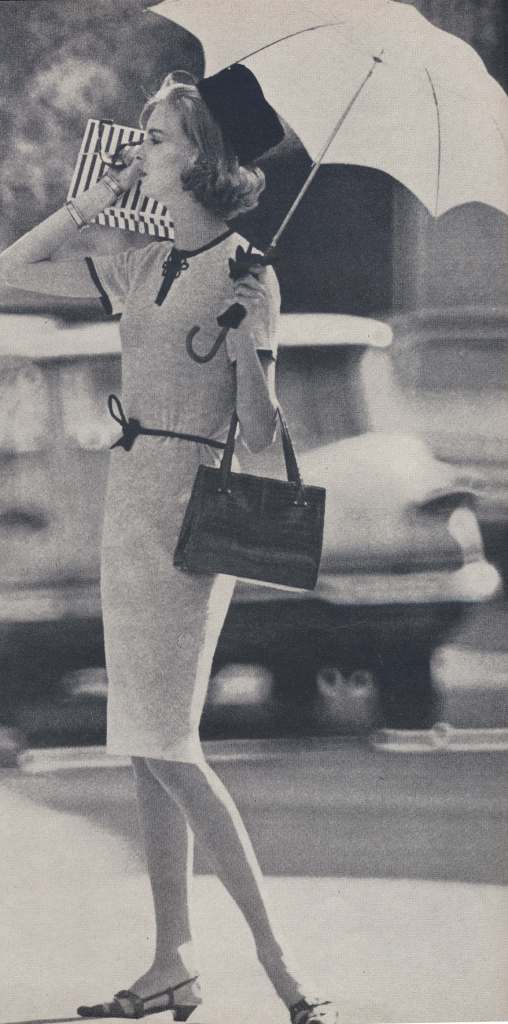
Vogue Knitting 1962

So instead, I bought a few older issues of Vogue Knitting from the early 60s.  They don't contain any patterns that I would want to knit, but I'm interested in how knitting has developed and changed - and on this evidence,  the early 60s were not a good time to be a knitter.  I think it's probably that high fashion at that time (as represented by Vogue)  was unsympathetic to knitting - I'm sure that ordinary knitters like my mother carried on making the kind of clothes (jumpers, cardigans, pullovers, ...) that they always had.   Although there are some casual sweaters, the majority of patterns for women in these issues are for dresses, coats, jackets, skirt suits, and similar smart ensembles.  The knitting is unambitious and to me looks uninteresting - the skirts are invariably straight or very slightly flared and there is a lot of plain stocking stitch or other simple patterns.  Any interesting detail, like the contrast trim on the dress in the photo, is often applied after the knitting is finished.  The simplest skirts are just a cylindrical tube, with some narrowing at the top and an elasticated waist - boring to make and boring to wear.  All these dresses and skirts are completely impractical too - they would  stretch out of shape the instant you sat down in them.  From looking at the photos, I can't help thinking that the ideal was to make something that didn't actually look knitted.


And then....  miniskirts, tights, skinny rib sweaters and all the rest of what we think of as Sixties fashion came along.  Everything changed - mostly for the better.  At least we were saved from having to look elegant.

Sunday, 16 May 2010

Holiday Yarn Shopping

We're just back from our holiday in Oregon - fortunately, we had no delays to our flight back, even though the volcano is still erupting.  We had a great holiday - quite busy, not much knitting done.
Ashland Peace Wall

We stayed with a friend in Ashland, in southern Oregon,  for a few days during the trip.  Ashland is a good place to visit, largely populated by hippies, it seems.  (The Peace Wall is at the entrance to the Ashland Co-op.)   The town has a lot of visitors because of its famous Shakespeare Festival - we saw an excellent production of Hamlet while we were there. 

Our friend drew up a walking tour of the town for us, including a visit to Websters, a yarn shop on the town's main square. They stock a huge range of delectable yarns.  Some were familiar, like Rowan, Debbie Bliss, Louise Harding, Noro.  (It seemed quite strange, in fact, to be so far from home and see Rowan yarns  that have also come from West Yorkshire.)  They stock the Isager yarns,  that I would like to use one day  - I have one of Marianne Isager's books, and I plan to get her Classic Knits book too, but  the yarn doesn't seem to be available in the U.K.  And there were many other yarns that were new to me. 

So what did I buy?  Not a lot - I have several things in progress, and several more projects planned, and I feel a bit uncomfortable already about the amount of yarn I already have.  (There's a confession! I don't much like having a lot of yarn waiting to be knitted, and don't want to buy more until I have used some of what I already have. I don't like having a big stash of yarn.)  But I did want to buy something, if only as a holiday souvenir. Webster's had a good selection of fine yarn, that seems to be difficult to find at home, and I bought one ball of a lace weight yarn from Classic Elite Yarns, in a silk and alpaca mix, which is beautifully soft.  With such a fine yarn, one ball would be sufficient to knit a scarf; you can just stop knitting when you  run out of yarn, more or less.  I did think afterwards that I have been buying rather  a lot of grey lately and maybe I should have been a bit more adventurous in choosing a colour.  On the other hand, grey seems an appropriate choice for a cobwebby kind of scarf. 

And I bought a pair of wooden knitting needles, size 3.5 mm, which is a standard American size (size 4) but not a standard British size.   I bought a set of bamboo needles a while ago, in metric sizes, and I currently have two projects in progress that use the 3.5 mm needles, so it is very inconvenient having only one pair of needles in that size.

One ball of yarn and one pair of needles seems a bit meagre as the outcome of a visit to a fantastic yarn shop, but I am happy with my loot.  Next time, I'll be more prepared and leave a  space in my suitcase.

Sunday, 2 May 2010

Revisiting a Past Project

Royal College Aran

The photo is from a "Fashion Workshop" collection of ideas for things to make  published by a long-defunct UK fashion magazine, Over21, in Autumn/Winter 1973.  It included several knitting patterns, including this one, titled Royal College Aran.   The blurb says "Fresh from a design course at the Royal College of Art, Susan Duckworth turned her talents to the traditional and folksy charm of  Aran, slicked up with  a '74 shape and doughboy pockets."

(Susan Duckworth is still a knitwear designer, and has become well-known and successful since her Royal College days, though she has mostly focussed on multicoloured designs using intarsia, it seems.)

I loved the look of this sweater when I first saw it, and how it made Aran stylish. My sister and I both knitted it for ourselves.   

By then I had already knitted myself several jumpers, though I can't remember most of them, and I had  knitted a traditional Aran jumper - they had become very popular round about then for women, I think for the first time.  That first Aran jumper no longer survives - I must have worn it out eventually.  (In my memory, winters were a lot colder then, partly because my parents' house had no heating except in two downstairs rooms. So an Aran jumper got a lot of wear.) 

I still have my Royal College Aran and wear it.  The design looks fresh and current to me, even now (though it seems rather quaint to read that it's a 1974 shape, as if that makes it new and exciting).  I have just packed it away for the summer, but I will add a photo later.

(Much, much later - in fact January 2013.)  I have been wearing the jumper again this week because it has been very cold.  It still looks up-to-date, I think, in spite of being nearly 40 years old.    You can see that I made a couple of changes: I did a twisted rib instead of a plain rib.  I made the cuffs ribbed, too,  instead of stocking stitch, and just had a single turn-back, instead of turning it over twice as shown.  And I continued the honeycomb cable up to the shoulder seams.    It is still very nice to wear.


Monday, 26 April 2010

Starting out

Today's Knitting and Crochet Blog Week topic is "Starting out":
How and when did you begin knitting/crocheting?

OK.... I learnt to knit in the 1950s, when I was about seven or eight, I think.  I had a doll's dress (or maybe it was my sister's) that was probably crocheted, in a green kind of silky thread, and it had hole in it, and I asked my mother to teach me to knit so that I could mend it.  Of course, I never did manage to mend it by knitting, but instead of explaining that it wouldn't work, she cunningly taught me to knit first.   I think that I made a hat out of a rectangle of garter stitch that was then folded in half and then sewn up down the sides.  I sort of remember that it was red.   The blurry photo shows me wearing a similar hat, though I'm not sure if it was one I knitted.

I don't remember knitting anything much after that until I was a teenager, when my sister and I both started knitting jumpers for ourselves - until then my mother did a lot of knitting for both of us.  In the sixties, knitting started to get exciting,  with designers such as Kaffe Fassett and Susan Duckworth starting out and publishing patterns.  I plan to write about  one of the jumpers we knitted then, later in the week. 

Knitting and Crochet Blog Week

After several days of nothing happening, we got our flight to the US rearranged for yesterday. So we're now in Oregon staying with our daughter and looking forward to a great holiday.


Knitting and Crochet Blog Week starts tomorrow, with a suggested topic for each day.  I planned to take part, if we didn't manage to get a flight, and I have some pieces already more or less written, so will post them on the appropriate day, or as soon afterwards as I can get internet access.    


Tuesday, 20 April 2010

Knitting stick

We are supposed to be on a flight to the US, from Manchester via Amsterdam, at this very moment, but because of the  Eyjafjallajökull eruption in Iceland, Manchester airport is still closed so we are still here.  I'm feeling thoroughly miserable - the purpose of the trip was primarily to visit our daughter whom we haven't seen since September.  I have no idea when or if we shall be able to rearrange the flights, so I'm blogging instead.

Earlier this month, John went to the Newark Antiques Fair with some friends.  It is supposed to be the largest antiques fair in the country, and he had a great time there and bought lots of things.  (Mostly very cheap, he claims.)

He gave me a knitting stick that he bought at the fair - a lovely gift (even if partly intended to salve his conscience).    It's a simple turned shape, with nothing to show who it was made for, or when or where, but I imagine that it's 19th century and maybe from the north of England.

   
The end of the stick is hollowed out, with a brass knurled ring set into it, and an ivory or bone (?) ring set into that, to hold the end of the knitting needle.

The stick is intended to be  tucked into a belt or waistband, so that it can hold the right needle steady.  It allowed knitters to knit outdoors, while they were walking.  An article by Kate Davies on Knitting Outdoors, in Rowan Knitting and Crochet Magazine 47, discusses how knitting sticks and similar gadgets were used to facilitate knitting while on the move and doing other things at the same time.  She also has a blog post with photos of plain and fancy knitting sticks.  

It would be interesting to try knitting with my knitting stick, with double-pointed needles, although the bone ring doesn't seem to be very firmly fixed so maybe not.  Knitting with a stick ought to be similar to knitting with the right needle fixed under your arm, which is what I do,  so maybe it would make it easier for me to knit in the round.

Saturday, 10 April 2010

Updating a Classic

I have had a copy of Marion Foale's Classic Knitwear for years (though I think that strictly speaking it is my sister's and I have it on long loan).  It was published in 1985, when I was not knitting, so I have never made any of the jumpers in the book (although I did persuade my mother to knit one for me).   Since I started knitting again, I have had it in mind to knit one of them some time. 


The jumpers and cardigans in the book are quite simple designs, and the stitches are not complicated.  They are all knitted in one colour, too. But they are all, I thought, very wearable - classics, in fact.


However, when I came to look at the patterns in detail, with a serious intention to knit one, I saw that they won't do.  The shapes are wrong for today - they are mostly very loose-fitting, in the body and the sleeves, and they all have dropped shoulders, which makes for bagginess around the armholes. Many of the jumpers have a close fitting rib, followed by an increase in the number of stitches, as well as a change to a larger needle.  That means that the waist is much wider than the hips - nowadays we make jumpers much more close-fitting.     


The jumper I wanted to knit, Badminton, is actually described as "a long slender shape", though to a modern eye it looks very roomy, especially around the waist and armholes. The waist is 6 inches bigger than the waist size it is intended for, and the tops of the sleeves are very wide too. 

But it still is basically a very appealing jumper, I think.  I love the  vertical lines (each is a single stitch in moss stitch (aka seed stitch)), and the square neckline, also in moss stitch.  So I am attempting to knit a slimmer version with set-in sleeves. I am using a straightforward modern pattern for DK yarn, and morphing that into Badminton

 The yarn I am using is Wendy Supreme mercerised cotton (DK weight)  - thicker than the yarn originally  intended.   The colour is a sort of blue-green (teal?). I'll report progress later.
Related Posts Plugin for WordPress, Blogger...