Showing posts with label Fair Isle. Show all posts

Thursday, 27 February 2020

Jumpers and Sports Wear in 1931


 Leach's Sixpenny Knitting Series was published from 1920 to 1935, according to the British Library catalogue - I wrote about one of the series in my last post.  We have a few of the issues in the Knitting & Crochet Guild collection, including the 'Jaeger Hand Knit Jumpers and Sports Wear' shown above.  It is marked as one of Leach's Sixpenny Knitting Series on the cover, though without a number, and also as 'Jaeger Hand-Knit No. 7' - there was evidently an arrangement that Leach's would publish Jaeger pattern booklets in this way.  There is no date explicitly given in the booklet, but a Jaeger knitting competition is advertised with a closing date in January 1932, so it must have been published in 1931. 

The booklet has several patterns for women, all very smart as you would expect from Jaeger.  There is the 'Attractive Sports Three-piece with matching beret', illustrated on the cover - a cardigan and skirt in a flecked wool to imitate tweed, and a very nice collared jumper in dark brown with orange spots. Also shown on the cover is a 'smart over-blouse', in camel colour with blue diamonds.

Of the other patterns, the most interesting technically is a Fair Isle jumper.  The pattern is headed '"Fair Isle" Patterns are Still in Favour' - the fashion for Fair Isle sports jumpers had started in the early 1920s, so perhaps it was noteworthy that they were still in vogue in 1931. 


I was surprised to see that the knitter is advised to knit the body, up to the armholes, on a circular needle, 'which makes the knitting very simple'.  I knew that circular needles were available in the 1920s, but had not previously seen them specified in a pattern. Here's an ad from 1923 for Flexiknit needles:

     
The sleeves of the Fair Isle jumper are also to be knitted in the round, from the cuff up, but on double pointed needles, I think because small diameter circulars were not available, and the cables were wire, so not flexible enough for magic loop or any similar technique.

Another novel feature of the Fair Isle jumper is that there is a band of stranded knitting sandwiched between two bands of corrugated rib in the cuffs and the lower edge.  I don't think I have ever seen that before - an interesting idea.  The suggested colours of the jumper are camel for the background, with orange, dark green, dark red, navy blue, Saxe blue, peach, brown and green. 

Another garment in the booklet looks surprisingly modern - 'A Jumper-Coat in Two Colours - a fastens smartly with a zip fastener as many of the newest models do'. 


According to Wikipedia, although zips had been invented in the 19th century, they only began to be used on clothes around 1925, initially on leather jackets, so this knitted jumper-coat would have looked very new.

Another outfit with a matching beret has an unusual side fastening to the jumper, and the skirt ribs imitate pleating.  (I like her fancy shoes, too.) 

 
And 'note the uncommon trimming on the beret':


There are a few other patterns in the booklet, too, for a V-neck jumper in cashmere, and a couple of cardigans - all plain and simple, but smart.

Finally, I mentioned in an earlier post that I had found a pair of Jaeger knitting needles, and that I thought that they were made around 1930 because of the lettering.  Here's the evidence, in an ad for Jaeger Floss in this booklet:


Same lettering.  QED.   I don't think I have seen that logo anywhere else. Here's a logo used elsewhere in the booklet:


For anyone who likes 1930s knitwear, or would like to look at the patterns in detail, a scanned copy of  'Jaeger Hand Knit Jumpers and Sports Wear' is on the Knitting & Crochet Guild website for Guild members to download. 

Thursday, 10 October 2019

Shetland Wool Week

Last week I was in Shetland, staying in Lerwick, for the 10th Shetland Wool Week. I had never been to Shetland before (or in fact anywhere that far north), so it was a fascinating week, quite apart from all the knitting-related activities. And we were extremely lucky with the weather, which was mostly dry and often very sunny, while back home in England it was raining for most of the week - a lot.

Walking along the Esplanade at Lerwick every day, there were wonderful views of boats anchored, and the sound beyond, dividing the mainland from Bressay island. This was the view over Hay's Dock, in front of the Shetland Museum, on a beautiful evening. 


I arrived on Saturday, and my first Wool Week event was the Welcome on Sunday evening.  500 people were there - so as there were 1,000 people attending Wool Week, a lot were disappointed.  I wrote here about knitting my Wool Week beanie, in this year's design.  At the Welcome, almost everyone was wearing their beanie, and there was a group photo at the end of the evening.


A photo of the Wool Week Welcome evening from BBC News.  I was there, wearing my Roadside beanie, though I can't see myself in this photo.

I spotted a couple of beanies that had substituted an image of something else for the fishing boats. A bicycle:


or a plane. Actually, I was told, a Bristol Blenheim, which has a WW2 Shetland connection.


Most people attending Wool Week wore their beanies whenever they were outdoors (and it was cool enough that you wanted to be wearing a hat anyway).  It was a useful way of identifying fellow knitters too, and starting a conversation.

I hadn't booked any of the classes, partly because John had intended to come with me, but couldn't in the end.  So we had planned to see Shetland together.  One Wool Week event I had booked for both of us was a bus tour west to Vementry, and to Ollaberry and Islesburgh in North Mainland. It was a (mostly) fine day, and a good opportunity to see more of the Shetland landscape.  You never seem to be far from a loch or the sea on Shetland.

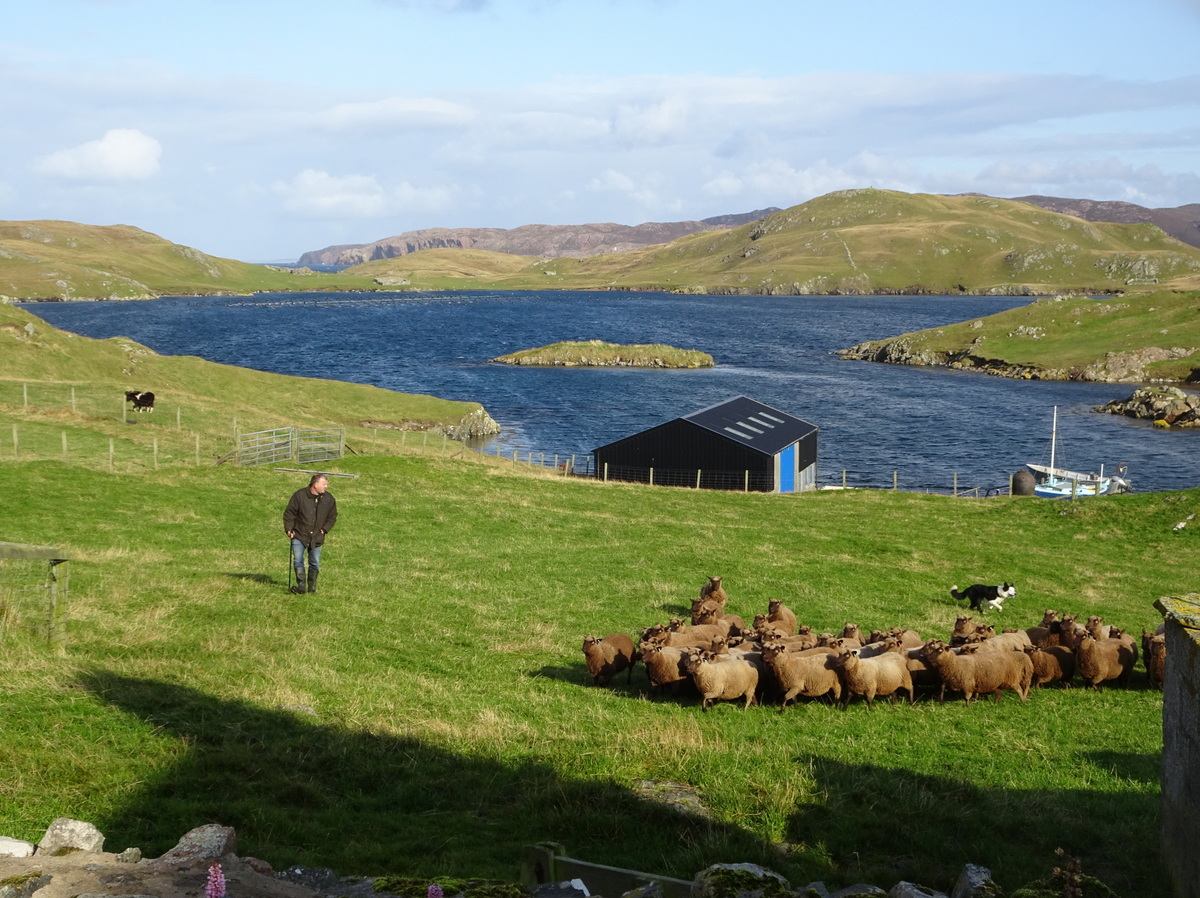
Gathering sheep at Vementry
At Vementry, we saw their prize-winning Shetland sheep, mostly moorit (i.e brown), and Shetland ponies. It's a beautiful spot, overlooking the shore, and (I think) Vementry Island in the distance.

We had lunch at Ollaberry Community Hall - a lavish spread of homebakes laid on by local women. There was an exhibition of knitwear - some new, some that had been kept carefully, for many years in some cases.  I was very taken with the large lampshade in Print o' the Wave (one of my favourite lace stitch patterns):


I also liked an outfit from the late 1960s, mainly because of its story.  Its owner said that her mother had knitted it for her when she went off to college in Aberdeen. There was a photo of her with friends, about to get the ferry, and wearing the outfit with a much shorter skirt - though actually, she said, she never wore it much because it wasn't really in fashion at the time. And her mother thought it was much too short, and added a piece to make it longer. A very 1960s teenage experience.


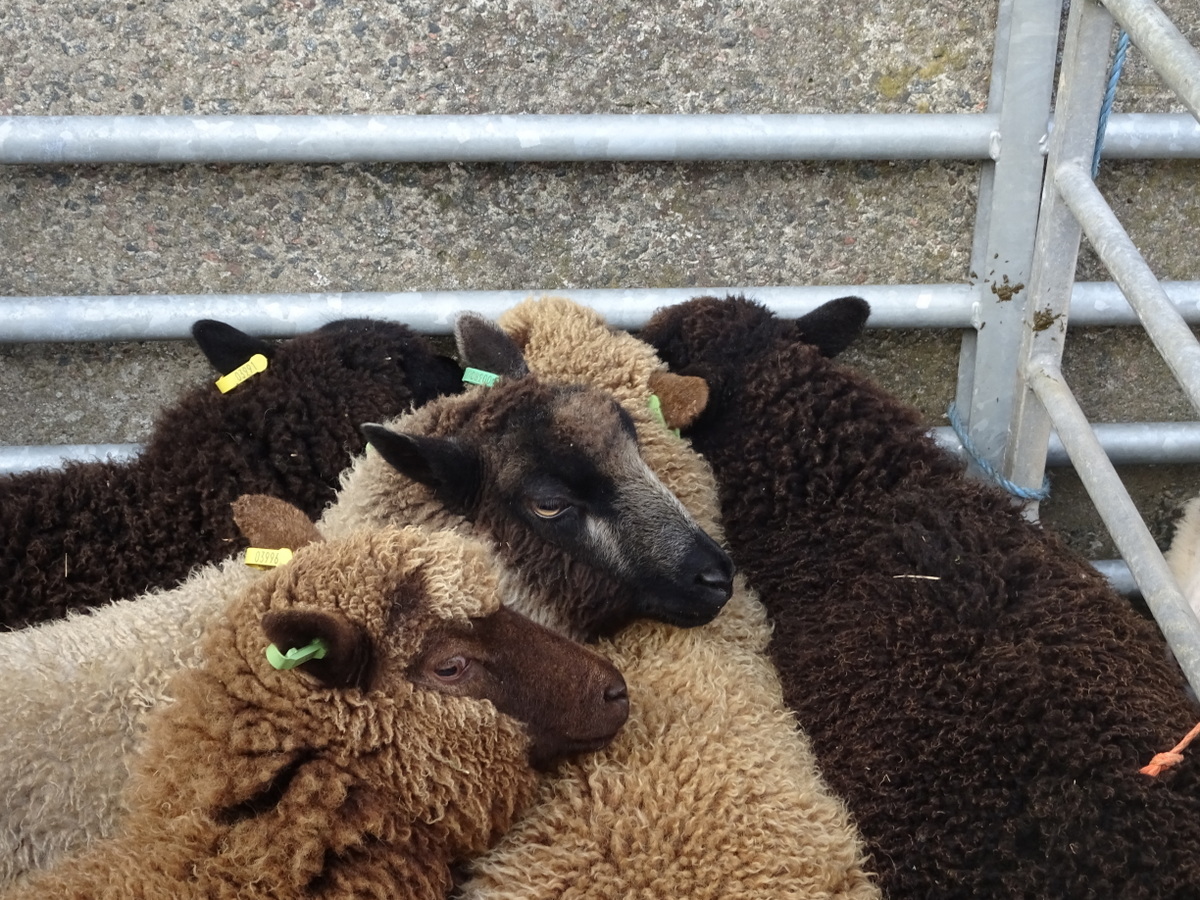
We ended the day at Islesburgh Farm, where we saw more prize-winning Shetland sheep, of several colours. (Some sheep evidently think that if they can't see you, you can't see them. They were mostly trying to hide their heads underneath another sheep.)


Another day, I went on a tour of Chris Dyer's croft on Bressay, a short ferry ride from Lerwick.  We saw more sheep - here Chris and his dog are driving them:


Chris has pigs and piglets, too.  And tomatoes, courgettes and peppers growing in a Polycrub, a specially strong version of a polytunnel, designed to withstand Shetland winds. He talked to us about his approach to running the croft, alongside his main job as an archaeologist.

Chris took us to the Speldiburn cafe on Bressay for lunch, where there was another exhibition of knitwear.  Again, some new, some old.  I particularly liked a couple of children's pullovers from the 1950s, both mainly pastel colours on a dark brown background. I don't think I know enough to judge, but that kind of colour combination seems to me to be different from  modern Fair Isle designs.


.


One day when I had no Wool Week events booked, I went for a walk around Lerwick, first past a group of old houses built almost in the sea, the lodberries, one of which is Jimmy Perez's house in the TV version of the Shetland books by Ann Cleeves.

 
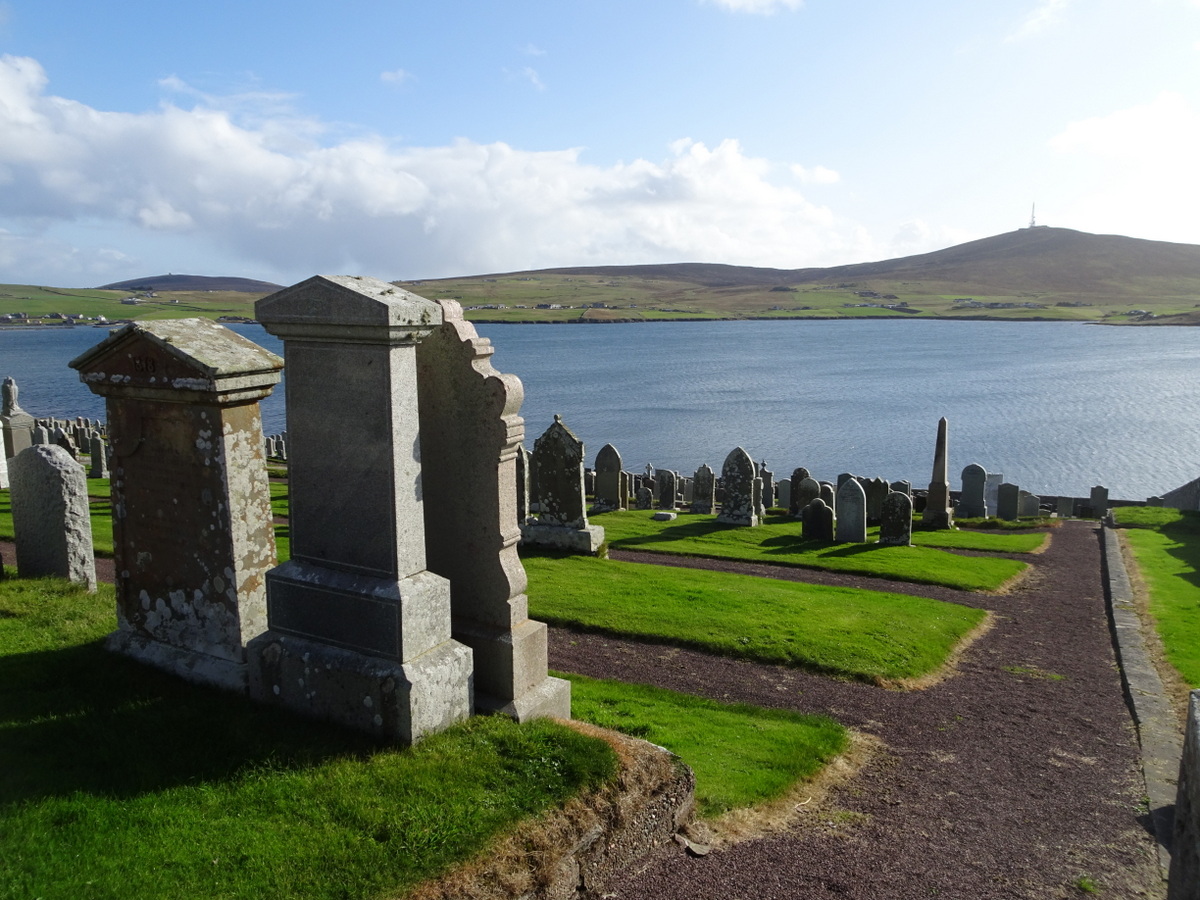
 On towards the Knab, the headland at the end of the road, where there is a cemetery with I think the best view of any cemetery I have seen.


There are a number of war graves in the cemetery, of men who were stationed on Shetland. So they were not necessarily Shetlanders - some were in fact Norwegian.


Here's the Knab, and the view south towards the open sea.


The path follows the shore from there (towards Tesco).  I hoped to see some seals on the rocks, but there weren't any, though I did see a lot of birds including a group of oystercatchers (called shalders in Shetland).


Another day, I got the bus to Scalloway, a fishing port about 6 miles from Lerwick, with an interesting museum, a castle, and some very picturesque houses along the harbour. 

.
The base for Wool Week was the Shetland Museum in Lerwick, which is excellent. It has displays on the archaeology and history of the islands, including Gunnister Man, who died about 1700.  His body was found in a peat bog, and his clothes have survived, including some knitted articles.  There is a reconstruction in the museum (hard to photograph because of reflections in the glass of the case). 

There are also displays on Shetland knitting, with many beautiful examples of both lace and Fair Isle.  I recognised one straightaway from Susan Crawford's Vintage Knitting Project book - Jeannie Jarmson's sleeveless rayon pullover, which is one of the patterns Susan re-recreated for the book. (Again, I couldn't get a good photo of it.)

 The Hub, where Wool Week visitors could sit to knit and chat, was in the Museum, as was the auditorium where I gave a talk on the Knitting & Crochet Guild collection on Wednesday evening - I'll say a bit about my talk in another post.

Shetland Museum
And on Fair Isle Friday, two Shetland ponies who have often been photographed in Fair Isle cardigans, were stationed in front of the museum. (Their owner said that they don't really like the cardigans, because they can't walk easily in them.  And they have such thick coats of their own that they don't need to wear woollies.) 


I'll also write in another post about the trip to the Jamieson's Mill at Sandness, where (guess what?) I bought some wool.   But that's enough for now.  I didn't do any of the many classes on offer, but there was plenty to see and do without that.  I enjoyed the week very much (though it would have been more fun if John had been there).  I'm very glad I went.

Thursday, 22 August 2019

Roadside Beanie

I'm going to Shetland Wool Week at the end of September - the first time I've been to Wool Week, and the first time I've been to Shetland too.  It's especially exciting, because I'm part of the programme - I'm giving an evening talk on the Knitting & Crochet Guild and its collection.

Every year, there is a special Wool Week hat, with a free pattern, and the idea is to wear it then so that fellow knitters can recognise you.  This year's pattern (available here) is the Roadside Beanie, designed by the Wool Week patron Oliver Henry.  I started mine at the end of April, and finished the knitting months ago, but only blocked it and sewed in the ends last week.  I took it to the Huddersfield Guild meeting on Thursday for the show-and-tell session which we have at the start of every meeting, and a friend took a photo of it.


Here's another photo, posed on a mixing bowl, to show the band of sheep around it, and the corrugated rib:


Back in April, when I was planning my beanie, I looked through the suitable wool that I already had, and found these colours:


The three balls of Jamieson's Spindrift, in Chartreuse, Jade and Parma, I bought a few years ago, when a local yarn shop closed.  I didn't then have any plans for them, but they were a bargain. And now I have found a use for them.   The other five colours were left over from a pullover that I knitted for John more than 30 years ago.  He posed in it for the very first post in this blog, in 2010.


 The pullover is from Sarah Don's book, Fair Isle Knitting, which I bought in 1981.  I used the colours she suggested: moorit, cream, blue, rust, yellow and grey.  As far as I remember, I wrote to either Jamiesons or Jamieson and Smith, in Shetland, to order the wool.  (No online shopping back then, of course.)   When I was looking for wool for my beanie, I couldn't find any of the blue left over, and I didn't in the end use the rust.  Being a conventional sort of person, I did feel that the grass should be green(ish), the sky should be blue(ish), and the sheep should be a possible sheep colour.  I think it's worked out very well, and I particularly like the corrugated rib, with a moorit background and the ribs shading through parma, jade, chartreuse, yellow and cream.   I'm looking forward to wearing it for Wool Week.

Friday, 2 August 2019

Fair Isle Knitting Made Easy

I'm not suggesting that I am about to make Fair Isle knitting easy - the post title comes from a Weldon's Sixpenny Series booklet that I have been scanning to put on the Knitting & Crochet Guild website, for members to download.

Weldon's Sixpenny Series No. 217

Weldon's published over 300 titles in their Sixpenny Series, in the 1920s and 1930s.  They aren't dated, so I might try to assign dates to them myself in a later post, as I did for Fancy Needlework Illustrated. I can at least date this issue, No. 217, fairly confidently to 1930 - it has an ad for a Patons & Baldwins pattern, which also appeared in another publication dated November 1930.

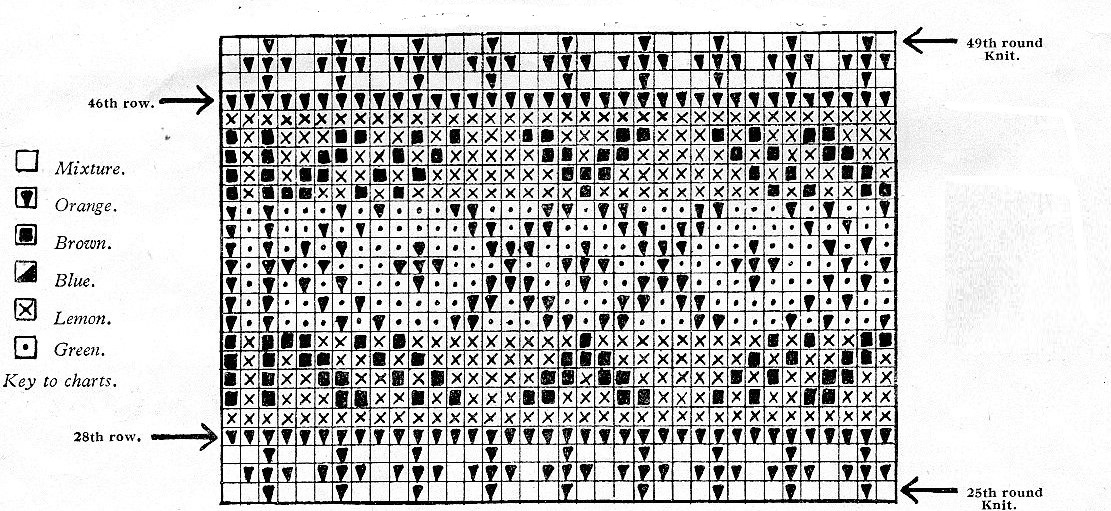
Why did Weldon's claim that the booklet made Fair Isle knitting easy? Largely because the colour patterns were charted, rather than being written out row by row, as was usual at that time (and still common much later, too).  The introduction says :
"In view of the enormous popularity of Fair Isle Woollies, the following "Easy-Way" method of knitting these designs has been devised. This method obviates the use of long and tiring directions which are substituted by simple charts, showing the pattern at a glance. These charts arc extremely clear as each square represents a stitch, and each sign a colour. A ruler laid across the chart above the row being worked, greatly helps in keeping the place."
Here's one of the charts, which now seems perfectly ordinary to knitters:


But Weldon's had to explain using charts to knitters who had never used them before, and probably never seen them before.  It was especially tricky here, because the designs in the booklets are knitted in the round up to the armholes, and then knitted flat up to the shoulders; the sleeves are knitted flat from the cuff upwards.   So the booklet has to explain how to read the chart when working in the round ("the chart must always be read from right to left"), and then how to read them when working flat, with alternate rows of knit ("plain") and purl: "The plain rows, which are the uneven numbered rows, are read from right to left of the charts, and the purl rows, which are the even numbered rows, from left to right."

The charts also show the shaping for the neck, armholes and sleeves, which is also explained very carefully.  (Of course, the patterns are all given in only one size, which simplifies showing the shaping on a chart.)  There's also advice about using a "a piece of coloured thread knitted in with a stitch" to mark the start of each round - which sounds like a separate piece of thread for each round, rather than how we would use stitch markers now. 

The booklet also explains how to hold one strand of wool in each hand when knitting Fair Isle patterns (though only when knitting in the round or on the knit rows in the flat sections).  I was surprised to see this useful advice given so early.  Many Fair Isle pattern leaflets published much later than this leave the knitter to work out for themselves how to work with two strands of wool at the same time.

Now for the designs. The two on the front cover are to "complete your sports outfit".   There are only two different patterns in each, one wide band and one narrow, but "an elaborate effect is achieved by reversing the colours" on alternate wide bands, which is a clever idea.  Here's another view of the  man's sweater:


The instructions say that "this pullover can, if preferred, be worn tucked in, as shown on the cover, in which case a deep welt is worked in place of patterns at the lower edge." In my view, wearing it tucked in is very wrong indeed, so I am glad to see that there is a more sensible alternative.

There is another woman's sweater like the cover design, of a similar shape with patterned bands all over and a V neck (and also shown worn with a beret). It's suggested that this is to wear with a tweed suit, "for sports and general wear".


 And the third jumper for women is the "Heath" design, with Fair Isle bands around the lower edge, around the cuffs, and bordering the V neck. I like this one a lot.


And finally, there is a sleeveless pullover, billed as 'a well-fitting "tuck-in"'.  (Noooo!  Don't tuck it in!)


Apart from the tuck-ins, the designs are very attractive. I think it's interesting, too, that the instructions are so technically advanced.  Many "Fair Isle" patterns published in Britain, even decades later than this one, instructed knitters to work all the pieces flat, with front and back knitted separately.  Recent Fair Isle sweater patterns are more likely to tell knitters to work in the round throughout, with steeks at the armholes and neck.  I don't know when steeking instructions were first published in this country, but I would have been astonished if they had appeared in a 1930 booklet.

I would love to know whether any Shetland knitters were consulted about techniques, or designed any of the sweaters. But it was very rare to name the designers at that time, and this booklet is no exception.

Knitting & Crochet Guild members will find a pdf copy of the booklet on the Guild website under Membership and then Pattern Downloads.  (If you aren't a member and are interested in vintage knitting and crochet publications, you might consider joining - Guild membership is open to anyone.)       

Sunday, 10 March 2019

Fair Isle in Cotton

I have written a few posts about Fancy Needlework Illustrated, and an article in Piecework magazine that I wrote about here.  It's one of my favourite magazines in the Knitting & Crochet Guild collection, even though it emphasised crochet and embroidery at the expense of knitting.  It was associated with a consortium of cotton spinners, so everything in the magazine is about making things with cotton. It never published patterns for woolly jumpers, for instance (until Weldon's took over the magazine in 1937).  So when Fair Isle knits became popular in the 1920s, they didn't appear in Fancy Needlework Illustrated.  But I have seen the cover of issue 132 (below) many times while working on the collection, and the disembodied cardigan is clearly done in stranded knitting.   Inside, it is described as a Fair Isle design, though it is of course knitted in cotton.  I posted it on Instagram (tagged #fairislefriday) and decided to share it here too, where I can go into more detail.

Fancy Needlework Illustrated, No.132, March 1936
The cover illustration of the cardigan shows the colours listed in the instructions - Dark Jade, Black, Ecru and Dark Tango (red, presumably).  The intro to the pattern says: "This lovely cardigan has been designed on the same lines as the well known and much admired Fair Isle Jumpers, which our Scotch friends are so expert at making.  In this case, however, the design has been very much simplified so that the most timid worker need not be afraid to attempt it.  Worked in bright colours of Ardern's Florentine Twist, it will answer many purposes — for skating, golf, etc."  (Ardern's was a cotton spinning company in Hazel Grove near Stockport.)   It doesn't look very much like a traditional Fair Isle, but it's very attractive.  The large buttons and the belt are the most obvious elements of 1930s style, I think, and it would be easier to wear today than most 1930s styles, because of its length - most sweaters of that era stop at the waist.  (Though it's only a size 32 in. (81cm.) so the pattern would have to be adapted to larger sizes these days.)


The other disembodied garment shown on the front cover is an embroidered gardening smock - completely impractical, unless you're picking flowers, or perhaps deadheading roses.  Nothing more strenuous than that.  As the cover suggests, there is rather a lot of embroidery in this issue.  Too much for me, certainly - I'm not a fan of embroidery if I'm expected to do it myself.

But there are more knitted and crocheted garments inside, including a nice knitted jumper with a buttoned front and a little collar.  It takes only 300g. of Ardern's Star Sylko size 5 (a mercerised cotton thread) - but then it only fits a size 34 in. bust (86cm.) and is only 17 in, (34cm.) long. 


There's also a pattern for a crocheted collar and cuff set with a matching powder puff case.  "This collar and cuff set with be found invaluable for the business girl.  It will add a bright spot of colour to her smart business frock, and as it is made of Ardern's crochet cotton there will not be any accidents in the wash."  The colours suggested are Spring Green, Amber, Heliotrope and Sapphire, which would certainly be bright.  (I didn't know what colour Heliotrope is, but according to Wikipedia it's pink-purple.)  The stitches used are Rice Stitch and Solomon's Knots, which doesn't mean anything to me, but probably will to a crocheter.


Finally, there is a pattern for "Foundation Garments in Crochet" - a "well-fitting set of suspender belt and brassière", also in Ardern's Star Sylko size 5.  To call it well-fitting is wishful thinking - the fit of the bra is entirely due to lengths of elastic, sewn to the bra to crossover at the back.  The crocheted part would only fit someone small enough not to need to wear a bra at all, it seems to me.  As for the suspender belt, the less said the better.


Wednesday, 25 April 2018

The Vintage Shetland Project

My copy of Susan Crawford's mammoth new book, The Vintage Shetland Project, arrived last month.  It was a lovely surprise - I ordered it at the end of 2015, I think, but publication was delayed because Susan was diagnosed with breast cancer and then going through some horrible treatment.  I had had updates saying that it was about to be published, but actually I had forgotten all about it by the time it was delivered.  It is huge - nearly 500 pages.  There are 27 knitting patterns in the book, based on vintage pieces from the Shetland Museum.  They are gorgeous - mostly Fair Isles, but some lace too.  And there is a lot of background information on the original pieces and the history of Shetland knitting through the 20th century. A lot to read (and a lot to knit) - I have only dipped in so far.


One chapter that has caught my attention so far is on Pattern Appropriation - the 'borrowing' of Shetland designs by commercial companies, especially in the 1950s.  One of her examples is a shawl that Kate Davies wrote about in The Book of Haps: it appeared in a Patons & Baldwins pattern leaflet, number 893, published in 1951 or 1952.  According to the leaflet, the shawl was 'designed by Mrs A. Hunter of Unst'.  The original shawl was bought from Mrs Hunter by James Norbury, chief designer for Patons & Baldwins, and is now in the Knitting & Crochet Guild collection.

Patons & Baldwins leaflet 893

It proved a very popular pattern, and the leaflet was reissued several times over succeeding decades.

Another example of appropriation illustrated in The Vintage Shetland Project is a pattern leaflet, also by James Norbury, that was free to readers of the Daily Herald newspaper. 

Vintage knitting pattern leaflet, 1950s
Man's Fair Isle Pullover, from the Daily Herald 

The leaflet was offered to readers in September 1952, and the article describing it makes clear that the pattern was copied from a Shetland original:  "To find fresh ideas for his designs, Norbury, the Herald and T.V. knitter, makes regular trips to knitting centres here and on the Continent.  His latest discovery is [this] authentic Fair Isle pattern...  This design has been knitted in the Shetland Islands for over 100 years.  Norbury first saw it when he judged the famous annual Shetland knitting competition in Lerwick recently.  He brought the pattern back to London and worked out an easy-to-follow pattern chart.  It is a challenge to all knitters who know the feeling of achievement to be had from making a garment in Fair Isle."  The model for the pullover is named as Michael Howard (no, not that one) - apparently a famous radio comedian at the time.

As with Mrs. Hunter's shawl, the pattern was based on a pullover that Norbury bought on Shetland, and the original pullover is now in the Knitting & Crochet Guild collection.

Original pullover from Shetland 

The card with the pullover reads "Shetland Man's Pullover. This is a modern design incorporating the 'Seed of Life' and 'Star of Glory' patterns."  At some time between James Norbury's purchase of the pullover, and its arrival in the Knitting & Crochet Guild collection, it was put on display with this label. 

It's clear from comparing the pullover with the Daily Herald leaflet that Norbury shortened the pullover, to be more in line with 1950s men's fashions.  He also modified the construction method - the original Shetland pullover is knitted in the round, but in the leaflet the front and back are to be knitted separately, with seams at the sides. But the colours of the original are copied exactly: five natural fleece colours, from white to dark brown, with navy, dark green, yellow, carrot and ruby.   I suppose that Norbury might have argued that the designs in the pullover were traditional, and so could be used by anyone, though I think any Shetland knitter might have disagreed - but copying the colours too, for a commercial publication, seems to me questionable.

The 'Seed of Life' and 'Star of Glory' patterns - detail


Related Posts Plugin for WordPress, Blogger...