Showing posts with label holiday. Show all posts

Saturday, 19 October 2019

Jamieson's

While I was in Shetland for Wool Week, I went on a tour of Jamieson's Mill at Sandness. It's about 30 miles from Lerwick, on the west side of Mainland.  A coach picked us up in Lerwick, for a 50 minute drive across the island.

Garry Jamieson gave us a tour of the mill (in two groups, so that there was plenty of time to look around the shop, too).  It was fascinating to see all the processes involved in converted the raw fleece into balls of knitting wool, all in one building (as well as weaving and knitting, too). Garry showed us one of the fleeces, in the state that they arrive in, and talked about the quality of the wool.


After washing, the wool is dyed. The dyepot looked like an enormous pressure cooker, gently steaming.


Bales of dyed wool
Later, it goes through a carding machine...


... and out the other end.

And then gets spun. I think this is what's going on here:


And after two strands of the spun yarn are plied together (Jamieson's Spindrift is 2-ply), it's ready to be wound into balls.


(The blur in the middle is the wool moving very fast.)

Finally, each ball gets a ball band, and 10 balls make a pack of wool...
 
... all ready to be sold.


Apologies for any inaccuracies - all due to me, and not to Garry's tour.

A couple of eye-catching things around the mill. 


And as I said, there was a shopping opportunity.  I had already bought the Shetland Wool Week Annual, which is mainly a book of patterns, beautifully illustrated with scenes of Shetland, and decided that I'd like to knit the Seaweed Slipover, designed by Wilma Malcolmson.


The background colour is pale grey, which I like a lot, but I decided that I wanted the other colours to be slightly lighter and brighter versions of the ones in the Album.  These are the ones I picked from the Jamieson's shop:


It's hard to get an accurate rendering of the colours, especially the pink (Lipstick).  These are from Jamieson's website:


I have knitted three Fair Isle jumpers or pullovers before, though a long time ago, but this will be the first one knitted properly, i.e. in the round, with steeks.  It will be my next project, after my current one.

I forgot to mention in my last post that while I was in Shetland, I realised that I had somehow missed one of Ann Cleeves' Shetland novels.  (Not the last one, so I don't know how I missed it.)  I bought a copy in the Shetland Times Bookshop in Lerwick, and read it on the way home. And now I'm re-reading the other seven.  Many of the places mentioned in the books are real places, and so it is lovely to read about places I went to.  There is a scene, for instance, where two people have a drink in the bar of the Mareel, the arts centre in Lerwick, near the Shetland Museum. I did that too!   I'd really like to watch the TV programmes again, as well, because I know that they show wonderful scenery, and now I've seen some of it.  The programmes don't seem to be available just now, but I'll keep looking.


Thursday, 10 October 2019

Shetland Wool Week

Last week I was in Shetland, staying in Lerwick, for the 10th Shetland Wool Week. I had never been to Shetland before (or in fact anywhere that far north), so it was a fascinating week, quite apart from all the knitting-related activities. And we were extremely lucky with the weather, which was mostly dry and often very sunny, while back home in England it was raining for most of the week - a lot.

Walking along the Esplanade at Lerwick every day, there were wonderful views of boats anchored, and the sound beyond, dividing the mainland from Bressay island. This was the view over Hay's Dock, in front of the Shetland Museum, on a beautiful evening. 


I arrived on Saturday, and my first Wool Week event was the Welcome on Sunday evening.  500 people were there - so as there were 1,000 people attending Wool Week, a lot were disappointed.  I wrote here about knitting my Wool Week beanie, in this year's design.  At the Welcome, almost everyone was wearing their beanie, and there was a group photo at the end of the evening.


A photo of the Wool Week Welcome evening from BBC News.  I was there, wearing my Roadside beanie, though I can't see myself in this photo.

I spotted a couple of beanies that had substituted an image of something else for the fishing boats. A bicycle:


or a plane. Actually, I was told, a Bristol Blenheim, which has a WW2 Shetland connection.


Most people attending Wool Week wore their beanies whenever they were outdoors (and it was cool enough that you wanted to be wearing a hat anyway).  It was a useful way of identifying fellow knitters too, and starting a conversation.

I hadn't booked any of the classes, partly because John had intended to come with me, but couldn't in the end.  So we had planned to see Shetland together.  One Wool Week event I had booked for both of us was a bus tour west to Vementry, and to Ollaberry and Islesburgh in North Mainland. It was a (mostly) fine day, and a good opportunity to see more of the Shetland landscape.  You never seem to be far from a loch or the sea on Shetland.
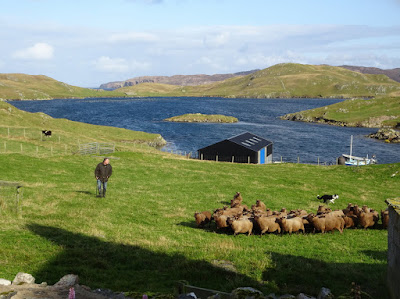
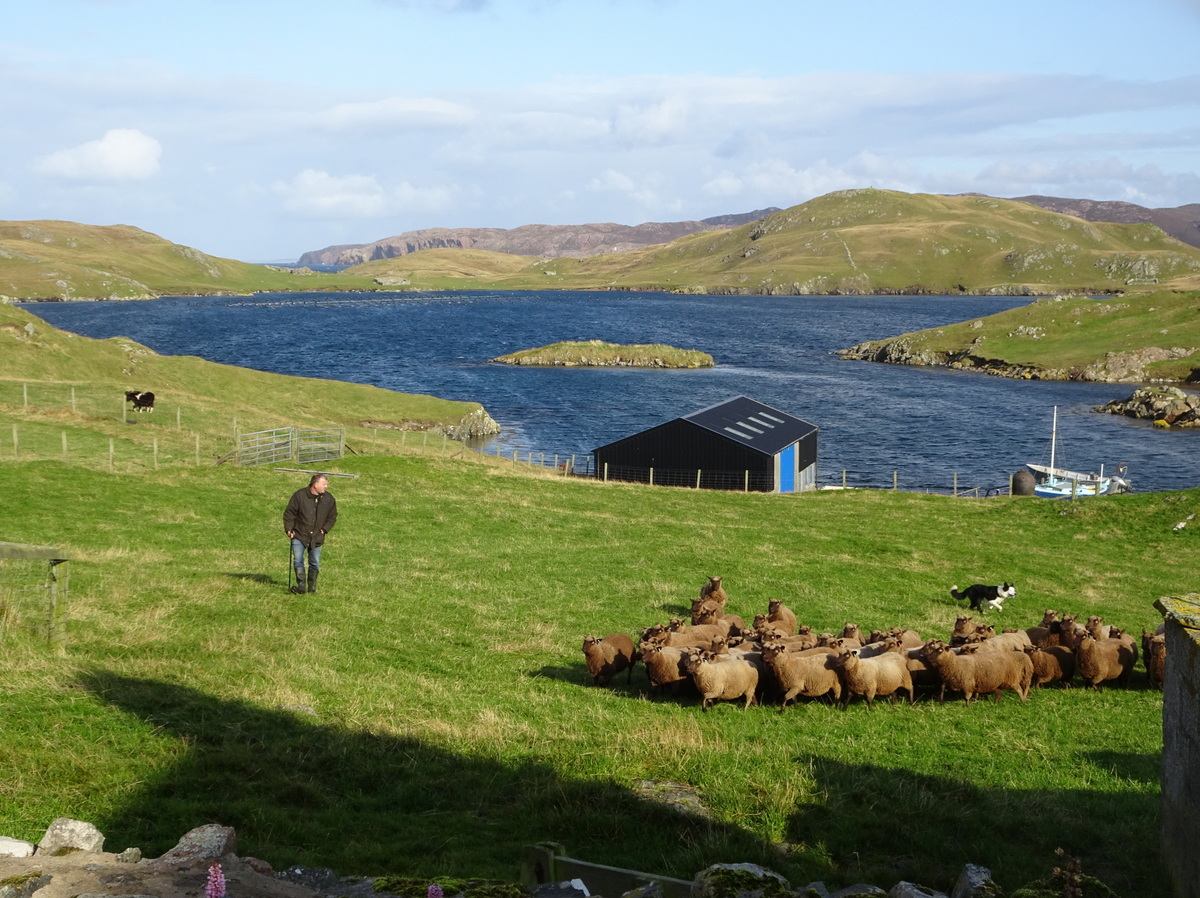
Gathering sheep at Vementry
At Vementry, we saw their prize-winning Shetland sheep, mostly moorit (i.e brown), and Shetland ponies. It's a beautiful spot, overlooking the shore, and (I think) Vementry Island in the distance.

We had lunch at Ollaberry Community Hall - a lavish spread of homebakes laid on by local women. There was an exhibition of knitwear - some new, some that had been kept carefully, for many years in some cases.  I was very taken with the large lampshade in Print o' the Wave (one of my favourite lace stitch patterns):


I also liked an outfit from the late 1960s, mainly because of its story.  Its owner said that her mother had knitted it for her when she went off to college in Aberdeen. There was a photo of her with friends, about to get the ferry, and wearing the outfit with a much shorter skirt - though actually, she said, she never wore it much because it wasn't really in fashion at the time. And her mother thought it was much too short, and added a piece to make it longer. A very 1960s teenage experience.


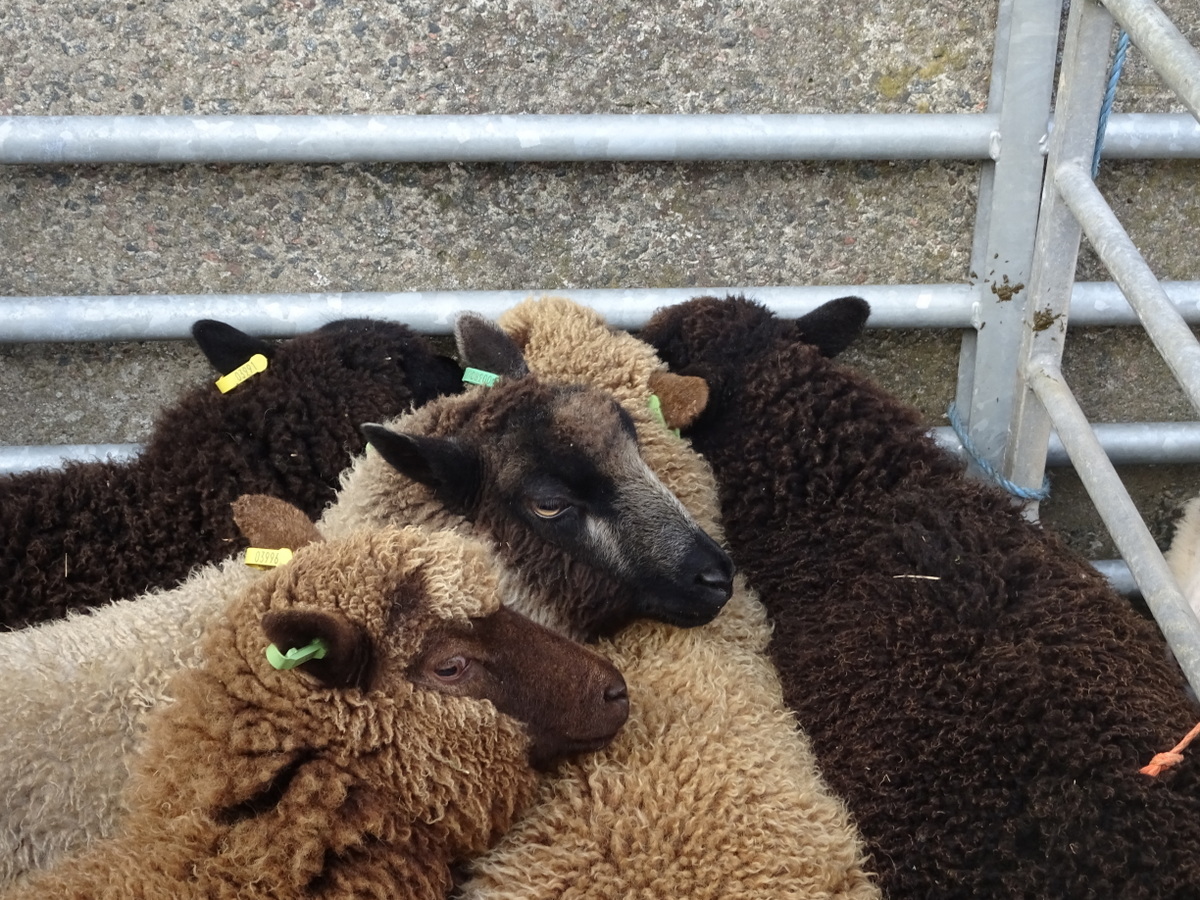
We ended the day at Islesburgh Farm, where we saw more prize-winning Shetland sheep, of several colours. (Some sheep evidently think that if they can't see you, you can't see them. They were mostly trying to hide their heads underneath another sheep.)


Another day, I went on a tour of Chris Dyer's croft on Bressay, a short ferry ride from Lerwick.  We saw more sheep - here Chris and his dog are driving them:


Chris has pigs and piglets, too.  And tomatoes, courgettes and peppers growing in a Polycrub, a specially strong version of a polytunnel, designed to withstand Shetland winds. He talked to us about his approach to running the croft, alongside his main job as an archaeologist.

Chris took us to the Speldiburn cafe on Bressay for lunch, where there was another exhibition of knitwear.  Again, some new, some old.  I particularly liked a couple of children's pullovers from the 1950s, both mainly pastel colours on a dark brown background. I don't think I know enough to judge, but that kind of colour combination seems to me to be different from  modern Fair Isle designs.


.


One day when I had no Wool Week events booked, I went for a walk around Lerwick, first past a group of old houses built almost in the sea, the lodberries, one of which is Jimmy Perez's house in the TV version of the Shetland books by Ann Cleeves.

 
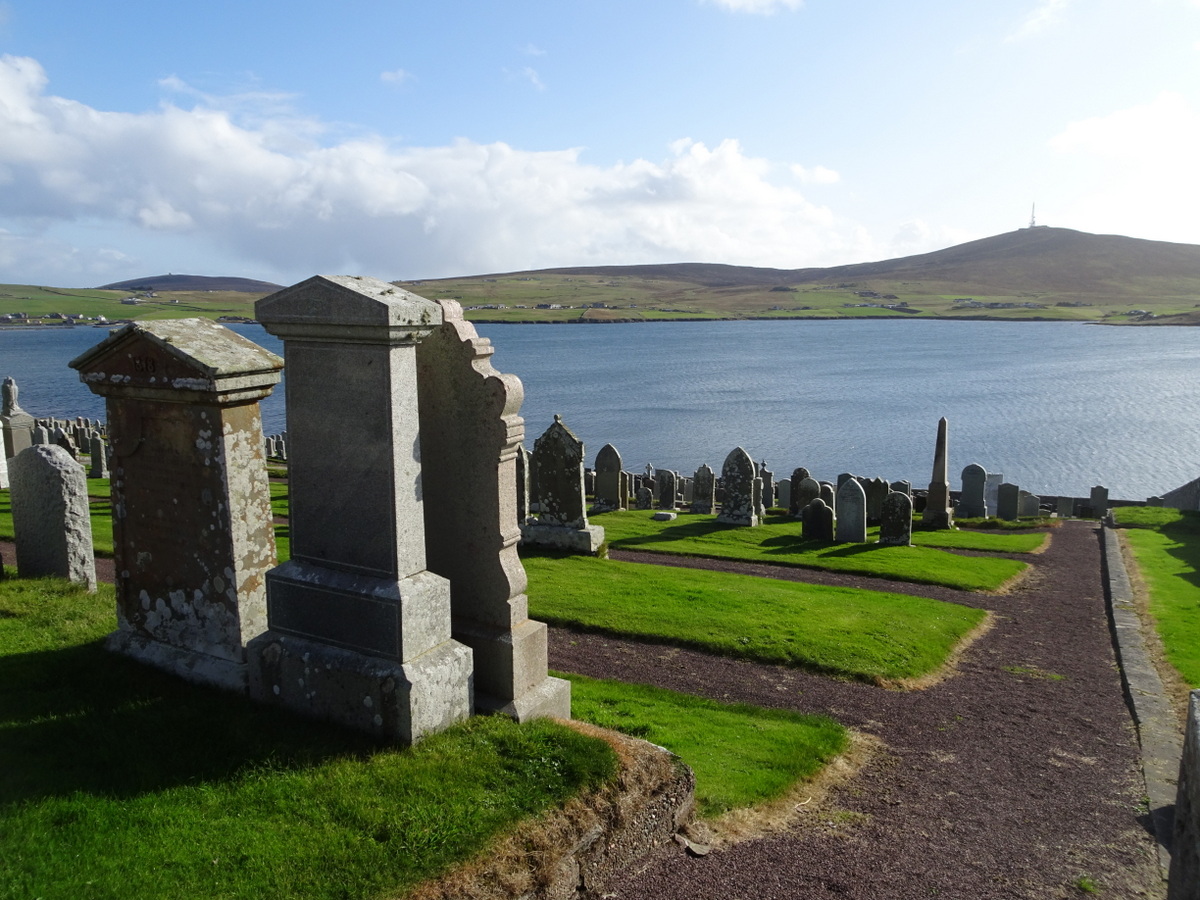
 On towards the Knab, the headland at the end of the road, where there is a cemetery with I think the best view of any cemetery I have seen.


There are a number of war graves in the cemetery, of men who were stationed on Shetland. So they were not necessarily Shetlanders - some were in fact Norwegian.


Here's the Knab, and the view south towards the open sea.


The path follows the shore from there (towards Tesco).  I hoped to see some seals on the rocks, but there weren't any, though I did see a lot of birds including a group of oystercatchers (called shalders in Shetland).


Another day, I got the bus to Scalloway, a fishing port about 6 miles from Lerwick, with an interesting museum, a castle, and some very picturesque houses along the harbour. 

.
The base for Wool Week was the Shetland Museum in Lerwick, which is excellent. It has displays on the archaeology and history of the islands, including Gunnister Man, who died about 1700.  His body was found in a peat bog, and his clothes have survived, including some knitted articles.  There is a reconstruction in the museum (hard to photograph because of reflections in the glass of the case). 

There are also displays on Shetland knitting, with many beautiful examples of both lace and Fair Isle.  I recognised one straightaway from Susan Crawford's Vintage Knitting Project book - Jeannie Jarmson's sleeveless rayon pullover, which is one of the patterns Susan re-recreated for the book. (Again, I couldn't get a good photo of it.)

 The Hub, where Wool Week visitors could sit to knit and chat, was in the Museum, as was the auditorium where I gave a talk on the Knitting & Crochet Guild collection on Wednesday evening - I'll say a bit about my talk in another post.

Shetland Museum
And on Fair Isle Friday, two Shetland ponies who have often been photographed in Fair Isle cardigans, were stationed in front of the museum. (Their owner said that they don't really like the cardigans, because they can't walk easily in them.  And they have such thick coats of their own that they don't need to wear woollies.) 


I'll also write in another post about the trip to the Jamieson's Mill at Sandness, where (guess what?) I bought some wool.   But that's enough for now.  I didn't do any of the many classes on offer, but there was plenty to see and do without that.  I enjoyed the week very much (though it would have been more fun if John had been there).  I'm very glad I went.

Wednesday, 26 June 2019

Olympus and Olympiada

I haven't written anything here for weeks - apologies.  We were on holiday for most of May, first in Romania, then, after a few days back home to unpack, do the washing, and repack, to Greece.  Since we got back from Greece, I've been catching up on all the things that didn't get done while I was away, as well as all the things that have accumulated since.  I am never going to get around to writing about Romania (though it was a very good holiday), so we'll forget about that.  But I'll show a few photos of our Greek holiday. 

As usual, we went with Gareth of Naturally Greece - this was our fifth holiday with him.  (There should have been one more, but we couldn't go the year I broke my wrists.)    We flew to Thessaloniki and then transferred to a lovely hotel, Ktima Bellou.  It's west of Mount Olympus - the top of one of the mountain's peaks is just visible from Ktima Bellou over the range of hills across the valley.


From there, we did some walks on the lower slopes of Mount Olympus, including part of the gorge from Prionia to Litochoro. There was snow on the bare slopes of the mountain, while the surrounding hills are forested.


We visited the archaeological site of Dion, near Mount Olympus, and its museum. Dion was a religious centre in ancient times, for the worship of Zeus and other Olympian gods  - and gods from elsewhere such as Isis.   (Much of the visible remains are from Roman times,  and the Romans were very broad-minded about adopting other people's gods.) 

The frieze of armour and shields that decorated the Roman basilica at Dion
For the second half of the holiday, we went to Olympiada, on the Halkidiki coast, and stayed at the Hotel Liotopi.  We did some more short walks and did a boat trip along the coast of the Mount Athos peninsula to see the monasteries - from a distance, as the boats have to stay a distance of 500m. from the shore (I think to avoid any possibility of women contaminating the place). And we visited Amphipolis, a huge archaeological site scattered over a large area.  The most impressive thing we saw there was the huge Amphipolis lion, which has been reassembled from fragments.


(Note the dog lying at the foot of the monument.  Greece seems to be full of dogs with nothing to do - at least this one has a role in providing a scale for the lion.)   It's thought that the base of the monument was much bigger, and there are lots of fragments left over, to one side of the site, so I can believe it. 

We visited several other areas of Amphipolis, including a large early Christian basilica, with re-used columns from earlier buildings, and some nice mosaics.  I especially liked the octopus.


We went to the excellent museum at Amphipolis, too, where one of the treasures is the silver ossuary with a gold wreath, which held the cremated remains of Brasidas, the Spartan general who defeated the Athenians in 422 BCE in a battle at Amphipolis, but was wounded and died shortly afterwards.


 If I understood the label correctly, the ossuary was found on the site of the museum in the archaeological dig carried out before it was built - which is about as unlikely as finding the body of Richard III in a car park.

I think that Greece had a very cold spring this year, so the spring flowers were very late.  By the end of May they would usually have been over, but there were flowers everywhere. At Ktima Bellou, we did a short stroll in the meadow next to the hotel and found lots of different flowers, identified for us by a friend of Gareth's who is very knowledgeable about plants.


The archaeological areas of Amphipolis were very pretty, with masses of poppies and other flowers.


We did a walk along the beach near Olympiada and found several kinds of specialised seashore plants - this is sea bindweed.


Throughout the holiday, we had very good food at every meal.  Ktima Bellou does wonderful organic food, much of it grown by the family, and Loulou at the Hotel Liotopi does regular cookery demonstrations of some of the dishes on the menu at her brother's restaurant where we ate every evening.


I don't like to think that I am so shallow and greedy that delicious food is an essential part of a good holiday, but sadly I find that it's true.  Since we got back we have been trying to recreate some of the dishes we had in Greece.  We have mastered spanakopita, and I'm working on a dish of roasted aubergine with walnuts and feta.  I don't think I'll ever cook octopus tentacles though.

Now, back to knitting.

Friday, 29 September 2017

Roman Lusitania

I'm very behindhand with writing posts - since my last post at the beginning of the month, we have been on holiday in Spain and Portugal, and I've done two knitting & crochet trunk shows.  As well as all the usual business of life.  I'm trying to catch up a bit before September runs out on me.

Here is a very small selection of the things we saw on our holiday - a tour of Roman Lusitania with Andante Travels. The Roman province of Lusitania was mostly within present-day Portugal, but part of it is now Spain, including its capital, Merida.  So we flew to Lisbon, but spent a lot of the holiday in Spain.

We saw, of course, lots of Roman sites, including the theatres at Merida and Medellin, Roman country villas and town houses, and a fish processing site at Troia.  And two Roman dams (built to supply Merida with water) that are still functioning, although the aqueducts themselves are now ruined.  The aqueduct is still very impressive, though, as it crosses a valley on high arches.


The Museum of Roman Art in Merida houses a wonderful collection from the local area.  Here's the gravestone of a woman, Sentia Amarantis, who presumably kept a tavern.  It appears to show someone filling a jug from a barrel, and presumably the barrel contained beer and not wine.

 
/
There were some wonderful mosaics in the museum.  One huge mosaic featured two winning chariot-racing teams - here's a detail.


Another one that I liked very much had a geometric design in black and white. Here's the central motif.


We visited prehistoric sites too. The Cromeleque dos Almendres is collection of nearly 100 standing stones, arranged in  two concentric ellipses, and an older circle.  The stones are huge rounded granite boulders - very characterful.  Some of them allegedly have shallow carvings on them, but the light wasn't right to see them, and I think the smooth stones are beautiful without any additions.


The countryside around there has many cork oaks, which we had not seen before.  The number 1 on this tree signifies that the bark was removed in 2011  (and it will be ready to strip again in 2020). 


Here's a tree that was stripped much more recently (this year I think) showing the red/orange layer underneath.


We also saw many reminders of the Moorish occupation of the area in the Middle Ages, including several cisterns - this one is under the museum in Caceres.


And a couple of aqueducts built long after the Romans (and the Moors) had gone. This one is at Elvas (just on the Portuguese side of the border).  It was begun in 1498, and still carries water.  We couldn't understand why it took such a zigzag route - from left to right over the road, and then from right to left back again.  (Surely easier to re-route the road?)


\Here's the same aqueduct from the other side. It's about 30m. high at this point - and all that vast quantity of stone is to carry a small channel at the very top.


We saw storks' nests everywhere  on telephone poles, on electricity pylons, and on top of all kinds of buildings.  There are several on top of the Aqueduct at Merida.  The young birds have fledged and left the nest by now, but some of the nests had a stork on them - perhaps thinking ahead to next spring?  Here's one of the churches in Medellin, with a stork on its nest on the tower.


And evidently the storks don't mind being very close to their neighbours - another church tower in Medellin had four storks' nests, two right next to each other.


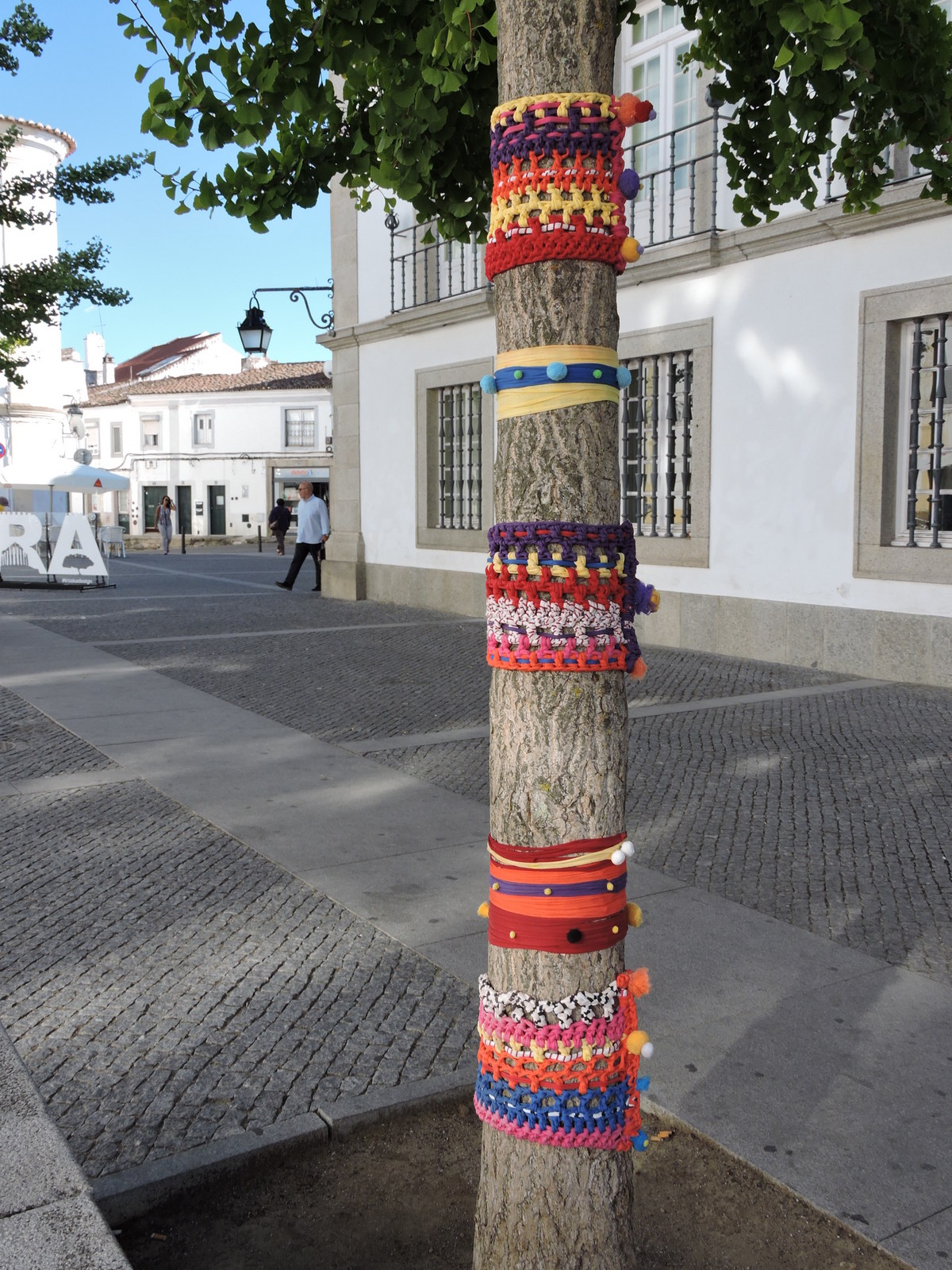
I didn't take any knitting with me (too busy) but we did see some yarn-bombed trees in Evora. (Though it's crochet, not knitting.


I was fascinated by the different styles of chimney that we saw.  Usually they are built like a little house, with a pitched roof. 


The street lamps were also very varied and stylish.


As you can see from the photos, it was generally sunny, and it was very hot too.  We were very well fed, in between visiting archaeological sites. (Delicious cheeses, in particular.  Pork and ham, too - I came home a few pounds heavier.) And wine was plentiful. It was a great holiday.
Related Posts Plugin for WordPress, Blogger...