Showing posts with label Shetland lace. Show all posts

Thursday, 10 October 2019

Shetland Wool Week

Last week I was in Shetland, staying in Lerwick, for the 10th Shetland Wool Week. I had never been to Shetland before (or in fact anywhere that far north), so it was a fascinating week, quite apart from all the knitting-related activities. And we were extremely lucky with the weather, which was mostly dry and often very sunny, while back home in England it was raining for most of the week - a lot.

Walking along the Esplanade at Lerwick every day, there were wonderful views of boats anchored, and the sound beyond, dividing the mainland from Bressay island. This was the view over Hay's Dock, in front of the Shetland Museum, on a beautiful evening. 


I arrived on Saturday, and my first Wool Week event was the Welcome on Sunday evening.  500 people were there - so as there were 1,000 people attending Wool Week, a lot were disappointed.  I wrote here about knitting my Wool Week beanie, in this year's design.  At the Welcome, almost everyone was wearing their beanie, and there was a group photo at the end of the evening.


A photo of the Wool Week Welcome evening from BBC News.  I was there, wearing my Roadside beanie, though I can't see myself in this photo.

I spotted a couple of beanies that had substituted an image of something else for the fishing boats. A bicycle:


or a plane. Actually, I was told, a Bristol Blenheim, which has a WW2 Shetland connection.


Most people attending Wool Week wore their beanies whenever they were outdoors (and it was cool enough that you wanted to be wearing a hat anyway).  It was a useful way of identifying fellow knitters too, and starting a conversation.

I hadn't booked any of the classes, partly because John had intended to come with me, but couldn't in the end.  So we had planned to see Shetland together.  One Wool Week event I had booked for both of us was a bus tour west to Vementry, and to Ollaberry and Islesburgh in North Mainland. It was a (mostly) fine day, and a good opportunity to see more of the Shetland landscape.  You never seem to be far from a loch or the sea on Shetland.
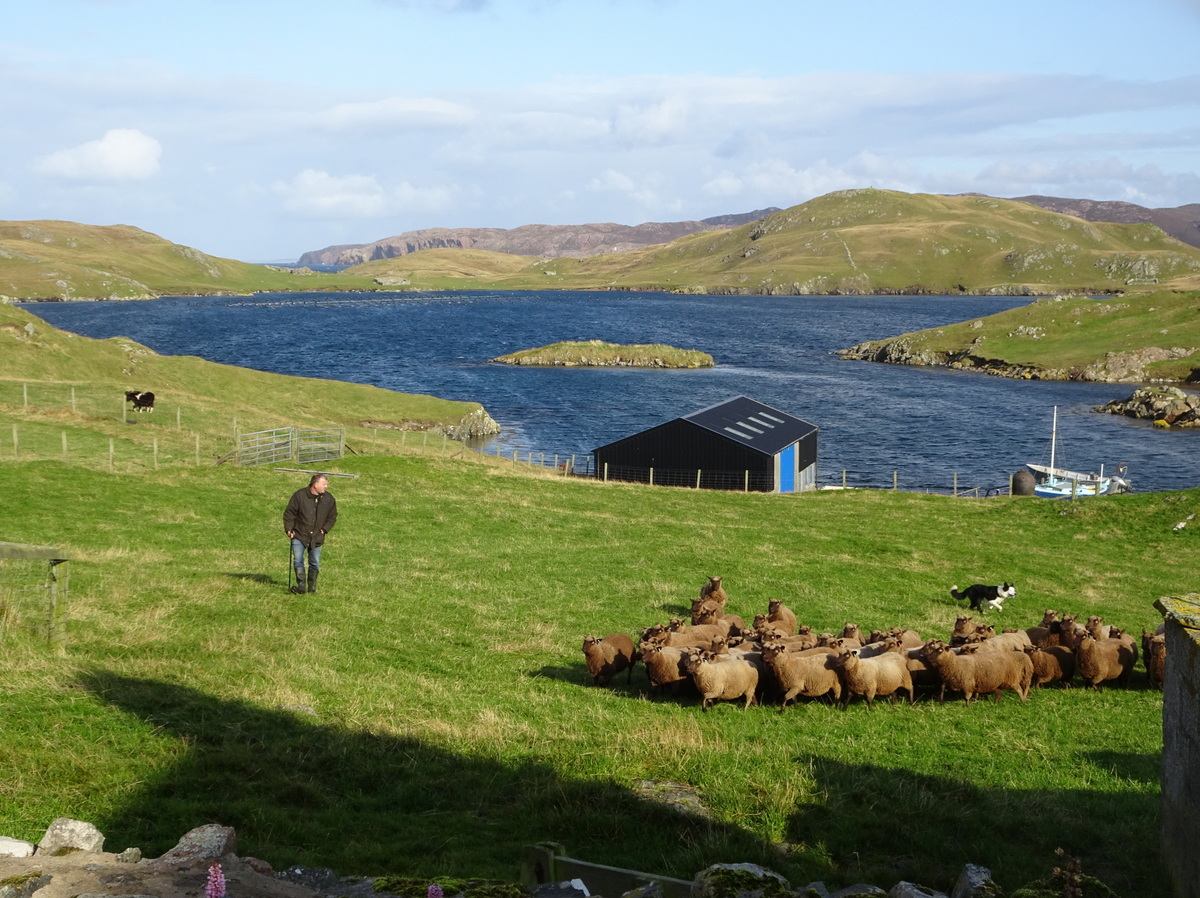
Gathering sheep at Vementry
At Vementry, we saw their prize-winning Shetland sheep, mostly moorit (i.e brown), and Shetland ponies. It's a beautiful spot, overlooking the shore, and (I think) Vementry Island in the distance.

We had lunch at Ollaberry Community Hall - a lavish spread of homebakes laid on by local women. There was an exhibition of knitwear - some new, some that had been kept carefully, for many years in some cases.  I was very taken with the large lampshade in Print o' the Wave (one of my favourite lace stitch patterns):


I also liked an outfit from the late 1960s, mainly because of its story.  Its owner said that her mother had knitted it for her when she went off to college in Aberdeen. There was a photo of her with friends, about to get the ferry, and wearing the outfit with a much shorter skirt - though actually, she said, she never wore it much because it wasn't really in fashion at the time. And her mother thought it was much too short, and added a piece to make it longer. A very 1960s teenage experience.


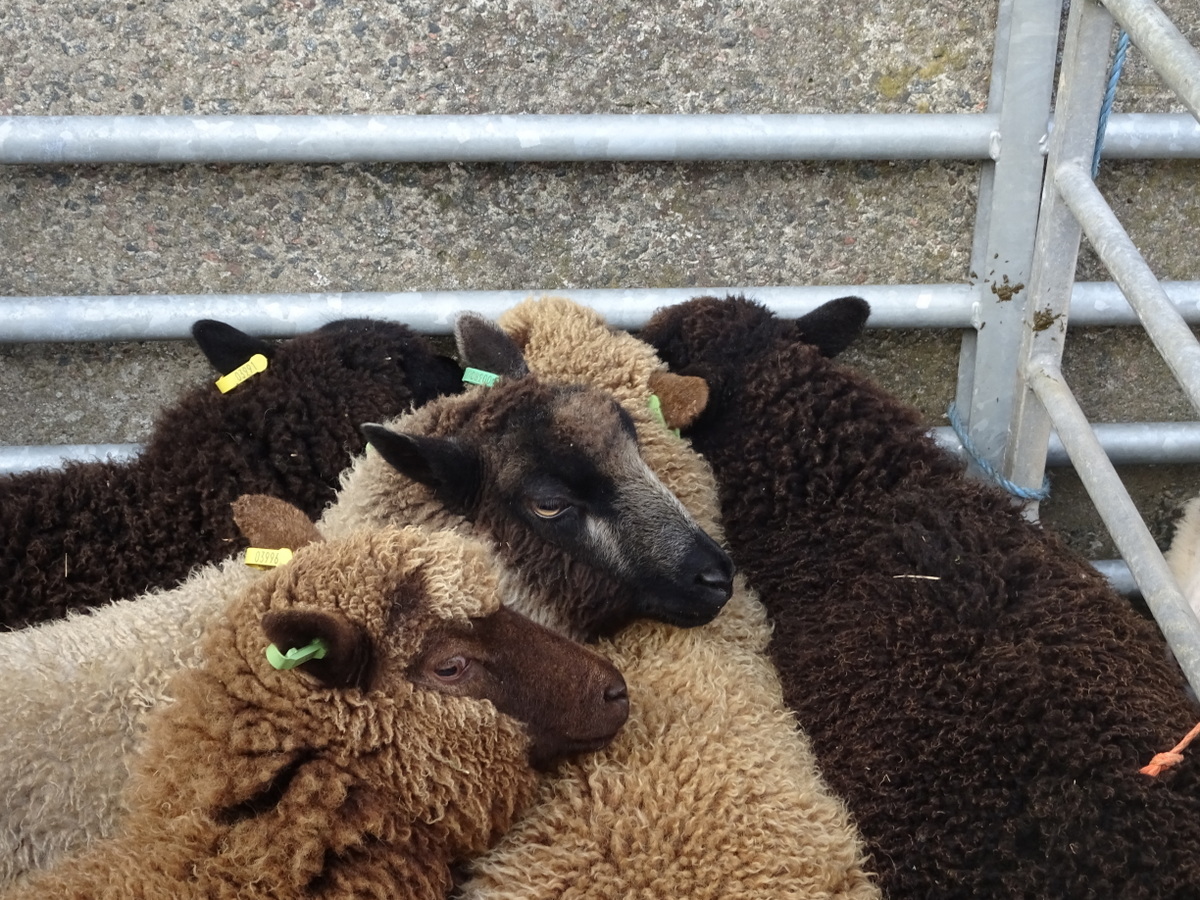
We ended the day at Islesburgh Farm, where we saw more prize-winning Shetland sheep, of several colours. (Some sheep evidently think that if they can't see you, you can't see them. They were mostly trying to hide their heads underneath another sheep.)

Another day, I went on a tour of Chris Dyer's croft on Bressay, a short ferry ride from Lerwick.  We saw more sheep - here Chris and his dog are driving them:


Chris has pigs and piglets, too.  And tomatoes, courgettes and peppers growing in a Polycrub, a specially strong version of a polytunnel, designed to withstand Shetland winds. He talked to us about his approach to running the croft, alongside his main job as an archaeologist.

Chris took us to the Speldiburn cafe on Bressay for lunch, where there was another exhibition of knitwear.  Again, some new, some old.  I particularly liked a couple of children's pullovers from the 1950s, both mainly pastel colours on a dark brown background. I don't think I know enough to judge, but that kind of colour combination seems to me to be different from  modern Fair Isle designs.


.


One day when I had no Wool Week events booked, I went for a walk around Lerwick, first past a group of old houses built almost in the sea, the lodberries, one of which is Jimmy Perez's house in the TV version of the Shetland books by Ann Cleeves.

 
 On towards the Knab, the headland at the end of the road, where there is a cemetery with I think the best view of any cemetery I have seen.
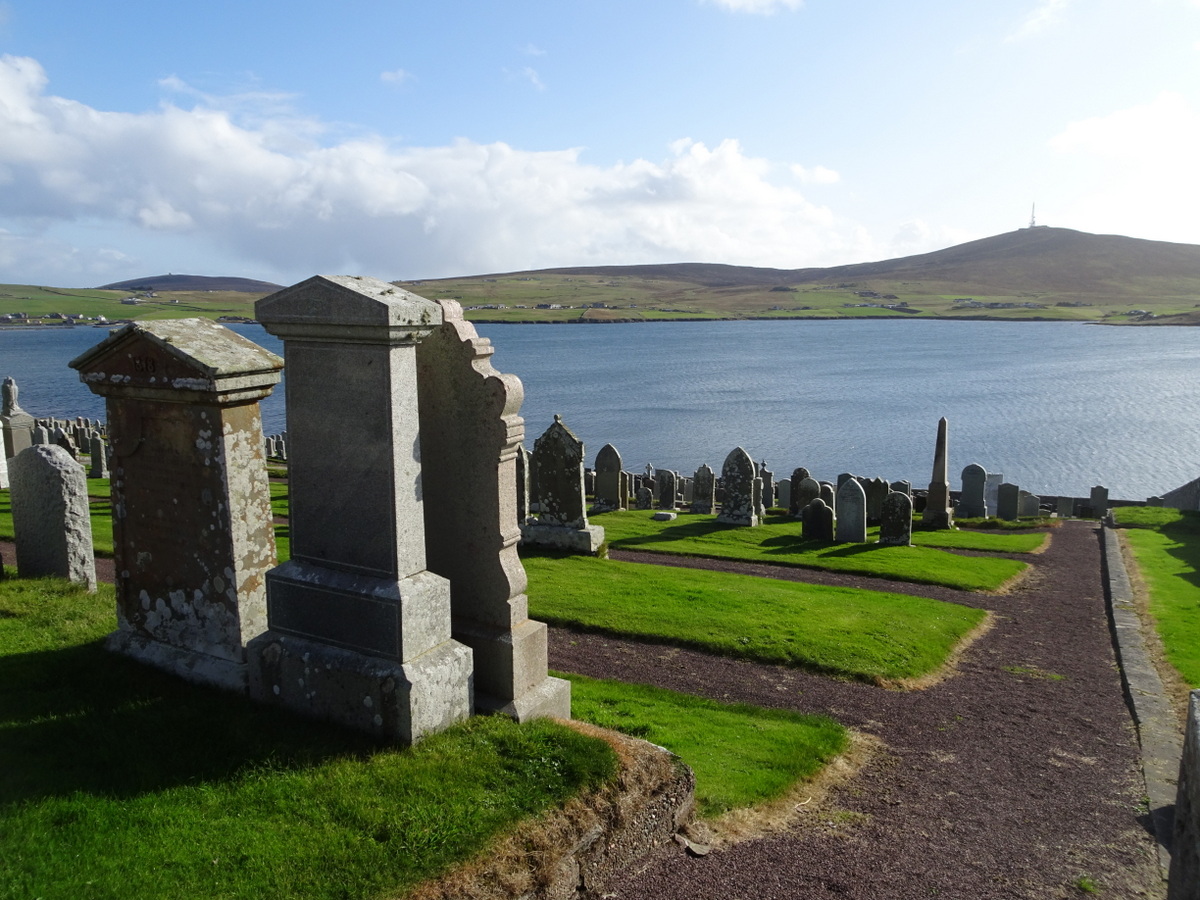

There are a number of war graves in the cemetery, of men who were stationed on Shetland. So they were not necessarily Shetlanders - some were in fact Norwegian.


Here's the Knab, and the view south towards the open sea.


The path follows the shore from there (towards Tesco).  I hoped to see some seals on the rocks, but there weren't any, though I did see a lot of birds including a group of oystercatchers (called shalders in Shetland).


Another day, I got the bus to Scalloway, a fishing port about 6 miles from Lerwick, with an interesting museum, a castle, and some very picturesque houses along the harbour. 

.
The base for Wool Week was the Shetland Museum in Lerwick, which is excellent. It has displays on the archaeology and history of the islands, including Gunnister Man, who died about 1700.  His body was found in a peat bog, and his clothes have survived, including some knitted articles.  There is a reconstruction in the museum (hard to photograph because of reflections in the glass of the case). 

There are also displays on Shetland knitting, with many beautiful examples of both lace and Fair Isle.  I recognised one straightaway from Susan Crawford's Vintage Knitting Project book - Jeannie Jarmson's sleeveless rayon pullover, which is one of the patterns Susan re-recreated for the book. (Again, I couldn't get a good photo of it.)

 The Hub, where Wool Week visitors could sit to knit and chat, was in the Museum, as was the auditorium where I gave a talk on the Knitting & Crochet Guild collection on Wednesday evening - I'll say a bit about my talk in another post.

Shetland Museum
And on Fair Isle Friday, two Shetland ponies who have often been photographed in Fair Isle cardigans, were stationed in front of the museum. (Their owner said that they don't really like the cardigans, because they can't walk easily in them.  And they have such thick coats of their own that they don't need to wear woollies.) 


I'll also write in another post about the trip to the Jamieson's Mill at Sandness, where (guess what?) I bought some wool.   But that's enough for now.  I didn't do any of the many classes on offer, but there was plenty to see and do without that.  I enjoyed the week very much (though it would have been more fun if John had been there).  I'm very glad I went.

Wednesday, 25 April 2018

The Vintage Shetland Project

My copy of Susan Crawford's mammoth new book, The Vintage Shetland Project, arrived last month.  It was a lovely surprise - I ordered it at the end of 2015, I think, but publication was delayed because Susan was diagnosed with breast cancer and then going through some horrible treatment.  I had had updates saying that it was about to be published, but actually I had forgotten all about it by the time it was delivered.  It is huge - nearly 500 pages.  There are 27 knitting patterns in the book, based on vintage pieces from the Shetland Museum.  They are gorgeous - mostly Fair Isles, but some lace too.  And there is a lot of background information on the original pieces and the history of Shetland knitting through the 20th century. A lot to read (and a lot to knit) - I have only dipped in so far.


One chapter that has caught my attention so far is on Pattern Appropriation - the 'borrowing' of Shetland designs by commercial companies, especially in the 1950s.  One of her examples is a shawl that Kate Davies wrote about in The Book of Haps: it appeared in a Patons & Baldwins pattern leaflet, number 893, published in 1951 or 1952.  According to the leaflet, the shawl was 'designed by Mrs A. Hunter of Unst'.  The original shawl was bought from Mrs Hunter by James Norbury, chief designer for Patons & Baldwins, and is now in the Knitting & Crochet Guild collection.

Patons & Baldwins leaflet 893

It proved a very popular pattern, and the leaflet was reissued several times over succeeding decades.

Another example of appropriation illustrated in The Vintage Shetland Project is a pattern leaflet, also by James Norbury, that was free to readers of the Daily Herald newspaper. 

Vintage knitting pattern leaflet, 1950s
Man's Fair Isle Pullover, from the Daily Herald 

The leaflet was offered to readers in September 1952, and the article describing it makes clear that the pattern was copied from a Shetland original:  "To find fresh ideas for his designs, Norbury, the Herald and T.V. knitter, makes regular trips to knitting centres here and on the Continent.  His latest discovery is [this] authentic Fair Isle pattern...  This design has been knitted in the Shetland Islands for over 100 years.  Norbury first saw it when he judged the famous annual Shetland knitting competition in Lerwick recently.  He brought the pattern back to London and worked out an easy-to-follow pattern chart.  It is a challenge to all knitters who know the feeling of achievement to be had from making a garment in Fair Isle."  The model for the pullover is named as Michael Howard (no, not that one) - apparently a famous radio comedian at the time.

As with Mrs. Hunter's shawl, the pattern was based on a pullover that Norbury bought on Shetland, and the original pullover is now in the Knitting & Crochet Guild collection.

Original pullover from Shetland 

The card with the pullover reads "Shetland Man's Pullover. This is a modern design incorporating the 'Seed of Life' and 'Star of Glory' patterns."  At some time between James Norbury's purchase of the pullover, and its arrival in the Knitting & Crochet Guild collection, it was put on display with this label. 

It's clear from comparing the pullover with the Daily Herald leaflet that Norbury shortened the pullover, to be more in line with 1950s men's fashions.  He also modified the construction method - the original Shetland pullover is knitted in the round, but in the leaflet the front and back are to be knitted separately, with seams at the sides. But the colours of the original are copied exactly: five natural fleece colours, from white to dark brown, with navy, dark green, yellow, carrot and ruby.   I suppose that Norbury might have argued that the designs in the pullover were traditional, and so could be used by anyone, though I think any Shetland knitter might have disagreed - but copying the colours too, for a commercial publication, seems to me questionable.

The 'Seed of Life' and 'Star of Glory' patterns - detail


Wednesday, 26 July 2017

'Leaf and Trellis' Stockings

Anyone who was at the Knitting & Crochet Guild Convention in Birmingham earlier this month might have seen a pair of 19th century knitted lace stockings that I showed, to illustrate the kind of object that we have in the Guild collection.  Here's one of the pair. (Click on the image to enlarge it.)


They were knitted from the top down, in the round, with a band of double rib to start and then a deep band of stocking stitch, before starting the lace part.  The lace is a stitch that in Shetland lace knitting is called Print o' the Wave, but in 19th century knitting books I have seen it called Leaf and Trellis.   Here it is as it appears on the stockings.  They are knitted in very fine cotton, so that it takes 5 pattern repeats to go round the ankle - there is a huge amount of work in these stockings.


On the way to Birmingham, I found an early version of the pattern, in Miss Lambert's My Knitting Book.  The 7th edition, published in 1844, is available online from the Winchester School of Art library, here.  I think that Jane Gaugain published the pattern earlier, in 1842 (see my earlier post here), but Miss Lambert might have been the first to call the pattern Leaf and Trellis.

In Birmingham, I knitted a swatch of Leaf and Trellis to compare with the stockings.  I used DK cotton for the swatch rather than anything finer, mainly to be easier for me.  But I wanted it to be visible to an audience, too, and didn't in any case have any cotton thread anywhere near as fine as that used for the stockings, or the tiny needles to go with it (around 1mm thickness or less, at a guess.)

Here's my swatch, with the cast-on edge at the bottom, because that seems more natural to me.  (I actually used the instructions in the 12th edition of Miss Lambert's book, from 1845, also available from the Winchester School of Art library.)


Like the stitch pattern in the stockings and other early versions of the pattern, all the decreases are done by knit 2 together, so they are all right-leaning.   Later versions, and present-day Print o' the Wave patterns, use  both left- and right-leaning decreases to make the pattern symmetrical.  As I wrote here, the Leaf and Trellis pattern published in Weldon's Practical Needlework in 1886 claimed the credit for introducing this variation.

The lace stockings must have been very precious to the woman who wore them - either because she had knitted them herself,  or because they had been bought and must then have been very expensive.  We can see that she valued them, because they have been darned in several places.  The heels wore through, as you would expect, and there are also darns on the back of the calf - perhaps she sometimes wore them with boots?   And there are more darns in the stocking stitch sections at the top of the stockings.  I would have guessed that they would have been kept up by garters, though that seems a bit precarious.  But I really don't know anything about how Victorian ladies wore their stockings, and perhaps they were attached to the corset?  I don't know.  


Here's one of the feet, showing the darn in the heel.  I'm not a sock knitter,  so I don't know whether there is anything unusual in the heel shaping.  The toe shaping on the other hand does look rather peculiar - it looks as though it's designed for an anatomically strange, very pointed toe.

 
But clearly the stockings did fit someone, who wore them a lot and looked after them.  And then eventually they were put away and kept carefully, until the end of the 20th century, when they were acquired for the Guild collection. And we can admire the skill that went into making them, and marvel at the amount of time they must have taken.

Friday, 28 October 2016

Blackpool

Last weekend a group of us from the Knitting & Crochet Guild in Huddersfield had our second knitting weekend in Blackpool.  As last year, we stayed at Paula Chew's Westcliffe Hotel   We ran our own workshops again - this year we looked at three varieties of lace knitting.  On Saturday morning, Marie did a workshop on Orenburg lace, following on from the talk she did in May.  She knitted several samples to illustrate her talk, and the aim was that we should all knit a similar sample in Blackpool.

I soon found that the yarn I had taken with me wasn't suitable, so I bought a skein of Susan Crawford's Fenella in  the shop in the hotel.  The colour is called Columbine, a very pale mauve.  So here's my finished Orenburg sample in Columbine.  (The colour isn't very accurate, I'm afraid.)


Here's how you knit an Orenburg shawl: you knit a strip of lace as the bottom border first, and then pick stitches along its top edge and the cast on edge.  Then you knit the side borders and the centre at the same time, from side to side.  Then you knit the top border, incorporating one of the centre stitches at the end of every alternate row.  Finally, you join the top border and left edge border with Russian grafting.  (That's a very brief outline...)  Our samples were designed to be like miniature shawls.  In my sample, the cast-on edge is bottom right, and the Russian grafting is at top left, or at least I think it's that way round.  Russian grafting is very neat, and it's hard to see where it is, after you have sewn the ends in.

On Saturday afternoon, we looked at Print o' the Wave, to represent Shetland lace knitting.  I had knitted swatches of several versions, including the one published by Jane Gaugain in 1842, that I wrote about here.  The aim of the workshop was to knit a swatch of a modern version of the pattern.  Everybody managed that, with at least two pattern repeats so that you can see how the design develops.  But I think that no-one attempted the Elaborated Print o' the Wave, from Sharon Miller's Heirloom Knitting.


Several people preferred the 'ordinary' Print o' the Wave anyway, and the Elaborated pattern is harder to follow because it has a 36-row repeat rather than a 12-row repeat.  I like both of them.

And finally on Sunday morning, Ann did an Estonian lace workshop.  She gave us a chart for Lilac Leaf Lace, with nupps.  Nupps are a form of bobble common in Estonian lace and quite tricky to do: first you make 7 stitches out of one, and on the next row, purl all 7 together.  Keeping the stitches loose enough to be able to purl them all together is the tricky part, but Ann gave us a demonstration first.  And all sitting together around Paula's dining table was a good way to learn - everyone else was finding it hard, but getting better, so that was really encouraging.  And Val had a very bright idea to keep the stitches loose, which helped a lot.

I did just a small sample - one and a half repeats, which gives two complete lilac leaves.   (I didn't do a border at the sides, so they are not very neat, and I have cropped them.)  I'm still not sure I like nupps much, but at least now I know that I can do them.  And I do have a plan to try them again.


On Sunday afternoon, we came home.  It was a really good weekend - Paula looked after us very well.  She has been running knitting holidays at the Westcliffe for 10 years, very successfully, which is a great achievement - congratulations to Paula.

Just to prove that we were indeed beside the sea, here's a view towards Blackpool Tower and the pier, taken early on Sunday morning from the end of King Edward Avenue.


Wednesday, 19 October 2016

Print o' the Wave, But Not Quite

As I said in a recent post about the Print o' the Wave lace pattern, I've been researching its history, and along the way I've been looking out for examples of it in use, outside Shetland.  I haven't found many, so far, but I did spot a few from the 1930s and 1940s, from the Patons archive.

In fact, they aren't quite the standard Print o' the Wave pattern as used in Shetland.  As well as the zizag openwork panels and the part that I think of as seaweed fronds, there is another panel of plain stocking stitch, which is pulled into a zigzag by the rest of the pattern.   I should I suppose  knit a swatch, but instead, here is a close-up from a another pattern I found - for a twinset, in Woman magazine from 1948.


(I spent a day at the British library recently, reading copies of Woman and Woman and Home from the 1940s.  Fascinating!  I'll write some blog posts about it.  Some time.)

Back to the 1930s.  The Lady's Jumper (the design is called Brenda) has a square neck - a good choice for a complicated lace pattern like Print o' the Wave.  It could be difficult to make a round neck look neat, when you have to fit the decreases into the lace pattern.  The sleeves have a long ribbed cuff, then there's an increase row, and then you knit straight to the top of the sleeve,  That's a common 30s sleeve shape (by which I really mean I've seen another one like it, to be honest...) but also it avoids having to fit sleeve increases into the lace pattern.  There is shaping at the top of the sleeve, but the pattern tells you how to do that, row by row, rather than just leaving it to the knitter.

  
Patons Helps to Knitters 332

The other pattern is a little girl's dress ('Joan' design - a very 1930s name), with the same variant of Print o' the Wave.  The skirt is just two straight pieces of lace, followed by a lot of decreasing to gather the skirt onto the bodice, which is in moss stitch.  It's a very pretty dress.

Patons Helps to Knitters  2/485

And here's a leaflet from the 1940s that also features a stitch pattern similar to Print o' the Wave, though this looks less like the standard Shetland version.  The 'seaweed frond' part of the pattern is much wider than in Print o' the Wave, and is in reverse stocking stitch instead of stocking stitch - the overall effect is very different, and not really as nice as Print o' the Wave, I think.

Patons 968

I have been assuming that the lace patterns in these designs were based on the Shetland Print o' the Wave stitch, but I suppose it might not have been. Because where did Print o' the Wave come from?  A friend showed me Nancy Bush's book on Estonian knitting last week, and there are several stitch patterns there that are like Print o' the Wave - the names all seem to have 'twig pattern' in the title (but in Estonian, obviously).   Here's a link to a free pattern for an Estonian lace shawl that has a twig pattern in it - and it does look similar to Print o' the Wave, with added nupps.   So perhaps the Patons & Baldwins designer got the idea from a Shetland shawl, or perhaps it came from a different tradition altogether.  I don't know.

Thursday, 13 October 2016

Print o' the Wave

Swatch of Print o' the Wave, from The Lady's Assistant by Mrs Gaugain

I'm doing a workshop on the Shetland lace pattern, Print o' the Wave, next week, and so I've been looking into its history.  I first saw the pattern at the In the Loop conference  in Winchester in 2012, when someone showed a photo of a garden fence on Shetland knitted in garden twine, I think, in Print o' the Wave - it looked wonderful.  (I wanted to buy some twine immediately to knit one too.)

I wrote earlier about the Shetland Museum's Study Day on “Authenticity in 'Shetland'Lace Knitting”. Part of the project looked at 19th century knitting patterns that claimed to be based on Shetland lace patterns.  The online material on the project says “Edinburgh-based Jane Gaugain published the earliest knitting books in Victorian Britain.  Her patterns are also the most authentically Shetland.”  

The Print o’ the Wave pattern appears in Mrs Gaugain’s 1842 book, The Lady’s Assistant in Knitting, Netting, and Crochet Work, 2nd vol. in “Pattern XXIV, Handsome Square Knit Shawl, of a Thin Lace-Like Fabric”.  The book is available online from the Winchester School of Art library here

Mrs Gaugain says of this pattern “This Shawl is exactly in appearance like the Shetland Shawls, only the centre stitch is more novel than any of them I have ever seen” - the centre stitch is Print o’ the Wave.  Her instructions specify that alternate (wrong side) rows are purled, but she goes on to say “all the pearl rows, like the Shetland Shawls, may be worked as plain rows”, i.e. you can knit the wrong side rows rather than purling them.  It’s not clear whether the version with knit rows instead of purl rows already existed as a Shetland lace pattern - she claims that the version she is presenting is novel, but there may already have been a similar stitch used by Shetland knitters.   

When I first looked at her pattern, I could not understand how anyone could look at it and identify Print o' the Wave - there is no illustration in the book.  But then I found another volume in the Winchester School of Art library, an Accompaniment to The Lady's Assistant, published in 1845, with illustrations of the patterns.  It had an illustration of the shawl that shows the Print o' the Wave pattern clearly (even though it's printed upside-down).


The shawl has a 52-row border to begin with (shown at the top of the illustration), and Print o' the Wave then starts in row 53, with a different pattern at each side. 


It's not easy to disentangle Print o' the Wave pattern from these instructions.  The abbreviations are not the problem, though they look a bit intimidating - you just have to translate P (for Plain) as knit, T (for Take in) as knit 2 together, and O (for Over) as yarn over.  But you have to figure out which are the edge stitches and where Print o' the Wave begins (and ends).  After some puzzling, I managed to extract the relevant part of the pattern and knit a swatch (see above).

The only difference between Mrs Gaugain's Print o' the Wave and modern versions is that all her decreases are done by 'T' or knit 2 together, i.e. a right-leaning decrease.  These days, the pattern is made more symmetrical by using right- or left-leaning decreases as appropriate.  (Though actually the difference is not as obvious as I expected.)    It must have been her deliberate choice to use the same decrease throughout the pattern, because else where in the book she uses  both kinds of decrease. Probably she just used knit 2 together because that was what Shetland knitters were doing at the time.

I found a later published version of Print o' the Wave from the 1880s in Mrs Leach's Fancy Work Basket.  (We have a copy in the Knitting & Crochet Guild collection, though it's also available online.)   The pattern there is called "Leaf and Trellis Pattern for Curtains".  Like Mrs Gaugain's pattern, all the decreases are done by knitting 2 together, so quite possibly, it was based directly on her book.  (Though it doesn't of course credit her, or mention Shetland.) 


Again, the illustration is upside down. But what's especially notable about it is that the sample is full of mistakes.  It's recognisably Print o' the Wave, but with extra holes added.  I think the instructions might be correct (I haven't checked) because the mistakes are random. It's atrocious.  You'd think that someone could knit a small swatch for publication without mistakes - it wouldn't encourage a reader to knit a whole curtain otherwise.  But Mrs Leach obviously needed a lot of material to fill her magazine, and this pattern is only a few column inches, so  perhaps there wasn't time to worry too much about accuracy.    

Mrs Gaugain did not call the pattern Print o' the Wave. (She didn't call it anything.)  But I guess that the pattern continued to be used by Shetland knitters, and it acquired the name at some time.  I don't know when, but certainly it was certainly before 1938, when it was named and illustrated in Mary Thomas’s Knitting Book.  It is claimed there to be one of only ten ‘truly native’ Shetland patterns.  (The others include Old Shale.) 

I've now knitted several swatches of different versions of Print o' the Wave for the workshop, and I still think it is a beautiful pattern.  I'll have to knit something larger than a swatch next. 

Wednesday, 29 June 2016

Dressing Shetland Shawls


I have just bought a copy of Kate Davies' The Book of Haps, a luscious book.  It has essays on the history of Shetland haps, and new shawl patterns from 13 designers (if I can count).  I'll write more about it later - not this week, as we have a handling day at Lee Mills on Friday, for Guild members attending the annual Convention in Sheffield, and then I'll be at the Convention myself.  But for now,  I'll write about the image of women dressing Shetland shawls, stretching them out on the special frames.  It's used in the book to head Roslyn Chapman's Documenting Haps and the image credit says that it's from a postcard.

We have a similar postcard in the Guild collection, which was sent from Lerwick on 10th May 1911. It was sent to Mr David Thomson, West High Street, Buckhaven, Fifeshire, and the message is also signed D. Thomson, so it might have been from a son to his father.  The message is in pencil, and not very easy to read, but says something like:
Just a PC to let you know that we have not been off yet and i don't think we will be off this week.... (2 words illegible)  Buyers are hanging back the herrings are only 4/- the (to?) 7/- per cran so it does not pay to catch them  we might shift from here at any time for 2 or 3 weeks but we don't (know?) where. the most of the boats are all lying here waiting for the month off June the herring they have been getting ... (3 words illegible) herring so they are no good for curing  You might send the (illegible)  From D Thomson.   
I knew that 'cran' is a quantity of herring from the line "With a hundred cran of the silver darlings" from Ewan McColl's song Shoals of Herring, though I had to look up what it means exactly: "A measure of fresh herrings, equivalent to 37½ gallons".  A lot of fish.  4/- means 4 shillings, and there were 20 shillings to a pound:  it doesn't sound much for such a quantity of fish, and evidently wasn't enough, from the postcard.

D Thomson, the sender of the postcard must have been a fisherman, presumably based in Buckhaven, but temporarily waiting in Lerwick for fishing conditions to improve.  His postcard home is a wonderful piece of history, linking fishing and knitting - traditional ways of earning money in Shetland.      

Sunday, 6 March 2016

Paint and Lace

I planned to paint a wall of the bathroom yesterday.  But then on my way home from buying a new paint brush and a paint kettle, I remembered that I was missing a live broadcast of a workshop taking place at the Shetland Museum.   It was part of the Knitting in the Round project at the University of Glasgow - I went to a Study Day on Knitting in Wartime in Glasgow last year that was part of the same project.   Yesterday's was on Authenticity in Culturally Based Knitting - specifically, Shetland lace knitting.  

So instead of starting painting when I got home, I started to watch the broadcast of the workshop instead.  I had missed the introductory talk by Lynn Abrams, and part of Carol Christiansen's talk that followed it.  She was reporting on a project just finished; volunteer knitters were asked to knit samples from lace patterns in 19th century publications which the writer had identified at 'Shetland'.  Some of the samples are on display at the museum, in an exhibition Authenticity in 'Shetland' Lace Knitting, and the accompanying information gives details of the books that were the pattern sources - and where to find them online, really useful.  Carol's talk was fascinating, tracing the history of Shetland lace patterns -  she said that a version of print o' the wave, for instance, which is one of my favourite patterns, appeared in a book by Frances Lambert in 1845.  


From The Knitter's Casket, Mrs Hope

She made a lot of interesting points, for instance that the 'Shetland shawl' patterns given in 19th century books were generally much simpler than the shawls made by Shetland knitters. This is borne out by Mrs Hope's The Knitter's Casket, published in the 1840s.  She gives instructions for making 'Shetland shawls and handkerchiefs' and gives receipts for patterns like the one illustrated, to be knitted in white Shetland wool for the centre of the shawl, and 'a shaded border knit in feather pattern' - a very basic design.    

Another highlight of the day for me was Roslyn Chapman's talk 'Shetland or Real Shetland', on the production of 'Shetland lace' in England.   The popularity of Shetland lace shawls on the 1840s led to a new 'Shetland lace' industry in Nottinghamshire - machine-knitted.  I had no idea there was such a thing.  She said that there is much use in ads of terms like 'real' and 'original' as opposed to 'imitation' - though often it's hard to know whether articles are 'real' because they are Shetland-made or hand-knitted, or both. Roslyn finished with an example which offered 'real imitation'  and asked what we thought it might mean. (No idea!)

I did a bit of hunting around and found 'real imitation Shetland shawls' myself  - I'm not sure if this is the ad that Roslyn presented or another example. It's from the Glasgow Herald in 1847:    
GRAND RE-OPENING OF ANDERSON'S WAREHOUSES.
COMMENCEMENT OF IMMENSE SALE OF DAMAGED GOODS.
THE very extensive alterations and improvements on ANDERSON'S WAREHOUSES being now completed, the Public are respectfully informed that they are to be re-opened on Monday, on a scale of magnificence hitherto unequalled.  An immense quantity of Goods, slightly damaged, have been secured at Prices so Low as to enable the Proprietor to offer Bargains that must astonish every Purchaser.  Arrangements are now so complete that an immense number of Customers can be accommodated without the slightest annoyance. The following will give some faint idea of the Bargains to be offered:- 

A pair of Gentlemen's Lisle Gloves for 1d. 

Ladies' fine Thread Netted Caps for 1½d.
Boy's fine Linnen Collars at 2½d.
Real French Cap Ribbons at ½d. and 1d. a yard.
Broad French Satin Ribbon. at 1¾d. a yard, worth 4d.
Real Imitation Shetland Shawls at 1s. 2½d., regular price, 3s. 6d.
(Good use of superlatives there, though I think the writer should be marked down for over-use of 'immense')   'Real French Cap Ribbons' suggests that they were genuinely French.  So what were 'real imitation Shetland shawls'?  It could be that they were 'real' because the patterns were those used by Shetland knitters, but imitation because they weren't Shetland-made.  Or it could mean something else...

There were four more talks in the afternoon, followed by a discussion.  I did get my painting done in between listening, when there was a lunch break and then a coffee/cake break, and after the workshop had finished, though the light wasn't very good by the time I'd done.

It was such a wonderfully generous idea to open the workshop to anyone, via the live broadcast - remote listeners could contribute to the discussion, too, by Twitter or email.  I could have listened to it all on YouTube in a few days' time - it will be available via the Shetland Museum website later in the week.  But listening to a live broadcast feels different, I think - I might catch up with the beginning, that I missed, and I might listen to some of the talks again, but I'm glad I was part of yesterday's event as it happened.

Saturday, 6 February 2016

Vintage Shetland

I don't know how other bloggers manage to write about things on the day they happen.  I can't write posts fast enough, and they  always seem to lag behind events.  So here I am writing this, and I want to write about something that happened today, but I haven't written about yesterday yet.  So today will have to wait until tomorrow....

Yesterday.  Susan Crawford visited the Knitting & Crochet Guild collection with her husband Gavin to do some final research for The Vintage Shetland Project.   (I pre-ordered a copy of the book before Christmas, and she tells me that I should get it in April.)   She hadn't visited the collection before - it was wonderful to show it to someone so enthusiastic and knowledgeable about knitting history.   We showed her some of the Shetland lace, and I got out some lace patterns from the 1940s and 1950s - here are a few of them.

Bestway 2548
Bestway 2548 claims to be 'designed in the Shetland Isles', but is in pineapple stitch, which I have not heard of before.  It looks a pretty stitch - I might knit a swatch to try it.

Bestway 2559
On the other hand Bestway 2559 does not claim any link with the Shetlands at all, although it uses feather-and-fan,  a very well-known Shetland lace stitch.  (And we have a Shetland scarf in the collection similar to the one shown in the pattern.)

These two Bestway patterns date from the early 1950s.   We looked at two Copley's patterns from the 1940s that use Shetland lace stitches, or very similar ones.  Lacy knitwear was popular in the 1940s when clothes rationing meant that women wanted to knit jumpers using a minimal amount of yarn.  Copley's 1440 uses only 3 ounces of wool (although it is so see-through that you would definitely need to wear a vest under it, I think).

Copley's 1440

Although it doesn't mention any Shetland inspiration for the design, at least Copley's 1440 uses Shetland wool.  The jumpers in Copley's 1271 are knitted in cotton bouclé (4 ounces, or approx. 100g., for each), so quite remote from any Shetland original.

Copley's 1271
(The woman on the bottom left is wearing a completely ridiculous hat.   She looks like she's got a flue brush on her head.   I don't know why that's the comparison that comes to mind, or how I know what a flue brush looks like, but I feel strongly that that is what my mother would have said, and she would have used one back then in the 1940s.  To brush flues, of course.)      

So we had a great afternoon with Susan and Gavin showing them things from the collection.  And talking a lot.  I'm sure Susan would have been quite happy for us to leave her locked in with the collection overnight, but eventually she had to go home.  They have a farm to run and animals to feed.  And she has a book to finish!  (I am so looking forward to getting my copy in April.)  
Related Posts Plugin for WordPress, Blogger...