Showing posts with label vintage knits. Show all posts

Thursday, 4 September 2025

A 1949 Sports Jersey


The sweater shown in the photo was donated to the Knitting & Crochet Guild collection more than 30 years ago, in 1994.   We have the matching pattern, too - in fact, probably the copy that the sweater was knitted from, though that wasn't recorded at the time of the donation.  


Don Maid leaflet no.212

The leaflet has clearly been kept folded in four for a long time, and mended with Sellotape (not a good idea for a long-lasting repair).  But the instructions are just about legible, and there isn't another copy in the collection.    

'Don Maid' was a brand of knitting wool manufactured by Donisthorpe & Co. of Leicester, a very long established spinning company, dating back to the 18th century.  Knitting wool was a minor part of their business, starting just before World War 2 with knitting wool for children's clothes, under the label  'Little Pals'.  The company seems to have seen the end of clothes rationing in the late 1940s as an opportunity to extend their range of knitting wools and patterns and hence introduced the Don Maid brand.  

We currently have just 17 Don Maid leaflets in the KCG collection: a few children's patterns, numbered between 1 and 18, and the rest adult patterns, numbered from 201 to 246 - I suspect that the gap in numbering reflects two different ranges of numbers for children's v. adult patterns.  Don Maid leaflets aren't common, and I don't think that many were produced after no. 246, published around 1952.

Judging by the dates when Don Maid patterns with numbers close to 212 were advertised, Don Maid leaflet 212 was issued in 1949.  Our sweater is described in the leaflet as a Sports Jersey.  The pattern instructions are to knit with 2 strands of 3 ply wool, held together, making a double knitting (DK) thickness, and that is how the sweater is knitted – the two strands are easily seen in the floats on the stranded knitting sections.  I think that Don Maid knitting wool was only made in 3-ply at that time, judging by the other leaflets in the collection and Don Maid ads I have seen.  Many spinners had produced DK knitting wool before WW2, but it had disappeared during the war, and was not reintroduced until the 1950s. Even so, Donisthorpe & Co. evidently thought that a pattern for a sweater in the equivalent of DK wool would be popular - and of course would sell a lot more wool. 

The sweater is knitted on size 7 needles (4.5mm).  The body and sleeves are in brioche stitch, i.e. on a multiple of 3 stitches, plus 1:

Row 1: Slip1 purlwise, (knit 2 together, yarn over, slip 1 purlwise) to last 3 stitches, knit 2 together, slip 1 purlwise.

Row 2:  Knit 1, (yarn over, slip 1 purlwise, knit 2 together), to last 2 stitches, yarn over, slip 1 purlwise, knit 1.  

This gives a very soft, warm and squishy fabric.  

The stranded colour bands are the most noticeable feature of the sweater.  The bands round the yoke and cuffs are knitted in with the rest of the sweater, but the bands along the raglan seams are knitted separately and stitched in place when the sweater is made up. 

It was very different from most 1949 knitwear designs, and I think could be worn now, with minimal adaptation.  I have only recently studied the sweater in the KCG collection in detail and realised how distinctive and unusual it was for its time  - it's now one of my favourite pieces. 

Monday, 3 July 2023

A 1920s Costume

I wrote about the Coats-Patons donation in the Knitting & Crochet Guild collection in my last post, and said there that some of them are knitted from vintage Patons & Baldwins patterns. I have identified some of the replica garments as knitted from  Beehive Recipe Cards, which I wrote about here. Although we only have a few of the cards in the collection, the British Library has a complete set of 86, and four of the replica garments given to the collection can be matched to the cards. Here's the first: 


And here is the illustration on the card:

Illustration from
Beehive Recipe Card No. 31

The description on the card is: 'The "Pauline" Costume, being made in TEAZLE Wool, is suitable for sports wear, it is knitted in two colours which, if tastefully chosen, will make a very distinctive one.  The skirt is worked in one piece and knitted so as to give a pleated effect.  The coat is worked in plain knitting, with a vest  knitted in the same manner as the skirt  fastened into the front of the coat.'   

So although the top looks like two separate garments, it is just one: the 'vest' is actually just a piece to join together the two sides of the coat.  It is not easy to see in the photo, but there is a deep band of fabric showing above the top of the vest  the model is wearing something like a camisole, and the outfit is more modest than it looks at first glance. 

Teazle wool was so called because you could create a furry effect on the finished knitting by brushing with a wire brush, though in this case the finished outfit is not intended to be brushed.  A few years ago, I recreated a tam pattern originally intended for Teazle wool, as I described here, and used Rowan Felted Tweed as a substitute, though without seeing the original Teazle wool it's impossible to know how similar they are. 

The back of the jacket is knitted first, and then continued into the two separate fronts (so there are no shoulder seams).  The broad collar, forming a full-length lapel, is knitted as a separate piece.  The skirt and vest are knitted sideways and the pleating is done by working alternate bands of garter stitch and stocking stitch, alternating the two colours.  

The suggested colours are Light Saxe (blue) and Pearl Green.  There is very little contrast between the colours in the black and white photo on the card, and I think that in colour the stripes would have given a subtle green-blue effect. The colours chosen for the replica are not subtle at all, and even in black and white it looks very obviously striped, but again if it was intended for showing on TV, the colours might have been chosen deliberately to show the stripes.

The Beehive Recipe cards in the British Library have British Museum date stamps (because the British Library used to be housed in the British Museum) showing the accession date.  The dates are December 1921 for cards 1 to 37, November 1923 for cards 38 to 74, and June or July 1924 for the rest.  Yarn shops advertised the cards from January 1921, and I think that the Pauline Costume can be dated to 1921.  

Another of the replicas is based on Card no. 26 for a Lady's Knitted Dress.
 

Here's the image from the card:

Illustration from
Beehive Recipe Card No. 26

The description from the card is "The 'Alicia'  Knitted Dress being light in weight is suitable for indoor or outdoor wear. The skirt is worked in a rib which gives a pleated effect, the remainder of the dress is knitted in a plain smooth fabric, with a simple pattern introduced at the neck and cuffs, whilst a thick twisted cord is used for the sash.  The garment being knitted in one piece — with the exception of the sleeves  is easily made and can be worked by any average knitter."  

Here's another photo showing the "simple pattern" at the neck. 


As the description says, the body of the dress is knitted in one piece, starting at the lower edge of the front, continuing up to the shoulders, casting on stitches in the centre to replace those cast off for the front neck opening, and then knitting the back of the dress downwards.  The sleeves are knitted from the cuff upwards, finishing with a straight edge.  This kind of construction was common in 1920s jumpers, though often the sleeves were also knitted in one piece with the body. 

There are no instructions for making the cord belt.  The card just says "make a cord  with tassels attached at each end", of the same wool used for the rest of the dress.  Evidently in the 1920s knitters were expected to know how to make cords, tassels, pompoms and the like, without further direction.  Personally, if I were making the dress I would like some indication of how many strands of wool to use and how long they should be, because a thick cord with tassels, like that shown on the card, would use a lot of wool, and mistakes could be expensive. 

I think it's an unexciting design, but it must have been so much more comfortable to wear than the fashions of 10 or 15 years previously (let alone Victorian fashions) that I can understand women wanting to wear a dress like that.  Pleated skirts (or rather skirts with a pleated effect) seem to have been popular in 1921, at least according to the Beehive cards.  Here are two more designs from the same  1921 tranche. 

Illustration from
Beehive Recipe Card No.30

The title of Card No. 30 is 'Lady's Knitted Dress', but actually it's a skirt and jumper.  The back and front of the jumper are knitted in one piece, as in Card No. 26, but there are separate ribbed pieces to go either side under the armholes.  I don't know why knitting designers of the 1920s were so averse to shoulder seams.   

Illustration from 
Beehive Recipe Card No. 41

Card No. 41 is another Knitted Costume ("Doreen" design), but unlike the Pauline design, above, the jacket is a proper jacket, without the awkward 'vest' piece.  It has some similarities to the jacket of the Pauline costume - the broad striped collar forming full-length lapels, and the belt going under the lapels at the front.  And the back and fronts are knitted in one piece, as before.  

(What's wrong with shoulder seams?  I avoid unnecessary seams where I can, and often choose to knit jumpers top-down, in the round, in one piece so that there are no seams at all, but these designs have seams elsewhere, just not shoulder seams.) 

If I were choosing a knitted costume to represent early 1920s knitting, I would choose the 'Doreen' design rather than the 'Pauline' design.  And I wouldn't choose the 'Alicia' design because it's not very interesting and doesn't seem characteristically 1920s.  But when the replicas in the Coats-Patons donation were made in the early 1950s, I have no idea what the purpose was, or why particular designs were chosen, so I can't judge.  

In my next post, I'll write about another replica garment that was knitted from a Beehive Recipe Card, and is much more attractive, in my view.    
  

Sunday, 23 February 2020

A Prize Winning Jumper

When we were in London two weeks ago, I spent a few hours in the British Library (one of my favourite places).  I had ordered some periodicals in advance, including Leach's Sixpenny Knitting series from 1923, partly to help with dating some issues of the Sixpenny Knitting Series that we have in the Knitting & Crochet Guild collection. Now I know that numbers 25 to 38 were published in 1923.  But, much more exciting, I also recognised a jumper shown on the front cover of number 38. 


The jumper on the right is clearly the original of a jumper in art silk (or rayon) that we have in the KCG collection.


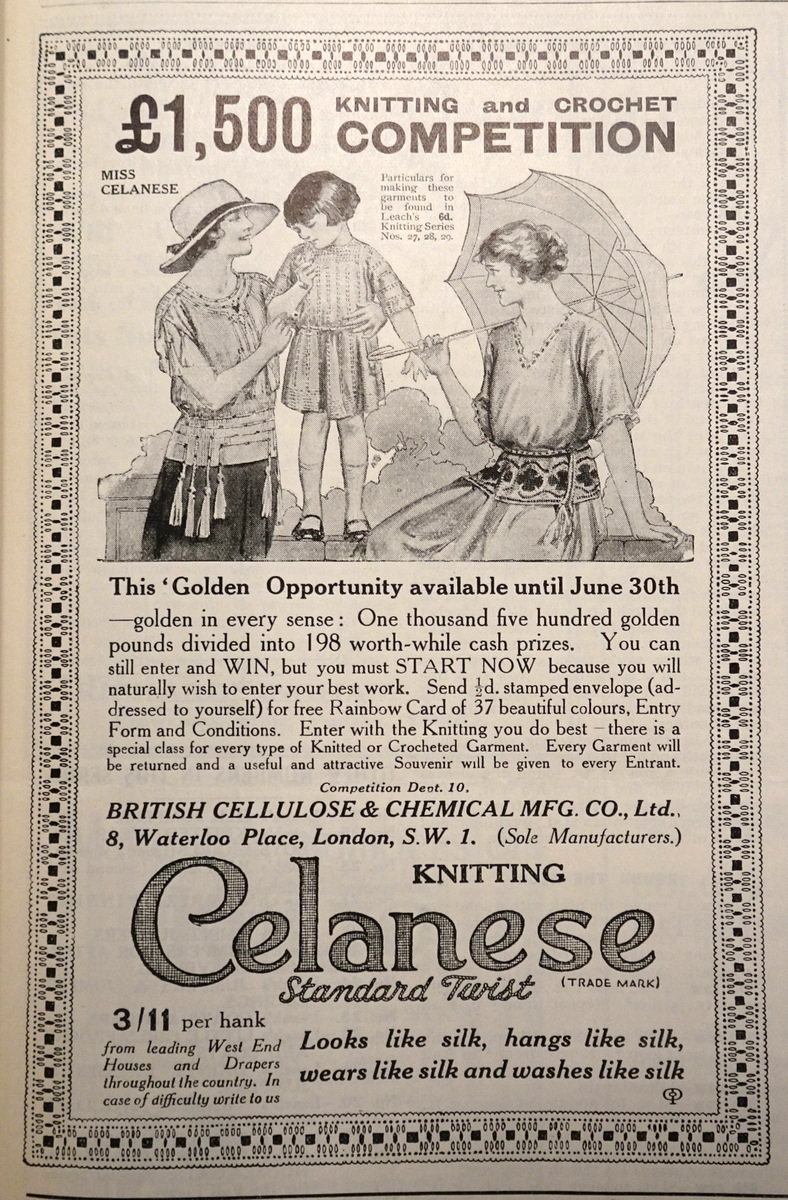
What's more, it was "The Jumper That Won £100".  The pattern instructions inside give more information: 'This lovely model won the first prize in a recent competition. You can copy it for less than twenty four shillings!'   The competition was organised by the manufacturers of Celanese artificial silk (rayon).  In an earlier issue of the Sixpenny Knitting Series, there was an ad for the competition:


The ad shows three garments, with references to where the patterns could be found (in the Sixpenny Knitting Series, again).  So it appears that the entries to the competition were to be judged on the quality of the knitting and crochet, not the originality of the design.  But printing the pattern for a prize-winning jumper does suggest that the winner might have designed the jumper, as well as making it to a very high standard.  Either way, the prize of £100 is an astonishing amount of money, worth over £6000 now.  The total prize money on offer would be worth over £90,000, and the ad promises that "Every Garment will be returned, and a useful and attractive Souvenir will be given to every Entrant" - the costs of sending the garments back would also be borne by the company, I assume.  Of course, all entries had to be made in Celanese art silk, so the manufacturers must have been confident that the additional sales resulting from knitters wanting to enter the competition would be worth more than the prize money.

The ad for the competition doesn't give full details, but I did find an ad in the Falkirk Herald newspaper, for the Falkirk & District Co-op Stores, which told me a bit more.  (The competition obviously benefitted retailers, as well as the manufacturers of Celanese.)  They mention four classes, three with first prizes of £100, second prizes of £50, third prizes of £25, and 40 consolation prizes of £5. The fourth class had smaller prizes, though still very worthwhile.   Even the consolation prizes of £5 would be worth £300 each today.

I also found a piece in the Sevenoaks Chronicle in August 1923, announcing a local winner:
£50 KNITTING PRIZE
Mrs Shoveller, of Boxmoor, Weald View-road, Tonbridge, is to be congratulated on having won the first prize in Class "D" of the Celanese Knitting Competition, the results of which were published on Tuesday.  Mrs. Shoveller, who was most surprised at this unexpected good fortune, entered a set of baby clothing, comprising coat, bonnet and gloves.  These were made with the loop stitch, one of her own invention.  The value of the prize was £50, and considering the enormous number of entries, which came from all parts of the United Kingdom, it was undoubtedly a well-earned reward......   Miss Ethel M. Curtis, of the Royal School of Needlework, acted as the judge.
I guess that Class "D" was for a baby outfit, and it appears that Mrs. Shoveller designed her prize-winning outfit herself.

Back to the pattern.  Alongside the instructions are photographs of a model wearing the jumper, which give a much better idea of what it should look like.  (Thought the lighting wasn't very good for taking photos, I'm afraid.)


It is partly knitted, in stocking stitch, and partly crocheted.  It is a very simple construction, with no shaping at all: it's made in 11 rectangular pieces, 7 crocheted and 4 knitted, which are then sewn together.  One crocheted piece is the basque, which goes around the hips, below the belt.  Here's a diagram showing how the other pieces fit together, with the opening for the neck in the middle.


Once the 10 pieces are sewn together as shown, the result is folded in half, top to bottom, and the side seams are sewn up, and the sleeve seams, which are just 2 inch seams in the crochet strips at the sides. Then the basque is attached to the body.  The final steps are to crochet around the square neck and to make the tasseled belt.

The jumper is intended to be very loosely fitting: the circumference of the body of the jumper is 50 inches (127cm.).  The cover drawing and the photograph show the jumper with sleeves ending just above the elbow, but actually most of the 'sleeve' is a dropped shoulder.  The loose fit is not unusual for early 1920s jumpers, for instance, the 'Egyptian' jumper, which appeared in Woman's Weekly, also in 1923,  is 46 inches (117cm.) around the body.  (And it has a similar construction, being a rectangle of knitting, with a neck opening in the middle, and a rectangle for each sleeve.)

The basque of the prize jumper, however, is only 40in. (102cm.) around.  The instructions for joining it to a much wider body are: "Pleat the wide strips of knitting [at the sides] towards the side seams both at front and back (these pleats can be plainly seen in the illustrations) and gather the rest of the jumper edge. Then sew jumper and basque together, putting seam of basque to one of the side seams."  Evidently, the jumper was intended to fit someone much slimmer than the 50 inch bust measurement suggests. The 40 inch hip measurement has to allow for skirt, petticoat, etc., so the person inside would have had to be perhaps a modern UK size 8, or 10 at most.

Let's look at the jumper in the collection again.  Although I'm confident that the maker followed this pattern, she did not make it as loose, or as long, as intended. (I'm assuming a woman made it.) The central crocheted panel is narrower, the jumper is shorter from shoulder to waist, and the basque is not as deep.  A bigger change is in the side panels of stocking stitch; instead of having a rectangle which extends part way down the upper arm, she has made this piece much narrower in the body, and added on extra stitches to make a well-defined sleeve.  Consequently, the upper body and the basque have the same circumference - there is no need for pleats and gathers as described in the pattern.

We have no provenance for this jumper, so we have no idea why she made these changes.  We don't even know when the jumper was made, except that we now know it must have been in 1923 or later.  Maybe she made it several years later, when the fashionable silhouette was more close fitting.  Maybe she just didn't like very loose jumpers.  Or she might have been influenced by another photo, showing a back view of the jumper:


This appears to show the jumper with a proper sleeve - in fact, since it doesn't have a sleeve, I don't know how the photo could have been staged.  I think it's possible that our maker saw this photo and liked that shape, and then found that she had to modify the pattern to achieve it.  That's pure speculation, of course.  But I'm very pleased that I have found the pattern - and that the original jumper won a very large prize in a national competition.  I think our jumper inherits some of that glory.       

Sunday, 27 January 2019

Steve's Jumper

The Knitting & Crochet Guild collection is moving to new premises very soon, which is exciting but involves a lot of work.  We have been busy tidying up - all sorts of things that were put to one side to deal with on another day.  On Friday, I brought home a box of 'miscellaneous publications' to sort out.  When I first started working on the collection, there were many, many boxes of very miscellaneous publications, but we have gradually worked through almost all of them - this is the last one, I think.  (I hope so.)  I have riffled through this box at various times and taken out all the things that can be easily placed elsewhere - magazines, spinners' pattern leaflets, booklets, and so on.  And the contents of other boxes have been amalgamated with this one. What was left in the box finally was a very random lot of stuff - mostly things that don't belong in the collection (sewing and embroidery leaflets, etc.) or out-and-out rubbish (creased and crumpled plastic pockets, booklets with no covers and pages missing).  But it was worth going through carefully, because there were some things worth keeping.  And one thing that I have been looking out for, but didn't ever expect to find.

About three years ago, my friend Stephanie (known as Steve) came to Lee Mills, where the Guild collection is stored at present, and showed us a jumper that her mother knitted for her when she was a teenager in the 1950s.   She demonstrated that it still fitted her, though I'm sure she hadn't worn it for many years.  She later gave it to the collection, and it has featured in several trunk shows that I have done since then.

Steve in her jumper, as a teenager

It is knitted in emerald green, with bands of stranded colourwork in cream and tan - very 1950s colours. It's a complicated knit, and very well made.

Steve thought that the pattern had been published in Radio Times, in the late 1950s.  I looked through the Radio Times archive in Manchester Central Library, but I couldn't find it (though I did meet several characters from 1950s BBC television like David Nixon the magician and Lenny the Lion).  Memory being fallible, I decided that Steve was wrong and that it was published somewhere else.  But I hadn't seen it in a pattern leaflet, and if it was in another magazine, there were so many possibilities that it would need a lot of luck to find it.

And then I found it in the miscellaneous box that I brought home on Friday.  It was indeed published in Radio Times, in a supplement to the November 21st 1958 issue.  (Perhaps the supplement had not been archived, and that was why I didn't find it in Manchester.) 


It's especially interesting to see the pattern, because Steve's mother changed the construction.  According to the pattern, it should be knitted in one piece, starting at the bottom of the front.  You cast on stitches for the sleeves either side, so that the stranded colour band is knitted in one piece from cuff to cuff. Then you make an opening for the neck, and carry on, knitting the second stranded colour band from cuff to cuff, cast off the sleeve stitches, and then knit the back.  You pick up stitches around the bottom of the sleeves and the neck opening for the ribbed cuffs and neckband, and finally sew the side and sleeve seams.

Steve's mother apparently didn't like the fact that at the side seams, you would have to join two stranded colour bands going in opposite directions, i.e. the one on the front knitted upwards and the one on the back knitted downwards.  She probably thought that the difference in direction would show - I think she was probably right.  She wasn't worried about the bands on the sleeves, because they don't meet at a seam - in fact you wouldn't usually see them next to each other.  So instead of knitting the body and sleeves entirely in one piece, she stopped after the sleeves were finished, and put that piece aside, leaving the stitches for the back on a spare needle or a length of wool.  Then she cast on again for the back; she knitted the welt and then the stranded colour band working upwards, and then the rest of the back up to the armholes. Then she grafted the two pieces together, which I think is extraordinary.  We had spotted that the two stranded knitting bands on the back of the jumper were knitted in opposite directions, and so we had found the graft, though it's very neatly done.  I don't think I have ever seen such a long graft in such a visible place, and I was surprised that a 1950s knitting pattern should be so ambitious.  But now I know - it wasn't.  The graft was Steve's mother's idea.

So having the pattern as well as the jumper tells us that Steve's mother was an expert knitter and a perfectionist - she saw something that she didn't like in a pattern that she wanted to make, and she fixed it. 

This was the last thing she knitted for Steve - she died in 1959, only about six months after the pattern was published.  I'm sure that Steve kept the jumper for that reason.  Steve herself  is very sadly no  longer with us - she died in 2017, not very long after giving her jumper to the Guild.  She would have been very pleased that the pattern for her jumper has been found.  (I think she would also have been a bit cross with me for doubting her memory that it was in Radio Times - sorry, Steve,) 

Detail of Steve's jumper, showing stranded colour work and basket stitch 
PS I have only just noticed, after writing the above, that the colour work bands in Steve's jumper are not exactly the same as in the pattern - the flowers are spaced further apart, because the intervening abstract design is doubled up.  I can guess how it happened - the chart shows a flower pattern with the abstract design either side, to show how it would look overall.  But you were only supposed to repeat the flower design and the following abstract design, not the whole chart.  Equally acceptable either way, I think.

Thursday, 8 November 2018

A New Match

It's very exciting (as I think I've said before) when we identify the pattern that was used to make an item in the Knitting & Crochet Guild collection.  I talked in a recent post about how important it is to have a story to tell about an item of knitting or crochet - the pattern it was made from (if there was one) is a crucial piece of its story.

The 1950s jumper below is one of many items in the collection that were the work of one woman, Jane Denny.  She was a prolific knitter - she commuted to work in London by train, and knitted on the journey.  She eventually gave the Guild more than 50 garments.  The earliest is a pixie hood that she probably wore to go to school in the 1940s, but there are also several little jumpers that she knitted in the 1950s, and later garments too.


We have three feather-and-fan jumpers knitted by Jane Denny in the collection - it was evidently a stitch pattern that she liked very much.  As you can see, it has a buttoned opening at the back of the neck (one of the buttons is missing), which was common in 1950s jumpers. This one is distinctive in having a square neck and dolman sleeves, and those features match it to a Marriner's pattern.

1950s vintage knitting pattern
Marriner 266
I like the square neck opening - a neat way of avoiding having to incorporate a curved line of decreases into feather-and-fan.  There is of course a seam along the shoulders, running into the sleeves, and an underarm seam.  It's awkward to seam the wavy edges of feather-and-fan neatly, but I think that the seams would look better when worn (as in the illustration on the pattern leaflet) than when laid out flat.

Marriner patterns at that time included a sketch of the garment as well as a photo, to give you an image to aspire to.  Wearing gloves, earrings and flowers on your shoulder is easily achievable, if a bit impractical for everyday wear, the hourglass figure not really. 


The obvious difference from the Marriner pattern is that Jane Denny's jumper is striped, in two shades of pink and a blue-purple.


Most knitters, I'm told, like to match the illustration on the pattern leaflet as closely as possible, and choose the same colour.  (I've done that myself.)  It's a very useful habit, as far as the collection is concerned -  it helps in matching a finished garment to its pattern. For instance, the pink crocheted disco dress (see here) was easy to recognise because the pattern leaflet also shows the dress in pink.   But Jane Denny not only chose a different colour, but also knitted her jumper in stripes.

One of the earliest cases where I matched a garment in the collection to its pattern was also a Jane Denny jumper, knitted to a Jaeger pattern.  I wrote about it here.


1950s vintage knitting pattern
Jaeger 3398

It was knitted to a Jaeger pattern, and again it was designed to be knitted in one colour.  But Jane Denny knitted it in broad bands of four different colours, combining together beautifully. We already knew quite a lot about her, and we know from the quality of the garments she gave to the collection that she was a skilful knitter.  We can now see, comparing these two jumpers with their patterns,  that she also had a very good eye for putting colours together, and didn't just follow the intention of the pattern designer.

Sunday, 21 October 2018

Arans in Birmingham

I have just been to Birmingham with my colleague Angharad - we did a trunk show and workshop on Arans yesterday for the Birmingham branch of the Knitting & Crochet Guild.  That is, I did the trunk show in the morning, and Angharad did a workshop in the afternoon.  We had two suitcases full of Arans - they are of course very bulky and heavy.  (Fortunately for us, we didn't have to transport them ourselves on the train - they were taken to Birmingham by car a few weeks ago and they are being brought back this week.)  I've given talks on Aran sweaters a few times, based on those in the Guild collection, and I showed some of the same things yesterday, including a replica of the sweater illustrated in Mary Thomas's Book of Knitting Patterns, published in 1943, that I showed here.  We had also chosen the Aran sweater in 4-ply (fingering) wool from a 1959 Woman's Weekly magazine (see here for more details):


and my own Susan Duckworth Aran from 1973, as well as more conventional Aran knits.

The collection has some distinctly unconventional Arans from the 1980s, using more or less standard Aran stitch patterns, but not knitted in wool.  One we showed yesterday is in purple chenille, following the Sirdar pattern below (cropped version):

Sirdar 5231
Another is in pale blue cotton:

Wendy 4033
We even have a batwing Aran sweater in a cream yarn with lurex, though in that case we don't have the pattern:


Here's a detail to show the gold sparkly bits:


If you recognise the pattern, please let me know.  Did the pattern specify lurex yarn, I wonder, or was that the knitter's choice.  And why not?  Maybe my life too would be richer for a batwing lurex Aran sweater.

At Angharad's workshop in the afternoon, we were given Aran weight yarn in cotton, to knit a wash-cloth.  We each chose stitches from the Arans in the trunk show.  I chose mine mainly from a very fine 1950s Aran:


I used the double cable from this sweater and the cable from the welt, and a related cable from the welt of the 1943 replica.  I carried on knitting it on the train back home, and then finished it last night.


It was a very successful workshop - devising your own pattern from a garment makes you examine it much more closely than you would do otherwise.

We had travelled to Birmingham on Friday, and as an extra, that evening our friend Janet took us to a Rowan Ruby Anniversary event, put on by the Stitch Solihull yarn shop.  The Birmingham branch had treated us to the tickets, and it was a lot of fun.

There was a display of current and vintage Rowan designs, as well as the current Rowan yarns and book to browse.   The Soumak wrap below by Lisa Richardson is both past and current: it was first published in 2013, but is also in Rowan's new 40 years book.

Lisa Richardson's Soumak and Mayfield designs
There were of course several designs by Kaffe Fassett: the China Clouds jacket is from Rowan Magazine 28 (2000) and Summer Star from Magazine 25 (1999).

China Clouds jacket by Kaffe Fassett

Summer Star by Kaffe Fassett

We were encouraged to wear a Rowan knit for the evening (in exchange for free entry in a raffle).  I wore the Gilda sweater that I made in 2009, in Rowan Wool Cotton - still a favourite of mine.   It was fascinating to see what other people were wearing - including a huge 1980s intarsia sweater.

There was a fashion show, too, presented by Anna of Stitch Solihull - here she is modelling a jacket with 'ROWAN YARNS' knitted into it.


It was a very good evening.  The shop provided drinks and a buffet with a 1970s theme (for the 40th anniversary) - including pineapple chunks and cubes of Cheddar cheese on cocktail sticks, and of course Black Forest gateau.  Looking through the Rowan books, I found at least two designs that I really want to knit.  And Angharad won the first prize in the raffle. 

Wednesday, 3 October 2018

A Scarf in Springtime

Earlier this year, the Knitting & Crochet Guild collection was given several balls of a vintage yarn. They were donated by a Guild member who volunteers in a charity shop.  She bought the yarn when it was brought into the shop, because she thought it looked very old, and had never heard of the make - 'Wakefield Greenwood'.   But when she asked on the Guild Facebook group for information about the company, she was pointed to posts on this blog - I have been gathering information about Wakefield Greenwood for several years, because it was a local company.  She offered the yarn to the Guild collection, and we were delighted to accept it.


The brand name is 'Springtime' - a wool yarn that was made in several thicknesses.  This is 'laceply & tinsel' - very fine, as the name suggests, and composed of 75% botany (i.e. merino) and 25% tinsel.  I don't know what the tinsel is - some sort of metallic thread.

Wakefield Greenwood (aka W. G. Spinners) introduced their wool and tinsel yarn in 1953.  The Yorkshire Evening Post featured it in their report on the British Industries Fair in that year:
Wakefield, Greenwood and Company, Huddersfield, this year features wool with a sparkle.  Each strand is spun with tinsel thread, giving a "brilliant" effect to garments. Though this new product was introduced only eight weeks ago, substantial orders have already been received from European countries, South Africa, and Australia.  In the shops it will retail at about 3d. an ounce more than normal wool. 
We have about 200 Wakefield Greenwood pattern leaflets in the collection, and I looked for any that used this yarn.  Here's one that looks like the same black and gold colourway as our yarn.  It's in stocking stitch, and the pattern specifies a tension of 36 stitches and 52 rows to 4 in. (10 cm.) with size 12 (2.75mm.) needles.  I have knitted a stocking stitch swatch on size 12s and it makes a very nice fabric, with a lot of drape.

W. G. Leaflet 1021
Here's another evening blouse pattern, for the same yarn.  The lace pattern looks very complicated and the result looks almost not knitted.  Maybe I should try it.... 

W. G. Leaflet 1145

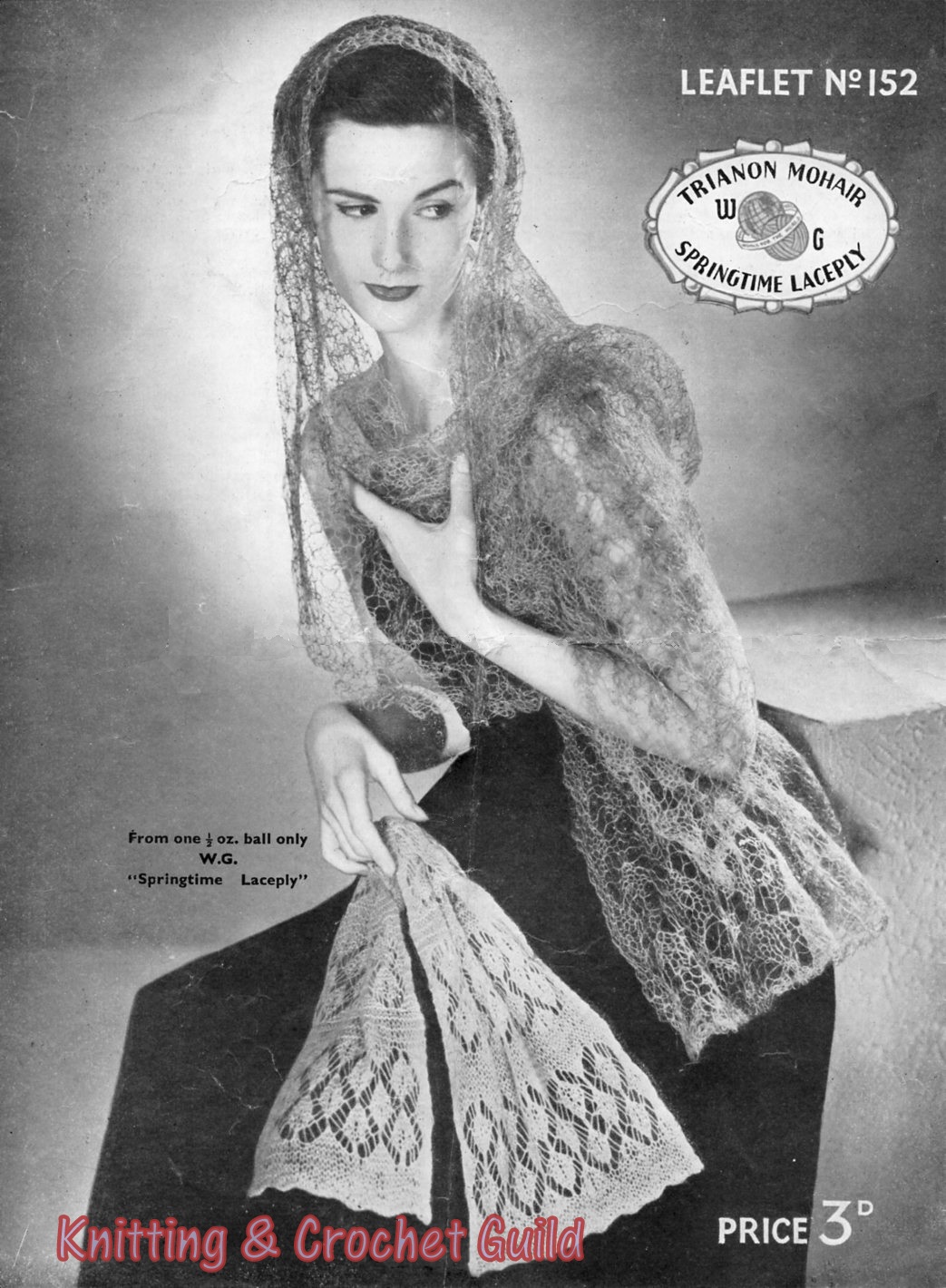
These two patterns are from later in the 1950s, but I did find a pattern for Springtime laceply that was advertised in 1953, when the tinsel yarn was introduced. 

W.G. Leaflet 152

According to the leaflet, you could make a short scarf, about 32 in. (81 cm.) long, with only one ½ oz. ball of Springtime laceply (i.e. without tinsel).  I decided to try it, to demonstrate what the yarn was like when knitted up.  I couldn't make a scarf of a sensible length from one ball, as it turned out, partly because the tinsel reduces the length in a ball, and also because I'm not very good at blocking.  So I used two balls - it's still quite a short scarf.  It's knitted on size 6 (4mm.) needles.  I found it absolutely impossible at first, because the only size 6 needles I could find were metal and very smooth -  their weight kept pulling them out of the stitches.  But then I found some bamboo needles of the right size and got on much better.  I put in lifelines, too, but didn't actually need them when I got the needles right.  


You can see that I haven't managed to stretch the lace pattern as much as in the pattern illustration.  In my defence, I think that the tinsel might possibly make it more resistant to blocking, maybe? 


I think it's much easier to relate to a vintage yarn if you can see something knitted in it that is also of the right era.  And now we have an example of something knitted in our 195os yarn to a 1950s pattern.  The scarf and some of the remaining balls of Springtime laceply and tinsel have already been in a trunk show of collection highlights last weekend, and will be included in future trunk shows too.  


Sunday, 16 September 2018

The Guild collection at In the Loop

I'm told that work is still in progress on the recordings of the talks at the In the Loop conference in July, so in the meantime, I will write a post based on my talk.

It was a short talk (20 minutes) on a huge collection, so I could only give an outline of what there is. Brief summary: knitted and crocheted items, tools and gadgets, yarn samples and shade cards, publications of all kinds (books, magazines, pattern leaflets and booklets).  Lots of everything.  At the conference, after outlining what's in the collection I talked about how we choose what to present in a trunk show - a suitcase full of selected highlights.  We have been doing trunk shows for a few years as a way of making the collection accessible to groups around the country - the first one was at Sheffield in 2014.  (I wrote about it here.)

When we choose a piece for a trunk show, we have to be able to say something interesting about it.  Ideally, we would like to be able to tell its story: who made it, when, what pattern did they use, who was it made for, and so on.  We no longer accept new donations of knitted or crocheted items unless they come with a story like this, but many of the items already in the collection have no story of that kind.

Sometimes, lack of a story doesn't matter - some of the pieces in the collection are such fine examples of craft that they speak for themselves.

Leaf-and-trellis pincushion cover 
Here is a Victorian pincushion cover that I have shown before on this blog, because it's an example of my favourite leaf and trellis pattern (aka print o' the wave) - I showed it here. Like many of the older items in the collection, it was bought at an antique textiles fair, and had no provenance.  We have no idea who made it and no way of finding out.  But it's a beautiful piece of work.  We don't know when it was made, but I'm sure it's Victorian.   It's possible that it was made to a specific pattern for a pincushion, in which case we might find the pattern one day, but the knitter might equally well have put together the leaf and trellis stitch pattern, and a pattern for a knitted edging (of which there were lots).   Either way, it's a very fine piece of work.

A theme of my talk was that we can sometimes identify the pattern that was used to make a piece, and that this can either provide a 'story' for it, or add to the story that we already have.  And the fact that the collection has so many publications alongside all the knitted and crocheted items helps us match pieces with patterns.

Occasionally, finding the pattern that was used to make an item casts some doubt on its story.  A piece that has often featured in a trunk show is a tea-cloth with a filet crochet edging, which has 'Welcome Home' worked into each side.


As the collection got more organised, it eventually turned out that there are three 'Welcome Home' tea-cloths, one of them with a detailed story.  It had been donated, along with a note of its history, by the daughter of the woman who made it.  The maker, Ethel Booth, was born in 1897, learnt to crochet at the age of 12, and made the tea-cloth for her father who was in the Army during the Boer War, "little knowing there would be the Great War".  That implied that the tea-cloth was made before the First World War (i.e. the Great War), but when I first saw it, before knowing this story, I was sure that it was a First World War design.  And in fact the story doesn't really hang together - the Boer War, or South African War, ended in 1902, before Ethel learnt to crochet.  And the First World War origin was confirmed when we found the pattern for the edging, in a magazine published in 1915.

Fancy Needlework Illustrated no. 33, March 1915.

 The design is called 'L'Entente', and was presumably intended to celebrate the alliance between Britain and France, shown by the British and French flags in the corners.  (Though I must say that filet crochet in white cotton is really not ideal for representing red, white and blue flags.)  The design was evidently a popular one, and I'm sure that the appeal was nothing to do with the alliance, but rather the 'Welcome Home' message.  Someone at home could make it in the hope that their father, brother, sweetheart,.... would come home from the war.

After we had identified the pattern for the 'Welcome Home' tea-cloth, we assumed that Ethel Booth's father had still been in the Army during the First World War, and she made it for him then.  But I've recently managed to trace Ethel Booth's family in census records and so on, and in fact her father had died by 1911.  So the story that she made it for her father is wrong, and I think that probably she made it for her future husband - they married in 1919.

All this happened before Ethel's daughter was born, and family stories often get slightly garbled in transmission, but she knew the final part of the story at first-hand, and I'm sure it's true: the last time the cloth was used was for Ethel's 90th birthday. 


Another item I talked about at In The Loop came with no story at all - it was bought from a charity shop.


It is a remarkably short crocheted dress.  When I first saw it, I mentally labelled it as a beach dress, on the grounds that a beach would be the only possible place to wear it.  But then we found the pattern:

Patons leaflet 6249

And it is not a beach dress at all.  The leaflets describes it thus: "Swingy little discotheque dress which longs to go dancing.  Prettily crocheted in a trendy yarn, with a short flirty skirt and a mini top."  (Did you know that 'disco' was originally short for 'discotheque'?  It's true.)

Because it’s a Patons pattern, and we have the Patons pattern leaflet archive in the collection, we have the master copy of this leaflet, that gives the original date of publication: October 1969.  The one I have shown is a later reissue from the early 1970s.


I'm not sure what you were supposed to wear underneath the dress.  The pattern calls for a pair of 'bra cups' to sew into the dress as a final stage in making up.  (Our dress doesn't have them.)  So you wouldn't need a separate bra.  But as the skirt is see-through (as well as very short) you would need underwear of some kind.  In fact, our dress is even shorter than the one shown in the leaflet - it has 5 fewer pattern repeats in the skirt.  Hopefully, the person who wore it was much shorter than the model.  Or else extremely daring.

Finding the published pattern to match our dress allows us to say a lot more about it than we could just from looking at it - we now have a story to go with it.  I finished my 'In the Loop' talk by showing a piece from the collection that is still in need of a story.


Like the pink disco dress, it was bought for the collection in a charity shop.  It is beautifully made in fine cotton.  But we don't know any more about it - it's difficult even to estimate when it was made.  If pushed, I would guess 1930s, but it seems too long for that date, or for the 1940s or 1950s.  And the work seems too fine for the 1960s or later.  It was very probably made to a published pattern and if so, we can hope to find the pattern one day - and then we will be able to give it an approximate date, and maybe say what it was intended for (a tennis shirt, I would guess).  So if you see a pattern for a shirt like this, please let us know - we would love to be able to include it in a trunk show and tell a story about it.

I'll say more about the Guild collection in future posts. 
Related Posts Plugin for WordPress, Blogger...