Friday, 31 January 2020

The Wristlet Crochet Ball Holder

The volunteers working on the Knitting & Crochet Guild Collection have selected 100 objects to show the range of the collection — including knitted and crocheted garments, books, pattern leaflets, gadgets, and many other things. Currently, the objects are being posted on social media (the Guild website, the KCG Facebook group here,  and on Instagram, user name @kcguild), one each day.  Today's 'object' (number 10) is a group of holders for knitting wool or crochet cotton, that hang from the wrist on a bracelet, including a crochet ball holder like the one in the photo below; here's some more information about it.

We have several in the collection of the same design, some in their original cardboard box, saying either 'The "Ownlee" Practical Crochet Ball Holder',  or 'The Wristlet Crochet Ball Holder' on the lid. The holders have a patent number (on the base of the flat circular disc) and some of the boxes, like the one on the photo, still contain printed booklets, so it's possible to find out quite a lot about their history.

The "Ownlee" Practical Crochet Ball Holder in its box, with booklet

In case it's not obvious, here's a drawing showing how it's to be used.


The idea was patented in 1912, by George Garratt Kent, who lived in East Finchley (London).  Crochet cotton, then as now, was sold ready wound into balls.  The crochet ball sits on the metal disk, with the bent wire going through centre of the ball.  The holder can swivel freely, hanging from the bangle.  An improvement, patented in 1913, that the disc is not rigidly fixed to the bent wire, but hinged.  George Garrett Kent was born in 1875, and in the 1901 census, he is listed as a wood engraver.  In 1911 and 1939 he is listed as a commercial clerk and then an estimating clerk, but with a mention of illustrating and engraving, so his occupation would have given him the practical skills to design the ball holder and make a prototype.

The crochet ball holder was sold through the Practical Novelty Company of Hatton Garden, London (centre of the UK's diamond trade, though I'm sure the Practical Novelty Company didn't deal in diamonds).  Someone in the company, I imagine, must have written the little booklet in the box, which tells a story of how the holder was invented:


The history of the “Practical" Crochet Ball Holders begins like a fairy tale, with "Once upon a time", but the "time" which this "once" was upon, was only a year or so ago, and this is not a fairy tale, but a true story. A man and his wife went to the seaside for a holiday. "Little drops of water, little grains of sand" got all mixed up with the lady's ball of crochet cotton because, like Humpty Dumpty, it "had a great fall" and rolled about on the beach. Along came Old Mother Hubbard's dog, which had "none" (meaning bones) and playfully attempted to carry the ball home to his empty cupboard. When a big "spider sat down beside her" and frightened the lady away, the man could stand it no longer. He dived into the recesses of his productive British brain, and Jack-Horner-like, pulled out a "plum" which was the original idea of the Practical Wristlet Crochet Ball Holders.
Naturally, the lady was pleased with the clever little contrivance which kept her ball just where she wanted it, and she showed it to her friends. So, like a snowball, which is formed with a handful of snow, and then set rolling down-hill, moving faster and growing bigger every moment, so the "Practical" Crochet Ball Holder started, gaining popularity every day, each sale resulting in the sale of many more, until it has become necessity to everyone who does crochet or knitting work, and is sold in nearly every country on the globe. 
Presumably, it was George Garratt Kent who was at the seaside with his wife, and inspired to invent the crochet ball holder. The booklet goes on to show two related gadgets that were patented jointly by George Garratt Kent and The Practical Novelty Company.


The "Practical Wool" Holder is the result of a demand for something to hold a ball of wool, as wound from the skein. The Table Stand is also an evolution, and appeals to ladies who prefer to keep their ball in place on the table, instead of on the wrist.

I don't think we have either of those in the KCG collection, which suggests that they weren't as successful as the Wristlet Crochet Ball Holder.  The booklet goes on to give prices for the Wristlet Crochet Ball Holder in various materials, from an Electro Plate Bangle with a Nickel Plated Base, at one shilling (5p) — 'quite good enough for ordinary use, at home or at the seaside or country, where one works a great deal out of doors, and the damp air is fatal to ornaments.'   The most expensive is either a Sterling Silver bangle with silver plated base, or Rolled Gold, both at 5 shillings (25p) — for 'those who wish to give a pretty present to those near and dear. Young men find them just the thing for the "dearest girl" and fond parents present one or the other to the young lady daughter who likes all the appointments of her work basket to be dainty and attractive.'   Finally, the booklet mentions the "Ownlee" crochet ball holder, shown in the photo above, which is the cheapest option, at 6½d  (about 3p).  I think that all the ones that we have in the collection are the cheaper ones.  (For comparison with prices of modern gadgets, 5 shillings in 1913 would be worth about £30 today.)

The gadgets were widely advertised in needlecraft magazines, with a warning to beware of inferior imitations.  But I don't think it was advertised after the First World War — a pity, because it's an ingenious idea which would still be useful now for anyone who uses crochet cotton.


Finally, we have a photo in the KCG collection which shows someone using a Wristlet Crochet Ball Holder, or something very like it.  It's a charming portrait.


Thursday, 23 January 2020

A Chic Jumper in an Egyptian Design

Woman's Weekly, July 28, 1923
There is a free knit-along in progress on Facebook at the moment (here), hosted by Ellie Reed (@drelliereed on Instagram). She has been working on the Knitting & Crochet Guild collection for the past year, scanning and cataloguing the knitting and crochet patterns in the pre-1950 domestic magazines.  As part of the project, she is running the knit-along, based on a pattern in a 1923 Woman's Weekly. The pattern is for a jumper with a band of camels, pyramids and palm trees in stranded knitting.  It's described as "A Chic Jumper Worked in a New Egyptian Design", and it was probably inspired by the discovery of Tutankhamun's tomb in November 1922, which sparked a huge interest in Egypt and its antiquities.  Ellie has knitted it already, for herself, and very successfully, and she is now knitting another for the knit-along.

The construction of the camel jumper is very simple.  The front and back are knitted in one piece, starting at the front with the colour-work band.  There are no shoulder seams: the front is split either side of the V neck, and at shoulder level the two pieces are rejoined, casting on stitches in the centre for the back neck.  There is no shaping for the waist and armholes: apart from the V neck, the front and back are just a long rectangular piece.  Each sleeve is also a rectangle.  It was common in the 1920s to make the back and front in one piece, and often the sleeves would be worked at the same time as the front and back, so that the only seams would be the side and under arm seams. For instance, here I showed a quite elaborate knit and crochet jumper pattern with that construction.

I plan to change the construction altogether, and knit front and back together, in the round, up to the armholes.  I don't like working stranded knitting flat, I don't like seaming stranded knitting, and I don't like the idea of having the front band knitted bottom to top and the back band knitted top to bottom.  Knitting in the round will fix all that.

The way in which the colour work is incorporated is also unsophisticated, to an extent that would be unacceptable now (certainly, I don't like it).   The most obvious thing that I think needs changing is that the band of camels and pyramids is not centred:  the pattern repeat is 46 stitches, and you cast on 110 stitches for the body, which means that in each band, front and back, you get two complete repeats and part of the third, finishing part way through the pyramids.  To fix that, the number of stitches will have to be a multiple of 46, which is a bit tricky to manage.....

The pattern says that the tension should be 4½ stitches to the inch, on size 6 needles - in modern parlance, 18 stitches to 10 cm. on size 5mm. needles.  The needles seem very big for what seems to be quite fine Shetland wool, possibly a 4-ply (fingering weight) - the whole jumper is supposed to take only 8 ounces of wool (about 200gm.)   I'm ignoring the stated tension - I'll work out my own tension, and then decide how many stitches I need from that (with some adjustment to make it a multiple of 46) .

Another issue concerns the edges  - the lower edge, the sleeve cuffs and the neck band. The jumper is knitted in stocking stitch, which of course will curl, given the chance.  In the original pattern, there are 4 rows of garter stitch at the lower edge, front and back.  In my experience, that's not enough to stop stocking stitch curling up.  So I plan to make a hem at the lower edge. I have so far knitted a swatch to try it, and to see what the camels, pyramids and palm trees look like.

I decided to use something like a 4-ply, and a more usual needle size for that weight.  The yarn I have used is Rowan Felted Tweed in Ginger (a rusty orange), left over from the tam I knitted for Piecework.  The main colour is a silver grey, which I thought was also Felted Tweed, left over from knitting Louisa Harding's Old Moor design. But actually, it's Brooklyn Tweed Loft, left over from my very favourite Boardwalk pullover.  (I like silver grey a lot.)

Here's my swatch for the camel band.  It was knitted in the round, with a steek - the first time I have cut a steek.  I made a picot edge to the hem, also a first.  I'm pleased with how neat it looks.  And the hem lies perfectly flat.  (John points out that Egyptian camels have one hump and not two, but never mind.)


There are narrow bands of stranded knitting around the V neck, on the sleeve cuffs and along the tops of the pockets.  I think the sleeves and pockets will also need hems to make them lie flat.  The band either side of the V neck on the front is especially problematic.  The contrast colour is joined in for the 7 stitches either side of the opening, and Ellie found that it's difficult to make the colour work  neat. And apart from that, the edge will curl - she bound the inside of the neck opening with petersham ribbon to make it lie flat.  I'd rather change the pattern so that the knitting behaves itself without the aid of petersham.  So I knitted a swatch to try out making the bands separately and sewing them either side of the front neck opening.  The colour work could be a bit neater - I'll change it a bit next time.


That may seem like a lot of changes to the pattern, but they are all in the spirit of the original design, I'd say.  I'm not going to knit the jumper for the knit-along, because I've got too many projects already (on the needles, or yarn and pattern all ready to go).  But I do plan to knit it some time soon.   And I shall look exactly like the sketch in the magazine.


Tuesday, 7 January 2020

2019 Books

I belong to two book groups, and for several years now I have been making Christmas cards for the members of  one of them, showing the books we have read during the year.  I give them out at the book group Christmas dinner in December.  Here's the 2019 card:


We read:

  • The Collini Case, by Ferdinand von Schirach
  • A Gentleman in Moscow, by Amor Towles
  • Ghost Wall, by Sarah Moss
  • The Golden Age, by Joan London
  • The Silence of the Girls, by Pat Barker
  • Saturday Night & Sunday Morning, by Alan Sillitoe
  • Pereira Maintains, by Antonio Tabucchi
  • Take Nothing With You, by Patrick Gale
As usual, there were several books that I'm sure I would never have read (never even heard of, probably) without the book group: The Collini CaseA Gentleman in Moscow, Pereira Maintains and The Golden Age The Collini Case deals with the long shadow of the Nazi era in Germany -  Ferdinand von Schirach's grandfather was the head of the Hitler Youth, and prosecuted for war crimes at Nuremberg. A Gentleman in Moscow is the story of a wealthy aristocrat who is confined to house arrest in a Moscow hotel after the Russian Revolution, and recounts how he survives and makes a life in straitened circumstances.  (It's going to be turned into a TV series with Kenneth Branagh, I read.)  Pereira Maintains is set in Lisbon in 1938, under the fascist dictatorship of Salazar - Pereira is a journalist writing about cultural topics and trying to stay out of politics, until finally he is forced to rebel.  The Golden Age is named after a children's hospital in Australia in the 1950s, where polio cases are sent for rehabilitation.  The main character and his parents have arrived in Australia as survivors of the Holocaust, and the novel also deals with the parents adjusting to their new lives.  I enjoyed all of those, and I think the rest of the group did, too.  The Silence of the Girls was my choice, a retelling of the Iliad from the point of view of one of the women who is awarded to Achilles as a prize, after her home is destroyed by the Greeks, and all her menfolk slaughtered. A really good book, though in our discussion we got into an argument about whether (in the world of the book) the Greek gods actually exist and do things or whether the apparently supernatural events are only supernatural to Briseis, because she believes in the gods.  (It's a work of fiction, so the gods are allowed to exist in the book, in my view, and can preserve corpses from decomposition, or whatever else they want to do.)  

I think I read Saturday Night & Sunday Morning a long time ago, and I'm sure I saw the film, but re-reading it now, I didn't like it.  I couldn't understand the main character - he seems to be unpleasant to people for no good reason, and then suddenly decides to get married.  But other members of the group did enjoy it, so it's just me.   I had read and enjoyed Patrick Gale's book A Place called Winter, inspired by his own great-grandfather's life, and enjoyed Take Nothing With You, too.  It's based partly on Patrick Gale's own experiences of learning to play the cello (not something I knew anything about).  The title is from the protagonist's treatment for thyroid cancer, being isolated in a lead-lined room having taken a radioactive iodine pill - he is advised not to take anything he values in with him, because it will become radioactive.  My husband has had the same treatment - reading a fictionalised account of it was a slightly odd experience. 

This year I decided to make cards for the members of my other book group, too.  (We don't have a book group Christmas dinner, so hasn't been the same prompt to distribute cards, so I  have made them New year cards.)  I used the same format - both groups read eight books in 2019. 


We read:


  • Elmet, by Fiona Mosley
  • Milkman, by Anna Burns
  • If Beale Street Could Talk, by James Baldwin
  • The Sealwoman's Gift, by Sally Magnusson
  • Transcription, by Kate Atkinson
  • The Way of All Flesh, by Ambrose Parry
  • The Noise of Time, by Julian Barnes
  • The Red-Haired Woman, by Orhan Pamuk

In the other group, we avoid reading books that any of us ahs read before (unless we decide to revisit a book that most of us read a long time ago, like Cold Comfort Farm or Saturday Night and Sunday Morning), but this group doesn't have that rule, so I had already read The Sealwoman's Gift - in fact it appeared on last year's Christmas card for the first group.  It's a fascinating story, based on real historical events.  Some of the other books by well-known authors that had received good reviews were a bit disappointing.  But Milkman (that  won the Man Booker prize in 2018) was worth reading, and I might not have chosen to tackle it but for the book group.   The Way of All Flesh (Ambrose Parry) is not in the same league, but we enjoyed it.  It's a detective story set in 19th century Edinburgh.  "Ambrose Parry" is actually two people, a novelist who has written many other books and his wife who is an anaesthetist.  Several of the characters in The Way of All Flesh did actually exist, including James Simpson, an Edinburgh obstetrician who introduced chloroform as an anaesthetic, so as well as being a good read, the book is very informative about the early development of anaesthesia.  As with other well-written historical novels, you feel that you are being educated as well as entertained. 

Monday, 25 November 2019

Bridget's Blunder

Last year, I posted a rhyme, Anna's Adventure, published by Patons & Baldwins about 1946, to advise knitters on how to wash wool.   Last week, I found another P&B rhyme in the Knitting & Crochet Guild collection.  "Bridget's Blunder" is about the dangers of using allegedly shrink-proof wool, other than P&B's own 'Patonised' wool.  Here it is, with a transcription below:


BRIDGET’S BLUNDER
My story tells of Bridget Whitting
Who loved both plain and fancy knitting,
But though she worked by day and night
Her efforts seldom turned out right.
Friends would say, "Cor! That jumper's posh!"
But when she'd given it a wash,
Instead of snugly fitting Bridget
It seemed more suited to a midget.
One day, when off to see her draper
She saw announced inside her paper
A brand-new wool; was she elated!
For bold as brass the maker stated
"This wool's the best that can be got,
It will not shrink, no matter what!"
So Bridget told her woolshop flat,
"I'll have a basinful of that."
And hurried home with glowing cheeks,
But couponless for weeks and weeks.
Soon willing labour bore its fruit—A salmon pinky jumpersuit,
Which Bridget wore with pride o'er-weening
Till, soiled and creased, it needed cleaning.
Said B., "It won't take half a wink,
The makers say it cannot shrink."
(But they forgot to say—the wretches!—
That wool made shrinkless sometimes stretches).
'Twas washed; the outcome nearly killed her,
It went three times round Aunt Matilda!
And looked in shade like Aunt Euphemia
Who suffers from acute anaemia.
"That's finished it," wept B., "I'm quitting,
I'm through for good and all with knitting;
I'll write at once to my M.P.
About this dire calamity."
Her tale was penned 'midst groans and hisses,
—The M.P. showed it to his Mrs.
Who said, "That girl should be advised
To stick to wool that's Patonised,
Which, used with reasonable care
Will wash and wash, and wear and wear;
Trust P & B, the leading spinners
Only to turn out certain winners.
Just tell her she's a chump to quit
When there's such lovely wool to knit."
B. took the tip, no longer weeps;
That M.P.'s in his seat for keeps! 

The poem appeared in The Nursery World 1st Knitting Book, published I think in 1946, like "Anna's Adventure".  Even after the war was over, clothes rationing in Britain continued until 1949, so the reference to being "couponless for weeks and weeks" after buying enough wool for a jumpersuit is no exaggeration - in fact, I doubt if anyone could afford the coupons for that much wool more than once a year, and even then it would be your main clothes purchase.

I suspect that the shrinkproof wool that stretched in the first wash might have been intended to refer to Emu wool.  Emu started to appear in ads from 1943 (possibly earlier) with the slogan "Knit with Emu and stop thinking about shrinking".  One ad claimed: Emu is the result of scientific research into wool shrinkage.  It is made permanently unshrinkable and easy washing by a secret process called "emunising". I assumed that emunising and Patonising were more or less the same process, but perhaps not.   And in any case, if Patons & Baldwins were indeed referring to Emu wools in "Bridget's Blunder", it didn't do the brand much harm - Emu Wools were very successful, and remained so until the 1980s.  The company was eventually taken over by Thomas B Ramsden (makers of Wendy, Robin and Twilleys yarns), who relaunched Emu Superwash Wool in 2005 (though it seems to have been since discontinued).  So shrinkproof Emu wool evidently had a long and distinguished career.


I wonder if there are any more P&B rhymes from the late 1940s still to be found?  We have had A for Anna's Adventure and B for Bridget's Blunder - was there a C, D, ...?   If you know of one, please let me know.

Thursday, 31 October 2019

1919

I'm still catching up on writing about Shetland Wool Week, and this post is about the talk I gave at the Shetland Museum as part of the Wool Week programme.  My talk was on the Knitting & Crochet Guild, but mostly about the Guild's collection. I talked about a few selected pieces from the collection, and we had a display of the actual items at the front of the auditorium, so that the audience could have a close look, before and after the talk.

I picked some things that had a particular connection to Wool Week, including a few that originated in Shetland.  But this post is about one of the pieces on display that has nothing to do with Shetland, or wool, for that matter.  I chose it because it's relevant to 2019 - it was made exactly 100 years ago, in 1919.

Cloth with 'Peace 1919' filet crochet border 


It's a tea cloth with a filet crochet border, and a linen or cotton centre with drawn thread work.  There are doves with sprigs of olive in their beaks along the sides, and 'Peace 1919' in each corner.

We know that the First World War ended on November 11th 1918, but strictly speaking that was the day of the Armistice between the Allies and Germany.  Formally, the war ended with the Peace Treaty signed in 1919 - so that many war memorials in Britain give the dates of the war as 1914 to 1919. (The Shetland war memorial in Lerwick does, in fact.)

There were peace celebrations in the summer of 1919, and someone must have made the 'Peace 1919' tea cloth then, and perhaps used it at a celebration tea party. Before I went to Shetland, John and I set up a tea party setting, with the tea cloth, and a filet crochet tea cosy that was also made in 1919, with the slogan '1914 1919 Victorious Peace'.   You can also see a set of First World War medals on the table, that belonged to one of John's grandfathers.  The cloth only fits a very small table, as you can see, so it must have been an intimate, rather low-key tea party.


Here's a better view of the 'Victorious Peace' tea cosy:


I wrote about the tea cosy here, after I had found the pattern for its other side (which shows a very decorative, slightly Art Nouveau teapot) in a 1918 issue of Woman's Weekly magazine.

I hoped then to find the pattern for the 'Victorious Peace' side of the tea cosy in a 1919 issue of Woman's Weekly, and on a later visit to the British Library I looked through all the 1919 issues.  I didn't find the tea cosy, but I did find the pattern for the 'Peace 1919' table cloth, on the front cover of the April 19th issue.


The magazine gave instructions for a corner, and for one of the doves along the side of the border. So you could make your table cloth as large as you wanted, just by adding more doves.   For comparison, here are a corner and a dove from the edge of our tea cloth. 


And I did eventually find the pattern for the 'Victorious Peace' tea cosy - not in Woman's Weekly, but in another weekly magazine for women, Home Companion, in the August 2nd issue.


(Home Companion is long gone - it ceased publication in 1956 - but Woman's Weekly is flourishing, and still publishes knitting and crochet patterns. )

The Peace 1919 tea cloth is a really excellent piece of work.  The crochet is very even, and the border fits the centre cloth exactly.  I'm not sure how that was done: it would be very difficult to make the border to a precise size, I think, so perhaps the cloth was made afterwards.  Not sure. And though I know almost nothing about drawn thread work, I am very impressed by the quality of the work in the centre of the cloth.  Here's a corner of the drawn thread work, and a close-up of a detail - so painstaking, to weave the fine cotton around the threads to make something quite solid again.


Making the cloth must have taken many hours.  And I wonder how often it was actually used - perhaps a few times in 1919, but maybe not much after that?   It has survived in very good condition, which suggests that it might have spent most of the last hundred years in a drawer.  Now it commemorates not just the end of a dreadful war but the skill of its unknown maker, too.

PS Apologies for the quality of the photos. The cloth is actually quite white, even though it looks grey-ish in the photos.  Flash washes out the detail, and increasing the contrast after taking the photos looks artificial.  Ignore the grey, and just imagine that it's white. 

Saturday, 19 October 2019

Jamieson's

While I was in Shetland for Wool Week, I went on a tour of Jamieson's Mill at Sandness. It's about 30 miles from Lerwick, on the west side of Mainland.  A coach picked us up in Lerwick, for a 50 minute drive across the island.

Garry Jamieson gave us a tour of the mill (in two groups, so that there was plenty of time to look around the shop, too).  It was fascinating to see all the processes involved in converted the raw fleece into balls of knitting wool, all in one building (as well as weaving and knitting, too). Garry showed us one of the fleeces, in the state that they arrive in, and talked about the quality of the wool.


After washing, the wool is dyed. The dyepot looked like an enormous pressure cooker, gently steaming.


Bales of dyed wool
Later, it goes through a carding machine...


... and out the other end.

And then gets spun. I think this is what's going on here:


And after two strands of the spun yarn are plied together (Jamieson's Spindrift is 2-ply), it's ready to be wound into balls.


(The blur in the middle is the wool moving very fast.)

Finally, each ball gets a ball band, and 10 balls make a pack of wool...
 
... all ready to be sold.


Apologies for any inaccuracies - all due to me, and not to Garry's tour.

A couple of eye-catching things around the mill. 


And as I said, there was a shopping opportunity.  I had already bought the Shetland Wool Week Annual, which is mainly a book of patterns, beautifully illustrated with scenes of Shetland, and decided that I'd like to knit the Seaweed Slipover, designed by Wilma Malcolmson.


The background colour is pale grey, which I like a lot, but I decided that I wanted the other colours to be slightly lighter and brighter versions of the ones in the Album.  These are the ones I picked from the Jamieson's shop:


It's hard to get an accurate rendering of the colours, especially the pink (Lipstick).  These are from Jamieson's website:


I have knitted three Fair Isle jumpers or pullovers before, though a long time ago, but this will be the first one knitted properly, i.e. in the round, with steeks.  It will be my next project, after my current one.

I forgot to mention in my last post that while I was in Shetland, I realised that I had somehow missed one of Ann Cleeves' Shetland novels.  (Not the last one, so I don't know how I missed it.)  I bought a copy in the Shetland Times Bookshop in Lerwick, and read it on the way home. And now I'm re-reading the other seven.  Many of the places mentioned in the books are real places, and so it is lovely to read about places I went to.  There is a scene, for instance, where two people have a drink in the bar of the Mareel, the arts centre in Lerwick, near the Shetland Museum. I did that too!   I'd really like to watch the TV programmes again, as well, because I know that they show wonderful scenery, and now I've seen some of it.  The programmes don't seem to be available just now, but I'll keep looking.


Thursday, 10 October 2019

Shetland Wool Week

Last week I was in Shetland, staying in Lerwick, for the 10th Shetland Wool Week. I had never been to Shetland before (or in fact anywhere that far north), so it was a fascinating week, quite apart from all the knitting-related activities. And we were extremely lucky with the weather, which was mostly dry and often very sunny, while back home in England it was raining for most of the week - a lot.

Walking along the Esplanade at Lerwick every day, there were wonderful views of boats anchored, and the sound beyond, dividing the mainland from Bressay island. This was the view over Hay's Dock, in front of the Shetland Museum, on a beautiful evening. 


I arrived on Saturday, and my first Wool Week event was the Welcome on Sunday evening.  500 people were there - so as there were 1,000 people attending Wool Week, a lot were disappointed.  I wrote here about knitting my Wool Week beanie, in this year's design.  At the Welcome, almost everyone was wearing their beanie, and there was a group photo at the end of the evening.


A photo of the Wool Week Welcome evening from BBC News.  I was there, wearing my Roadside beanie, though I can't see myself in this photo.

I spotted a couple of beanies that had substituted an image of something else for the fishing boats. A bicycle:


or a plane. Actually, I was told, a Bristol Blenheim, which has a WW2 Shetland connection.


Most people attending Wool Week wore their beanies whenever they were outdoors (and it was cool enough that you wanted to be wearing a hat anyway).  It was a useful way of identifying fellow knitters too, and starting a conversation.

I hadn't booked any of the classes, partly because John had intended to come with me, but couldn't in the end.  So we had planned to see Shetland together.  One Wool Week event I had booked for both of us was a bus tour west to Vementry, and to Ollaberry and Islesburgh in North Mainland. It was a (mostly) fine day, and a good opportunity to see more of the Shetland landscape.  You never seem to be far from a loch or the sea on Shetland.

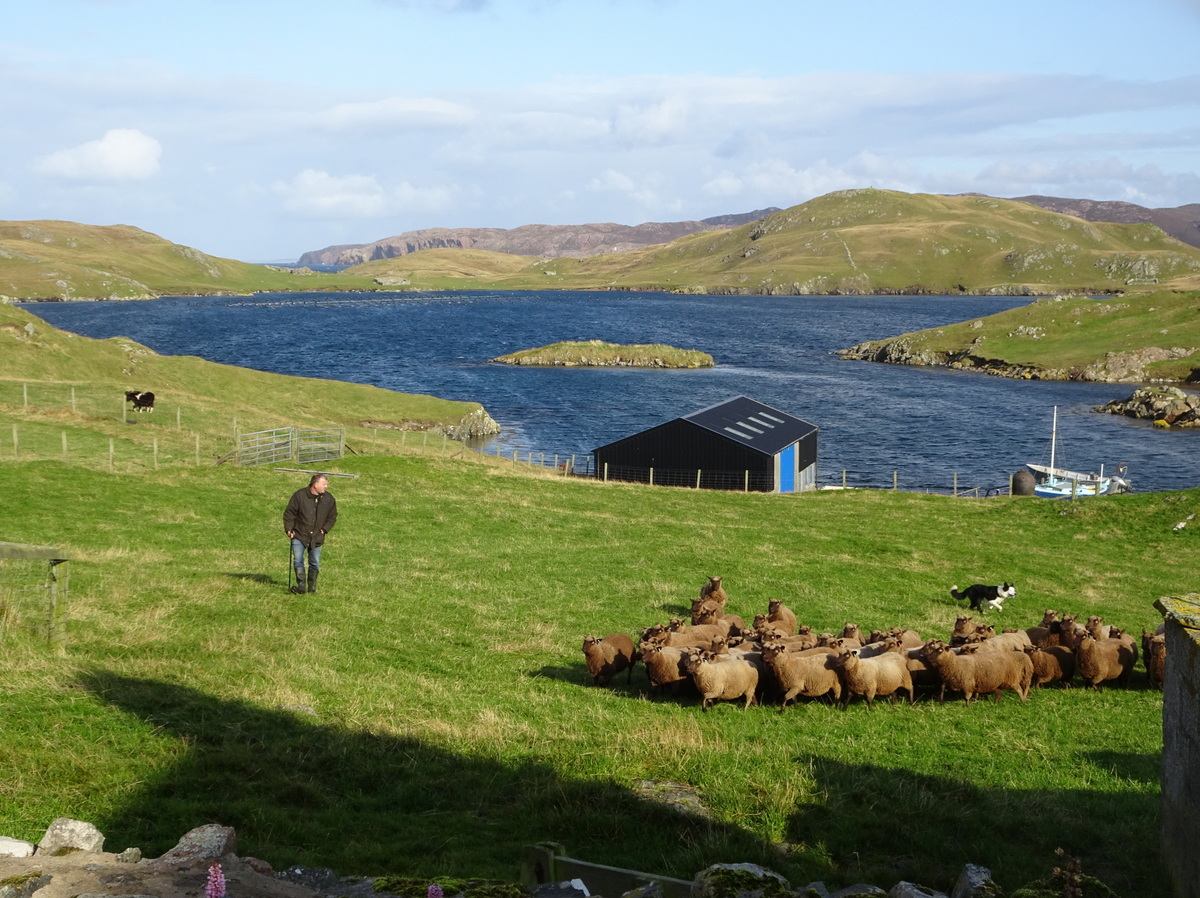
Gathering sheep at Vementry
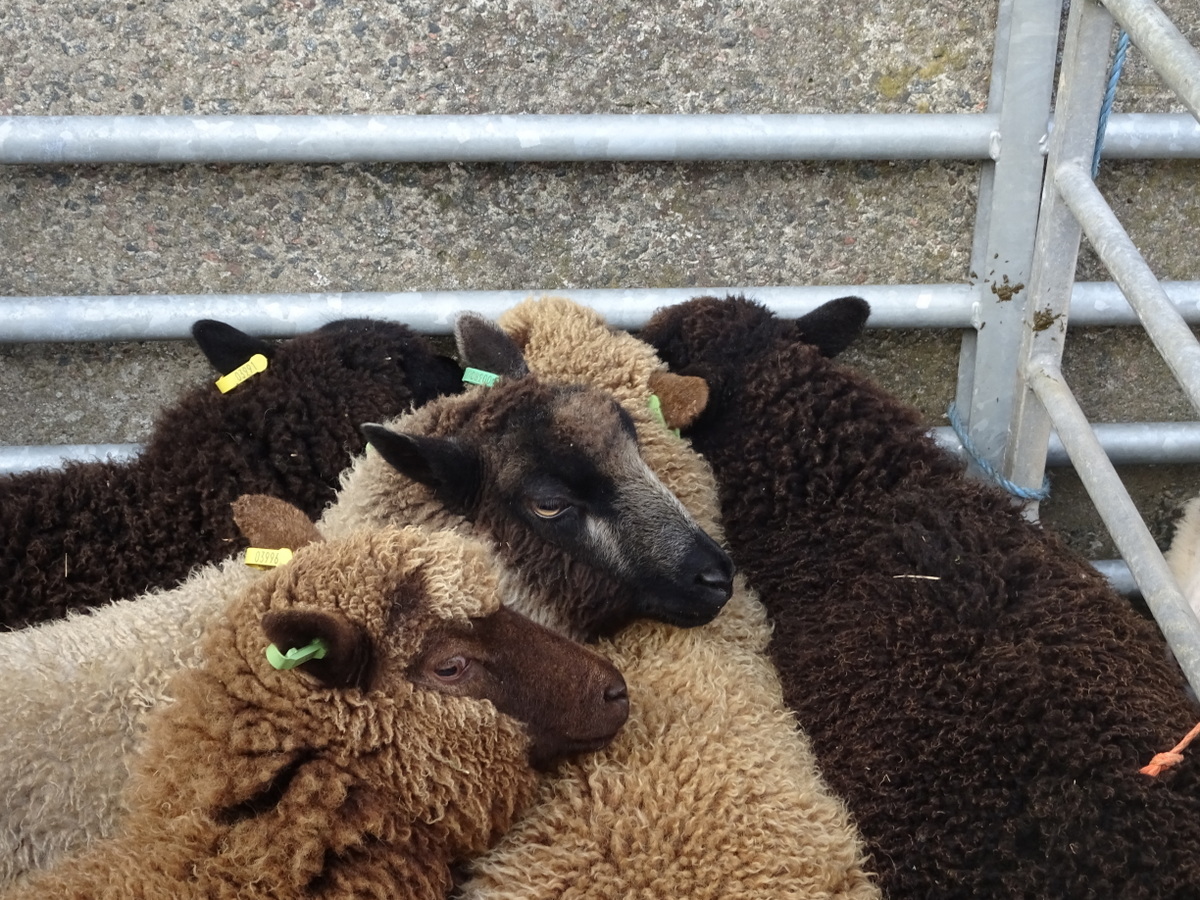
At Vementry, we saw their prize-winning Shetland sheep, mostly moorit (i.e brown), and Shetland ponies. It's a beautiful spot, overlooking the shore, and (I think) Vementry Island in the distance.

We had lunch at Ollaberry Community Hall - a lavish spread of homebakes laid on by local women. There was an exhibition of knitwear - some new, some that had been kept carefully, for many years in some cases.  I was very taken with the large lampshade in Print o' the Wave (one of my favourite lace stitch patterns):


I also liked an outfit from the late 1960s, mainly because of its story.  Its owner said that her mother had knitted it for her when she went off to college in Aberdeen. There was a photo of her with friends, about to get the ferry, and wearing the outfit with a much shorter skirt - though actually, she said, she never wore it much because it wasn't really in fashion at the time. And her mother thought it was much too short, and added a piece to make it longer. A very 1960s teenage experience.


We ended the day at Islesburgh Farm, where we saw more prize-winning Shetland sheep, of several colours. (Some sheep evidently think that if they can't see you, you can't see them. They were mostly trying to hide their heads underneath another sheep.)


Another day, I went on a tour of Chris Dyer's croft on Bressay, a short ferry ride from Lerwick.  We saw more sheep - here Chris and his dog are driving them:


Chris has pigs and piglets, too.  And tomatoes, courgettes and peppers growing in a Polycrub, a specially strong version of a polytunnel, designed to withstand Shetland winds. He talked to us about his approach to running the croft, alongside his main job as an archaeologist.

Chris took us to the Speldiburn cafe on Bressay for lunch, where there was another exhibition of knitwear.  Again, some new, some old.  I particularly liked a couple of children's pullovers from the 1950s, both mainly pastel colours on a dark brown background. I don't think I know enough to judge, but that kind of colour combination seems to me to be different from  modern Fair Isle designs.


.


One day when I had no Wool Week events booked, I went for a walk around Lerwick, first past a group of old houses built almost in the sea, the lodberries, one of which is Jimmy Perez's house in the TV version of the Shetland books by Ann Cleeves.

 
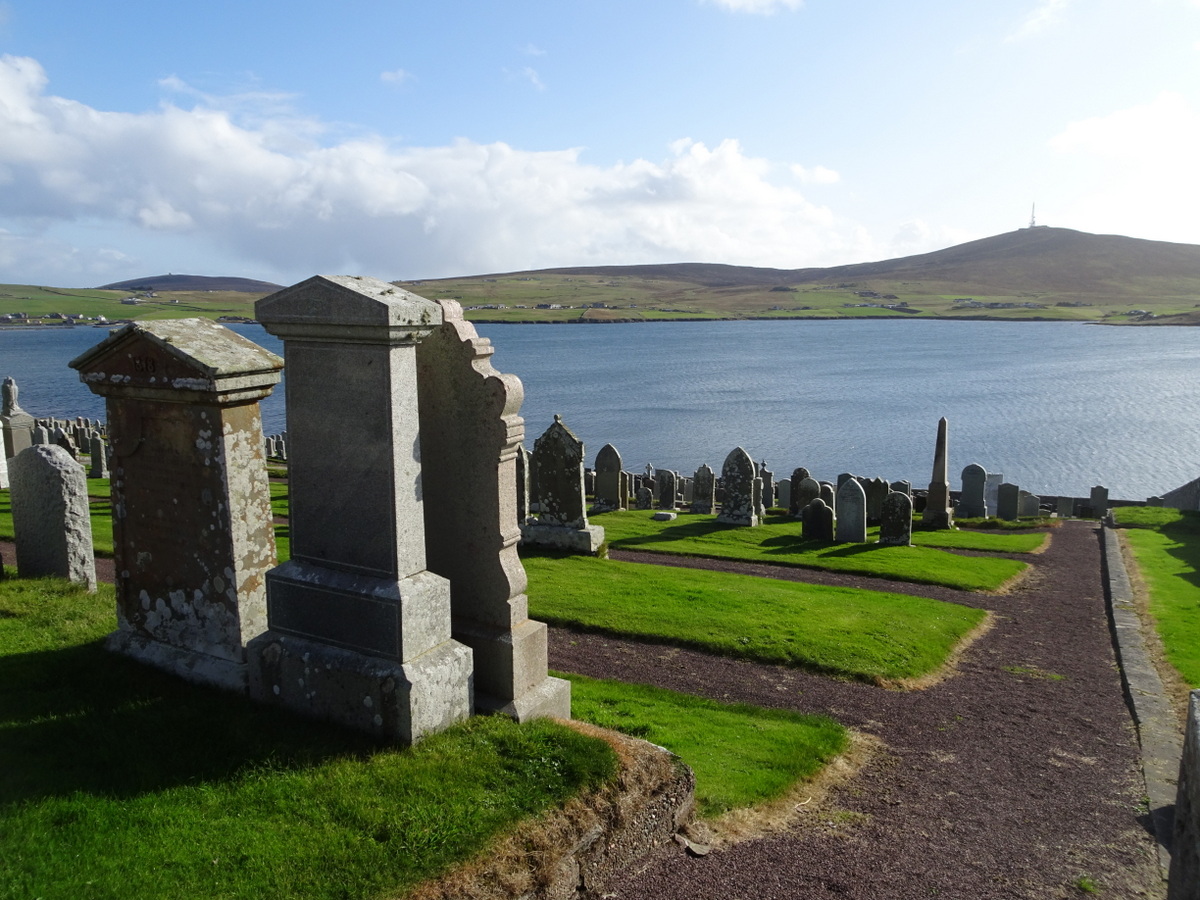
 On towards the Knab, the headland at the end of the road, where there is a cemetery with I think the best view of any cemetery I have seen.


There are a number of war graves in the cemetery, of men who were stationed on Shetland. So they were not necessarily Shetlanders - some were in fact Norwegian.


Here's the Knab, and the view south towards the open sea.


The path follows the shore from there (towards Tesco).  I hoped to see some seals on the rocks, but there weren't any, though I did see a lot of birds including a group of oystercatchers (called shalders in Shetland).


Another day, I got the bus to Scalloway, a fishing port about 6 miles from Lerwick, with an interesting museum, a castle, and some very picturesque houses along the harbour. 

.
The base for Wool Week was the Shetland Museum in Lerwick, which is excellent. It has displays on the archaeology and history of the islands, including Gunnister Man, who died about 1700.  His body was found in a peat bog, and his clothes have survived, including some knitted articles.  There is a reconstruction in the museum (hard to photograph because of reflections in the glass of the case). 

There are also displays on Shetland knitting, with many beautiful examples of both lace and Fair Isle.  I recognised one straightaway from Susan Crawford's Vintage Knitting Project book - Jeannie Jarmson's sleeveless rayon pullover, which is one of the patterns Susan re-recreated for the book. (Again, I couldn't get a good photo of it.)

 The Hub, where Wool Week visitors could sit to knit and chat, was in the Museum, as was the auditorium where I gave a talk on the Knitting & Crochet Guild collection on Wednesday evening - I'll say a bit about my talk in another post.

Shetland Museum
And on Fair Isle Friday, two Shetland ponies who have often been photographed in Fair Isle cardigans, were stationed in front of the museum. (Their owner said that they don't really like the cardigans, because they can't walk easily in them.  And they have such thick coats of their own that they don't need to wear woollies.) 


I'll also write in another post about the trip to the Jamieson's Mill at Sandness, where (guess what?) I bought some wool.   But that's enough for now.  I didn't do any of the many classes on offer, but there was plenty to see and do without that.  I enjoyed the week very much (though it would have been more fun if John had been there).  I'm very glad I went.
Related Posts Plugin for WordPress, Blogger...