Showing posts with label World War I. Show all posts

Thursday, 31 October 2019

1919

I'm still catching up on writing about Shetland Wool Week, and this post is about the talk I gave at the Shetland Museum as part of the Wool Week programme.  My talk was on the Knitting & Crochet Guild, but mostly about the Guild's collection. I talked about a few selected pieces from the collection, and we had a display of the actual items at the front of the auditorium, so that the audience could have a close look, before and after the talk.

I picked some things that had a particular connection to Wool Week, including a few that originated in Shetland.  But this post is about one of the pieces on display that has nothing to do with Shetland, or wool, for that matter.  I chose it because it's relevant to 2019 - it was made exactly 100 years ago, in 1919.

Cloth with 'Peace 1919' filet crochet border 


It's a tea cloth with a filet crochet border, and a linen or cotton centre with drawn thread work.  There are doves with sprigs of olive in their beaks along the sides, and 'Peace 1919' in each corner.

We know that the First World War ended on November 11th 1918, but strictly speaking that was the day of the Armistice between the Allies and Germany.  Formally, the war ended with the Peace Treaty signed in 1919 - so that many war memorials in Britain give the dates of the war as 1914 to 1919. (The Shetland war memorial in Lerwick does, in fact.)

There were peace celebrations in the summer of 1919, and someone must have made the 'Peace 1919' tea cloth then, and perhaps used it at a celebration tea party. Before I went to Shetland, John and I set up a tea party setting, with the tea cloth, and a filet crochet tea cosy that was also made in 1919, with the slogan '1914 1919 Victorious Peace'.   You can also see a set of First World War medals on the table, that belonged to one of John's grandfathers.  The cloth only fits a very small table, as you can see, so it must have been an intimate, rather low-key tea party.


Here's a better view of the 'Victorious Peace' tea cosy:


I wrote about the tea cosy here, after I had found the pattern for its other side (which shows a very decorative, slightly Art Nouveau teapot) in a 1918 issue of Woman's Weekly magazine.

I hoped then to find the pattern for the 'Victorious Peace' side of the tea cosy in a 1919 issue of Woman's Weekly, and on a later visit to the British Library I looked through all the 1919 issues.  I didn't find the tea cosy, but I did find the pattern for the 'Peace 1919' table cloth, on the front cover of the April 19th issue.


The magazine gave instructions for a corner, and for one of the doves along the side of the border. So you could make your table cloth as large as you wanted, just by adding more doves.   For comparison, here are a corner and a dove from the edge of our tea cloth. 


And I did eventually find the pattern for the 'Victorious Peace' tea cosy - not in Woman's Weekly, but in another weekly magazine for women, Home Companion, in the August 2nd issue.


(Home Companion is long gone - it ceased publication in 1956 - but Woman's Weekly is flourishing, and still publishes knitting and crochet patterns. )

The Peace 1919 tea cloth is a really excellent piece of work.  The crochet is very even, and the border fits the centre cloth exactly.  I'm not sure how that was done: it would be very difficult to make the border to a precise size, I think, so perhaps the cloth was made afterwards.  Not sure. And though I know almost nothing about drawn thread work, I am very impressed by the quality of the work in the centre of the cloth.  Here's a corner of the drawn thread work, and a close-up of a detail - so painstaking, to weave the fine cotton around the threads to make something quite solid again.


Making the cloth must have taken many hours.  And I wonder how often it was actually used - perhaps a few times in 1919, but maybe not much after that?   It has survived in very good condition, which suggests that it might have spent most of the last hundred years in a drawer.  Now it commemorates not just the end of a dreadful war but the skill of its unknown maker, too.

PS Apologies for the quality of the photos. The cloth is actually quite white, even though it looks grey-ish in the photos.  Flash washes out the detail, and increasing the contrast after taking the photos looks artificial.  Ignore the grey, and just imagine that it's white. 

Monday, 27 November 2017

Spending a Day in 1918

When we were in London a week ago, for the Knitting History Forum, I spent a happy day at the British Library, looking at magazines from 1918. I was gathering material for my blog about the First World War, One Hundred Years Ago. It's been through a very thin patch since I broke my wrists last year, and I almost decided not to add any more posts, but then I thought that I should at least post the material I had already collected, and now I'm planning to revive it and keep it going. The war won't last much longer, after all.  (I'm sure that's what people hoped in 1917, too.)

So I ordered Woman's Weekly, Home Chat and Home Notes for 1918.  They were all weekly magazines for women, and all survived until the 1950s - Woman's Weekly is still with us, of course.  Woman's Weekly was a good read (though of course I didn't have time to properly read very much of it).  There was lots of interesting material about how to train for some of the new job opportunities available to women.  Mary Marryat, who still nominally wrote the advice column in the 1950s (but I'm sure wasn't the same woman - if indeed she ever existed) was issuing good advice to young women getting into relationships with men in the armed forces.  (Some of it extremely practical - e.g. you can tell from his pay-book if he's already married.)  And Cecile, who I think also survived as the Woman's Weekly cookery writer until the 1950s, provided recipes and meal plans for the meagre rations.

And as I was looking through the issues of the magazine, week by week, I saw a pattern I recognised.

Woman's Weekly magazine, 23rd March 1918

The 23rd March issue has an illustration of a tea cosy on the cover - and I recognised it, because there is a tea cosy made to the same pattern in the Knitting & Crochet Guild collection.   (Strictly speaking, it's a tea cosy cover, not a tea cosy -  it wouldn't do anything to keep a pot of tea warm by itself.)


The cosy in the collection is identical to the Woman's Weekly illustration, except that our example has a decorative frill around the edge - but the pattern just says that when you have made the two halves of the cosy, you should finish off "with any little edging round the top".

I probably wouldn't recognise all the filet crochet tea cosies in the collection, but I know this one, because of its other side.  I'm sure that the designer intended that both sides of the cosy should be the same, but the maker of ours used different designs.  The other side has a "VICTORIOUS PEACE 1914-1919" design, and it's very familiar because I show an illustration of it in my talk on knitting & crochet in World War I.


It was surprising and exciting to recognise an image from 1918 so unexpectedly.  Next time I visit the British Library, I'll look through Woman's Weekly for 1919, to see if our maker found the 'Victorious Peace' design there too. 

I'm afraid that Home Chat and Home Notes were nowhere near as interesting as Woman's Weekly - Home Notes in particular was very dull.  Clearly, enough readers went on buying them to keep them both going for another 40 years, but personally I'd have bought Woman's Weekly instead.

Friday, 13 May 2016

Knitskrieg


I have been reading a new book, Knitskrieg! A call to yarns by Joyce Meader - subtitled "A history of military knitting from the 1800s to the present day" (published by Uniform Press - full details here).   I have met Joyce several times over the past  few years, most recently in Glasgow last year, at the Knitting in Wartime study day, when she gave a fascinating talk, covering a lot of the same ground as the book.  The book is lavishly illustrated - many of the illustrations are from Joyce's collection, and there are also photos of replica garments made by Joyce and modelled by her friends.

Joyce starts with the Napoleonic Wars, represented by a knitted forage cap of the 33rd Regiment of Foot.  The original is in the Bankfield Museum in Halifax - a rare survival, if not unique.

3rd Foot forage cap, in the Bankfield Museum, Halifax

(A digression: I went to a talk and demonstration recently by John Spencer in the 33rd Foot re-enactment group. He said that the group had had a set of replica forage caps made - you can see them in one of the photos on their website.)

The forage cap was part of the official uniform; in later wars, the emphasis of the book switches to unofficial knitting, of  'comforts'.  The Crimean War of 1853 to 1856 was the first war that Britain was involved in that was reported almost as it happened, and was notoriously badly managed.  For the first time, the British public were concerned at the plight of the men fighting on their behalf, and the terrible conditions in the Crimea, especially during the winters.   Joyce writes about the book of knitting and crochet patterns, Comforts for the Crimea, published in 1854  by Mlle Riego de la Branchardiere, a prolific author of books on needlecrafts, and describes aristocratic ladies frantically knitting comforts to be sent out to the troops in the Crimea.  

Later chapters cover knitting comforts in the American Civil War, the South African War of 1899 to 1902, and the First and Second World Wars.  One or two original patterns are given in each case, in the original words, which are sometimes more or less incomprehensible, though Joyce also gives 'translated' versions of a few patterns at the end of the book.  I was delighted to see a photo of a gentleman with a suitably military moustache wearing the striped sleeping helmet that Joyce showed in Glasgow.  (If you feel inclined to knit a striped balaclava, there is an updated pattern using modern yarn and needles in the book.)

Photo: Uniform Press
The Second World War chapter shows pattern leaflets produced by the spinning companies (American and Australian as well as British) for a wide range of Service woollies.  There are also more unusual illustrations, such as a combined 'Knitting and Recipe Leaflet' from Batchelor's Peas, with the message "Save Time by using Batchelor's canned ready-cooked foods - spend it in knitting for yourself and the Services!"   And some ephemera which must be very rare - a chit from the Board of Trade allowing a representative of a comforts group to buy wool in Service colours off ration,  and little brown paper packets used by spinners to send out samples of Service wools.

(Another digression: I remember Batchelor's Peas from when I was a child - they were usually marrowfat peas, aka processed peas, which were dried and then soaked and cooked before being canned. They were a lurid, unnatural bright green.  Canned garden peas, which were fresh before they were canned, were a bit of a luxury.  You can still buy both - as well as Batchelor's canned mushy peas.)

There is a chapter on later 20th century wars that Britain was involved in:  Korea, Rhodesia and the Falklands. This includes a section on the virtues of 'string' vests, and another on the Guernseys issued to British soldiers in the Falklands.  The book comes right up to date covering Iraq and Afghanistan, and knitting by soldiers, as well as for soldiers.  Joyce also mentions knitting used to protest against war, and her pattern for knitted Remembrance Day poppies is illustrated with white peace poppies as well as red.

Photo: Uniform Press

Joyce has an enviable collection of military knitting patterns, equipment and ephemera, as well as all the replicas she has knitted, and has put them to good use in this book.

Wednesday, 1 April 2015

Knitting in Wartime

This is a belated report on last week's study day in Glasgow on 'Knitting in Wartime', part of the Knitting in the Round project at Glasgow University.   It was an interesting programme (you can see it on the project web site) and there were about 70 people in the audience. Jane Tynan talked about knitting comforts for the troops in the First World War, and Maggie Andrews about knitting in both world wars.  Maggie also talked about the Womens' Institute, found in the U.K. in 1915, and so deeply involved in the home front during the war, and again in WW2.  Joyce Meader  brought two huge bags of knitted comforts for the troops, most of which she has knitted herself from patterns from the Crimean War onwards.   She also brought along many of the pattern booklets and a sock machine.  Wendy Turner talked about the Glasgow Women's Library, where she is the museum curator, and brought along a selection of knitting patterns from the library collection.  She says they have boxes and boxes of knitting patterns, completely unsorted so far.  (I felt quite nostalgic - the Knitting & Crochet Guild collection of knitting patterns used to be like that!)

And finally, I gave my talk on knitting & crochet in the First World War,  "Useful Work for Anxious Fingers".  I emphasised the crochet part more than usual, so as not to overlap too much with Jane and Maggie's talks,  though the title doesn't really apply to some of the crochet, which was not very useful and often didn't show much sign of anxiety about the war either.   I took along a replica of a little bag to put sugar lumps in when you went out for afternoon tea.  The pattern was published in Needlework for All in April 1918 - by then, imports of sugar and other foodstuffs had been seriously affected by the success of German U-boats in sinking British merchant shipping, and sugar was rationed. The magazine's description says "The modern anxiety is not how to manage on a limited supply of sugar, but rather how to get the most fascinating yet practical receptacle for it," which seems an incredibly blinkered attitude in 1918, when there were so many more serious things to be anxious about.  


The study day was held at The Lighthouse, based around the old Glasgow Herald building, which was an early design by Charles Rennie Mackintosh in 1895.  You can go up to the top of the tower of the old building (originally a water tower) and get a good view over the roofs of central Glasgow.

Model of the Glasgow Herald building, in the Mackintosh Centre
The turret of the Glasgow Herald building, from the top of the water tower

A nearby roof 

I liked these signs for the loos, in the recent extension to the building.  (I read somewhere that these signs are called sex symbols, which would also be pretty hilarious.  Not sure it's true though.)


Just before the train left Glasgow station on the way back, the conductor did the usual announcement about the departure time, destination and intermediate stations, finishing with something like "The train will be leaving shortly and if you are not planning to travel, now would be a good time to leave the train and absquatulate."  What?  When he came round to check the tickets, I asked him to repeat the word, and whether it is genuine.  He assured me that it is, and that he had learnt it at school. He had put it in because the train staff have been asked to make their announcements more distinctive and  personal, compared to the bland automated announcements.  He wrote it down for me, and I looked it up when I got home.  Sure enough it's in the Shorter Oxford English Dictionary -  a "U.S. formation of  jocular use"  (19th century), meaning "to decamp".  I must use it in future whenever possible.  

Wednesday, 11 March 2015

Herring Lassies

We have a few old postcards in the Knitting & Crochet Guild collection that show people knitting, including these two of Scottish herring lassies.  Hundreds of these women left their homes every year for the fishing ports on the east coast, where large catches of herring were landed. Their job was to gut, salt and pack them.  At the end of the herring season they went home with their earnings which probably kept them and their families until the next year.

The first postcard here, "Scottish Lassies' Recreation" was postmarked Great Yarmouth in 1907, and I guess that the scene it depicts was also in Great Yarmouth.  The town was already a seaside resort and visitors were evidently interested in seeing the herring lassies, and buying postcards of them.

There are many other photos of herring lassies that show them knitting when they weren't working - it seems to have been their usual leisure activity.  I would love to know what they are knitting - the one on the left has what looks something like a Balaclava helmet in front of her apron, and the women next to her something that looks like a large sock (a sea-boot stocking?).

Scottish Lassies' Recreation
The other card is undated (and was never sent), but is probably about the same date. The women are both wearing knitted shawls around their heads.  The paler shawl seems to have a very open texture, and there are large holes knitted into the border.  (Click on the images to enlarge them.)

Herring Lasses off Duty

Herring fishing in the North Sea was disrupted by the First World War, and the herring lassies and their families lost a vital income. This report from February 1915 describes the work of the herring lassies up to the start of the war, and a scheme to pay the unemployed women to knit comforts for soldiers and sailors.  So knitting, which had been a leisure activity, became their main source of income.

(PS I have found a reference in the Dundee Evening Post, in October 1902, to the opening of a rest house in Yarmouth: "This season excellent provision has been made for the fisher girls, who last year numbered no fewer than 3000, by the erection right next to the gutting-grounds of a handsome bungalow residence, by the generosity of Miss Davidson, of the Church of Scotland, where the girls may go in the intervals between their work.  They will be also able to obtain hot meals, to avoid the necessity in times of pressure of returning to their lodgings in the town, and other arrangements are made for their comfort and convenience, such as attending to cut fingers, &c., in what has been named the Rest House for Scottish Fisher Folk".  This appears to be the building that is in the background of the first postcard.)

Sunday, 25 January 2015

Knitting for Soldiers and Sailors

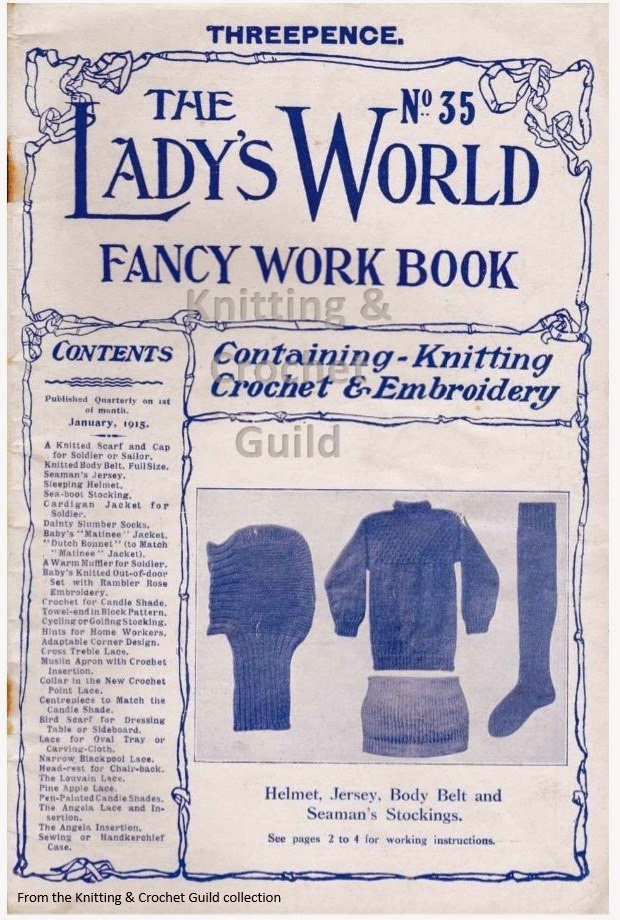
The Lady's World Fancy Work Book, January 1915.

I wrote last year about the April 1914 issue of The Lady's World Fancy Work Book.  In those pre-war days, most of the magazine was concerned with 'fancy work', especially decorative crochet.  But there were also a few knitting patterns, for instance a woman's knitted 'sports coat' - a cardigan, more or less.

By January 1915, the magazine had decided that they should provide patterns for readers who wanted to knit comforts for soldiers and sailors.   The introduction to the issue said, "So many comforts have been knitted for soldiers, but we fear comforts for sailors are being overlooked, and we would remind the home worker of the need of scarves, sweaters, stockings, mittens, etc., that is experienced by the men in the North Sea at this time of the year."  (Though actually if readers had been knitting for soldiers, that was no thanks to the magazine, which had not published any 'comforts' patterns in the previous issue.)  The front cover illustrates four of the patterns.  The body belt is "an absolute necessity for both soldier and sailor".  Khaki wool is specified for the sleeping helmet, so that is aimed at the Army not the Navy.   The other two are specifically for sailors.  The Seaman's Jersey is in navy double knitting wool.  It is knitted in stocking stitch, apart from a patterned yoke, and has a ribbed roll collar.  The Sea Boot Stockings are knitted in the same wool.   Inside the magazine, there is a pattern for a Cardigan Jacket for a Soldier, also in double knitting wool "of a brown heather mixture colour, very suitable for soldiers' wear, although of course khaki or navy blue would be quite as serviceable."   And there is a very simple crocheted muffler for a soldier, in khaki double knitting wool.

Elsewhere in the magazine there are patterns for baby clothes, including a lacy 'matinee' jacket, and cycling or golfing stockings with fancy tops.


And in spite of the cover illustration of comforts for soldiers and sailors, more than half the magazine is still taken up by fancy work.  The biggest project is a chair-back in filet crochet, showing a cherub driving a chariot (full of apples? or oranges?) pulled by a rather depressed-looking lion.   A bit baffling, really.  The chair-back takes 188 rows of crochet, and the instructions for each row are given stitch by stitch.  Six and a half pages of print (a proof-reading nightmare).  Use a chart, people! Would the finished chair-back be worth all that effort?   I don't think so.


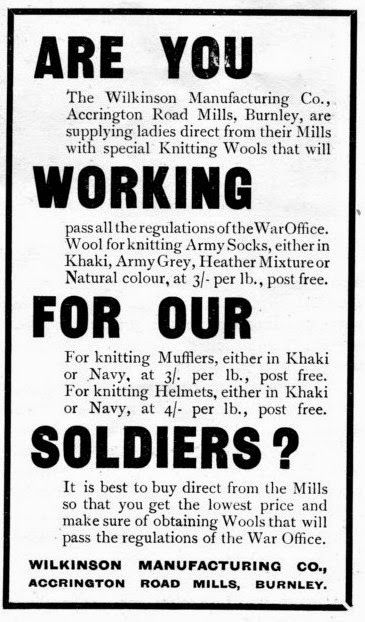
There are several ads in the magazines from spinners producing suitable wools for knitting comforts for soldiers and sailors, so perhaps that gives a better indication of what the magazine's readers were really spending their time on.


You can find a pattern from the magazine for a rather strange-sounding combination of cap and scarf, here.    A copy of the whole magazine is available to members of the Knitting & Crochet Guild.

Thursday, 1 January 2015

Needlework for All - Christmas 1914


Happy New Year to everyone!  I intended to write this post nearer to Christmas 2014, but missed.  But it's not Twelfth Night yet, so it's still the Christmas season...

Needlework for All was a monthly magazine, started in 1909, and there are several issues, including the Christmas 1914 double number, in the Knitting & Crochet Guild collection.  Like other needlecraft magazines being published at the start of the war, it emphasised 'fancy work', especially crochet.   But in late 1914, many of these magazines included patterns for making comforts for the troops, and the Christmas 1914 Needlework for All has "Comforts for Soldiers and Sailors, &c." as a subtitle to reflect that.  (In fact, I think that after this issue, the magazine pretty much reverted to fancy work - they appear to have decided that they'd done comforts, and didn't need to do any more.)

The first page of the magazine introduces the contents:
Christmas and the New Year come to us in this season of 1914 very differently, alas! to their wont.  But yet, with the war-clouds overshadowing their brightness, the old traditions still cling close, and there is the longing, deep ingrained in the hearts of most of us, to express the Christmas feelings of goodwill by the giving of presents.  The gifts which everyone has in mind before any others are those that will take the form of some comfort for the sailors and soldiers—and who is there that has not among the Forces of the King someone near and dear for whom the thinking and making of comforts is some relief to the anxious thoughts that will come?
Ever since the War broke out our little Magazine has set itself to the best of its ability to the task of helping by suggestions and instructions towards the working of practical additions to the kit of the sailors in their weary and anxious task of watching and waiting, for the soldiers in their warfare at the front, or their work in the training camps, and for the wounded and sick who have come home so quickly, thanks to the wonderful organisation for their rapid transit; nor have suggestions been overlooked for the making of warm garments for the refugees from that heroic little Belgium, or for winter comforts for the children of the sailors and soldiers whose Christmas will be such a sad one this year.
The editor then goes on to congratulate the magazine on having done such a good job already that the previous "War Numbers" that included patterns for comforts had completely sold out - and readers had found the patterns "completely satisfactory, and easy to carry out".   So the Christmas issue includes reprints of several of the earlier patterns.  

More on the comforts later.  But fancy work has not been forgotten:
No pains have been spared, however, to make our first Christmas Number as complete and comprehensive as possible.  While catering for the universal demands in connection with the War, due provision has not been omitted for those workers who have leisure or, happily, enough ease of mind to allow themselves the relaxation of fancy work.  
Filet crochet was very popular for fancy work, and the magazine includes two filet crochet designs, an edging and an insertion, which could be used for trimming tablecloths, etc., one with a military theme:    
The Victoria Cross Crochet Lace is a design that will have very special interest, even in the brighter days to which we so earnestly look forward when the immediate cause of its inspiration shall have passed away.  


The editor goes on:
there are hints as to the making of all kinds of useful knick-knacks of the inexpensive order, which specially meets the scale of present-giving of this season, and there are dainty little garments for children in knitting and crochet which will do duty for Yuletide souvenirs in the most attractive manner. 
One of the children's garments is a very practical-looking knitted jersey for a boy of five, and could not be described as a 'dainty little garment', by any stretch, but perhaps the editor was not much acquainted with five-year-old boys.  

Child's knitted jersey - age five years


The comforts for soldiers and sailors include, of course, the helmet illustrated on the front cover.  It is crocheted, except for the knitted rib around the face, and incorporates ear slits.   I think that helmets were not official issue, and so there is no standard pattern, and a great variety in the helmet designs that were published.  

Crochet helmet with ear slits.
There is also a rifle glove, that leaves the thumb and first finger uncovered.

Rifle glove

And there is a pattern for a cholera belt (or body belt), thought by many people to be absolutely essential for keeping the abdomen warm, and the soldier in good health. There had been an appeal earlier for 300,000 body belts, which had been sent to the troops in France early in November, and many knitters would by this time have been very familiar with them.


 As the editor  mentions in the introduction,  there are several things in the magazine to make for the sick and wounded, who of course had been coming back from France in large numbers.  There is an odd selection:  some have very specific medical uses, such as a knitted eye bandage and a knitted thumb-stall.  Not the appropriate sort of thing for volunteers to be knitting, without a specific request from a hospital, surely?

Knitted Eye-bandage
 Altogether, the magazine gives a slightly unsettling view of the activities of its readers at this stage of the war - making a fairly random selection of comforts for the troops, but then going back to the more familiar 'fancy work', making decorative articles for the home, and garments for children.    

Members of the Knitting & Crochet Guild can download a copy of this issue of Needlework for All , along with other First World War magazines - more will follow.

Sunday, 30 November 2014

"Centenary Stitches" exhibition in Lincoln


Yesterday I went to Lincoln, to see the 'Centenary Stitches' exhibition, of clothes that were knitted for the "Tell Them Of Us" film.  I have written previously (here and here) about providing copies of patterns from the Knitting & Crochet Guild collection to be passed on to the huge team of volunteer knitters that were working on the project.  So I have been wanting to go to see the exhibition ever since it opened on November 8th - and as it closes on December 6th, I nearly ran out of time.  But it's been a very busy month.  (And if you want to go to see the exhibition and haven't been yet - be warned that the Lincoln Christmas Market starts on Thursday and it will be packed.)    

The display is amazing - the middle of the room is filled with suspended rails, with coats, jackets, sweaters (anything with armholes, really) hanging off them, so that you can walk in between them and examine everything.  At the back of the room is a similar display of shawls.


 And there's a shelf of disembodied heads with hats on (that I unaccountably forgot to take a photo of).  A few special garments for the main characters in the film are on stands at the sides, including two that were reversed engineered from photos - a impressive feat.

I recognized one of the garments from the patterns that I provided - the blue coat and hat for a little girl is from a Patons pattern leaflet, Helps to Knitters X.

    
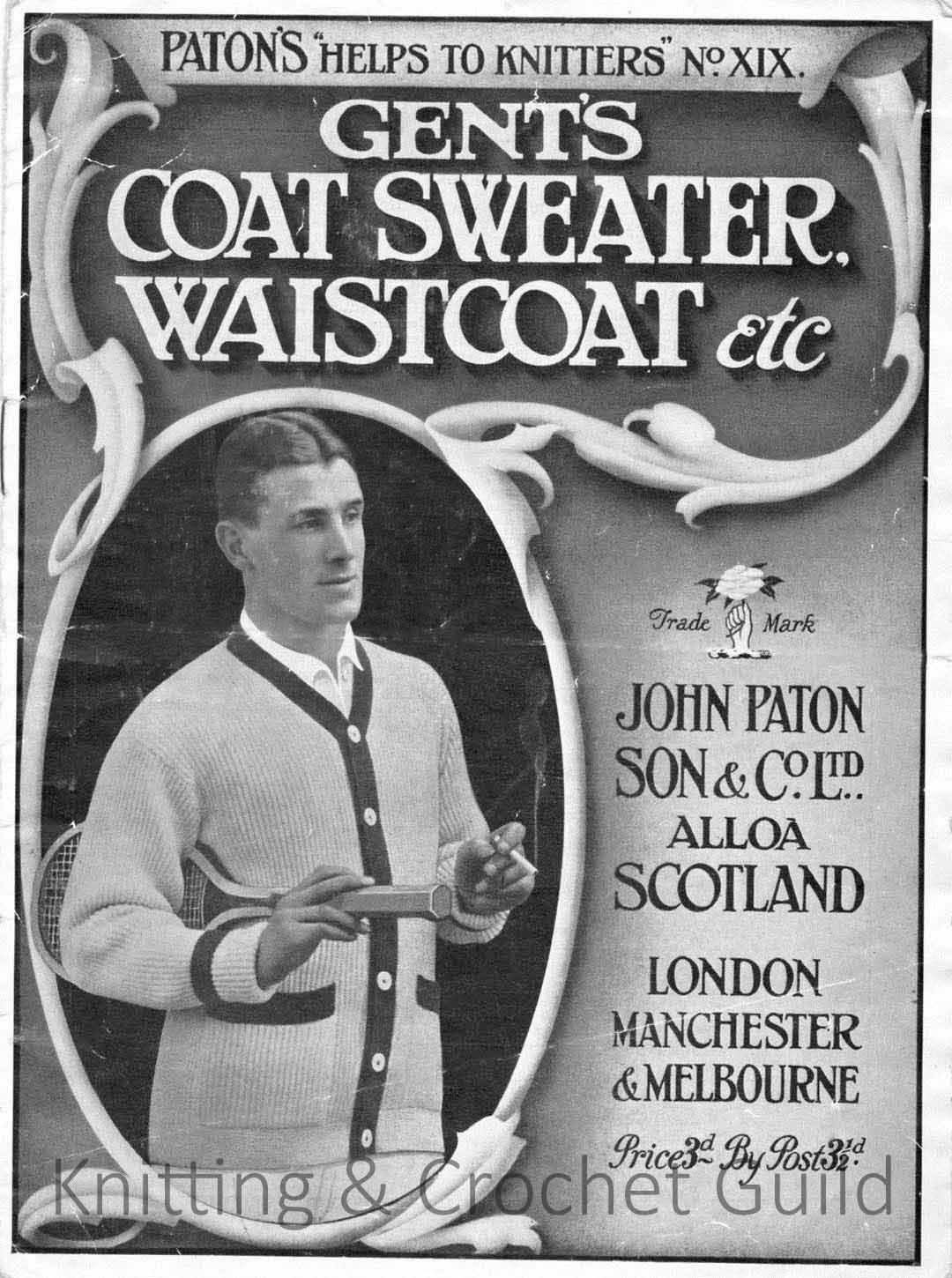
And I am sure that a man's sports coat in the exhibition, in white with navy trim, is from Paton's Helps to Knitters XIX.  (It's called a 'coat sweater' in the leaflet - now we'd call it a cardigan.)

Paton's Helps to Knitters XIX
There are several more garments in the exhibition, I understand, that were knitted to the patterns from the Guild collection, but I haven't identified them all.  (There is a book of patterns, Centenary Stitches, to accompany the exhibition, and I'm assured that none of the patterns in the book are based on those from the collection.)

I was disappointed that there was no mention anywhere in the exhibition of the Knitting & Crochet Guild and our support for the project.  I thought it was a pity, too, that the garments' labels did not give any information about the original source of the pattern.  Sometimes the label said something like "a gansey in a 1916 book", but often there was no information at all, and surely there are other people as well as me who would like to know which 1916 book.

Lincoln Cathedral

Tuesday, 11 November 2014

Knitting History Forum

I was in London on Saturday for the Knitting History Forum conference - I've been busy ever since, so this post about it is later than I intended.

The conference was at the London College of Fashion, off Oxford Street.  There was a diverse programme of talks, beginning with Angharad Thomas talking about her researches into the history of two-colour patterned gloves, leading up to the Sanquhar and Yorkshire Dales gloves that she is particularly interested in - see her most recent blog post about Sanquhar gloves, Glove Heaven.  Tom van Deijnen (aka Tom of Holland) talked about his Visible Mending Programme and showed the cardigan in the Knitting & Crochet Guild collection that he mended for us a few months ago - I wrote about that here.

I had not met Amy Twigger Holroyd before, though I had seen some of her work the previous day at the Fashion & Textile Museum's Knitwear exhibition - more on that later, possibly.  She talked about her Keep and Share programme  and brought along some of the things that she has made, or re-made, in that programme.  (And she was wearing a very nice cardigan that I recognised later in her on-line store.)   She passed around some of the pieces that she has worked on - commercial knits that she has re-worked into something special, including some 'stitch-hacked' pieces where a plain piece of stocking stitch has been converted into an embossed design in reverse stocking stitch on a stocking stitch background. As every stitch in the area she is working on has to be redone by hand individually, it is painstaking, slow work, but the results are amazing. She passed around a fine-knit vest that she has stitch-hacked - the images are from here.

Amy Twigger Holroyd's stitch-hacked vest.

Detail of  stitch-hacked vest.
The last two talks were on  war-time knitting - I gave a repeat of my talk "Useful Work for Anxious Fingers', on Knitting & Crochet in the First World War 1, that I gave at the Knitting & Crochet Guild convention in July.  This time, I showed the crochet handbag that I made to a Woman's Weekly pattern from 1917.   


And finally Joyce Meader of The Historic Knit showed a selection of garments for soldiers and sailors that she has knitted, following original knitting patterns from the Crimean War onwards.  She had brought some of the pattern booklets, and passed them around.   There were several different versions of a Balaclava helmet, socks, pullovers, sweaters, and so on.  Some odd ones, like knitted puttees, which I think may have been intended as leg-warmers to wear on chilly nights when the days were hot, e.g. in Mesopotamia.   
   
Some of Joyce Meader's WW1 patterns - image from The Historic Knit 

An enlightening and enlivening afternoon.  (Although battling afterwards along a thronged Oxford Street in the rain was not much fun.)

Thursday, 9 October 2014

A Handbag from 1917

I mentioned a while ago that I had spent a day in the British Library in London, reading bound volumes of Woman's Weekly from the First World War, looking to see how the magazine was helping its readers cope with the war.  I was expecting to find patterns for knitted comforts for soldiers and sailors, though there were not very many of those.  But there were articles on war work for women, and later in the war cookery features on how to cope with food shortages.

One thing that caught my eye was a crochet pattern, aimed at readers who had a sweetheart or a brother in the Army. It appeared in the March 24, 1917 issue, and is headed "The Latest Crochet Handbag - Make it in the colours of “his” regimental ribbon."


The illustration with the pattern is, of course, not in colour, and the description begins:
"I wish I could show you on this page the delightful blend of colours used in the making of this bag.  It is quite of an Oriental tone; but now that everything of note is regimental, many of you will prefer to use the colours of the regimental ribbon in which you are particularly interested. You can arrange the colours any way you wish.  A few strips of each colour in turn can be worked, or the bag can be divided into the number of colours required, so that there is an equal number of each. Or you can begin with a neutral colour, such as Navy blue or black, to match your costume; then have a band of the regimental colours near the top, finishing with the main colour as at base of bag.... Quite a medley of colours was used for the bag illustrated, as follows:  Bright red, Royal blue, emerald green, cinnamon brown and gold."
Not subtle, then.

I decided to try to make one, to illustrate my talk  "Useful Work for Anxious Fingers - Knitting and Crochet in the First World War".   We have a few pieces of WW1 crochet in the Guild collection at Lee Mills, but it is all household crochet, in white.  This handbag would be a nice contrast - and I have just finished it.


It was a bit of a challenge to make.  The pattern specifies "Star Sylko No. 8 with a No. 4 steel hook"  ("but of course, those who can afford real silk will do so.")  Star Sylko was a crochet cotton, and I made the assumption that 'No. 8' would mean the same now as it did then.  I bought a mixed selection of Anchor crochet cotton, No. 8, which is fine and slightly shiny, and I think it has worked out very well.  I have no idea what size a No. 4 crochet hook was, so after consulting a couple of modern books with patterns for fine crochet, I chose a 1.5 mm hook.
 I have never crocheted anything so fine before.  In fact, as I said in a post last December, I hadn't done any crochet until then for 30 years or so, and then only in double knitting wool. And in December, I had to sit with 'How to crochet' instructions next to me - I couldn't remember how to do doubles, trebles, etc.  So  I wasn't at all sure that I would be able to make the bag successfully.  The pattern did say  "IT IS JUST CROCHET IN CIRCLES AND SO EASY TO WORK!"  which was somewhat reassuring, but even so, when I managed to crochet fairly evenly after a bit of practice, I was pleased and relieved.   

 As usual for patterns of that date, the instructions aren't very precise about measurements.  After you start decreasing towards the top, the pattern says you should continue until it measures 6 inches across the top, laid out flat, or "until long enough".  In fact, it is more than 6 inches across the top, but I did decide it was long enough, and it's possibly a bit longer than shown in the illustration.  (The tassel should be the same size in both.)  My drawstrings are not as long as in the illustration, but I thought that the bag would be worn over the wrist, and so I have made mine a suitable length for that. 


And I did choose regimental colours, as Woman's Weekly suggested.   Royal blue, green and white, are, I believe, the colours for the King's Own Yorkshire Light Infantry.  My grandad, John Potter,  was in that regiment in the First World War.  (The other colours, claret and purple, are intended as a background.)  I've also attached  Army buttons to the drawstrings, following the pattern.  They are the right era, but not KOYLI buttons, I'm afraid.  

I'm not sure I'm ever going to use it as a bag, but it will be on show several times over the next few months when I give my talk.  I certainly couldn't use it as an everyday handbag, when I think of all the things I carry around with me -three sets of keys; mobile phone;  packet of tissues; lip balm; purse with money and debit & credit cards; bus pass; wallet with assorted shop & cafe loyalty cards, library cards, etc.; mirror.  Etc.

What did women carry in their handbags in those days?  I consulted The Secret History of the Handbag and found a cartoon from the early 1910s, of an elegant lady with a huge leather handbag over her shoulder, and the rhyme:
Elsie, why this monstrous bag?
Don't you think it rather swanky,
When you know that it contains
Hairpins, powder puff, and hanky?
So there you are.  It would be a perfectly adequate little bag for those things, with room for a small money purse as well.  

Thursday, 2 October 2014

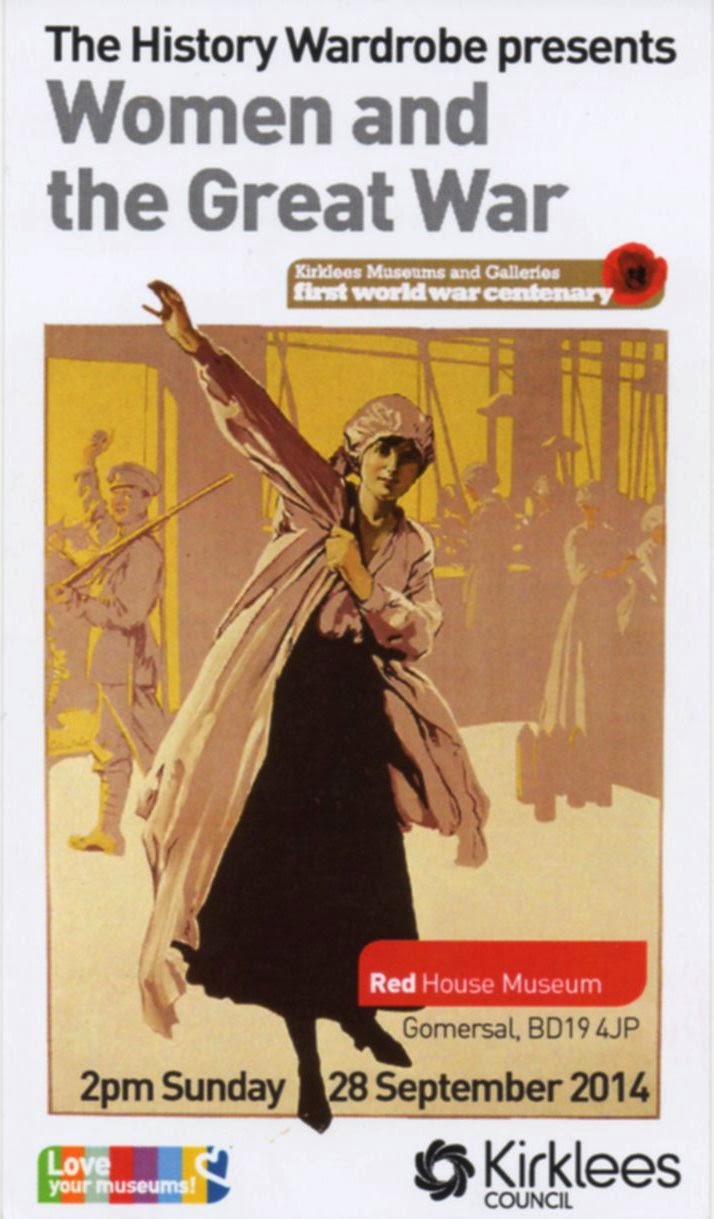
Women and the Great War


On Sunday, we went to a History Wardrobe event at the Red House Museum in Gomersal - a talk on Women and the Great War, featuring original clothing.  Lucy Adlington talked about a common idea (though hopefully not as common as it was?) that women played little role in the war. She talked about the shelling of Scarborough and Hartlepool, and the Zeppelin raids, which very obviously brought the war to the Home Front, killing women and children, as well as men.  And she talked about the work that women did during the war.  On show was an original nurse's uniform from the History Wardrobe collection, with a pair of starched cuffs, to keep the uniform sleeves clean, and still marked with the owner's name, W.Ingram.  

The other presenter, Meredith Towne, played the role of a young dressmaker who had lost her job at the start of the war, as customers cut back on luxuries, and eventually became a munitions worker.  She appeared first in a very pretty dress from the start of the war, or just before, and later in a munitions uniform - amazingly, an original outfit, apart from replica trousers.


They also showed a beautiful wedding dress, with a wedding photo to go with it.  (Astonishing that these things have survived!)  The groom and best man were in Army uniform, so it was definitely a war-time wedding.


It was a very entertaining talk, with lots of fascinating information, and it was such a privilege to be able to see so much original clothing at close quarters. (Lucy also has a copy of the British edition of Vogue, from 1918!  And allowed me to look through it after the talk!  What a treat.)  History Wardrobe are repeating the show in various places around the country - it's worth tracking them down.

Lucy has written a book on Great War Fashion and I bought a copy after the talk, though I have only had time to dip into it so far.  It is very well illustrated - a few of the photos are of Meredith wearing items from the History Wardrobe collection.   It looks very well researched, too, and full of useful information.  I'm looking forward to settling down with it for a good read.  

Wednesday, 10 September 2014

Knitting for Tommy


Apologies for the long gap since the last post - been busy.

One of the things I have been doing is reading a new book on knitting in the First World War - Knitting for Tommy by Lucinda Gosling.  I  have been waiting for it for several months, because  I supplied some of the images, from the Knitting & Crochet Guild collection, and also saw a draft version of the text.  And a couple of weeks ago, Luci sent me a copy of the finished book (which was actually published on 4th August, for the centenary).  It's lovely to see it all come together, with lots of other images from the Mary Evans Picture Library.  And here and there I recognise the ones from the collection - a couple of ads for spinners, promoting their khaki yarn, and several pages from Woman's Own magazine with knitting patterns for comforts for the troops.

Luci has done a lot of research in publications of the time - there are no other books on First World War knitting that I know of, so hers had to be based on original sources.  The Mary Evans Picture Library has runs of several magazines of the period, including The Queen, Punch, The Tatler, that she has been able to use.   The Queen had a needlecraft column and during the First World War, it published several patterns for knitted comforts designed by Henrietta Warleigh - as Luci points out, an unusual instance at that time of a named designer.  

 The Library also has a collection of First World War postcards, including several with knitting subjects -- usually sketches or cartoons, sometimes featuring winsome little girls. Some of these illustrate Luci's chapter on Knitting Fun, along with cartoons from Punch.

The book reproduces several knitting patterns that are readable, although perhaps not as easy to follow as we would expect these days.  So it would be possible, with a bit of interpretation and perhaps some experimentation in adapting them to modern yarns, to knit a wide variety of comforts from this book.  There are socks, body belts, waistcoats, mufflers, and cardigans.  There are several caps and helmets, and an amazing variety of gloves and mittens, with and without fingers, including the rifle glove that has an open thumb and first finger, and a mitten part to cover the other fingers. And as well as garments intended for serving soldiers, there are specialised garments for the wounded, to cater for a range of injuries.

For anyone who is interested in the topic, this is an indispensable book.

Related Posts Plugin for WordPress, Blogger...