Showing posts with label history. Show all posts

Monday, 23 July 2018

In the Loop

I got back on Saturday from the In the Loop at 10 conference at Winchester School of Art, home of the Knitting Reference Library.   "At 10", because the first In the Loop conference was held in 2008 (also in Winchester).

The 10th anniversary cake
The conference was on Thursday and Friday, and I gave a talk on the Knitting & Crochet Guild collection on Thursday morning.  Unfortunately, most of the conference (except for the keynote talks) was in two parallel sessions.  At the same time as my talk, there was a talk on the Knitting Reference Library from Catherine Polley, the School of Art Librarian.  So a lot of people missed my talk, and I (and a lot of other people) missed Catherine's.  But the talks were recorded, we were told, and so hopefully we will be able to catch up with the talks we missed later.  (If that doesn't happen, I may post some of the content of my talk here.)

Because of the parallel sessions, I missed a lot of talks that I would have liked to hear.  (Alex Franklin's talk, for one, on 'Unravelling Miss Marple', i.e. Miss Marple's knitting as a reflection of her problem-solving and detective abilities.)  So I hope that the recordings will allow me to catch up later.  For now, here are a very few selected highlights. 

Linda Newington, who has now retired to Shetland from the School of Art library, gave a keynote talk on the some of her favourite things from the Knitting Reference Library, and the history of the In the Loop conferences. 

The second keynote talk was from Ingun Grimstad Klepp - an entertaining talk on the history of knitting in Norway and her work on promoting the use of Norwegian wool, and the role of wool in sustainability.  The history part of the talk was fascinating, with lots of images of Norwegians wearing their traditional knitted jacket (kofte) - keeping them, and wearing them, for years. She showed a familiar image - the Marius sweater, designed in 1953 and still very popular.


She also talked about sustainability and the importance of taking lifetime use into account when considering the impact of garments made from different fibres - a recent paper of hers on this work is 'Does use matter?'  Ingun is also leading the KRUS project to promote Norwegian wool.  A lot of wool is produced in Norway, from a lot of different sheep breeds, but there is also a lot of imported wool. (She pointed out that if yarn has to advertise itself with a Norwegian flag, it's probably not Norwegian wool.)

The third keynote talk was from Jessica Hemmings, who presented the work of artists who are using knitting to make challenge conventional ideas.  But also, she made some uncomfortable points about unconsciously adopting conventional ideas ourselves - she referred here to the talk by Lorna Hamilton-Brown, challenging the idea that "Black People Don't Knit".   And she pointed out the temptation for academic researchers to claim too much for knitting and other crafts - because if you make smaller, but more realistic, claims, that won't impress the academic world. 

Below are mentions of a few of the other talks I heard, in random order.

Danielle Sprecher, curator of the University of Westminster Menswear Archive, presented some of the knitwear that has been collected.  Some designers have donated pieces from their own archive, such as Peter Jensen and his brontosaurus sweater, but Danielle said that a lot has been bought on eBay.

Freddie Robins talked about "Someone Else's Dream", a recent exhibition. She collected picture sweaters with designs of landscapes (on eBay), and Swiss darned onto them, to create a much more disturbing image.  One landscape featuring an isolated tree has the body of a man hanging from a branch.  Another sweater was knitted from a Woman's Weekly leaflet, before Freddie subverted it.

Image from http://www.freddierobins.com/
Here is the front of the very charming Woman's Weekly sweater:

From a free leaflet with Woman's Weekly magazine, 10th March 1984.
Freddie also mentioned an earlier exhibition, Knitted Homes of Crime. She made knitted versions of the homes of female killers or the houses where they committed their crimes.  They are creepily like the knitted 'country cottage' tea cosies.

Image from Knitted Homes of Crime

Wendywear 500 leaflet

Clare Sams talked about her career as a textile artist, beginning with knitted panels based on scenes and events in Hackney.  I had seen one of her pieces before, at the Harrogate Knitting & Stitching Show in 2014 - a pigeon with a crisp packet.  She said that the pigeon is part of a much larger installation based on a pond near her home which looks idyllic and picturesque, but on close inspection also has litter, supermarket trolleys, rats,....


Clare Sams' feral pigeon with crisp packet   

She described a recent piece she has done with her husband based on the enormous fatberg that was found in a London sewer - the piece was exhibited in Great Yarmouth at the end of last year, and reported in the local paper here.  A 9m. long tunnel represented the sewer, and strips of fabric the fatberg - no smell though. 

I caught just the tail-end of Adrienne Sloane's talk on knitting and craftivism.  When I got there, she was talking about her piece The Unravelling, a knitted American flag that she is gradually unravelling.  Here's a YouTube video of Adrienne doing some of the unravelling (with a lot of background noise, unfortunately).

There were several talks on knitting history.  Jane Malcolm Davies who talked about the Knitting in Early Modern Europe https://kemeresearch.com/ research project which has built up an online collection of what Jane called 'cowpat caps' (because that's what they look like if they come from an archaeological site, i.e. have been buried for several hundred years). Similar caps feature in portraits of men like Erasmus and Luther - they were 'the headgear of choice for big brains', as Jane put it.   Creating the database has shown the need for an agreed terminology to describe knitted fabric - and sometimes the fabric is just a fragment rather than a complete garment, so there may be little clue about how it was made.  Terms such as purl, stitch, row or round describe the process of knitting, not the resulting fabric, so the project is instead using terms like loop, wale, course, ...

Sandy Black gave a talk on British designer knitters of the 1970s and 80s - from personal experience, as she was one of them.  I was a fan of Patricia Roberts' designs at the time, and was aware of a few other designers, too, and I remember that knitting seemed much more exciting then than previously. Sandy's insider knowledge gave a broader view, from someone who was making a living by designing and so knew the publishers, the spinners, fellow designers, ... 

Frances Casey is researching knitting for the troops in the First World War, and disputes the view that the knitted comforts sent to troops at the Front were badly knitted and that too many were sent. She pointed out that this view is almost entirely based on Punch cartoons from the first few months of the war, and that by the end of 1915 the supply of knitted comforts was being organised to help to fill a huge demand. 

Susan Strawn talked about 'Finding Virginia Woods Bellamy' - a woman who invented a modular knitting system and wrote a book about it, which is now almost unobtainable.  (Though many of her designs are listed in Ravelry.)  Susan has a copy of the book and has knitted many of the designs. They are very light, stretchy and resilient, and she produced about a dozen of them, one by one, from a tiny bag - like Mary Poppins' portmanteau. 

It was a very full programme - there were a lot more talks that I could mention, and more that I hope to catch up on when the recordings become available.  I fitted in a visit to Winchester Cathedral, too, and paid my respects to Jane Austen, who is buried there,. And on the way home on Saturday, I spent a few hours in the British Library - but that's another story. 

Jane Austen's memorial stone in Winchester Cathedral

Friday, 24 November 2017

Knitting History Forum

I was in London last weekend, for the Knitting History Forum conference on Saturday at the London College of Fashion.  Professor Sandy Black organises the programme, and this year's was the 10th anniversary meeting, which is quite an achievement.  I have been to three of the past conferences, and there has always been a fascinating range of talks. I was there this year to talk about Wakefield Greenwood, a Huddersfield yarn company, and what I have found so far about its history.

"Wools for the World" - details from the back of a Wakefield Greenwood pattern leaflet


You can see the programme for the conference here.  I felt that my talk hardly counted as history compared to some of the others, because I was talking about things that happened within living memory - other speakers were going back hundreds of years.

Maj Ringgaard from Copenhagen talked about 17th and 18th century knitted stockings in silk and wool that have been found in waterlogged excavations in Copenhagen.  I was fascinated by the decorative details - many of the stockings had clocks (decoration on the outside of the ankle). Maj showed several fancy clocks in purl stitches on a stocking stitch background.

(There was also a bit of discussion about the correct terminology - apparently knitting historians aren't supposed to talk about stocking stitch, or knit and purl stitches, any more.  But I know what those terms mean, and if you're a knitter, I expect you do too - although if you are American, you might have to translate stocking stitch to stockinette. I can't remember what the alternatives to knit and purl are, but the approved alternative to stocking stitch seems to be 'simple knitting', which I don't find very helpful.)

As well as clocks, the Copenhagen stockings had false seams up the back (in purl stitches, with often a bit of decoration either side).  The seam was imitating the hose made out of cloth cut on the bias that the knitted stockings replaced, but Maj suggested that it might also have had a practical purpose as a marker for the leg shaping.

The following talk was also about 17th century knitwear.  Helena Lundin, from Uppsala, has been looking at knitted fragments of wool and silk found in the remains of the Swedish Navy flagship Kronan that exploded in 1676 with the loss of 800 men.  The fragments (when they can be identified) came from gloves, headgear, silk waistcoats and stockings, and they are mostly stocking stitch, although I was excited to hear that one fragment is in twined knitting

Nearer to home, Lesley O'Connell Edwards has been examining 16th century stockings and sleeves knitted in wool, from the Museum of London collection.  The stockings are often in very poor condition as you would expect, but sleeves don't get such hard wear.  There was some discussion of how the sleeves were worn - whether as a warm under-layer, or on top of other clothes, partly to protect them.  But it's astonishing that knitted wool has survived so long.  I remember seeing a 16th century child's vest on display in the Museum of London a few years ago - it was fascinating to examine the stitches through the glass, and try to work out how it was constructed.  (It's knitted in the round.)

Matteo Molinari talked about the crochet traditions in his home village in Italy, near the Austrian border.  The older generation of women still make beautiful crocheted items for their homes - mats, curtains tablecloths, and so on.  There has been a tradition, too, that teenage girls should crochet a bedspread for when they get married.  Matteo said he found that the value of a crochet piece was judged by the fineness of the thread and hook, and the amount of work involved in making it.

The final talk of the afternoon was from Ruth Gilbert who showed photos of some ancient pieces of textile from Egypt, which look like knitting but aren't - they were made by some kind of sewing technique, I gathered.  She also presented some later pieces which she thinks might have been made by a technique something like French knitting, i.e. with something like a knitting nancy).  But unless an Egyptian knitting nancy is found from the right date,  it's hard to see how you could get beyond saying that a fabric like that could have been made that way.

It was a fascinating set of talks, covering a wide spread of knitting history.  And afterwards, there was a drinks reception,  to celebrate the 10th anniversary, which rounded off a very good day.

Thursday, 23 February 2017

Weldon's Practical Needlework

I was going to write a PS to my last post, but then I thought. "Who reads a PS?"  Probably no-one who's already read the original post.   So I'll write a new post.

Weldon's Practical Crochet, 15th Series, No. 77 in the Practical Needlework series.
 In my last post, I was speculating about the date of this Weldon's Practical Needlework magazine,  recently donated to the Knitting & Crochet Guild, which had ads from the First World War inside, but I thought was much earlier.  I suggested that it might have been originally published about 1895, but kept in print for much longer - and obviously the ads could be updated for every reprint. Hence, 1890s patterns, but WW1 ads.

Then I remembered that Richard Rutt wrote an appendix to his History of Hand Knitting giving publications dates for Weldon's Practical Needlework issues, up to July 1915, when they started to be dated.  Actually, he only gives dates for issues in the Practical Knitting sub-series (he's writing about hand-knitting, after all, and not crochet or macrame or millinery or any of the other things covered in Practical Needlework).  But all the issues were numbered consecutively, and then given another number within their sub-series - so the issue illustrated above was the 77th Practical Needlework issue, and the 15th in the Practical Crochet sub-series.  (Confusingly, this is expressed as "Fifteenth Series" on the cover.)  So we can use the appendix to date all the Practical Needlework issues, not just the knitting ones.  

It's quite simple actually - each volume of 12 issues corresponded to a year, and Rutt dates volume 1 to 1886, so volume 7 is 1892.  And if we want to be precise, No. 77 was first published in May 1892 (because 77 = 12 x 6 + 5).

I don't know whether Rutt counted backwards from the dated issues. or whether he had other evidence too.  But it certainly works by counting backwards.  Here's No. 395, in volume 33.

Weldon's Practical Crochet, 180th Series, No. 395 in the Practical Needlework series.

It's dated November 1918 - that's the '11/18' in the bottom left corner.  (Click on the image to enlarge it.)  And extending Rutt's list of volumes and years, volume 33 does correspond to 1918.  And No. 395 would be the November issue (395 = 32 x 12 + 11).

The magazine continued with only a change of title font into the 1920s.

Weldon's Practical Needlework, No. 478.  
 This issue on Tea Cosies is dated October 1925. (You'll have to trust me on that - the pages are bigger than A4 and when I scanned the cover the date got missed off.)  And again the arithmetic works out - it's volume 40 (so 1925) and issue No. 478 (= 12 x 39 + 10).  In spite of the change of font, the cover design must have been looking very old-fashioned by 1925.  There was a redesign shortly afterwards, and the series then continued - in fact, it was still being published after the Second World War, though then as a Practical Knitting series only.

There's one problem with Richard Rutt's list of dates:  the British Library catalogue says that the Weldon's Practical Needlework series started in 1888.   Hmmm.   One possible explanation for the difference is that I think the British library has the bound annual volumes, not the monthly separate issues.  (Weldon's sold both - and if you can sell it as a monthly magazine and a yearly volume as well, why not?)   You can't produce an annual volume until you have all 12 separate numbers, and maybe volume 1 didn't appear until 1888.  And it has been known for the British Library catalogue to assign the wrong date to undated 19th century publications.  So I'm putting my money on the dates given by Richard Rutt.

Thursday, 16 April 2015

Read, Knit and Work Plain Work

As you know, I am always looking out for references to knitting in unlikely places.   Our holiday in Wales last week wasn't very fruitful in that respect, but I did find one mention.  We went to Llanfyllin, about 10 miles north west of Welshpool, where we had a very nice lunch with our friends in the Seeds restaurant.  And after lunch, we went to the church - St Myllin's.   (Llanfyllin  means, more or less, the church of St Myllin. Changing an initial m to f sometimes is something that happens in Welsh.)  

On the front of the gallery at the back of the church was a series of painted panels, detailing various benefactions to the church and the town, including this one:

The charitable good Lady Mrs. Mary Vaughan of Llangedwyn, widdow of Edward of Llwydiarth Esqr. in 1720, aetat. suae [at the age of] 74 Did, among many other her great charitys, by her Deed grant and settle on Trustees Eleaven hundred and sixteen pounds ten shillings principal money to purchase lands the yearly Interest, Rents & proffitts thereof for ever for endowing & establishing charity schools, for 20 poor Boys & 10 poor Girls within this parish, & 12 poor Boys in the next parish of Llan-mihangel, to be educated in the Principles of the Church of England as by Law established, to be cloathed once a year; the Boys to be taught to read, write & Arithmetick; the Girls to read, knit & work plain work. This pious Lady lived some years after, saw these Schools flourish, Visited them and gave them further charitable incouragement. ...
I saw a similar record of a charitable endowment made in 1718 last year, in Herefordshire, reported here.  That listed similar subjects, but they weren't split between boys and girls (though perhaps it was thought to be obvious).  Here, it is made very specific.  The boys get what we would now think of as a very basic primary education - literacy and numeracy.  But the girls only get the reading part of that -  reading used to be taught separately from writing, and before it.  And then to "knit and work plain work" - which I think means plain sewing.  I assume that knitting and sewing were thought to be useful skills for an 18th century housewife in a poor household.  In some regions of  Britain, knitting stockings would be a way of earning money, but I think in those areas, men as well as women knitted at that time, and the skills would be learnt within the family.

£1116 10s. would have been a huge sum of money at that time, so Mrs Vaughan was a generous woman.  I wonder if the charity still exists?


Wednesday, 11 March 2015

Herring Lassies

We have a few old postcards in the Knitting & Crochet Guild collection that show people knitting, including these two of Scottish herring lassies.  Hundreds of these women left their homes every year for the fishing ports on the east coast, where large catches of herring were landed. Their job was to gut, salt and pack them.  At the end of the herring season they went home with their earnings which probably kept them and their families until the next year.

The first postcard here, "Scottish Lassies' Recreation" was postmarked Great Yarmouth in 1907, and I guess that the scene it depicts was also in Great Yarmouth.  The town was already a seaside resort and visitors were evidently interested in seeing the herring lassies, and buying postcards of them.

There are many other photos of herring lassies that show them knitting when they weren't working - it seems to have been their usual leisure activity.  I would love to know what they are knitting - the one on the left has what looks something like a Balaclava helmet in front of her apron, and the women next to her something that looks like a large sock (a sea-boot stocking?).

Scottish Lassies' Recreation
The other card is undated (and was never sent), but is probably about the same date. The women are both wearing knitted shawls around their heads.  The paler shawl seems to have a very open texture, and there are large holes knitted into the border.  (Click on the images to enlarge them.)

Herring Lasses off Duty

Herring fishing in the North Sea was disrupted by the First World War, and the herring lassies and their families lost a vital income. This report from February 1915 describes the work of the herring lassies up to the start of the war, and a scheme to pay the unemployed women to knit comforts for soldiers and sailors.  So knitting, which had been a leisure activity, became their main source of income.

(PS I have found a reference in the Dundee Evening Post, in October 1902, to the opening of a rest house in Yarmouth: "This season excellent provision has been made for the fisher girls, who last year numbered no fewer than 3000, by the erection right next to the gutting-grounds of a handsome bungalow residence, by the generosity of Miss Davidson, of the Church of Scotland, where the girls may go in the intervals between their work.  They will be also able to obtain hot meals, to avoid the necessity in times of pressure of returning to their lodgings in the town, and other arrangements are made for their comfort and convenience, such as attending to cut fingers, &c., in what has been named the Rest House for Scottish Fisher Folk".  This appears to be the building that is in the background of the first postcard.)

Tuesday, 11 November 2014

Knitting History Forum

I was in London on Saturday for the Knitting History Forum conference - I've been busy ever since, so this post about it is later than I intended.

The conference was at the London College of Fashion, off Oxford Street.  There was a diverse programme of talks, beginning with Angharad Thomas talking about her researches into the history of two-colour patterned gloves, leading up to the Sanquhar and Yorkshire Dales gloves that she is particularly interested in - see her most recent blog post about Sanquhar gloves, Glove Heaven.  Tom van Deijnen (aka Tom of Holland) talked about his Visible Mending Programme and showed the cardigan in the Knitting & Crochet Guild collection that he mended for us a few months ago - I wrote about that here.

I had not met Amy Twigger Holroyd before, though I had seen some of her work the previous day at the Fashion & Textile Museum's Knitwear exhibition - more on that later, possibly.  She talked about her Keep and Share programme  and brought along some of the things that she has made, or re-made, in that programme.  (And she was wearing a very nice cardigan that I recognised later in her on-line store.)   She passed around some of the pieces that she has worked on - commercial knits that she has re-worked into something special, including some 'stitch-hacked' pieces where a plain piece of stocking stitch has been converted into an embossed design in reverse stocking stitch on a stocking stitch background. As every stitch in the area she is working on has to be redone by hand individually, it is painstaking, slow work, but the results are amazing. She passed around a fine-knit vest that she has stitch-hacked - the images are from here.

Amy Twigger Holroyd's stitch-hacked vest.

Detail of  stitch-hacked vest.
The last two talks were on  war-time knitting - I gave a repeat of my talk "Useful Work for Anxious Fingers', on Knitting & Crochet in the First World War 1, that I gave at the Knitting & Crochet Guild convention in July.  This time, I showed the crochet handbag that I made to a Woman's Weekly pattern from 1917.   


And finally Joyce Meader of The Historic Knit showed a selection of garments for soldiers and sailors that she has knitted, following original knitting patterns from the Crimean War onwards.  She had brought some of the pattern booklets, and passed them around.   There were several different versions of a Balaclava helmet, socks, pullovers, sweaters, and so on.  Some odd ones, like knitted puttees, which I think may have been intended as leg-warmers to wear on chilly nights when the days were hot, e.g. in Mesopotamia.   
   
Some of Joyce Meader's WW1 patterns - image from The Historic Knit 

An enlightening and enlivening afternoon.  (Although battling afterwards along a thronged Oxford Street in the rain was not much fun.)

Wednesday, 13 August 2014

For Instructing Children in Knitting

I can't recall ever seeing a mention of knitting in a church before - certainly not carved in stone.  But there is one in Abbey Dore church in Herefordshire.  In the church there is a stone slab inscribed with "A list of the Benefactions left to poor House keepers in this Parish to be annually paid out of the Estate under mentioned".  The slab was commissioned by the Church wardens in 1793, and lists bequests made between 1610 and 1720.  

One of the items on the list reads:  "1718. Rev. William Watts a School house & Garden with 5L. P. Ann.  now payable from Upper Cefen Bach for instruction of Children in Reading & Writing or sewing knitting & spinning the Teacher to reside in the said House the Church wardens & Overseers of the poor are to visit the said School & see that it be not neglected."


I think this means that Rev. Watts bequeathed the property at Upper Cefen Bach (a farm, perhaps) from which the sum of £5 could be raised annually, as well as the school building with its garden, and that the £5 was sufficient to pay the teacher's annual salary.   Reading & writing as an alternative to sewing, knitting & spinning is odd - perhaps reading & writing was for the boys, and sewing etc. was for the girls?  I assume it was intended to be a vocational curriculum, teaching children skills that would be practically useful to them, though it seems a bit strange to leave out arithmetic.   But it's interesting to see knitting listed as a school subject in the 18th century.   And was the teacher a man or a woman?

Tuesday, 28 January 2014

Wensley Dale Knitters

Wensley Dale Knitters
John gave me a belated Christmas present which he bought at the Antiquarian Book Fair in York earlier this month.  It is a print from Walker's Costume of Yorkshire,  a book of coloured prints, with some text accompanying each, that was published in 1814.  The plates in the book show ordinary working people, in various parts of Yorkshire, going about their daily lives. Images of that kind are unusual for the days before photography (and extremely useful to museum curators in Yorkshire).   

My print shows a village scene in Wensleydale, with everyone busy knitting.  I suppose it should be possible to identify the village from the church and the profile of the hill across the valley, and possibly the exact spot, assuming that Walker was accurate in drawing the scenery.   

The accompanying text describes how the working people of Wensleydale knitted whenever they had their hands free, whatever other occupations they had:   

"Simplicity and industry characterize the manners and occupations of the various humble inhabitants of Wensley Dale. Their wants, it is true, are few; but to supply these, almost constant labour is required. In any business where the assistance of the hands is not necessary, they universally resort to knitting. Young and old, male and female, are all adepts in this art. Shepherds attending their flocks, men driving cattle, women going to market, are all thus industriously and doubly employed. A woman of the name of Slinger, who lived in Cotterdale, was accustomed regularly to walk to the market at Hawes, a distance of three miles, with the weekly knitting of herself and family packed in a bag upon her head, knitting all the way. She continued her knitting while she staid at Hawes, purchasing the little necessaries for her family, with the addition of worsted for the work of the ensuing week; all of which she placed upon her head, returning occupied with her needles as before. She was so expeditious and expert, that the produce of the day's labour was generally a complete pair of men's stockings."

I love it - it's a great gift for a knitter interested in history. 

Monday, 16 December 2013

Another Year in Books

This week, one of my book groups met for our annual Christmas dinner, and for the third year I made Christmas cards for the other members showing the books we have read this year.


I found  The Hundred Year Old Man Who Climbed out of the Window and Disappeared by Jonas Jonasson a bit tedious (even though it has sold over 3 million copies world-wide, according to Wikipedia), but the book I really didn't like was  A Short History Of England by Simon Jenkins.  It was inevitably superficial, since it attempted to cover so much ground in a single book - not even a particularly long book.  It starts with the withdrawal of the Romans from Britain and ends more or less at the present day (although the last part of the book is of course about the United Kingdom and not just England).  Jenkins writes about important men (hardly any women) and significant events and ignores the rest of the world entirely, except as adversaries or allies of England in war.  It's  history as "just one damn thing after another".  For me, it didn't convey any sense  of what it might have been like to be living at a particular time in history, which is what I find interesting in reading about past times. 

When it was my turn to propose the book that we should read next, I chose Shakespeare's Restless World by Neil MacGregor  as an antidote.  Fortunately, we all enjoyed reading it.  It is full of fascinating detail about life in Shakespeare's time, and beautifully illustrated - the book is structured around surviving objects from that time.  It describes a very different world, when Venice was a world power and the King of Morocco was extremely wealthy,  while England was a not very powerful country on the edge of Europe, under threat of invasion from Spain for much of the period.  London was an unhealthy place to live at the best of times, and there were frequent outbreaks of plague.  There was huge political uncertainty too - public discussion of who would succeed Elizabeth I was forbidden (I didn't know that).   Reading about the concerns of Londoners in Shakespeare's time makes it even more remarkable that his plays are still relevant today.   

I have had to keep all the books that we read during the year so that I could photograph them for the card.  But now the Simon Jenkins book and The Hundred Year Old Man are going to the nearest charity shop.  I enjoyed reading the others and will keep them.

Sunday, 27 January 2013

Wool holders

In the Knitting & Crochet Guild's collections at Lee Mills, there is a variety of tools and gadgets, as well as the knitted and crocheted items, and the publications.  There are of course knitting needles and crochet hooks, but also needle gauges and many other things (including some whose use we don't know).   

I have been admiring two of the plastic woolholders.  One is a Beehive woolholder - judging by eBay, these were made in large numbers and are still quite common. 

Beehive woolholder
  
The beehive was the symbol of Patons & Baldwins (and originally the trademark of Baldwins, before the two companies merged).   The link is acknowledged by a message inside the base of the woolholder:  "The design of this Beehive woolholder has been approved by Patons & Baldwins, makers of Beehive wools, and is marketed with their consent."  Also inside the base are two registered design numbers, 856057 and 856077, which show that the design was registered in 1948.  (That doesn't of course mean that they were all made then.)

A beehive is a good shape for a woolholder - it feels good, too.  There is plastic strap to hang it by, and the other hole in the top is for the wool to emerge through.  The base is removable (and has a handy needle gauge in it, too).   


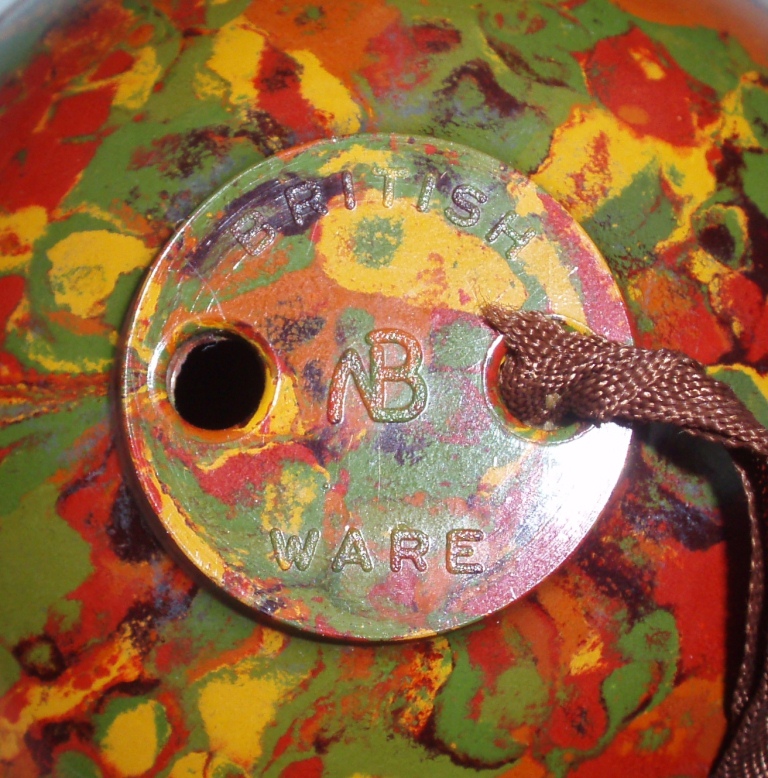
The other woolholder is also some sort of plastic, probably older, possibly bakelite.   It has one hole in the top and two in the bottom, so I'm not quite sure how it was intended to be used. The strap may have been replaced - it is a length of tape, with a button on either end to stop it slipping through the hole, so it looks a bit home-made.

Mottled plastic spherical woolholder

 If the strap is in the original location, the wool emerges from a hole in the base, if the base is the end that says "British Ware" and gives the N.B. monogram of the manufacturer (the same as the beehive woolholder).   It doesn't seem as successful a design as the beehive - you really have to hang it on your wrist or belt, whereas the beehive could stand on a table if you wanted.   


Looking at these woolholders inspired me to want to try one, so I have bought one on eBay.  It is probably much later than the two from Lee Mills, and is made of a softer plastic. But functionally it is very similar to the beehive - it has a plastic strap at the top, and a hole at the top for the wool to emerge.  As soon as a suitable opportunity arises, I'll try it out and report  on how well it works. 

Sunday, 2 December 2012

Bedspread, 1837

Because I'm dealing with the publications collection at Lee Mills, I don't usually see much of the collection of knitted and crocheted items that is gradually being recorded.  But occasionally, the volunteers working on the inventory let me know that there is something I ought to see.   The week before last, they called me over to see a bedspread.  It is knitted in white cotton, in diagonal strips in a variety of stitches,  and is in very good condition.  And the maker included a panel with her name and the date:  Hannah Smith - 1837.


It is about 7 feet by 9 feet, and the yarn seems to be about 4-ply/fingering thickness, so must have taken a lot of work.    It is one of the oldest items in the collection (as well as one of the biggest).   Finding it was thrilling - it makes the hard work at Lee Mills worthwhile when things like this turn up.   There are a few more photos of it on the Guild's web site here, though they don't really convey any idea of its size, or how stunning it is to see it in reality. 

No-one working at Lee Mills currently had seen the bedspread before, or was aware of its existence. Although there was a brief record of it, in the old files at Lee Mills, things were lost following the flood in December 2010 and we don't know whether any item has survived until it actually appears as the contents of the boxes are recorded.  So finding something like this feels like excavating buried treasure.      

Sunday, 11 November 2012

Talking about Elizabeth Forster

Yesterday, I went to London to give a talk at the AGM of the Knitting History Forum, on Elizabeth Forster.  The meeting was at the London College of Fashion, just off Oxford Circus.  It was a very good day, though it meant an early start to get to the College for 10.45.    I forgot to take a camera with me (how daft is that?)  so I cannot show you photos of the splendid Christmas decorations in Oxford Street, or of the wonderful pieces of knitting that had been brought to the 'show and tell' session  You'll have to make do with a couple of book jackets off the web, and the title slide for my talk.  The title was suggested by Sandy Black, and I thought it was great - there must have been lots of knitting pattern designers working at the same time as Elizabeth Forster, and we know very little about them. The designers of the patterns published in magazines or by spinners were hardly ever named.  We don't even know many of their names - they were invisible.  


There were several other talks in the afternoon - a really interesting programme.  Lise Warburg from Denmark talked about twined knitting or "knitting with both ends of the ball".  The idea is to give a thicker warmer fabric, though it is often very decorative as well, whether or not both strands are the same colour.  Lise traced the geographic spread of the technique and suggested that it might be related to the travels of the Vikings through Eastern Europe to Byzantium.

Jane Malcolm-Davies gave a talk about the Tudor Tailor project - specifically about the replicas of 16th Century knitted children's clothes that have been made, and the difficulties in writing unambiguous instructions for them.  She brought along some of the replicas:  vests, caps, mittens, socks and a swaddling jacket.  I think that I have seen the original of one of the vests (or one like it) in the Museum of London, and tried to figure out through the glass how it was made, so it was fascinating to be able to examine the replica closely.  


Mary Hawkins talked about her efforts to find the replica of William Lee's 16th century knitting frame that was made by Eric Pasold. She eventually tracked it to the Science Museum in London.  The museum was able to supply her with photos of the models (it turned out that there were two) taken some time ago (with one of the models upside down), but although they haven't lost the actual models, they don't know exactly where they are....

Sandy Black finished the day with a talk on the work of Maria Luck Szanto who was a postwar designer of couture hand-knitted clothes.   I had heard Sandy give a similar talk at the In The Loop conference in September, but actually got a lot out of hearing it again.  The clothes she showed were beautiful - often constructed from several oddly-shaped pieces, which came together in the workshop  in a feat of virtuoso tailoring.  Often the stitch patterns were very intricate too (and always beautifully executed)   - fine pleats, lace patterns graduated to fit the shape of the garment, brocade patterns combined with beading.  Maria Luck-Szanto features in Sandy's new book, Knitting: Fashion, Industry, Craft, which is on my Christmas list. 


Tuesday, 25 September 2012

"And now an urgent SOS message"

Two weeks ago, BBC Radio 4 broadcast a fascinating programme on SOS messages, presented by Eddie Mair.  When I was a child, SOS messages were a regular feature of news programmes.  They were usually something like: "And now here is an SOS message for Joseph Peter Bloggs.  Will Joseph Peter Bloggs, believed to be working in the Stockport area, go at once to Ambridge General Hospital, where his mother, Mrs Ethel Mary Bloggs, is dangerously ill."  In an era when mobile phones had not been dreamt of and many households didn't have access to a phone, such messages were often the only way to get a message quickly to absent members of the family.

The programme reminded me of an ad for Sylvan soap flakes that I saw in a knitting magazine from 1946.  At that time, even though the war was over, most things were still rationed and in short supply - clothes rationing for instance went on until 1949.

The ad is completely incomprehensible, if you don't know about SOS messages.  It also helps if your mother always told you to make sure that your underwear was in a respectable state, in case you got knocked down by a car and taken to hospital in an ambulance, and people would see.

Since the radio is announcing "Here is a police message", I think this is a variant of the SOS message, put out following a road accident to appeal for witnesses.

In case you can't read the dialogue easily, Girl A says "Turn it off!" and Girl B says "But darling, it might be someone we know." (The two young women are evidently expecting that the names of people injured in the accident will be given out.) 

A: "I don't care.  I always think it might have been me and I start worrying about my undies."
B: "But you used to have such dainty ones."
A: "I still have. But I simply daren't wear them.  However could I get them washed?"

And Girl B goes on to advise her to use Sylvan Flakes, and tells her how to get them.

But the obvious question is, if she wasn't wearing her "dainty undies", what was she wearing?

Thursday, 28 June 2012

Thirteen to the Dozen

In a recent session of sorting pattern leaflets at Lee Mills, we found a small batch of Templeton's  leaflets which seem to have been the company's own copies - they have hand-written notes on them with dates and costings.  The dates are between 1938 and 1940.

Templeton's leaflet 602

Leaflet 602 is for a "Twin set in 'Opalsheen' knitting wool".   (Opalsheen was a mixture of wool and "art. silk" or rayon.)  It is dated 27/4/39 and the costs associated with it are listed:

Photo & Block           £5 - 15 - 6
Printing                      £8 -  0 - 0
Design (Singleton)   £6 -  6 - 0

(These are of course in pre-decimal currency, i.e. pounds, shillings and pence, when there were 20 shillings to the pound and 12 pence to the shilling.  So £5 - 15 - 6d is £5 + 15 shillings (75p) + 6 old pence (2½p).)

The total cost is £20 - 1 - 6d, and then there is a slightly baffling bit:   "= 20.878d per doz. of 13".   From other leaflets in the same batch, it's clear that Templeton's had leaflets printed in batches of 3000.  In that case the cost of 13 leaflets would indeed be 20.878d.  (And I'm glad I could work it out on a calculator, and not by hand, as I suppose the person who wrote the note had to.)  So I guess that if a retailer ordered a dozen leaflets, they actually got 13.  

Very odd!  I know that a baker's dozen means thirteen, and the story I heard is that long ago the penalties for selling short measure were severe, so bakers would add an extra loaf to each dozen to be on the safe side.  But it seems extraordinary to find the same practice surviving to 1940.  (But perhaps only in Scotland?)

It seems that Templeton's were not making a lot of profit on their pattern leaflets.  No. 583 ("A smart suit in "Mystic" fancy yarn", dated 22/2/39)  retailed at 3d, and it cost more than 2d to produce each one. The printing costs were especially high in that case, (£14 - 10 - 0d) because it was an 8-page leaflet.  Leaflet 602, also retailing at 3d, is only 4 pages, and the unit cost was less than 2d.  But that assumes that Templeton's could sell the entire batch of 3000, and presumably there was some profit for the retailer too. 

Templeton's leaflet 583
In fact, 3d seems very cheap by today's standards.  According to a historical inflation calculator I found here, 3d in 1939 is worth about 66p now - much less than the current price of spinners' pattern leaflets.

By the way, the company that produced these leaflets was James Templeton & Son Ltd. of Ayr.  I don't know whether there was any connection with James Templeton & Co. of Glasgow, who made carpets.  We went to a wedding two years ago at the former Templeton carpet factory - a very fancy building on Glasgow Green, modelled on the Doge's Palace in Venice.  If anyone knows of any connection between the two companies, I should be glad to know.    

Wednesday, 16 May 2012

Sanquhar Museum


While we were in Galloway we went to Sanquhar, which is a small village north of Dumfries.  The Tolbooth museum is a typical local museum with a disparate collection of objects from the local area.  What I was particularly interested in, of course, was the display on Sanquhar gloves.  

(Dumfries and Galloway Museums Service have set up a wonderful on-line display of the Sanquhar knitting in their various collections here  - well worth looking at if you are interested in the Sanquhar designs.)

Since I spend so much of my time working on patterns, magazines, and other publications for the Knitting and Crochet Guild, one thing that particularly interested me at the museum was that the Sanquhar patterns were not published until the 1950s, when People's Friend magazine issued two supplements featuring Sanquhar patterns.  One (which we don't have in the Guild collection) was specifically on Sanquhar knitting - details here.  The other was on Scottish knitting in general, but included a scarf pattern that used one of the traditional Sanquhar designs.   People's Friend is published in Scotland  (part of the D C Thomson empire, based in Dundee)  - presumably at that time, the Sanquhar patterns were more or less unknown outside Scotland.


The museum also showed a Patons & Baldwins pattern leaflet, likewise from the 1950s, for Sanquhar gloves.  The P&B leaflet and one of the People's Friend supplements have the same model on the front cover (at least it looks that way to me), so I surmise that the production of the leaflet and the supplement were somehow linked, but the museum display did not comment on that.
   
  
So what happened next?  When and how did Sanquhar gloves get more widely known outside Scotland?  How did they get to be so popular in Japan?       

Wednesday, 2 May 2012

The Complete Knitting Book


I wrote in a previous post about a booklet of patterns designed by Marjory Tillotson during World War I.  At that time she was employed as a designer of knitting patterns by Baldwin's, a spinning company in Halifax, which merged with Patons (of Alloa in Scotland) in 1920. Marjory Tillotson married at about the time of the merger.  As was common in those days, she was not allowed to carry on with her job after she married.   However, she continued to  design knitting patterns for many years, as a freelance designer.  (1)     

She also wrote books on knitting, and I bought a copy of one recently.  The Complete Knitting Book was first published in 1934.  It must have been very popular - there were 5 editions by 1948. Mine is the 4th edition, published in 1940.

She says in the introduction that knitting should be a creative craft, by which she means that knitters should not "rely upon stereotyped directions and designs, and copy slavishly those printed directions."  This must have been a very unusual approach at that time (still is, for that matter).   So the book starts with general principles of knitting, and then follows a long section on different stitch patterns.  The section on "The Knitting of Garments" gives layouts for standard types of garment, so that in theory you can choose a stitch pattern and a yarn, decide on the measurements for the garment you want to produce,  measure your tension and then knit a garment that you have more or less designed yourself. 
Measurement Diagram for Woman's Jumper


The diagram shown is for a woman's V-neck jumper.  The letters indicate the points where the knitter should take their own measurements, e.g. CD is the required length of the neck opening, GG is the circumference of the wrist and so on.  The numbers shown are examples for a particular size and tension - plain numbers indicate the number of stitches, those in circles show the number of rows.  Numbers in brackets occur where you have to decrease over a number of rows - e.g. for the V-neck, the diagram indicates that for the given size and tension you should decrease 12 stitches over 63 rows - the [5] shows that you should decrease on every 5th row.   (It requires quite a lot of arithmetic to work everything out, but evidently many knitters were prepared to do it.)   She does give outline knitting instructions, but really, the instructions are all in the diagram.  e.g "Back:  Commencing at hem, cast on AA measurement of stitches.  Rib CA length, then introduce required pattern design, either plain, open-work or coloured, and shape according to diagram."

One problem that she couldn't completely solve, it seems to me, was how to estimate the amount of yarn required.  For the woman's jumper, she says that the materials required are "4 to 5 oz. 2-ply, 8oz. 3-ply or 10oz. 4-ply fingering wool and size 8 needles."     It's a bit odd, for one thing, that size 8 needles are recommended for such a wide range of yarns - if you used finer needles for the finer yarn, the estimate would be off.  But also, if you used any kind of novelty or non-standard yarn, the yardage per ounce might be very different  (although you wouldn't know until you had knitted with it - it's only quite recently that spinners have stated the yardage on balls of yarn).

Incidentally, I spoke to someone recently who worked for Bestway in the early 1960s.  Bestway published knitting patterns for yarns from many different spinners, but sometimes they wanted to suggest alternative yarns, and needed to give accurate quantities.  When she first worked there, as the most junior employee, she was given the task of measuring the length of different balls of yarn,  so that the number of balls required could be estimated, based on the total yardage.  What a tedious job!  Whoever decided to print the yardage on the ball-band did us all a great favour. 


1. Cally Blackman, Handknitting in Britain from 1908-39: the work of Marjory Tillotson, Textile History, vol. 29, pp. 177-200, 1998. (2)
2. I think it adds a touch of class to have footnotes in a blog post. 
Related Posts Plugin for WordPress, Blogger...