Mostly about knitting history. Sometimes about what I'm knitting. Sometimes about other things too.
Showing posts with label Barbara Walker. Show all posts
Monday, 11 February 2019
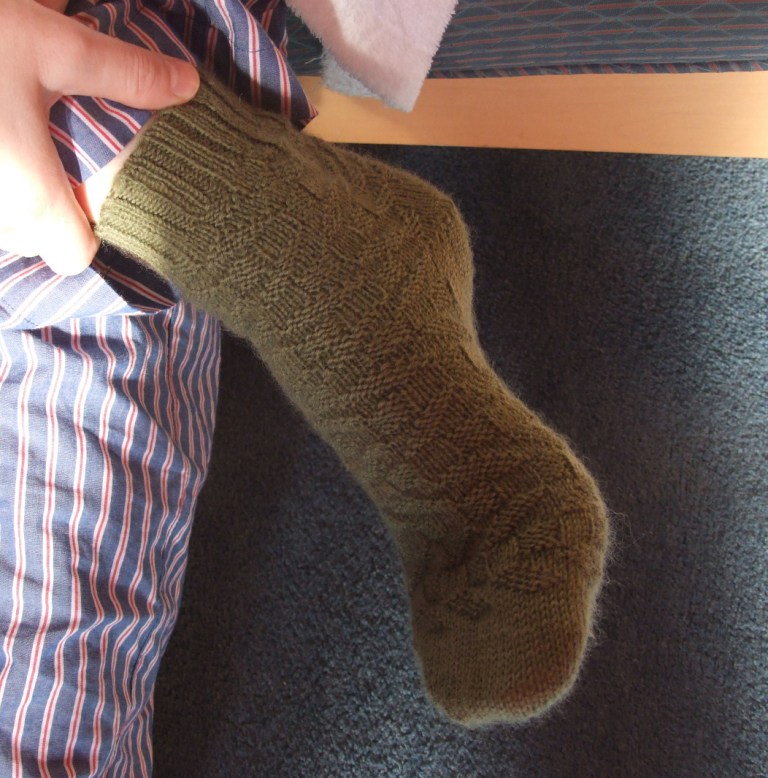
Vandyke Check Socks
I have been knitting a pair of socks for my sister - just finished them. My New Year's knitting resolution was to knit both socks of a pair at the same time (to avoid mismatches, not to mention second sock syndrome), starting with this pair. I tried knitting with two circular needles, but found it too awkward - too much cable to contend with - and so used magic loop with a single circular needle instead.
The yarn is Regia Graphics Color sock wool. My sister wanted a pair of socks to wear with her Joules printed rubber ankle boots - I haven't seen them, but here is the matching handbag.
I think the yarn is a pretty good match to the colours in the handbag, especially as I didn't go looking for it, but found it more or less by accident - after my knitting friend Cath Harris died, her family had a coffee morning in aid of the charity Myeloma UK to find homes for some of her extensive stash of wool and other craft materials, and I found it there.
I knitted the socks toe-up, using the same basic construction (German short-row heel, with a gusset) that I have been using recently, because I know it fits me very well. It turns out that my socks fit my sister very well too.
I didn't want to use a complicated design with this variegated yarn, so I chose the Vandyke Check stitch pattern from Barbara Walker's A Treasury of Knitting Patterns. I have used it before - for the first pair of toe-up socks I ever knitted, made for my daughter in 2011.
The pattern really doesn't show up very well, but I do like the texture given by the blocks of knit and purl stitches, so I'm happy with the choice.
I hope you enjoy wearing your socks, Margaret. I have enough yarn left to knit a pair of socks for me, too, but I think I'll have a break from socks for a while.
Labels:
Barbara Walker,
finished,
socks,
stitch patterns,
toe-up socks
Saturday, 17 December 2016
A Long, Long Scarf A-Winding
I have been knitting a scarf for my sister for quite a while now - I wrote in August about knitting a swatch for it, here. It's been my main knitting project ever since, though I've been doing other bits of knitting, too (as well as everything else that needs doing apart from knitting). It took a long time because of Margaret's specification - she wanted it to be 80 inches long and 10 inches wide (about 200 × 25 cm.) And it is.
I could have made it a bit longer, because I had 20g. of yarn left, out of the original 200g. But we had arranged to meet last Monday, so I had to stop knitting and press it before then. Otherwise, I would have finished off the yarn - I think 80 inches was intended as a minimum, not a maximum, and I don't have an obvious use for 20g. of 4-ply yarn.
It wasn't a surprise present. Margaret approved the colour before I bought the yarn, and I sent her the swatch so that she could check that it wouldn't be irritating (it's alpaca and nylon, because she can't wear wool). So on Monday she tried it for size and declared it long enough, before re-wrapping it to put away until Christmas Day.
It is all knitted in dewdrop stitch, from Barbara Walker's Treasury of Knitting Patterns - an easy lace pattern. Three out of four rows are just k3, p3 all across the row, and the complications that make it lacy are all on the 4th row.
The wrong side looks just as good as the right side, too, though they aren't the same. In the photo below, the wrong side is shown on the right.
A very successful project - it will be wonderfully warm and cosy to wear. And not itchy.
I could have made it a bit longer, because I had 20g. of yarn left, out of the original 200g. But we had arranged to meet last Monday, so I had to stop knitting and press it before then. Otherwise, I would have finished off the yarn - I think 80 inches was intended as a minimum, not a maximum, and I don't have an obvious use for 20g. of 4-ply yarn.
It wasn't a surprise present. Margaret approved the colour before I bought the yarn, and I sent her the swatch so that she could check that it wouldn't be irritating (it's alpaca and nylon, because she can't wear wool). So on Monday she tried it for size and declared it long enough, before re-wrapping it to put away until Christmas Day.
It is all knitted in dewdrop stitch, from Barbara Walker's Treasury of Knitting Patterns - an easy lace pattern. Three out of four rows are just k3, p3 all across the row, and the complications that make it lacy are all on the 4th row.
The wrong side looks just as good as the right side, too, though they aren't the same. In the photo below, the wrong side is shown on the right.
A very successful project - it will be wonderfully warm and cosy to wear. And not itchy.
Friday, 26 August 2016
Swatching for a Scarf
I have been trying out stitch patterns for a scarf I'm planning to knit for my sister. I bought the yarn at Ribbon Circus in Hebden Bridge, at the Crafternoon Tea at the beginning off this month. And I knitted a swatch of a possible pattern, Different Breeze, some time ago - the first thing I knitted when I was able to hold knitting needles again after breaking my wrists. But although it's a very pretty lace pattern, there are no easy rows - you need to concentrate on every one. It's going to be a long scarf, and so I'd like some rows in every pattern repeat where I can knit without thinking.
For other possibilities, I've swatched a couple of stitch patterns from Barbara Walker's Treasury of Knitting Patterns. The first is Lace Rib. It meets my criterion - every other row is a repeat of p3, k2, so doesn't need much thought.
So that was a strong candidate. But being based on rib, it naturally concertinas inward - the swatch has been pressed to flatten it out, and even then it is perhaps not as drapy as I would like.
I have also knitted a swatch of Dewdrop Pattern. It's an 8 row pattern with 6 rows of k3, p3. The lacy increases and decreases all happen on the 4th and 8th rows. So it will be quite fast to knit, I think.
(By the way, if you look at Dewdrop Pattern in A Treasury of Knitting Patterns, you'll see that my swatch doesn't look very like Barbara Walker's. Hers seems a bit more stretched out, vertically.)
On the 4th and 8th rows of the pattern, you do a three-into-one decrease, which according to the instructions should be done as slip one, knit 2 together, pass slipped stitch over. But I found that the slipped stitch gets quite stretched when is passed over, and that stitch becomes a prominent part of the pattern, so that it isn't symmetrical. You might be able to see that in the bottom half of the swatch. (Again, Barbara Walker's doesn't seem to look like that.)
So I tried a different 3-into-1 decrease, where the centre stitch is on top. That's also easy to do. First, slip the first two stitches together, knitwise, That puts them on the right needle in reverse order. Then knit the 3rd stitch, and pass the first two stitches over it, either one at a time or both together. The result is that the 2nd stitch, i.e. the middle one of the three, ends up on top, with the other two tucked underneath it. I've done that in the top half of the swatch.
So I think dewdrop stitch will be my choice for the scarf. It's easy to knit, it lies flat, it drapes nicely, it's pretty. And another plus: although the pattern isn't reversible, and the wrong side looks completely different to the right side, it's quite presentable.
.
For other possibilities, I've swatched a couple of stitch patterns from Barbara Walker's Treasury of Knitting Patterns. The first is Lace Rib. It meets my criterion - every other row is a repeat of p3, k2, so doesn't need much thought.
| Lace Rib |
So that was a strong candidate. But being based on rib, it naturally concertinas inward - the swatch has been pressed to flatten it out, and even then it is perhaps not as drapy as I would like.
I have also knitted a swatch of Dewdrop Pattern. It's an 8 row pattern with 6 rows of k3, p3. The lacy increases and decreases all happen on the 4th and 8th rows. So it will be quite fast to knit, I think.
| Dewdrop Pattern |
On the 4th and 8th rows of the pattern, you do a three-into-one decrease, which according to the instructions should be done as slip one, knit 2 together, pass slipped stitch over. But I found that the slipped stitch gets quite stretched when is passed over, and that stitch becomes a prominent part of the pattern, so that it isn't symmetrical. You might be able to see that in the bottom half of the swatch. (Again, Barbara Walker's doesn't seem to look like that.)
So I tried a different 3-into-1 decrease, where the centre stitch is on top. That's also easy to do. First, slip the first two stitches together, knitwise, That puts them on the right needle in reverse order. Then knit the 3rd stitch, and pass the first two stitches over it, either one at a time or both together. The result is that the 2nd stitch, i.e. the middle one of the three, ends up on top, with the other two tucked underneath it. I've done that in the top half of the swatch.
So I think dewdrop stitch will be my choice for the scarf. It's easy to knit, it lies flat, it drapes nicely, it's pretty. And another plus: although the pattern isn't reversible, and the wrong side looks completely different to the right side, it's quite presentable.
| Dewdrop Pattern, reverse |
Monday, 27 June 2016
Mistake Rib
I just discovered mistake rib! It's obviously not new, as it already has a name, but it's new to me.
The discovery came about because I've ordered a copy of Sequence Knitting by Cecelia Campochiaro. I've been hearing about the book since it was published, e.g. in Tom of Holland's blog, here. It's not easy to buy it in the U.K., so I have finally ordered a copy from the U.S., and it is now making its way slowly over the Atlantic (I hope). After I ordered it, I started thinking about the kind of sequences that I think she's talking about. One idea is to choose a sequence of knit and purl stitches and repeat them over and over on every row, so every row starts at the beginning of the sequence. You get different stitch patterns depending on the number of stitches you have. So for instance, the simplest sequence would be K1, P1. If you have an even number of stitches, you get single rib, and an odd number of stitches gives moss stitch. It's fascinating that two stitch patterns which look and behave so differently should be so closely related.
Then I started thinking about the sequence K2, P2. If the number of stitches is a multiple of 4, you get double rib, and if it's a multiple of 4, plus 2, you get what's sometimes called double moss stitch. And if it's a multiple of 4, plus 1 or 3, I discovered that you get an interesting stitch pattern that's a mixture of single rib and moss stitch.
Looking at the swatch, there is a column of the knit stitches of single rib, then a column of moss stitch, then a column of the purl stitches of single rib, and another column of moss stitch, and that sequence repeats. Here's a chart, which might make it clearer. A blank square means knit on odd rows, purl on even rows; ● means purl on odd rows, knit on even rows. (It's reversible, so there aren't 'right' and 'wrong' sides.)
The resulting fabric is deeply corrugated and quite stretchy, but doesn't pull in like double rib.
I thought that such a simple but good-looking stitch pattern must be already known, and not a new invention. And a few days later, in the way that coincidences happen, I found a knitting pattern that uses it.
It's a smart jacket, from about 1940, and would be very warm, I think. The leaflet doesn't give a name to the stitch pattern, but it prompted me to look in Barbara Walker's Treasury of Knitting Patterns. And there I found it, called Mistake Stitch Ribbing. She says 'This handsome ribbing may very well have been discovered by an accident. The "mistake" consists of working Knit-Two Purl-Two ribbing on one less stitch than required.' It doesn't seem very plausible to me that it should have been the result of a mistake - as she also says, it would have been obvious very quickly that it wasn't double rib. I think any knitter intending to knit double rib would have corrected the mistake before realising that it is a worthwhile stitch pattern in its own right. But the rather unfortunate name seems to be firmly attached.
It would be nice to knit something more than a swatch in mistake rib. It would make a nice scarf, and there are lots of examples in Ravelry. (It is reversible of course - every row is the same.) But I have plenty of scarves - something different would be good.
The discovery came about because I've ordered a copy of Sequence Knitting by Cecelia Campochiaro. I've been hearing about the book since it was published, e.g. in Tom of Holland's blog, here. It's not easy to buy it in the U.K., so I have finally ordered a copy from the U.S., and it is now making its way slowly over the Atlantic (I hope). After I ordered it, I started thinking about the kind of sequences that I think she's talking about. One idea is to choose a sequence of knit and purl stitches and repeat them over and over on every row, so every row starts at the beginning of the sequence. You get different stitch patterns depending on the number of stitches you have. So for instance, the simplest sequence would be K1, P1. If you have an even number of stitches, you get single rib, and an odd number of stitches gives moss stitch. It's fascinating that two stitch patterns which look and behave so differently should be so closely related.
Then I started thinking about the sequence K2, P2. If the number of stitches is a multiple of 4, you get double rib, and if it's a multiple of 4, plus 2, you get what's sometimes called double moss stitch. And if it's a multiple of 4, plus 1 or 3, I discovered that you get an interesting stitch pattern that's a mixture of single rib and moss stitch.
The resulting fabric is deeply corrugated and quite stretchy, but doesn't pull in like double rib.
I thought that such a simple but good-looking stitch pattern must be already known, and not a new invention. And a few days later, in the way that coincidences happen, I found a knitting pattern that uses it.
![]() |
| Penelope 1084 |
It would be nice to knit something more than a swatch in mistake rib. It would make a nice scarf, and there are lots of examples in Ravelry. (It is reversible of course - every row is the same.) But I have plenty of scarves - something different would be good.
Thursday, 15 March 2012
Spin Knitting
I don't usually write about my knitting projects until they are finished, because sometimes they don't work out. Sometimes I have to unravel the whole lot and use the yarn for a different project entirely, and writing about that would be very disheartening. So for instance, I was knitting a cardigan for several months last year which has not gone well at all - I have knitted most of it twice and it looks like I shall have to abandon it. I was following the pattern rather than tinkering with it as I usually do, so it is annoying that it hasn't worked. And I don't want to write any more about it.
But I think that maybe I should write more often about work in progress, when I am modifying a pattern or making it up as I go along. So here's one I'm knitting now - though actually it's nearly finished and I'm confident that this one is going to work, because it's made top down and I can try it on as I go.
The yarn is some 1970s yarn, that we found at Lee Mills, called Twilleys Spin Knitting. I had never heard of it until I was sorting the Twilleys pattern books, and found one for Spin Knitting which seemed intriguing. Then the following week, I saw a pack of it in a pile of odd balls of unwanted yarn, and bought it.
The pack contains 550g of yarn in a single length. It is a single ply, and it gets twisted slightly as you knit it and that "completes the spinning process", it says, hence the name. It's oiled wool (so makes your fingers soft but smelly) and a natural creamy colour. The pack label warns you to keep the plastic wrapper on, except for a hole in the top for the yarn to go through - otherwise there is a danger that the whole lot would fall out of the paper band into a horrendous tangle.
The pack does not give the length of the yarn, except for saying that it is
much longer than the same weight of other yarns of similar thickness, so
it would have been difficult to estimate what I could knit with it,
without the pattern book. But there was a pattern for a long sleeved
jumper in my size, that would use exactly one pack, so that's what I
planned to make.
![]() |
| Diamond pattern jumper |
Although the original plan was that I would knit something like the diamond pattern jumper in the pattern book, I wanted to knit it top down rather than bottom up (in case I ran out of yarn, which would be easier to cope with around the hem than around the neck) and in the round. I based it on Barbara Walker's book Knitting from the Top, and followed her instructions for a raglan-sleeved pullover. Except that she adds the neck band afterwards, by picking up stitches around the neck, and I do hate picking up stitches. So I figured out a way to start with the neckband - tricky, because as well as doing short rows to make the front of the neck lower than the back, I had to decrease at the front after the neckband, because the front of the neckband is longer than the back.
That all worked fine, except that I had originally planned that the jumper would be in reverse stocking stitch, like the one in the pattern book, but then I decided that the knit side looked neater than the purl side, so I turned the whole thing inside out. And then when I got to the diamond pattern, I thought that it would not show up so well against the knit background, so I switched back to reverse stocking stitch.
So far, the jumper has been knitted with a single continuous thread, although I shall have to break it to knit each sleeve. And there will not be a single seam in the whole thing, yippee. I guess it's a bit retro, really, though as I can remember the 1970s perfectly well it seems a bit strange to think of it that way.
I don't think the Spin Knitting yarn can have been a great success - it's not very portable and not very economical either. If you wanted to knit a larger size of jumper, you would need to buy two packs of yarn and then have a lot left over - the pattern book is full of patterns for hats, scarves and mittens to use up the surplus. But I think my jumper will turn out well - warm but light. (I'm hoping that I can get rid of the oily smell when I wash it.) I'll post about it again when it's finished.
By the way, someone has yarn-bombed Saltburn pier, with an Olympic-themed scarf, 50 yards long. Do take a look - it's wonderful.
Sunday, 6 November 2011
Toe-up Socks
I have been knitting a cardigan for months now, and it is not turning out well. I have knitted most of the body twice, and I'm still not happy with it - it's all very disheartening. So I decided to knit a pair of socks for my daughter - she likes to wear fancy socks and I don't particularly.
I have only knitted one pair of socks before and they were not a great success (as described here), but only because they were knitted in bamboo yarn and so went very baggy as soon as I wore them. The actual knitting was satisfying - the construction is so clever. This time I wanted to knit them toe-up, because I find casting on for the ankle very fiddly and prone to disasters (like getting a twist into the knitting when you join it up, or dropping a stitch on the first round).
The basic pattern is by Wendy Johnson, free through Ravelry or from her web site (follow the links to "Free Patterns" and then it's the Detailed Toe-up Sock Pattern). Her pattern produces a plain pair of socks - the idea is just to demonstrate the techniques of toe-up socks with a short-row toe and heel. So I used a stitch pattern from Barbara Walker's Treasury to add some texture and interest on the instep and ankle. It's the Vandyke Check pattern (mostly chosen because it has an 8-stitch pattern repeat and I had 64 stitches in total, but it has turned out very well). It is made up of blocks of stocking stitch and reverse stocking stitch, so it doesn't add any bulk. The yarn is 4-ply 75% wool and 25% polyamide from Cygnet, in olive green.
The socks fit very well and my daughter is very pleased with them. (I can tell because she said "You can knit me lots more of these!")
I have only knitted one pair of socks before and they were not a great success (as described here), but only because they were knitted in bamboo yarn and so went very baggy as soon as I wore them. The actual knitting was satisfying - the construction is so clever. This time I wanted to knit them toe-up, because I find casting on for the ankle very fiddly and prone to disasters (like getting a twist into the knitting when you join it up, or dropping a stitch on the first round).
The basic pattern is by Wendy Johnson, free through Ravelry or from her web site (follow the links to "Free Patterns" and then it's the Detailed Toe-up Sock Pattern). Her pattern produces a plain pair of socks - the idea is just to demonstrate the techniques of toe-up socks with a short-row toe and heel. So I used a stitch pattern from Barbara Walker's Treasury to add some texture and interest on the instep and ankle. It's the Vandyke Check pattern (mostly chosen because it has an 8-stitch pattern repeat and I had 64 stitches in total, but it has turned out very well). It is made up of blocks of stocking stitch and reverse stocking stitch, so it doesn't add any bulk. The yarn is 4-ply 75% wool and 25% polyamide from Cygnet, in olive green.
Labels:
Barbara Walker,
finished,
socks,
techniques,
toe-up socks
Wednesday, 2 February 2011
Swatching
I have had another attempt to find a stitch pattern for Rowan silk-wool DK yarn. I am thinking of knitting a cardigan in the 6 balls of yarn that I bought last year, as I described in a previous post.
I have been trying out lace patterns that will fit well with the raglan increases in a top-down cardigan. The stitch pattern in the centre of the swatch is the Vertical Lace Trellis from Barbara Walker's A Treasury of Knitting Patterns. I increased one stitch at each end of the centre panel on every right-side row, and the extra stitches are incorporated neatly into the lace pattern.
I have done the side panels in plain stocking stitch, because I am still experimenting with needle sizes and tension for this yarn It is allegedly DK yarn, and the recommended needle size is 4 mm, supposedly giving a tension of 22 stitches and 30 rows to 10 cm, which is of course perfectly standard for DK yarn. However, I have used 5.5mm needles for this swatch, and the tension over the stocking stitch is about 18 stitches and 22 rows to 10 cm. The resulting fabric looks fine to me - not too loose. So the yarn seems to me to be behaving a lot more like Aran weight than DK.
In comparison with the Felted Tweed DK that I am using for my Old Moor jumper, the Silk-Wool looks much thicker. Felted Tweed has 2 strands of yarn, quite loosely wound around each other (there are probably some technical terms to use here that I don't know) whereas the Silk-Wool has 4 strands of yarn and is more tightly wound, and the yarn looks and feels much denser.
Such huge disparities in yarns that claim to be the same weight make it potentially very difficult to substitute a different yarn for the one that a pattern is written for. I guess the lesson is not to go by what the ball-band says, but look at the yarn itself and how it feels. In my case, I don't have a pattern, except for Barbara Walker's general guidelines in her book Knitting from the Top. So all I have to do is find an appropriate gauge for this yarn, and a good stitch pattern for what I want to achieve. I think I have done both of those with this swatch.
I have been trying out lace patterns that will fit well with the raglan increases in a top-down cardigan. The stitch pattern in the centre of the swatch is the Vertical Lace Trellis from Barbara Walker's A Treasury of Knitting Patterns. I increased one stitch at each end of the centre panel on every right-side row, and the extra stitches are incorporated neatly into the lace pattern.
I have done the side panels in plain stocking stitch, because I am still experimenting with needle sizes and tension for this yarn It is allegedly DK yarn, and the recommended needle size is 4 mm, supposedly giving a tension of 22 stitches and 30 rows to 10 cm, which is of course perfectly standard for DK yarn. However, I have used 5.5mm needles for this swatch, and the tension over the stocking stitch is about 18 stitches and 22 rows to 10 cm. The resulting fabric looks fine to me - not too loose. So the yarn seems to me to be behaving a lot more like Aran weight than DK.
In comparison with the Felted Tweed DK that I am using for my Old Moor jumper, the Silk-Wool looks much thicker. Felted Tweed has 2 strands of yarn, quite loosely wound around each other (there are probably some technical terms to use here that I don't know) whereas the Silk-Wool has 4 strands of yarn and is more tightly wound, and the yarn looks and feels much denser.
Such huge disparities in yarns that claim to be the same weight make it potentially very difficult to substitute a different yarn for the one that a pattern is written for. I guess the lesson is not to go by what the ball-band says, but look at the yarn itself and how it feels. In my case, I don't have a pattern, except for Barbara Walker's general guidelines in her book Knitting from the Top. So all I have to do is find an appropriate gauge for this yarn, and a good stitch pattern for what I want to achieve. I think I have done both of those with this swatch.
Tuesday, 7 December 2010
Knitting Scales
I have been musing on what to knit with the 6 balls of bronze-y coloured Rowan silk-wool yarn I bought recently. I have borrowed a copy of Barbara Walker's Knitting from the Top, so that will give me the structure of a raglan-sleeved cardigan that I can knit downwards until the yarn runs out, but I still need to choose a stitch pattern.
Because of the slightly metallic sheen, I've been thinking of fish-scales and the sort of armour made of small plates. So on a bus journey yesterday, I tried some possible stitch pattern that might look vaguely like that.
(For anyone who thinks, like my husband, that the photo is upside-down, it's not. I'm going to knit top down, so I want to see how the stitch pattern will look that way up.)
I started (after the moss stitch band) with the Openwork Diamonds pattern from Walker's A Treasury of Knitting Patterns. But a lacy stitch doesn't seem appropriate if you are thinking of fish scales or scale armour. So for the rest of the swatch, I filled in the holes in the lace pattern (on the row after a yarn over, I purled into the back of it, to twist it rather than leaving a hole). I think either of these stitch patterns would work well with the raglan increases for the sleeves and would look neat.
But now that I have tried knitting with this yarn, it seems quite thick for double knitting, and it's producing a denser fabric than I expected (on 4mm needles). So I'm not sure it's going to be suitable for a light evening cardi. Maybe a more open stitch would be better, maybe some sort of mesh. That would be kind of chain mail, rather than scale armour or fish scales.
And since I'm going to unravel my swatch, maybe I could measure the yarn I've used and estimate the required area of a small cardigan and see if I'm going to have enough. The plan is to stop when the yarn runs out, but I don't want it to look stupidly short. More investigation needed.
Because of the slightly metallic sheen, I've been thinking of fish-scales and the sort of armour made of small plates. So on a bus journey yesterday, I tried some possible stitch pattern that might look vaguely like that.
(For anyone who thinks, like my husband, that the photo is upside-down, it's not. I'm going to knit top down, so I want to see how the stitch pattern will look that way up.)
I started (after the moss stitch band) with the Openwork Diamonds pattern from Walker's A Treasury of Knitting Patterns. But a lacy stitch doesn't seem appropriate if you are thinking of fish scales or scale armour. So for the rest of the swatch, I filled in the holes in the lace pattern (on the row after a yarn over, I purled into the back of it, to twist it rather than leaving a hole). I think either of these stitch patterns would work well with the raglan increases for the sleeves and would look neat.
But now that I have tried knitting with this yarn, it seems quite thick for double knitting, and it's producing a denser fabric than I expected (on 4mm needles). So I'm not sure it's going to be suitable for a light evening cardi. Maybe a more open stitch would be better, maybe some sort of mesh. That would be kind of chain mail, rather than scale armour or fish scales.
And since I'm going to unravel my swatch, maybe I could measure the yarn I've used and estimate the required area of a small cardigan and see if I'm going to have enough. The plan is to stop when the yarn runs out, but I don't want it to look stupidly short. More investigation needed.
Saturday, 9 October 2010
Lace and Cables
I have an old hand-knitted jumper of my mother's that I have kept because of all the time and effort that clearly went into it. I recently realised that I also have the pattern for it. It is in a book that she was given for her birthday in 1947, Practical Family Knitting Illustrated, by Margaret Murray and Jane Koster.
The caption is: "Here is a lightweight jumper that is delightful to wear under a tailored suit. The ribbed effect of the open-work panels and the cable stitch produces a slim-fitting line, while the scalloped edging gives an attractive finish to the waist and short sleeves."
The photo looks very 1940s, mainly because of the very square shoulders, but they are at least partly due to shoulder pads. (And if you wore the jumper under a suit as suggested, with a coat on top if it was winter-time, you could easily be wearing a stack of three shoulder pads on each side. I remember that from the 1980s, when shoulder pads were again commonly worn. Bad idea.)
Mother's version has a more natural shoulder line. I'm not sure if she adjusted the shaping at the top of the sleeve, or whether it's just the lack of shoulder pads. She did change the pattern to make the jumper bigger - the instructions in the book are only for a 34 in. bust size, and she inserted an extra cable and lace panel, front and back, and made the neck opening larger at the same time.
It is a very pretty stitch pattern. The lace part is called Fountain Lace in one of Barbara Walker's Treasury of Knitting Patterns books, apparently - I guess it is a traditional pattern.
I don't remember Mother wearing it, but it is well-worn. I think you would probably keep a jumper like that even if you were no longer wearing it - it must have been quite time-consuming to make. My sister thinks that she knitted it around about 1980, when she acquired some very fine knitting wool from somewhere. At that time she mostly did simpler knitting that she could do while reading or watching TV in the evenings, with her feet up on the sofa.
In fact, there are quite a few mistakes in both the lace and the cables, if you examine it closely. I think that's partly because the book doesn't give charts. Whoever invented knitting charts did a great service to knitters. (Although Mary Thomas used charts in her 1943 Book of Knitting Patterns, so they seem to have already been invented before Practical Family Knitting Illustrated was published.) I have knitted a test swatch and it is very difficult to follow instructions like:
spread over several lines like that. Even worse when the page with the colour photo comes in the middle of the instructions for the row. Evidently, Mother didn't copy out the instructions but worked from the book - there is a large tea stain on the first page; the colour photo page has fallen out, been taped back in and fallen out again; and the spine is giving way at that point in the book. "Well-thumbed" doesn't really do justice to the amount of wear this poor book has had.
But as a birthday present it was very successful - Mother used it over many years, and I still have it. I'm sure that this pattern could be updated to be wearable today and I plan to do it. My mother's friend who gave her the book later became my godmother, and re-knitting Mother's jumper seems a good way of remembering her as well.
![]() |
| Lace jumper in a dainty open-work pattern |
The caption is: "Here is a lightweight jumper that is delightful to wear under a tailored suit. The ribbed effect of the open-work panels and the cable stitch produces a slim-fitting line, while the scalloped edging gives an attractive finish to the waist and short sleeves."
The photo looks very 1940s, mainly because of the very square shoulders, but they are at least partly due to shoulder pads. (And if you wore the jumper under a suit as suggested, with a coat on top if it was winter-time, you could easily be wearing a stack of three shoulder pads on each side. I remember that from the 1980s, when shoulder pads were again commonly worn. Bad idea.)
Mother's version has a more natural shoulder line. I'm not sure if she adjusted the shaping at the top of the sleeve, or whether it's just the lack of shoulder pads. She did change the pattern to make the jumper bigger - the instructions in the book are only for a 34 in. bust size, and she inserted an extra cable and lace panel, front and back, and made the neck opening larger at the same time.
It is a very pretty stitch pattern. The lace part is called Fountain Lace in one of Barbara Walker's Treasury of Knitting Patterns books, apparently - I guess it is a traditional pattern.
I don't remember Mother wearing it, but it is well-worn. I think you would probably keep a jumper like that even if you were no longer wearing it - it must have been quite time-consuming to make. My sister thinks that she knitted it around about 1980, when she acquired some very fine knitting wool from somewhere. At that time she mostly did simpler knitting that she could do while reading or watching TV in the evenings, with her feet up on the sofa.
In fact, there are quite a few mistakes in both the lace and the cables, if you examine it closely. I think that's partly because the book doesn't give charts. Whoever invented knitting charts did a great service to knitters. (Although Mary Thomas used charts in her 1943 Book of Knitting Patterns, so they seem to have already been invented before Practical Family Knitting Illustrated was published.) I have knitted a test swatch and it is very difficult to follow instructions like:
5th row - P. 2, * k. 9, p. 4, k. 1, k.2
tog., k. 2, m. 1, k. 2, m. 1, k. 2 tog., k.1,
k. 2 tog., m. 1, k. 2, m. 1, k. 2, k. 2 tog.
t.b.l., k. 1, p. 4; rep. from * twice, k.9.
p. 2.spread over several lines like that. Even worse when the page with the colour photo comes in the middle of the instructions for the row. Evidently, Mother didn't copy out the instructions but worked from the book - there is a large tea stain on the first page; the colour photo page has fallen out, been taped back in and fallen out again; and the spine is giving way at that point in the book. "Well-thumbed" doesn't really do justice to the amount of wear this poor book has had.
But as a birthday present it was very successful - Mother used it over many years, and I still have it. I'm sure that this pattern could be updated to be wearable today and I plan to do it. My mother's friend who gave her the book later became my godmother, and re-knitting Mother's jumper seems a good way of remembering her as well.
Subscribe to:
Posts (Atom)