Showing posts with label KCG. Show all posts

Saturday, 19 January 2019

A Few More Patterns

Last weekend, I was knitting at Sheringham, on the north Norfolk coast - the Leighton Buzzard branch of the Knitting & Crochet Guild hold an annual weekend at the Youth Hostel there.  A busy weekend, with a yarn swap, a quiz, talks and workshops.  Alongside the workshops, I did a couple of sessions on tools and gadgets from the Guild collection which were innovations in their time, and have a patent number attached - such as the Double Century needles.  I took a few knitting patterns with patent numbers too. (You might not think that you could patent a sock pattern, but it has been done - I'll write about it some time.)  There was time to look around Sheringham and visit the shops, including the two yarn shops.  And of course a lot of knitting was done (or crochet, for those that are that way inclined).

During the weekend, a Guild member gave me some pattern leaflets and booklets from a friend of hers, as a donation to the collection - a mix of styles and dates, from the 1930s to the 1970s or 80s.  It's exciting to look through the very old patterns - there's often something fascinating that we don't already have in the collection.

The two oldest patterns in the new donation are Scotch Wool & Hosiery Stores leaflets from the early 1930s. Their leaflets at that time were 'given free' - presumably if you bought the wool.   The first is for a 'Gentleman's Pullover', with or without sleeves.   It has a band of stranded knitting above the welt, and another around the V neck - in a rather boring colour combination of brown on fawn.

Scotch Wool & Hosiery Stores B 4

The other is a children's pattern, size 24 in. (61 cm.) chest. There is a boy's pullover, with a V neck, and a girl's pullover with a square neck, buttoned on the shoulder.

Scotch Wool & Hosiery Stores B 38
We have some of the Scotch Wool Stores pattern leaflets from the 1930s in the collection already, but there are a lot of gaps, so it's good to be able to fill in two of them.

I'll show a few of the later leaflets too.  From the 1950s is this elegant double-breasted jacket.

Lister 299 6d
And this leaflet is from the 1960s: 

Prismar 1024

It's aimed at teenagers - the girls on the cover are evidently fans of jazz and the Beatles. There was a time in the 1960s when every teenage girl wanted a ribbed sleeveless sweater with a polo neck, just like the one here.

And representing the 1970s is a 'poncho style shawl', crocheted in dishcloth cotton.

Twilleys 1024

Some very nice additions to the collection.  I bought another myself, in the Salvation Army shop - a Bestway pattern from the 1940s that I thought we didn't already have, and I was right.  (I could actually have checked the list of Bestway patterns in the collection on my phone, but it's more fun to wing it, and see if I'm right later.)  And a pair of Barnet knitting needles in a junk shop - not a make I had heard of.

Bestway 624

I mentioned that there was plenty of time during the weekend for knitting and crochet.  I was knitting a pair of socks for my sister - both socks at once, in line with my New Year's knitting resolution. They are progressing nicely - this is how much I had done by Sunday evening:


It was a very good weekend - and Sheringham 2020 is already planned.

Thursday, 12 July 2018

At the Convention

Last weekend, I was at the Knitting & Crochet Guild's annual convention, this year at the University of Warwick.

2018 is the Guild's 40th anniversary, so of course we had a birthday cake.


Because of the anniversary it was a very special convention. Sasha Kagan, who is one of the Guild's patrons, gave the keynote speech.  Another speaker was Pauline Turner, a founder member of the Guild, a pioneer of crochet, and the 2018 inductee into the Crochet Guild of America Hall of Fame.

We had half-day workshops on Saturday and Sunday, led by Guild members.  Another of our patrons, Debbie Abrahams, taught a workshop on finishing techniques.  I didn't manage to get to that - there were a lot of enticing workshops on offer.  On Saturday, I did a workshop on making a tiny version of Elizabeth Zimmerman's baby surprise jacket, either crocheted or knitted.  The idea was that after trying it out on a small scale, we would be able to make a bigger one, maybe with some variations. Here are the ones we made in the workshop - mine is the one at the bottom.


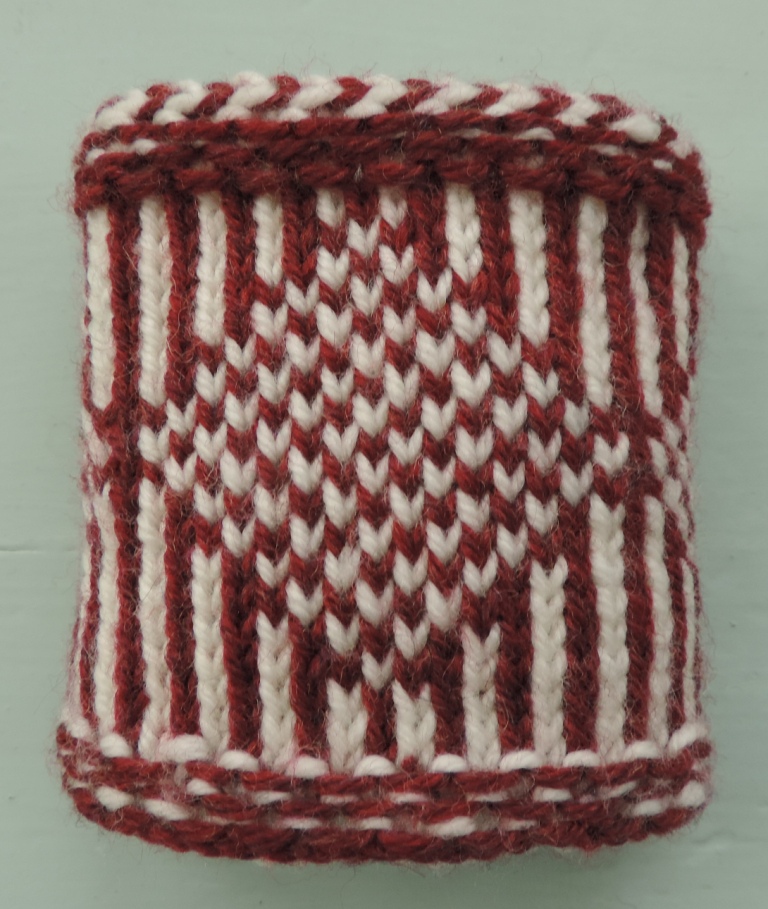
The workshop I went to on Sunday was on Estonian colour work knitting, taught by Rachel Lemon. Here is the sample I knitted (finished off on the train home, so if I got anything wrong at that point, it's because Rachel wasn't on hand to consult).


It was fascinating - very unlike other stranded knitting I have tried, because it has a lot of texture from using purl stitches.  The bands of stranded knitting are separated by braids, too (narrow raised bands of knitting) - I was particularly intrigued by the vikkel braid, which is the band of navy and white arrowheads pointing to the right, towards the bottom.  Difficult to grasp at first, but OK with some help.  Impossible to imagine how anyone could invent it.

My  workshop knitting was sort of intended to be one of a pair of cuffs or wristlets, but it's not good enough for that - it's just a practice piece. (Also, it's very difficult to get my hand through, which is rather a disadvantage for a cuff.)  I do intend to explore Estonian knitting further though. 

Kaffe Fassett is also a patron of the Guild, and although he wasn't available, he did send a lovely stole knitted in Kid Silk Haze, to be raffled.  And on Friday, before the start of the convention proper, Brandon Mably taught a one day workshop on using colour.  I attended it and it was amazing - I've never been very adventurous about putting colours together, and the workshop led me to look at combining colours in a different way.  Brandon showed me that startling colour mixes can sometimes work very well, and may not appear at all startling from a short distance.  And sticking to 'tasteful' and safe colour combinations risks looking just dull.

Here's the swatch I knitted in the workshop:


The first poppy, at the bottom, seems a mix of soft yellows and greens, but in fact one of the yellows, picked by Brandon from my neighbour's collection of wools, is a really bright lime yellow. In the mix with the other colours, though, it perks them up without being overwhelming.  Further up, there's a bright blue among the dark shades that has a similar effect.

Here are the swatches that the workshop participants knitted during the day, still on the needles at the end of the workshop. (Mine is the one at the top left.) It was wonderful to see the beautiful results that everyone produced.


This is an approach to using colours that I really want to explore more - it feels so exciting. Unfortunately, as a side-effect, it did also make me feel like buying lots of different colours of wool, immediately.  So I'm not quite sure yet how to proceed.  Because I don't need more wool.

Saturday, 15 July 2017

Guild Convention in Birmingham

It's been a busy week, so I am only just getting around to writing about the Knitting & Crochet Guild Convention which was in Birmingham last weekend.  The Convention is an annual event, though Birmingham is a new venue.

On view was the Guild's display for this year's shows, on the theme of 'Passing on the Passion'.


It features a few items from the Guild collection, including a Kaffe Fassett 'Foolish Virgins' jacket, a crocheted top from C&A, and a knitted crown.

That's one of the very few photos I took at the Convention - I was too busy knitting most of the time.  (I bought some Rowan Felted Tweed in John Lewis, and started knitting a Heidi Kirrmaier cardigan, but that's another story.)   I also spent some time looking around the centre of Birmingham - it's not a city I know well.  The hotel was in the Chinese Quarter, with the Bull Ring markets nearby.  Around the corner are the National Trust Back-to-backs, which are fascinating.  Several of us who arrived a day early for the Convention went on a tour.

And I spent a lot of time in the Museum and Art Gallery.  It has wonderful collections, including a new display of the Staffordshire Hoard, which is amazing (and very difficult to photograph through the glass cases - I tried).

At the Convention, as well as the Guild's AGM, we had three very good talks.  Betsan Corkhill, of Stitchlinks, talked about the role of knitting in healthcare.  The second talk was by Emma Price of In the Woolshed, which produces natural dyed yarns.  She talked about her career to date, initially alternating between accountancy and spending time in India with people practising traditional crafts, before starting In the Woolshed.  She now also leads textile journeys to India.  And finally, Denise Musk, a life member of the Guild, brought along some of her machine knitted garments in amazingly complex fabrics, and talked about how they developed from her initial ideas.

As well as the talks, there were two workshop sessions led by Guild members, with six topics on offer in each session.  But I skipped one session in favour of the Staffordshire Hoard and Pre-raphaelite paintings, and so only did one workshop.  It was on Moebius Knitting, with Fiona Morris.  Fiona brought along some very inspiring samples, and taught us how to cast on - a surprisingly quick technique.  I didn't get very far past casting on in the workshop, though I did finish one round and I've subsequently done a few more.


It's very satisfying for anyone with a mathematical background that it is a genuine Moebius strip, with one edge and one surface.  But my sample isn't very tidy and I'd like to do more practice and then try one of the very nice cowls that Fiona showed us.

I contributed to the Convention, too.  There was a 'show-and-tell' session on Saturday evening, when members could show something they made during the past year.  I took the summer scarf, started in April, which is now finished - I'll write about that later.  And Maureen and I did a short presentation on 'How to do a Trunk Show'.  I had brought two items that haven't previously featured in trunk shows and talked about them - but those are two more stories for the future.

Wednesday, 11 January 2017

Twined Knitting in Sheringham


Last weekend I went to Sheringham youth hostel for a knitting weekend.  As last year, it was organised by the Leighton Buzzard branch of the Knitting & Crochet Guild.  The weather this year was different, though - damp, misty, quite mild, no wind.  Sea and sky were almost indistinguishable.  But a knitting weekend doesn't need sunshine and we had a very good time.

On the Friday and Saturday evenings, we sat in the lounge and knitted, had excellent dinners provided by the Youth Hostel staff, and did more knitting.  And lots of chatting.

On Saturday morning we went to The Mo, the Sheringham museum, on the sea front.


It is not open to the public in the winter, but we had a special tour behind the scenes.  The museum has recently been extended, thanks to a lottery grant, and we were shown how the new storage areas are being used.  We saw some wonderful ganseys, too - some modern ones that we could handle, and others from the museum's collection.  One particularly fine gansey dates from the 1950s - the knitting is meticulously neat, with 14 stitches to the inch, I was told.  (Didn't manage to get a decent photo, I'm afraid.)

 In the afternoon, we had workshops back at the Youth Hostel.  I repeated the twined knitting workshop that I did for the Huddersfield branch of the Guild in December.  (And never got around to writing about - Christmas got in the way.)   I had designed a wristlet to knit in two colours of DK.  (There was also a flat piece, that you could think of as a coaster, for those people who couldn't manage knitting in the round.)  


I didn't know anything at all about twined knitting before I found that I had somehow volunteered to lead a workshop for the Huddersfield branch.  It was originally scheduled for April 2016, but postponed due to my argument with a ladder.  So I've been practising twined knitting for quite a while.  Looking back, I see that when I knitted a cuff or wristlet in twined knitting in March last year,  I said here that I didn't want to knit a second one.  But since then, I've got more enthusiastic, and I decided that over the weekend I would knit something a bit bigger, just for me.  Over the weekend (including the long train journeys there and back)  I worked on a pair of fingerless mitts.  Not in two colours this time, but using the two ends of one ball of yarn.  I love the effect of two-end knitting and the surface patterns you can make.  The mitts are going to be very warm and cosy.  More when I have finished them.


Thank you very much, Brigitte, for organising another really enjoyable weekend.


Monday, 11 January 2016

Knitting in Sheringham

I have just been to Sheringham, on the north Norfolk coast, for a knitting weekend.  It was mainly for the Leighton Buzzard branch of the Knitting & Crochet Guild, but was open to other Guild members too.  There were 26 of us altogether, and we took over Sheringham Youth Hostel.  There were some talks and workshops, and in between we did a lot of talking and a lot of knitting.  The hostel staff provided breakfast and dinner, and it was a really good weekend - thanks very much to Brigitte for organising it.  

The theme of Saturday morning was knitting in World War 1, with talks from Rita Taylor and from Lesley Lougher of Sheringham Museum.  Lesley talked about an exhibition this summer on Queen Mary's Needlework Guild, and the activities of local women during the war.

In the afternoon, there was a programme of workshops.  Back in 2011, I did a workshop with Mary Graham on knitting with wire, and she led another in Sheringham, so it was a good opportunity to have another go.  She provided wire, needles and beads, and I knew from my previous attempt that in a couple of hours it is possible to knit something interesting. Here's what I produced in Sheringham:


Being wire you can change its shape quite a lot, so I bent it into a flatter, swirly shape and wore it as brooch for the rest of the day.  I was very pleased with my effort, though it's very crude compared to the pieces that Mary knits.  She knits things that resemble seed pods and other organic shapes, and are clearly intended to look like that, rather than happening entirely accidentally like mine - her knitting is much more even than I can achieve in wire, too.  But I'm happy with my strange little 3-d shape.

In the second workshop session of the afternoon, I repeated the workshop on slip-stitch patterns that I did at the Knitaway weekend in Blackpool last October.  It was good to see people successfully knitting very neat samples of linen stitch - or in one case a blanket square in 3-in-1 stitch, in 2 colours.

The Youth Hostel in Sheringham is only about half a mile from the sea, and we had three days of no rain - even some sun on Sunday morning.  (I think the first time I've experienced two days in succession without rain since November.)  So I walked through the town to the shore a couple of times.


Sheringham is a nice little town - "twixt sea and pine" apparently, though I didn't spot any pine trees.  It's now at the end of the railway line from Norwich, but before the Beeching cuts, the line continued and the station was the other side of the main street, beyond a level crossing.


It must have been highly inconvenient to have the traffic held up whenever there was a train, and so when the line was terminated at Sheringham, the station was moved.  But the old station is still there, and is now the start of a heritage line to Holt.

Much more attractive than the new station, which has no buildings at all - just a sort of bus shelter.  There aren't even any seats, just sloping ledges to rest on.   (I'm not feeling very warm towards the operators of the Sheringham-Norwich line, because the train I should have got on my way home was cancelled, and the next one was late, so I was very late getting home.)

You can walk miles along the coast from Sheringham, in either direction, but I didn't have time for a long walk. But you should at least see the sea when you are at the seaside.


I started knitting a small scarf last week, to have something portable and straightforward to work on during the weekend, and I finished it on Saturday.  I've wet-blocked it - I'll write about it when it's dry.

Wednesday, 18 November 2015

Bunting

It's the Knitting and Stitching Show in Harrogate at the end of this month, and the Knitting & Crochet Guild will have a stall there, as usual.  Julia, who has designed the Guild's stall, asked for some bunting in her colour scheme of pink, green and cream/white.  So I got some cheap acrylic yarn (really cheap - 3 balls for £2 in Poundland, plus an extra ball for £1) and set to work.


I made the triangles in crochet - not my thing usually, but I could cover the ground more quickly than if I knitted them.  I did quite a few triangles when  we were in Suffolk ten days ago (it got dark early, so there was quite a bit of crocheting time).  And last Thursday, being the 2nd Thursday in the month, was the day when I go to three knitting groups in one day - lots of triangles then.   Now I've used up the yarn and made 34 triangles (two wouldn't fit into the arrangement above).   They will be made up into bunting, with more triangles made of printed fabric with crochet medallions on some of them - I saw then all laid out in order yesterday and they looked very pretty.

So if you're going to the Harrogate Show, stop by the Guild stall and say hello - and please admire the bunting!


Monday, 6 July 2015

Sociable Knitting

I have just been away at the Knitting & Crochet Guild annual convention, held this year in Sheffield.  We were staying at Endcliffe village, in University of Sheffield student accommodation.  It was very quiet (most of the students had gone), and the grounds are very green, with mature trees around the modern buildings.


It was a very good weekend - interesting talks and workshops, catching up with people met at previous conventions, seeing new faces.  Seeing some of the beautiful things that have been made in the past year.  Talking (a lot).  Knitting (a lot).

I went to two workshops over the weekend, one by Louise Walker of Sincerely Louise,who also gave a talk on Faux Taxidermy the subject of her forthcoming book. If you want to knit a tiger-skin rug, or a knitted triceratops head on your wall, Louise is your woman.  Her workshop was on Photographing your Knits - lots of useful information about the importance of lighting, and making best use of the facilities of your camera.  As a result, I've discovered several options on my camera that I didn't know were there, and I an definitely going to buy a proper photographic background.  Hopefully, future images in this blog will be better as a result.

The other workshop, by Judy Jones, was Knitting & Crochet for More than Two Hands, aka Sociable Knitting (or Sociable Crochet).  We worked in groups of four, each group working on a square blanket, either crocheted or knitted.  Judy had brought along two part-knitted blankets, one of which had been worked sociably several times before.  The other, which I was working on, started off as just a plain square, about 12 inches on each side, that Judy had made for us.   Each knitter has their own ball of yarn, and two knitters opposite each other do two increases at each corner, while the other two just knit. So when everyone has knitted one round, four rounds have been knitted altogether, and there are 16 more stitches on the needles.


Our little square was quite tricky to work on at first - we  were working very close together and there wasn't a lot of room for four pairs of hands. but by the end of the workshop, it was quite a bit bigger and easier to work.  


 It's a very sociable activity, and very satisfying because, of course, the square grows four times as fast as if you were working on your own.


The sociable crochet piece looked equally interesting - a sort of giant granny square.

.
 It would be a great activity for Knit in Public Day - other Guild members were fascinated to see what we were doing, so it would attract a lot of attention.

Wednesday, 30 July 2014

WIPaholics Anonymous

Still catching up with the week before last....

On the 17th, after we got back from Blackpool, I went to the Huddersfield branch meeting of the Knitting & Crochet Guild.  The theme this month was unfinished projects - we all brought along an unfinished project that for some reason we were having trouble finishing, and talked about it.  Hence, the title of the meeting, WIPaholics Anonymous  (WIP = Work In Progress).  Marie, the convener, acted as a kind of Alcoholics Anonymous facilitator, and had even compiled a 12-step plan for us to work towards completing, or otherwise dealing with, our problem projects.  The stories of the unfinished projects were often very funny, and occasionally sad.

So what was my unfinished project?  It featured in this blog in 2011 here, and it had already been unfinished for more than 25 years (!) at that point.


I had kept it for all that time - the piece I had already knitted, and the rest of the yarn.  When I wrote the previous post, I couldn't find the pattern, and thought that I had lost it, but I've since looked harder and found it.   So in theory, it could be completed.

Patricia Roberts' Dolly Blue design
But the previous blog post was right in explaining why I didn't go any further with it all those years ago - the back turned out far too small, and there's also a problem with the cables:  when the white and yellow cables diverge from each other, they pull a hole in the background fabric, and I can't see how to avoid that.

I have had this project hanging around for a serious chunk of time, but I think it had just become one of the fixtures in my life - I rarely thought about it, and never thought about it hard enough.  But it was an obvious project to take to the meeting (and would have won the prize for the oldest WIP, if there had been one).  And in listening to other people talking about their unfinished projects, I got to thinking properly about mine.

The photo doesn't show the design very clearly because of the jacket over the top (it's a sweater with a collar and a buttoned front opening).  I can see why it appealed to me at the time, and I still like it.  I love the colours that I chose, too, though I don't wear black as much as I used to.  I showed everyone the pattern, and what I have knitted so far, and there were lots of helpful suggestions for completing it, and general encouragement to do that.

However.  If I wanted to finish the sweater, I would have to start again, and rip out what I have done so far, and I hate doing that.  I'd have to figure out why it turned out so small the first time, and fix that - maybe adjust the pattern.  And there would still be the problem with the cables dragging holes in the fabric.  And most of all, I now realise that it just feels totally stale.  I don't even want to use the yarn for anything else - it would just remind me all the time that it should have been this sweater.

So I am abandoning it.  I left what I've knitted so far with someone else at the meeting who wants to try felting it, and I'm going to give the rest of the yarn away.  And I think I feel better for having made that decision.  For me, it was a very helpful evening.

Of course, I've got a few other unfinished projects too.....

Tuesday, 15 July 2014

Shetland Lace Workshop

Tari in progress
On Saturday afternoon, at the Knitting & Crochet Guild convention in Derby, I did a Shetland lace workshop led by Sarah Alderson of Wessenden Woollies.  We started knitting a shawl that she has designed, Tari.  I had brought a skein of laceweight yarn for the workshop, but after struggling with it for a while, decided that it was too fine for me - I found it hard to knit with and kept making mistakes.  So mid-workshop, I dashed off to the stash-busting table where Guild members had put surplus yarn to sell, and bought a cone of wool in a lovely emerald green (£2).  It's not a colour I would normally choose, probably, but I'm glad I was pushed into it (it was the only laceweight I could find on the table).  I don't know anything about the yarn except that it's wool and fine enough to knit the shawl pattern with 3mm needles, but not too fine for me to knit. 

I had barely got started with the green yarn by the end of the workshop, but I have now finished two pattern repeats - enough to show the lace patterns emerging.  This is one end of the final shawl - the garter stitch section on the right gets wider, and then narrower again.  I think it's going to turn out very well.  

It will need blocking (when it's all finished) to show the lace design properly - here's a section of Sarah's own shawl to show what the lace looks like when it's blocked. 


There were four other workshops running at the same time as ours - an Irish crochet workshop led by Sally Magill was in the same (big) room as ours, so I saw what they were making too.  They had produced some very nice motifs in two hours - shamrocks, roses, scrolls.      


Marie's blue shamrock
Rose and scroll
Sally's sampler of Irish crochet motifs 
The other three workshops seem to have been equally successful - all led by Guild members.  

Sunday, 24 November 2013

Harrogate Knitting & Stitching Show

I was at the Knitting & Stitching Show in Harrogate on Friday, working on the Knitting & Crochet Guild stall most of the time.  Our display included some items from the collection - 1950s matinee jackets, beautiful children's Fair Isle sweaters from the 1940s and 1950s - and some new pieces inspired by vintage patterns.  We also had things for sale, including shawl pins made from old knitting needles, which sold very well.   For a short while before the show opened at 10 a.m., the stall was empty and we could sit and knit.  But for most of the day, we were really busy talking to visitors to the stall.   That's a good thing, of course - the point of having a stall at the show is to meet knitters and crocheters and tell them about the Guild.  

The Guild stall before the show opened...
 
... and afterwards

We took it in turns to have a break from the stall and look at the rest of the show.  I didn't spend long on that - there's too much risk of spending a lot of money.  But I did visit a stall selling nothing but Latvian mitten kits, and bought one  - I think everyone else from the Guild stall did the same thing.  The stall had a display of the finished mittens, very colourful and eye-catching, and the kits were selling fast. 

Latvian mittens
      
A few of the other stalls caught my attention too.  I called in at the Baa Ram Ewe stall to say hello to Verity and Jo  - they had a very attractive Christmas display on their stall with a fireplace, Christmas cards, etc. 

Baa Ram Ewe's display

And I looked at the UK Hand Knitting Association's stall, where the finalists' entries for the 2013 Textile Awards were on show.  Some very striking things - one I really loved was the Kagome cardigan by Emma Vining, who was a finalist in the Open category.      
   
Emma Vining's Kagome cardigan
Altogether, it was a very good day.

Thursday, 3 October 2013

Vogue Knitting visit

There is a knitting tour of England & Wales in progress right now, under the auspices of Vogue Knitting magazine,  that started Tuesday morning at Manchester Airport.  (The people on the tour are all from the U.S., I think.)  Tuesday afternoon, the tour visited  Scholes to see a selection of the choicest items from the Knitting & Crochet Guild's collection.  We hired the clubhouse at Scholes Cricket Club for the day, which proved to be an ideal venue.  It is mainly one big room, with windows all along one side, looking over the cricket  pitch and to the hills beyond, so there was plenty of space and light. 


We went one weekend a few weeks ago to check on  a few details, and I took a photo of the view while a cricket match was in progress - it was drizzling at the time, so the view wasn't at its best.  (Not ideal weather for cricket either.)      


There were about 40 in the Vogue Knitting party, and we wanted to give them all the chance to get close to the things we were showing them.  We had chosen five sets of items (Irish crochet,  traditional knitting,  etc.) , with one or two volunteers for each set (I was showing a selection of magazines and pattern leaflets).  We divided the visitors into five groups, too, and over the course of the afternoon, each group progressed around all five sets of items.   The scheme worked very well, though it did mean that we volunteers were talking about our set of items five times, over about two hours.  But I found that each repetition worked out differently, because each group picked up on different things in what I was showing, and asked different questions.   I'll write something about the things that I showed  in the next few posts.

And at the end of the afternoon, we all had tea (very important in cricket, I understand).   I had bought cakes from ProperMaid in Huddersfield who supply a lot of local cafes.  We had Beetroot & Chocolate, Courgette & Lime and Lemon & Poppyseed Drizzle - all really delicious I'm told, and the Beetroot & Chocolate certainly was.  (There was a lot of discussion with the visitors about what courgettes are, though.)  I had also bought parkin, made by a local company, to give them a taste of traditional Yorkshire food.

ProperMaid Courgette & Lime cake

It was an exhilarating afternoon for all of us.  For those of us from the Guild, it reminded us what an amazing collection we have, and the visitors saw some really wonderful things.  Exhausting though - it took a lot of organising and preparation on our side, and several people had come a long way to help. 

And after we had cleared everything up and put the furniture back approximately where it was before, I got home at about 6.45 and then went out for a meeting of the Huddersfield KCG local group.  The meeting was on the theme of lace,  and several people had brought along beautiful lace shawls and scarves that they had made, including a silk stole knitted in the Shetland print o' the wave pattern, which was just lovely.  Ann Kingstone showed the sample knits for some of her lace patterns (knitted by her sister Marie, who was also there), including Hartfield - even finer and more delicate and gorgeous in reality than it looks in photos.  Three of the Guild members who were staying in the area to help with the Vogue Knitting visit came along to the meeting.  Jane, who had been showing some of the Irish crochet in the collection, had brought with her an Irish crochet shawl that she had made, and so was able to show that at the Guild meeting as well - a beautiful piece of work.  I took along one of the knitted lace samplers from the collection, in amazingly fine cotton.  And also (although it wasn't really up to the standard of anything else on show) I took along the honeycomb lace infinity scarf I have made for my daughter - mainly so that I could talk about how tricky it was to keep track of the stitch pattern. 

And then I went home and fell into bed.  I wish I could say that I slept like a log, but I didn't - it was such an exciting, busy day, it was difficult to wind down.  I am so glad that after all our preparation and planning (and several hiccups along the way, up until the last minute)  it all worked out just right.       
  

Saturday, 27 July 2013

Talking about Arans, Again

At the Knitting & Crochet Guild Convention in Derby,  I gave a repeat of the talk I gave to the Huddersfield local group, as described here, but with added PowerPoint. The theme was how Aran sweaters first became known to hand knitters in the U.K., and became very popular  from the 1960s on.

I took three sweaters from the Guild collection as props for the talk, as well as a couple of things of my own. I've written about my own vintage Arans before:  one is the Susan Duckworth sweater that I knitted in 1974 and still wear, and the other is  the Aran bobble hat that my mother knitted for my sister in the late 1960s. 

The first Aran sweater that I took from the collection is a replica of one that was bought in Dublin in 1936 by Heinz Kiewe, and illustrated in Mary Thomas's Book of Knitting Patterns, published in 1943.  

Replica of the 1936 Aran sweater in Mary Thomas's Book of Knitting Patterns

I don't know of any other Aran sweater that was written about in this country before 1943, so the original would be a historic garment, if it still existed.  But it seems that it doesn't.   Mary Thomas gave instructions for the stitch patterns in her book, but no details of the overall construction.  In 1987, Richard Rutt devised a complete knitting pattern from the printed photograph in the book, and it was published in the Guild's magazine, Slipknot.  We have two sweaters knitted from his instructions in the Guild collection, and it was one of those that I took to Derby. 

The second sweater is one of the gems of the collection.  It is beautifully knitted, in a fine yarn - it appears to be 3-ply (light fingering).  

A 1950s Aran sweater in fine yarn

 I think that it dates from the 1950s - the neck is very close fitting, with buttons at one side, and that is typical of the 1950s.  The stitch patterns are not unusual, but all the details have been so carefully worked out - for instance, the welts and neckband have little cables in them, which merge neatly with the cables in the body and sleeves.  

Detail - welt and body stitch patterns
    
And my favourite detail is that the central horseshoe cable in each sleeve is continued as a narrow shoulder strap and then merges into one of the cables in the neckband.   It is all just perfect - in design and in execution.  It's wonderful.

Detail - neckband
The third sweater I took from the collection is not, strictly speaking, an Aran. It is the Wheatsheaf sweater, knitted from a free pattern in the Sunday Times Magazine in 1984.  It looks like an Aran at first glance, partly because it is knitted in the thick cream wool we associate with Arans, but actually it is quite different.  

Wheatsheaf Sweater

Although the Wheatsheaf sweater has cables and bobbles, the central panel is nothing like a typical Aran sweater - in fact, much of it is not even knitted, but embroidered.  The ears of wheat, for instance, are in blanket stitch - and in the Guild's example have been beautifully done to give a very 3-dimensional effect.  

Like the Susan Duckworth Aran, the Wheatsheaf sweater demonstrates that by the 1970s,  Arans had become so well-known and mainstream that just a few basic elements (thick wool in natural cream, cables, maybe bobbles)  would indicate "Aran", and designers could then deviate from the typical Aran sweater and produce something completely novel. 

And having done all the research for my talks, and closely examined the Aran sweaters I took to Derby, I'm beginning to feel that I want to knit another.   I've bought myself  Alice Starmore's  Aran Knitting (purely for research purposes)  and it is full of enticing patterns......  

Related Posts Plugin for WordPress, Blogger...