 |
| Portland Latte |
Monday, 25 February 2013
Jetlag
I have been in Portland (Oregon) for a week, visiting my daughter. Just got back today, though it still feels like yesterday, because it was an overnight flight and I've missed a night's sleep. I had some good coffee and good food in Portland, bought some very nice yarn, did lots of other things. More later when I have caught up with myself.

Saturday, 16 February 2013
Wedding Dresses to Crochet
In the collection of knitted and crocheted items at Lee Mills, there are three or four wedding dresses. One of the Huddersfield students who has been working with us is doing a project on the wedding dresses, and I have been looking out for patterns for her in the publications collection. I have found only two pattern leaflets for wedding dresses so far. Perhaps that's not too surprising - if you were going to the effort of making a wedding dress, you would surely want it to be unique, rather than choosing a mass-produced pattern.
The Emu pattern dates from the early 1970s, I think. The Patons pattern is dated 1981, and was issued just before the wedding of Charles and Diana. (Hopefully, if anyone made a wedding dress from the pattern, their marriage turned out better than that one.)
(Click on an image to get a larger view.)
 |
| Emu 2914 |
 |
| Patons 1856 |
Thursday, 14 February 2013
A Quick Knit in Stocking Stitch
I decided a while ago that it's OK to have more than one project on the needles at the same time, as long as they are all progressing and not stalled. And I need to have some knitting that I can do at the same time as reading or watching TV, otherwise I feel that I am wasting valuable knitting time. My Color Affection shawl was meant to be TV knitting, because it's all garter stitch, but actually I have to watch it all the time. I have been knitting it since last November, and it is growing - just not very fast. It's become the project that I take to knit-and-natter groups, so I keep doing a couple of hours work on it regularly, and it will get finished some time, don't know when.
While Color Affection has been growing imperceptibly, I needed some TV knitting, and I wanted something fast. So I have been knitting a plain stocking stitch jumper for myself. I started it in January and have just finished it.

It was based on a Marriner pattern from the early 1960s, although the relationship is more distant than I intended. It was the collar I liked, mainly: jumpers with turn-down collars were very popular at that time, and this seemed a nice example. I like how the collar has turned out, but it isn't really very similar to the illustration. In practice, I could not see how to get the two front edges of the collar overlapping as shown. And actually, I don't see how it could work, now that I think about it: the two sides of the collar have to overlap about an inch above the button, but there is nothing to hold them together there.
I had to adapt the pattern anyway - the original was written for 4-ply (fingering weight) yarn, and I wanted to use double knitting (Wendy Merino DK). So my jumper is based on a basic DK raglan-sleeved jumper pattern, modified to have three-quarter sleeves with turn-back cuffs. But I followed the original Marriner instructions in knitting the collar and the front bands, suitably adapted for the thicker yarn. The back of the collar is deeper than the fronts - the extra depth is created with short rows. I'm intrigued by the possibilities of short rows, and wanted to see how it worked here. And the collar works very well - it sits nicely, even if nothing like the original.

I must confess that the button is a cheat. I did make a buttonhole, but then realised that (a) it was in the wrong place and (b) I wouldn't know what the right place was until I had finished the collar. And that the neck opening was big enough to go over my head anyway. So I just sewed the button through both layers of the button band.
Now that the jumper is finished, I have chosen my next TV knitting project. I can cope with more complicated stitch patterns than stocking stitch without looking at what I'm doing, and it's going to be a wide rib with twisted stocking stitch - more details later.
Meanwhile, I have started the Baht 'At fingerless mitts from Born and Bred. I have had the pattern and the yarn (Titus from Baa Ram Ewe) for weeks, but have been restraining myself from starting it until I finished the Marriner jumper. I am using the wool holder I bought on eBay, and that's proving useful to keep the yarn tidy and in place.

I went to my regular Thursday knit-and-natter this morning, and knitted 2 stripes (4 rows) of the Color Affection shawl. I counted the number of stripes I still need to do, before I get to the final border: 29. It was possibly a mistake to count them - it's a bit daunting. Still, I should finish it this year if I keep at it.
While Color Affection has been growing imperceptibly, I needed some TV knitting, and I wanted something fast. So I have been knitting a plain stocking stitch jumper for myself. I started it in January and have just finished it.

It was based on a Marriner pattern from the early 1960s, although the relationship is more distant than I intended. It was the collar I liked, mainly: jumpers with turn-down collars were very popular at that time, and this seemed a nice example. I like how the collar has turned out, but it isn't really very similar to the illustration. In practice, I could not see how to get the two front edges of the collar overlapping as shown. And actually, I don't see how it could work, now that I think about it: the two sides of the collar have to overlap about an inch above the button, but there is nothing to hold them together there.
 |
| Marriner 559 |
I had to adapt the pattern anyway - the original was written for 4-ply (fingering weight) yarn, and I wanted to use double knitting (Wendy Merino DK). So my jumper is based on a basic DK raglan-sleeved jumper pattern, modified to have three-quarter sleeves with turn-back cuffs. But I followed the original Marriner instructions in knitting the collar and the front bands, suitably adapted for the thicker yarn. The back of the collar is deeper than the fronts - the extra depth is created with short rows. I'm intrigued by the possibilities of short rows, and wanted to see how it worked here. And the collar works very well - it sits nicely, even if nothing like the original.

I must confess that the button is a cheat. I did make a buttonhole, but then realised that (a) it was in the wrong place and (b) I wouldn't know what the right place was until I had finished the collar. And that the neck opening was big enough to go over my head anyway. So I just sewed the button through both layers of the button band.
Now that the jumper is finished, I have chosen my next TV knitting project. I can cope with more complicated stitch patterns than stocking stitch without looking at what I'm doing, and it's going to be a wide rib with twisted stocking stitch - more details later.
Meanwhile, I have started the Baht 'At fingerless mitts from Born and Bred. I have had the pattern and the yarn (Titus from Baa Ram Ewe) for weeks, but have been restraining myself from starting it until I finished the Marriner jumper. I am using the wool holder I bought on eBay, and that's proving useful to keep the yarn tidy and in place.

I went to my regular Thursday knit-and-natter this morning, and knitted 2 stripes (4 rows) of the Color Affection shawl. I counted the number of stripes I still need to do, before I get to the final border: 29. It was possibly a mistake to count them - it's a bit daunting. Still, I should finish it this year if I keep at it.
Friday, 8 February 2013
Summer Gloves
Once upon a time, ladies always wore hats and gloves when they went out. So you wore gloves not just to keep your hands warm in the winter, but in summer too. The rule persisted into the 1960s: my secondary school in the early 1960s had white gloves for summer (optional) on its school uniform list, although I don't recall anyone wearing them to go to school in.
The need for summer gloves was a great opportunity for cotton spinners - including Twilley's, who started out making cotton yarns for knitting & crochet, though they later diversified into other types of yarn. The company started issuing pattern leaflets just after World War II, I think (judging by the style), and the first batch of leaflets includes several glove patterns.
The early patterns look fairly utilitarian - one leaflet shows a woman's gloved hands holding a dog lead, and a man's hands on the steering wheel of a car (and holding a cigarette at the same time). But leaflet 109 has a pair with an overall lacy pattern and an alternative gauntlet cuff, and they are altogether fancier.
The black lace pair in leaflet 265 are obviously just for posing elegantly in, and nothing more strenuous than that.
Apart from the gloves, you could make a whole range of clothes and accessories from this batch of leaflets. There are several patterns for handbags (often with matching gloves, of course). The week-end bag in leaflet 194 is especially smart. It looks like something that Celia Johnson might have used in Brief Encounter - the film was made in 1945, so is roughly the same date as the leaflet. (But why does she have two umbrellas through the straps of her bag? One for a friend?)
(By kind permission of Thomas B Ramsden & Co., members of the Knitting & Crochet Guild can obtain a copy of any of the vintage Twilley's patterns in the Guild collection, for their own personal use. Email collections at kcguild.org.uk for more details.)
The need for summer gloves was a great opportunity for cotton spinners - including Twilley's, who started out making cotton yarns for knitting & crochet, though they later diversified into other types of yarn. The company started issuing pattern leaflets just after World War II, I think (judging by the style), and the first batch of leaflets includes several glove patterns.
 |
| Twilley's 109 |
 | |
| Twilleys 265 |
 |
| Twilleys 194 |
(By kind permission of Thomas B Ramsden & Co., members of the Knitting & Crochet Guild can obtain a copy of any of the vintage Twilley's patterns in the Guild collection, for their own personal use. Email collections at kcguild.org.uk for more details.)
Sunday, 27 January 2013
Wool holders
In the Knitting & Crochet Guild's collections at Lee Mills, there is a variety of tools and gadgets, as well as the knitted and crocheted items, and the publications. There are of course knitting needles and crochet hooks, but also needle gauges and many other things (including some whose use we don't know).
I have been admiring two of the plastic woolholders. One is a Beehive woolholder - judging by eBay, these were made in large numbers and are still quite common.
The beehive was the symbol of Patons & Baldwins (and originally the trademark of Baldwins, before the two companies merged). The link is acknowledged by a message inside the base of the woolholder: "The design of this Beehive woolholder has been approved by Patons & Baldwins, makers of Beehive wools, and is marketed with their consent." Also inside the base are two registered design numbers, 856057 and 856077, which show that the design was registered in 1948. (That doesn't of course mean that they were all made then.)
A beehive is a good shape for a woolholder - it feels good, too. There is plastic strap to hang it by, and the other hole in the top is for the wool to emerge through. The base is removable (and has a handy needle gauge in it, too).

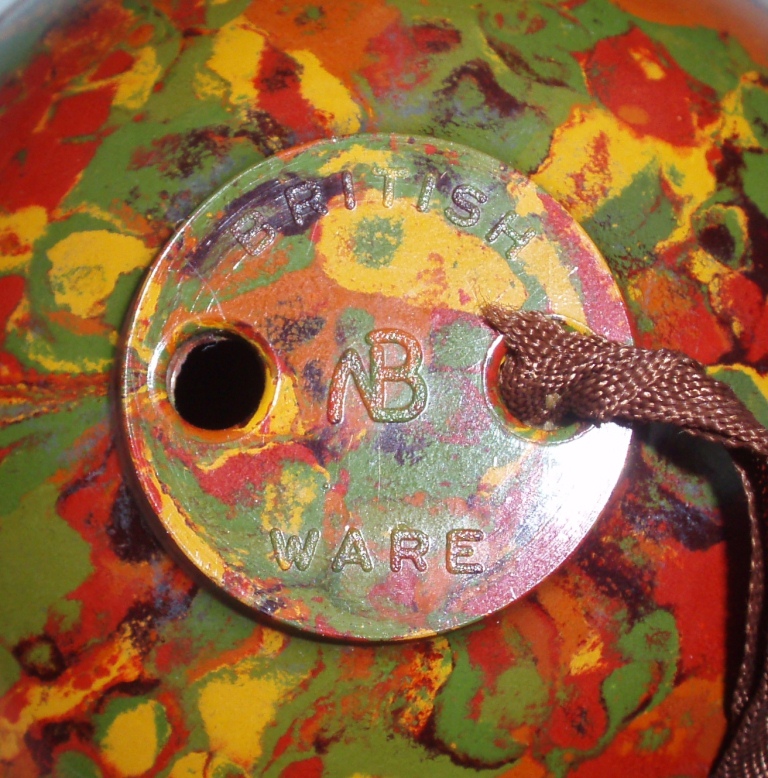
The other woolholder is also some sort of plastic, probably older, possibly bakelite. It has one hole in the top and two in the bottom, so I'm not quite sure how it was intended to be used. The strap may have been replaced - it is a length of tape, with a button on either end to stop it slipping through the hole, so it looks a bit home-made.
If the strap is in the original location, the wool emerges from a hole in the base, if the base is the end that says "British Ware" and gives the N.B. monogram of the manufacturer (the same as the beehive woolholder). It doesn't seem as successful a design as the beehive - you really have to hang it on your wrist or belt, whereas the beehive could stand on a table if you wanted.

Looking at these woolholders inspired me to want to try one, so I have bought one on eBay. It is probably much later than the two from Lee Mills, and is made of a softer plastic. But functionally it is very similar to the beehive - it has a plastic strap at the top, and a hole at the top for the wool to emerge. As soon as a suitable opportunity arises, I'll try it out and report on how well it works.

I have been admiring two of the plastic woolholders. One is a Beehive woolholder - judging by eBay, these were made in large numbers and are still quite common.
 |
| Beehive woolholder |
The beehive was the symbol of Patons & Baldwins (and originally the trademark of Baldwins, before the two companies merged). The link is acknowledged by a message inside the base of the woolholder: "The design of this Beehive woolholder has been approved by Patons & Baldwins, makers of Beehive wools, and is marketed with their consent." Also inside the base are two registered design numbers, 856057 and 856077, which show that the design was registered in 1948. (That doesn't of course mean that they were all made then.)
A beehive is a good shape for a woolholder - it feels good, too. There is plastic strap to hang it by, and the other hole in the top is for the wool to emerge through. The base is removable (and has a handy needle gauge in it, too).

The other woolholder is also some sort of plastic, probably older, possibly bakelite. It has one hole in the top and two in the bottom, so I'm not quite sure how it was intended to be used. The strap may have been replaced - it is a length of tape, with a button on either end to stop it slipping through the hole, so it looks a bit home-made.
 |
| Mottled plastic spherical woolholder |
If the strap is in the original location, the wool emerges from a hole in the base, if the base is the end that says "British Ware" and gives the N.B. monogram of the manufacturer (the same as the beehive woolholder). It doesn't seem as successful a design as the beehive - you really have to hang it on your wrist or belt, whereas the beehive could stand on a table if you wanted.
Looking at these woolholders inspired me to want to try one, so I have bought one on eBay. It is probably much later than the two from Lee Mills, and is made of a softer plastic. But functionally it is very similar to the beehive - it has a plastic strap at the top, and a hole at the top for the wool to emerge. As soon as a suitable opportunity arises, I'll try it out and report on how well it works.

Saturday, 19 January 2013
Tuppence Coloured
I wrote a couple of weeks ago about sorting all the Robin leaflets in the Lee Mills collection. Some of them are worth sharing, especially the earliest leaflets, which are very charming.
They date from the late 1930s or early 1940s, I think - the earliest ones that we have are children's, and I can't date them very precisely. The cover illustrations are black-and-white photos that at some stage in the process were hand-coloured. This was common for pattern leaflets through to the 1950s (when colour photography took over), sometimes with rather nasty results. But these are very attractive - just the knitted garment is coloured, as well as some of the lettering and the Robin logo, leaving the rest in black-and-white.
We have two patterns for little girls' dresses, called Mary and Margaret. Both are knitted in Robin Perle, which was artificial silk (rayon), with angora trim. (It is all just very very charming.) The Mary dress has a quite complicated construction - it is knitted from the top down, with godets, or triangular inserts, to create fullness in the skirt. (The dress is coloured a very pale blue, which doesn't show up well.) The godets are in stocking stitch, outlined in eyelets from the yarn-over increases, and are separated by strips of reverse stocking stitch. The alternating stocking stitch and reverse stocking stitch give the pleated effect, like a very wide rib. In the Margaret dress, the skirt and sleeves are knitted in a lacy stitch, and the yoke is alternating stripes of art. silk and angora, with buttons down the front. Both dresses are very short and so have a pair of matching "trunk knickers".
Tuppence coloured? The leaflets indeed cost tuppence (2d, in old money) - the price is inside, rather than on the cover, where it usually is. But I don't suppose that there was a "penny plain" black-and-white version.
We have several copies of the Mary and Margaret leaflets and, astonishingly, all the copies are different colours. I can't imagine how this was an economic way of producing the leaflets. At what stage was the colouring done? Did they produce the patterns in very small batches? No idea. But they are really pretty.


They date from the late 1930s or early 1940s, I think - the earliest ones that we have are children's, and I can't date them very precisely. The cover illustrations are black-and-white photos that at some stage in the process were hand-coloured. This was common for pattern leaflets through to the 1950s (when colour photography took over), sometimes with rather nasty results. But these are very attractive - just the knitted garment is coloured, as well as some of the lettering and the Robin logo, leaving the rest in black-and-white.
 | |
| Robin 171 |
We have two patterns for little girls' dresses, called Mary and Margaret. Both are knitted in Robin Perle, which was artificial silk (rayon), with angora trim. (It is all just very very charming.) The Mary dress has a quite complicated construction - it is knitted from the top down, with godets, or triangular inserts, to create fullness in the skirt. (The dress is coloured a very pale blue, which doesn't show up well.) The godets are in stocking stitch, outlined in eyelets from the yarn-over increases, and are separated by strips of reverse stocking stitch. The alternating stocking stitch and reverse stocking stitch give the pleated effect, like a very wide rib. In the Margaret dress, the skirt and sleeves are knitted in a lacy stitch, and the yoke is alternating stripes of art. silk and angora, with buttons down the front. Both dresses are very short and so have a pair of matching "trunk knickers".
 | ||
| Robin 74 - Mary |
 |
| Robin 77 - Margaret |
Tuppence coloured? The leaflets indeed cost tuppence (2d, in old money) - the price is inside, rather than on the cover, where it usually is. But I don't suppose that there was a "penny plain" black-and-white version.
We have several copies of the Mary and Margaret leaflets and, astonishingly, all the copies are different colours. I can't imagine how this was an economic way of producing the leaflets. At what stage was the colouring done? Did they produce the patterns in very small batches? No idea. But they are really pretty.


Wednesday, 16 January 2013
Not-Quite-A-Mystery Hat
For those who haven't heard of her, Woolly Wormhead is a well-known designer of knitted and crocheted hats. In November, she ran a Mystery Hat Knit-Along; she introduced a new hat pattern in three stages, starting with the brim. The idea was that no-one knitting it would know what the finished hat was going to look like until the last part of the pattern was released. I didn't hear about the Knit-Along until two parts of the pattern had already been released, when I saw the hat being knitted at Tuesday Knit Night. It looked intriguing, and I joined in at that point. I finished the hat a while ago, and have been wearing it in the cold weather that we are having at the moment.
So, no more mystery - this is what my finished hat looks like:

The construction is really clever. You start by knitting a long stocking stitch tube to make the brim, and then join it together to make a circle. If you've got the row tension right (which I did), you then need to pick up one stitch for the body of the hat for every row of the brim. So you're picking up each strand of yarn in turn between two columns of stitches in the brim - that's very straightforward, and makes a very neat join.

The body of the hat is reverse stocking stitch with little circles made of cables all over. The cables give it a nice texture. Then on the crown, you decrease the stitches very rapidly, so that the top of the hat is gathered in to the central point.

And finally, you sew a button on to the brim, to hold down the tab where the ends of the brim overlap. I found a nice button at the Harrogate Knitting & Stitching Show.

Now that it is no longer a mystery hat, the pattern is called Encircle - you'll find it on Ravelry or here.

(By the way, the hat is not magically levitating - I put it onto a souffle dish, and then perched that on a jar. The combination made quite a good hatstand.)
So, no more mystery - this is what my finished hat looks like:

The construction is really clever. You start by knitting a long stocking stitch tube to make the brim, and then join it together to make a circle. If you've got the row tension right (which I did), you then need to pick up one stitch for the body of the hat for every row of the brim. So you're picking up each strand of yarn in turn between two columns of stitches in the brim - that's very straightforward, and makes a very neat join.

The body of the hat is reverse stocking stitch with little circles made of cables all over. The cables give it a nice texture. Then on the crown, you decrease the stitches very rapidly, so that the top of the hat is gathered in to the central point.

And finally, you sew a button on to the brim, to hold down the tab where the ends of the brim overlap. I found a nice button at the Harrogate Knitting & Stitching Show.

Now that it is no longer a mystery hat, the pattern is called Encircle - you'll find it on Ravelry or here.

(By the way, the hat is not magically levitating - I put it onto a souffle dish, and then perched that on a jar. The combination made quite a good hatstand.)
Subscribe to:
Posts (Atom)
