Showing posts with label knitting needles. Show all posts

Thursday, 13 February 2020

More Knitting Needles

This post is all about knitting needles, so if they don't interest you, you might like to stop reading now.

Katie at Crafty Praxis, in the Byram Arcade, Huddersfield, has recently started selling some knitting yarns as well as the regular stock of arts and crafts by local artists and designers.  The yarn includes hand-dyed yarns by my friend Steph of Millhouse Designs, as well as some Stylecraft yarn.  Katie also has some vintage knitting needles, and when I was there last week to buy a birthday card, I looked through them and bought  these, to donate to the Knitting & Crochet Guild collection:


Obviously, I wanted to pick ones that aren't already in the collection. But we don't have a catalogue of the knitting needles, so I had to choose on the basis of memory and a lot of guesswork. But in fact, now that I have checked, I was right! - they are all additions that we don't have. (Honestly, I amaze myself sometimes.)


I chose a packet of four Aero double-pointed needles (dpns), for knitting socks or gloves. We do have a lot of Aero dpns in packets already. (Metal dpns that aren't still in their original packets are unidentifiable - they aren't marked with a brand name.)   But these are 5 inch (12cm.) needles, which are unusually short.   When I checked, we don't have any Aero 5 inch dpns in the collection (and possibly no 5 inch dpns of any make). You can, I discover, still buy 5 inch dpns, though usually in sets of five, so that you have the stitches on four and knit with the fifth.  Personally, I don't like smooth metal dpns, because they are liable to fall out of the stitches, and the shorter length would make falling out more likely, especially if you have the stitches on only three needles. Perhaps we have so few 5 inch dpns in the collection because other knitters have felt the same.  Modern 5 inch dpns seem to be mostly bamboo or wood, and so less likely to slip. 

The Aero dpns are of course grey, as Aero needles always are.  The packet stresses the virtues of the needles:  'These "Aero"  pins have been produced to meet the insistent demand for a rustless, non-glitter, lightweight metal pin: if stronger pins are required, the "Flora MacDonald" hardened and tempered steel pins are recommended.'  They are made of aluminium with a grey coating of some sort, and were originally made before the Second World War, though these may be later. 

Next is a pair of plastic Robinoid needles, size 5, with a paper label.  The label is in poor condition, but clearly says 'Made by blind people - Hand polished smooth - Hand made points - Firm knobs'.  I knew that we had Robinoid needles in the collection already, but this is a colour we didn't have.  I think they date from the 1930s, and the name possibly indicates that they are made of celluloid.


Then a pair of Jaeger needles, in a very stylish colour combination (as you would expect from Jaeger).   I knew that we didn't have any needles like this in the collection, because I would have remembered.  I think these date from around 1930, because I have seen an ad for Jaeger yarns from 1931 that uses the same lettering.


The brighter blue needles are Durex, size 3.  We have Durex needles already, but not this colour or style.  These are in excellent condition and look almost unused.


 Finally, a pair of Glydon needles.  I knew that we didn't have any needles of this make in the collection, because I had never heard of it before.   They are of a lightweight metal, uncoated.  I assume that they are not pure aluminium because I have seen several references asserting that aluminium needles would discolour and stain wool.  They may be an aluminium alloy, like Stratnoid needles, in which case they were presumably made after the Stratnoid patent expired. 


Glydon needles aren't listed in Susan Webster's excellent and comprehensive list of knitting needle brands, either.  This is partly a good thing, because finding a needle brand that is unknown to Susan Webster is an achievement, but it's also a bad thing because it means I can't find anything about them from her list. So if anyone can supply any information about Glydon, I'd be very pleased to hear it.

Wednesday, 15 August 2018

Who was Marion Grey?

I've found this pair of knitting needles - not in the Knitting & Crochet Guild collection, though that's where they are going.  They were in one of my own needle boxes, but I can't remember when I acquired them, or where from - I certainly didn't buy them new.


I must have had them before I got interested in knitting needle makes, and started looking closely at needles for anything that's written on them, because I had never noticed before what's written on these:

MARION GREY, COLINDALE, NO. 7


This is not a needle brand listed in Susan Webster's catalogue, as far as I can see, which is quite exciting.  I suppose it's possible that Marion Grey was a knitter who had a set of needles with her name on (just as you can get personalised pencils and other things with your name on) - but as someone who loses knitting needles far too often, I think that I'd want to put contact information on mine.  'Marion Grey, Colindale' wouldn't be sufficient to find her easily.  Another possibility, which I think is more likely, is that Marion Grey had a yarn shop in Colindale (an area of north London) and had needles made to publicise the shop.  Or, just conceivably, maybe she had a knitting needle factory?

If anyone knows anything about Marion Grey of Colindale, please do let me know. 

Sunday, 4 March 2018

The Benbow Knitting Pin

In 2014,  I wrote a blog post about a mysterious pair of knitting needles in the Knitting & Crochet Guild collection.


The following year, crazyhaberdasher from Australia added a comment on the post, and said that she had seen an ad for the needles in a Weldon's magazine from the 1920s.  Here's the ad, with her permission, taken from her blog post:


So it definitely is a pair of knitting needles (I originally wondered if they might have some other purpose entirely).  Here's the text of the ad.:


 THE "BENBOW" KNITTING PIN.
A 9-inch "Benbow" holds as much as a 12-inch ordinary.
A 12-inch "Benbow" holds as much as a 15-inch ordinary.
The  illustration shows 212 stitches, 106 being in the curve.
THIS PIN is specially designed to take the place of the 15-inch KNITTING PIN, and is advantageous in many respects. For instance, when the worker is ready to commence the sleeves and shoulders, no matter how wide the garment may be, she can allow one-half of the stitches to retire into the CURVE, thus preventing any complication, and when inclined to put her work aside, can draw the whole of the width down to the CURVE, and will find no fallen stitches on resuming same.  Made in UNTARNISHABLE ALLOY, ERINOID, VULCANITE, and CELLULOID. 

Ours are some sort of plastic, so Erinoid or celluloid. (I imagine that an expert in early plastics would be able to identify the material.  Not me.)

The registration number, 700,735, dates the design to 1923, and I've recently found a description of the needles in a 1923 newspaper (The Sheffield Independent of 15th December),  The article is headed "Novelties for the Knitter", the Benbow Knitting Pin being one of the novelties:

The knitting pin, with curved top, is specially designed to take the place of the 15-inch knitting pin.  A 9-inch model has 12-inch capacity, and a 12-inch one 15-inch capacity. The idea is that by having a semi-circular curve at the end of the pin, 106 stitches can be compressed into this space and afford the knitter of a garment the comfort and convenience of a shorter pin. 
This is clearly the Benbow knitting pin, even though it's not named.  I guess that the author didn't want to stray into advertising by giving the name, but as it is, I don't think the description would help anyone wanting to buy a pair.  It seems to have been a very shortlived novelty anyway.  Awkward to manage, I imagine - you would have a lot of weight on the end of the needles, where the curve is, and if you like to knit with the right needle under your arm, like me, it would be a bit uncomfortable to have all that bulk there.

(I'm slightly curious about the name "Laughton B Lilley", too - Laughton was the name of the company that made Stratnoid knitting needles, and Harry Lilley was the patentee of the original duralumin Stratnoid needles.  But Laughton B. Lilley sounds made-up to me.)

The other 'novelty for the knitter' in the 1923 article is "a winder with a knitting-pin gauge":
The wool or silk winder is made in the form of a maltese cross, of two strips of thin material, and can be closed when not in use, to save space; but the most important part of the patent is the gauge holes to measure knitting pins.  When anyone is engaged in knitting an article they naturally settle on the thickness of the pin they wish to use for that purpose, but having a number of pins of various sizes to hand it is a very simple mistake—lacking a measure to test the size of the needle—to use a needle of the wrong gauge as the work proceeds, and thus possibly spoiling an otherwise perfect garment.
We don't have anything like that in the Guild collection, but we do have cross-shaped holders designed for winding artificial silk on to, like these:

Plywood holders for art silk (rayon)

I wrote here about the need for something like these for winding art silk, or rayon yarn, because it is so slippery. And I have seen something like the 'novelty' described in 1923, illustrated by Susan Webster.  Susan's winder has two cross pieces, pivoted in the middle, which open out to a shape like the two winders shown above, except with squared-off ends to the arms.  And two of the ends have holes in, to measure knitting needles.  Susan dates the winder to World War 2, but if it is the one described in the article, it's much earlier. 


Wednesday, 7 February 2018

More Knitting Needles

As part of the Big Clear Up at Lee Mills last week, we did a lot of work sorting out knitting needles. They were left over from Hook and Needle Week in 2014, when we did a lot of sorting out of not just crochet hooks and knitting needles, but all kinds of tools and gadgets, such as yarn holders.

We must have had thousands of knitting needles at Lee Mills before Hook and Needle week, donated over the years.  Many weren't paired up, so a lot of the work in 2014 was putting pairs together and identifying the odd ones.  Quite a lot of different makes of knitting needles were extracted for he collection at that stage.   At the end of Hook and Needle Week, I think everyone was tired of sorting knitting needles, and so the rest got put aside.

Last week, we returned to them and sorted through a crate of mostly grey needles - mostly enamelled metal, some plastic.  A lot were the very common Aero and Milward needles, but occasionally there were other brands in the crate, so we were picking those out.  We are disposing of all the duplicates, but we found several dozen pairs that should go in the collection.

Some of them were branded with the names of spinners that I know from pattern leaflets - Copley, Vyella, Don Maid, Jester, Cronit.  They are mostly represented by just one pair of needles, but a couple are more common:  Robin (and Robinoid),  and Beehive Brand (Patons & Baldwins). 

Robin knitting needles
 
There are a lot more brands that I never heard of before - and to be honest, they are are pretty similar grey enamelled metal needles, with only the brand name to distinguish them: Bienna, Ibex, Fearnside, Poppy, Pixilite, Bouquet, ....

Poppy knitting needles 

One name I knew already is Stratnoid: in the 1920s, Stratnoid needles were made of duralumin, an aluminium/manganese alloy.  They are very nice to knit with - light and strong.  And shiny, a pleasant change from grey. But last week, I found needles of a much later Stratnoid design, which are the usual grey enamel, sadly.

Stratnoid knitting needles

But at least this design is different from most of the others because I can approximately date it, from an ad in 1968.


We have now worked through all the assorted metal needles.  A lot (the duplicates) will be re-homed, and we have expanded the knitting needle collection with the rest. 

All week, I was hoping to find a knitting needle brand not listed in Susan Webster's mammoth list of knitting needle brands, that you'll find here.  But whenever I looked in her list for some strange name I had never heard of, I found that Susan was there before me.  With just two possible exceptions: AKE and Vulcan. But I quite expect to find that they are just variations of brands that she already knows.... 

Monday, 23 October 2017

Vulcanite Knitting Needles

Before other plastics were developed and came into common use, one of the materials used for knitting needles was vulcanite, a hardened rubber.  A haberdashery catalogue from 1918-19 lists steel, wood, bone, ivory and vulcanite knitting needles.  So I've known about vulcanite knitting needles for several years, but I didn't think that we had any in the Knitting & Crochet Guild collection.

But then recently I saw that we had some black double-pointed needles, that I thought might be vulcanite.  Another name for vulcanite is ebonite, and it was used to make jewellery and other decorative pieces in imitation of ebony or jet - black is its 'natural' colour.


The needles that I thought might be vulcanite are size 14 (2mm.) and some are in a set of four with a paper band around them, though it's not very informative - it just says 14 W.G. (presumably for 'Wire Gauge') and Made in England.


You can test whether a knitting needle is vulcanite by rubbing it gently to warm it - it should smell of rubber. I've done that and they do smell of rubber - at least to me. I've asked several other people to test them, without mentioning rubber.  No-one else said that they smelt of rubber, and you would be amazed at the range of things that various people thought they could smell.   (Strawberries?!!)

So I'm relying on  my own nose.  Also, they are surprisingly sharp, which makes me think that they are not made of one of the usual plastics.

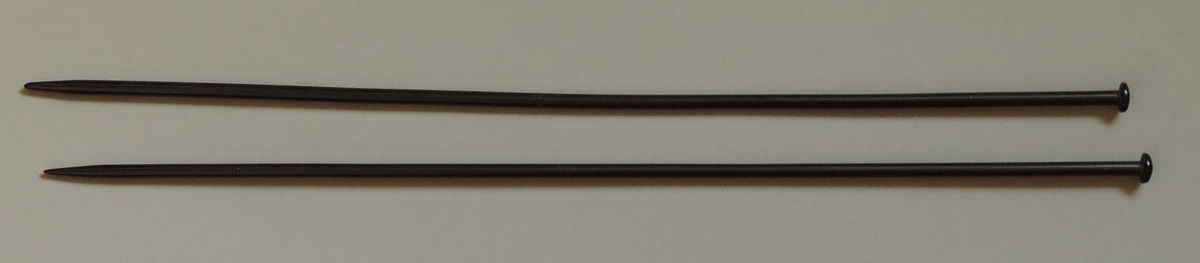
And this week we have been given some more knitting needles, including a pair of black straight needles, 12 in. (30.5 cm.) long and size 7 (4.5 mm.)   They don't have any label or markings on them, not even the size.


Again, they are sharper than most plastic needles.  And to me, they smell of rubber.  So I'm convinced they are vulcanite, and I'm not asking anyone else to smell them for me. 

It seems that vulcanite was not used for knitting needles after the start of the Second World War.  So if I'm right, these really are vintage knitting needles. 

Tuesday, 13 June 2017

Making Bone Knitting Needles

In the previous post I showed two ads for knitting needles, from 1921.  Both ads mentioned bone knitting needles, implying of course that the advertised needles were far superior.  Since I wrote that post, I have found a description of how bone knitting needles were being made in the early 1920s, at a factory in Gloucestershire. (I was browsing in some historic newspapers online, looking for something else entirely.)

By the 1920s, the process was highly mechanised, though still requiring a great deal of skill,  But it was also doomed - the article mentioned that a factory nearby was making casein, an early plastic.  The writer thought that it "has probably affected the bone trade in no small measure, but there still remains an extensive demand for knitting needles and other like articles manufactured from bone."  Not for much longer, I think.

We have a lot of bone knitting needles and crochet hooks in the Knitting & Crochet Guild collection, and  I picked out a small selection today. Here are two pairs of straight needles, a set of four double-pointed needles, and a crochet hook. The needles are sizes 5mm. and 5.5 mm. - bone could not be used for fine needles.  It's hard to measure the size of the crochet hook - it tapers along most of its length, so I don't know where to take the measurement.  

Vintage knitting needles; vintage crochet hook; bone; 1920s
Bone knitting needles and crochet hook
The bones for knitting needles were a by-product of the meat trade, and I had assumed that they came directly from butchers.  But evidently they didn't - they were collected by rag-and-bone men, largely I assume from private houses after the meat had been eaten.  I remember a rag-and-bone man making regular appearances on our street, with his horse and cart, when I was very little, but he was just part of the background, and I never thought about what happened to the rags and bones.  Later, if I had thought about it, I might have guessed that the bones were converted into bonemeal for fertiliser, and possibly some was, after the more useful pieces had been selected for destinations like the needle factory.

The article describes the initial preparation of the bone - which must have been a very smelly business:
The bones collected by the rag and bone merchant—or the tatter man—eventually find their way to the mills, and one section of the bones which are the result of stew are sawn off and are ready for use at once. The remainder, however, have to be thoroughly boiled. This is done in large tanks, the bones being boiled in steam-heated water for some 24 or 48 hours, as the case may require. Having been thoroughly boiled, which renders them soft and possible to handle easily, the bones pass on to the second process. This consists of sawing them into square strips—a most tricky and tedious business —and they then go to a series of machines through which the square strips are run emerging at the other side of the machine in the round. The bone is converted from the square to the round by means of a small revolving knife, through which the bone is drawn. This done the round strips are next placed in vats containing a bleaching chemical, and on being removed from this the bone, which was previously a creamy colour is perfectly white. 
The bone strips were then taken upstairs to the skilled needle makers:
The bones are now in round strips about eight inches long and bleached white. They next pass to the first floor of the factory, and here the strips are finely polished. To do this the pieces arc placed in the end of a rapidly revolving spindle, one at a time, and as they revolve they are polished by means of a piece of emery paper held in the hand of the operative. The points are then made, a revolving emery wheel being used, and the knobs for the other end having been turned out by a special machine, are attached by glue, the finished needles tied together in pairs, and packed ready for the purchaser. 
Knobs for bone knitting needles

A disadvantage of bone, mentioned in the Double Century ad, was that to make long needles two pieces had to be joined together by splicing. Evidently bone would only yield lengths of about 9 or 10 inches (23-26 cm.)  The article explains how pieces were joined to make longer needles:

Needles of 12 inches [31cm.] or more in length have to pass through an additional process—that of splicing. Bone cannot be obtained in long enough lengths to enable needles of this size to be made in one piece, and so two short strips are taken and cut at the ends in such a manner that they may be strongly spliced together with the aid of fine string and a specially prepared cement. When the needle is complete it is almost impossible to discover the joint, so perfectly is the work finished. 
I didn't know until I saw the Double Century ad that bone needles might be spliced, and I looked for some long needles today to see if I could see the join.  And indeed, the double-pointed needles shown above are just under 12 inches long, and they are all spliced, if you look very carefully.  The join is still almost invisible after all this time, and is perfectly smooth.  (Look for the faint diagonal line in the photo below.)

Splice in a bone knitting needle

The factory described in the article also made crochet hooks (or crotchet hooks, as they are called throughout):

The first stages of the manufacture of crotchet hooks is identical with that of knitting needles. On arriving at the finishing department, however, the pieces of bone are polished and then one end is slightly tapered. This accomplished, both ends are rounded and the hook made. The making of the hook is an operation which needs no little skill on the part of the operative, for the slightest mistake as the bone is placed against the revolving disc which performs the operation would immediately destroy the piece of bone on which the hook is being made. The hook is polished once again, and is then ready for packing.
The better class hooks are decorated on the handle, and this is done by a specially constructed machine, and also requires great skill on the part of the worker. 
The crochet hook shown above is one of the 'better class', and is beautifully decorated.

Decoration on bone crochet hook

I'm really pleased to have found out how bone needles and hooks were made, at the tail-end of the history of working with bone.  It had been a raw material for making tools and decorative objects such as sewing needles and combs for hundreds of years.  By the 1920s, perfect knitting needles and crochet hooks made of bone could be mass-produced  - and then bone was completely superseded by new materials like anodised aluminium and plastics.  I don't know when the factory described in the article closed down, but I think it must have been within a few years.

Sunday, 11 June 2017

Advertising Knitting Needles

I wrote a post two years ago about Double Century knitting needles, which had a metal core inside a plastic coating.  The original idea was patented in 1913 by Emily Doubble, although she seemed an unlikely inventor, as she was a widow in her 70s at the time. But this week, Emily's great-granddaughter commented on my post and said "she did invent a knitting needle which her son, Theodore, patented for her. My aunt told me that she was fed up on her fine needles breaking and had the idea of putting a metal wire in them. She was a great knitter, embroidery and wood carver!"

(One of the best things about writing a blog is that sometimes people give you fascinating information in comments - sometimes several years after the post first appeared.)

Belinda's comment reminded me that at the time I wrote the post, the earliest ad I had seen for Double Century needles dated from 1945, though it was clear from the wording that the needles must have been in production before the start of World War II.

But I've since found a much earlier ad.  It appeared in Needlecraft Practical Journal, and I date it to 1921.  (I'll write later about dating issues of Needlecraft, because it's not at all straightforward.)

1921 ad in Needlecraft Practical Journal; vintage knitting needles


At that time, bone was a common material for making thicker sizes of knitting needle, and you could also get ivory knitting needles, though they were of course much more expensive.  Double Century needles were always a cream colour, and this ad shows that it was because they were imitating the colour of bone or ivory.

In the same issue of Needlecraft, was an ad for Stratnoid knitting needles - another brand based on a patent.


This is also an earlier ad than I had found previously.   The patent (to make knitting pins from duralumin, an aluminium alloy) was granted in 1919, so the manufacturers were quick to get the idea into production.

The claim is that Stratnoid knitting pins are "STRONG - FLEXIBLE - LIGHT AS BONE - STRONG AS STEEL".  As with Double Century, bone was one of the materials to compete with.  It's interesting that they are claimed to be flexible - the finer ones will bend a bit, but you'd need a lot of force to bend the thicker ones.  And the ad doesn't mention their other big advantage over steel - they don't rust.

And with both Double Century and Stratnoid needles, you could knit faster, allegedly.  I've tried both, and they are very nice to knit with, but I don't think I can knit faster than with other needles.  Perhaps I should be comparing with rusty steel needles, wooden needles with splinters, or bone needles with  snags, but if so, I'd rather not do the experiment - I'm convinced already.    


Tuesday, 9 May 2017

More Knitting Needles

Through the local newspaper, the Huddersfield Examiner,  I have been trying to find out more about Wakefield Greenwood, a Huddersfield business that sold knitting yarns to stores throughout the country, and elsewhere, in the 1940s to 1960s.  I got a few replies to my appeal in the Examiner for information, and a couple of weeks ago I met someone who worked for the company for more than 20 years.  She has given me a lot of fascinating information, so I am gradually getting a more complete story, ... and she gave me several things for the Knitting & Crochet Guild collection, including a box of knitting needles.


I've definitely turned into a knitting needle nerd, I now realise, because I got quite excited by some of the makes.  Several of the pairs still had their original paper labels - not because they were unused, but because the donor liked to use the labels to keep the pairs together.

Here are the labels:


The needles at the top are Wimberdar brand - along with three other pairs of green/blue/turquoise plastic needles in the box. Wimberdar specialised in brightly coloured plastic needles, though they made other things too.  There are several pairs of Milwards Phantom needles in the box, in both grey metal and mauve plastic.  Then a really exciting pair - the Ivy needles.  I had never heard of Ivy needles before, and more surprisingly, neither has Google, as far as I can see.  There is no clue on the label as to who made them, except that it says "Made in England".  There are no marks on the needles or head, apart from the size, and IVY written on the head, not very clearly - barely visible except in a strong side light.


The labels on the Stratnoid needles read "The New Stratnoid Knitting Pins", The needles are the usual gray enamelled metal, like several other brands, and so are no longer the shiny duralumin of the original Stratnoid needles.  So 'new' in this case means 'just like everyone else' - a bit disappointing, when they started out being different from everyone else.

And of course there was a pair of Aero needles, made by Abel Morrall of Redditch - they must have been the commonest knitting needles in the country.

One pair of needles which did not have a label was, even so, particularly exciting,  I hadn't heard of the make before and the needles were marked with a patent number.  (I do like a knitting needle with a patent number.)  The make is Jouvenia, and they are the usual grey enamelled metal, so don't look very interesting.


Here's the head, with the patent number:


Patent 395307 is a British patent granted in 1933 to Joseph Jouve, a Frenchman.  The reason for the head being offset is that it has a hole in it, alongside the needle itself, where the point of the other needle can be inserted.  So the pair of needles can be joined together like this:


 (Although actually it is not at all easy to get the points of both needles at once into the hole on the opposite head.)  The idea is that fixing them together like this will keep the knitting securely on the needles, as in this drawing from the patent application.

.  
A Google search for Jouvenia found a couple of ads for Jouvenia needles in the French magazine Tricot Journal in 1936, and a sheet of headed paper from the Jouvenia factory in Paris, so it seems that Jouvenia needles were made and marketed in France, in spite of the British patent.  Yet one pair at least ended up in Huddersfield.    

Altogether a fascinating little collection of knitting needles.  If you like that sort of thing.
  

Wednesday, 8 March 2017

Stratnoid Knitting Pins

I do like a knitting needle with a patent number.  (At least I do if I can find the patent - sometimes I can't, and then it's just frustrating.)  It seems so unlikely that something as straightforward as a knitting needle should have anything patentable about it.  But several brands of knitting needle that we have in the Knitting & Crochet Guild collection do have patent numbers, for instance the Double Century needles that I have already written about.

Another brand with a patent number is Stratnoid  (a horrible name).

Vintage knitting needles; patent number 151307; duraluminl

Patent number 151307 was issued in 1919.   The patentee was Harry Norman Lilley, of Astwood Bank near Redditch, and he said in the application:
"My invention relates to improvements in the manufacture of knitting pins, crochet hooks and the like and has for its object to enable such articles to be easily and rapidly produced in such a manner that they are not liable to get rusty or otherwise deteriorated in use as has hitherto been the case.

Knitting pins, crochet hooks and the like have usually been made out of steel and plated or otherwise polished in order to render them rustless and not liable to be deteriorated in use and therefore have to undergo a series of processes whereby the production of such articles by these means requires undue time. To avoid this it has been proposed to manufacture knitting pins and crochet hooks of aluminium but this is objectionable in use as it marks or soils articles with which it contacts.

Such articles need not particularly be made of steel, and our invention ... consists in making knitting pins, crochet hooks and the like of aluminium and manganese alloy which is readily workable, such as that which is known under the registered trade mark "Duralumin", whereby an easy manufacture may be undertaken which effects a large saving both in tools and machinery."  
 It's interesting that aluminium by itself was "objectionable in use" because it would stain the wool - presumably that's why later aluminium needles are anodised in pretty pastel colours.  Also interesting that the patent doesn't mention another big advantage of the Stratnoid needles - they are much lighter than steel needles, but very strong.   In the KCG collection, we have a haberdasher's catalogue of knitting and crochet equipment from 1918-19 (see here), that lists knitting needles made of steel, bone, wood, vulcanite and ivory.  Anything finer than a size 12 (2.25mm) had to be steel, but the thicker needles (more than about 4mm) were only sold in the lighter materials.
   
At the 1911 census, Harry Lilley had been a commercial traveller for a needle manufacturer, so although he obviously understood the pros and cons of different knitting needle materials from the sales point of view, it doesn't seem likely that he knew a lot about metallurgy and the processes involved in making knitting needles by 1919.  But all the patent says, really, is "I think it would be a good idea to make knitting needles out of this new Duralumin stuff."  And in the 1939 register, he was still a commercial traveller, so the patent didn't change his life much.

(In fact, he seems to have got the composition of Duralumin wrong - according to various websites, it was an alloy of 95% aluminium, and 4% copper, with the rest made up of manganese and magnesium, so "aluminium and manganese alloy" suggests that he wasn't very familiar with it.)

The patent was taken up (though I don't know when) by the firm of Stratton and Co., of Birmingham.  According to Grace's Guide, the company was set up in 1911 by George Abe Laughton, who at that time was running a small section of another company, selling coronation badges and flags. "Components were bought in from a small supplier who suffered from the ravages of alcohol and supplies were erratic. Laughton bought the business for £50 and acquired four hand presses and two girl workers. He named this enterprise Stratton, reputedly after the hero in a novel his wife was reading."   A nice story about the source of the company name, but in fact their eldest son, born 1906, was named George Stratton Laughton. So he might have been named for the hero of the novel, and the company named for him.  (And when he grew up and joined the family firm, he was known as Stratton Laughton, not George Laughton.)

By 1920 (again according to Grace's Guide) the company was making knitting needles, radio receivers and men's jewellery (an odd portfolio).  It then merged with Jarrett & Rainsford, the company that George Laughton had worked for until 1911, and became Jarrett, Rainsford and Laughton.  The Stratton name was kept for such things as powder compacts (vintage Stratton powder compacts are evidently very collectable) and of course Stratnoid knitting needles.    

The earliest ad for Stratnoid needles and hooks that I have found dates from about 1925.  It features a testimonial from a customer: "JUST IMAGINE MY DELIGHT when I discovered 'STRATNOID' -- so light, soft as silk, and never discoloured my white wool as aluminium ones did.  I have several sizes in 'STRATNOID' and they are JUST PERFECT."


Vintage knitting needles & crochet hooks, 1920s
Stratnoid ad, about 1925
The brand continued to at least the late 1950s. In 1955, an ad listed the  "points of appeal about Stratnoid Knitting Pins":
  • Solid heads that CANNOT come off.
  • Polished rounded points that pick up stitches easily.
  • Supersmooth finish for rapid work.
  • Lightweight and unbreakable.
  • Neutral shade that obviates eye strain.
The last point seems a bit of a stretch, but all the others seem valid.  (The head couldn't come off because it was made in one piece with the rest of the needle, I believe, unlike some of the anodised aluminium needles.)  

Here's another ad, from 1958.  At that time, the company often offered free knitting patterns in their ads - if you bought a pair of Stratnoid knitting needles, you could send off for a free pattern.

Vintage knitting needles, 1950s
Stratnoid ad, 1958

And after that, the ads seem to have stopped (if I see a later one, I'll add it.)  But the needles have carried on - as Harry Lilley's patent application didn't say, they are very durable.  (Though we have had several rejects in the KCG collection that were slightly bent.)  I've tried knitting with them, and if you like very smooth needles, these are ideal.  Though I might not go so far as to say "JUST PERFECT", like the 1925 ad.

Saturday, 4 April 2015

Double Century

I have recently bought some vintage knitting needles, and I think they are the nicest straight knitting needles I have ever used.    The brand is Double Century and they have a plastic coating over a steel core.  They are very good to knit with.  The coating is smooth - but not too slippery, unlike metal needles. They don't bend, unlike plastic or wooden needles.  The steel core gives them a satisfying weight, although perhaps some people might find them too heavy.  And the points are just right  - not too blunt or too sharp.  

The name and other details are incised into the plastic, and I think that originally the lettering was filled in with some black substance.  A few of the Double Century needles in the Knitting & Crochet Guild collection still have the inlay (see photos), but it has usually worn off.


Vintage knitting needles
Add caption


After "The Double Century" there is a patent number, and on the other side of the needle, "English Made" and "B.G." for "British Gauge", I think, and then the size.  The coating of the needles is always a cream colour, to imitate bone or ivory.  

The patent, for "Improvements in or relating to Knitting Needles, Crochet-hooks and the like" was applied for in 1913 by Emily Doubble, widow, of  "Knole", Harpenden, Herts.

The specification reads:
"This invention relates to knitting needles, crochet-hooks, and the like of the kind which are made of vulcanite, ebonite and such like pliable material, the object of the invention being to lend a stiffness to the hook or needle when in use.

It has been found the knitting needles, crochet-hooks, and such like appliances of domestic use when formed of ebonite, vulcanite or other material, though possessing a desirable smoothness and silence in working, are apt to become soft and to lose their stiffness when held in the hand for any length of time, owing to the heat of the hand softening them.

According, therefore, to this invention, I reinforce the needle, crochet-hook or the like by imbedding a core of stiffening material ... to increase its rigidity.

In one manner of carrying out the invention as applied to a knitting needle, a steel wire is imbedded in the centre of the needle when the same is in a liquid or semi-liquid state, the reinforcement being entirely covered at the pointed end of the needle..."
I have been trying to find out more about Emily Doubble, and how her patent led to my knitting needles.  She  seems an unlikely inventor.  In the 1911 census, she is recorded as living at the same address as on the patent application, aged 72, and already a widow.  She had had 14 children, and living with her were two daughters and a son, all unmarried.  The son, Theodore William Doubble, must surely be the T.W. Doubble, Chartered Patent Agent, who is also named on the patent application - his occupation in the 1911 census is engineer, so he seems a much more likely inventor than his mother.    

Then there is a gap after 1913 when the patent was granted, and 1945, which is the date of the next reference I have found to Double Century needles.    

Vintage knitting needles, 1940s

They were advertised in June 1945 in the magazine Home Chat as "The Knitting Pins with a history and a future."   Evidently the manufacture of Double Century needles had been suspended during the war, and in 1945 they were still not available. The ad says "The Steel for their unbreakable centres has been needed for essential war work.  Soon they will be back for those insist on the finest knitting pins in the world."  Many ads with a similar message appeared around that time, saying "our product has not been available during the war but it soon will be".  

The company making Double Century needles was James Smith & Son, in Redditch.  The town had a long history of needle-making, and the firms of Henry Milward and Abel Morrall (makers of Aero knitting needles) were also based there.

When I first saw this ad, with the date 1698, I thought that Double Century referred to the age of the company, i.e. more than 200 years, and thought that the name might have been introduced in 1898.  But surely it is not a coincidence that the brand name is Double Century and the patent was granted to Emily Doubble?  What is the link between a widow living in Harpenden, and a needle-making company in Redditch?   It's very mysterious.

Vintage knitting needles, 1950s

By 1950, steel shortages were past and you could buy Double Century needles without any problem. An ad in Needlework Illustrated claims that they are "Just like ivory" (because of the colour and feel, I suppose) and the "Best Knitting Pins in the World".  I might not go so far as to agree with that, but they are certainly my favourites just now.   If I find out more about their history, I'll let you know.

Thursday, 19 June 2014

A to Z of Knitting Needles

This evening we had the monthly meeting of the Huddersfield branch of the Knitting & Crochet Guild, and we showed some of the tools and gadgets from the collection.  (It was called 'Inspect a Gadget'.  It's been explained to me.) 

Angharad decided to put together an A to Z of knitting needle brands.  She didn't quite get a complete alphabet, but most letters are represented in the collection, from Aero, Ace, Anlaby and one or two more As through to Zephyr.   Some of the trickier letters are there, including Quaker Girl and Jester, but no Xs - and no Ns or Os, which is slightly more surprising.  

Here are some of the less common brands from the collection.   First a selection of plastic needles.

Cronit, Ladybird, Peacock, Glamor, Clive, Ace, Wimberdar, Robinoid
And the J and Q:
Jester
Quaker Girl
I knew it would be easy to get nerdy about knitting needles.

Tuesday, 3 December 2013

The Price of Knitting Needles

I have been sorting out a corner of the office at Lee Mills recently.  It was full of all sorts of papers - books, magazines, leaflets - all mixed up, and mostly very old.  One of the fascinating things I found is an illustrated price list from 1918-19 for W.H. Head & Son, a shop that sold materials for knitting, crochet and other needlecrafts.  


Catalogue of knitting needles, crochet hooks, tools & gadgets
W. H.Head & Son price list, 1918-19

The shop sold everything you would need for your knitting, from yarn and pattern leaflets to tools and accessories of all kinds, including, of course, knitting needles.  They were available in sizes 1 to 18 (7.5 mm. to 1.25 mm.), in different lengths, double pointed or with knobs, in sets of four or in pairs.   They were made in different materials:  steel, bone, wood, vulcanite and ivory.   Vulcanite is  vulcanised rubber, a hard material, usually black,  that can be polished and was sometimes used for jewellery, in imitation of jet.  Ivory (always 'Real Ivory', not just ivory) is the most expensive material by far.  Not every size of needles is available in every size:  steel is used for the finest needles, and lighter materials (bone, vulcanite, and wood) for the thickest.  But the middle sizes were for sale in  all of the materials, so prices can be compared.  A pair of 12 inch needles in size 10 (3.25 mm) cost 4½d (under 2p) in wood, twice as much in bone or vulcanite, and a shilling (5p) in steel.   Real Ivory needles cost 3 shillings (15p) - eight times the price of wood.   

What's the present-day equivalent of Real Ivory for knitting needles?  I guess it would be carbon fibre, but maybe there's some even more high-tech material that I'm not aware of.  And the cheaper end of the market is plastic and steel.    It might be interesting to see whether the price differential between luxury and basic needles is anything like it was in 1918. But of course the situation then was completely different - for many women, hand-knitting for their families was an economic necessity, whereas Real Ivory needles were probably bought by women who could afford to knit for recreation.           

W. H.Head & Son also sold  extra large or Leviathan knitting needles, in sizes A, B, C, D and E.  I don't know what sizes they were, but possibly they corresponded to the sizes that are marked 0, 00, 000, etc. on some gauges. I don't know what knitters used them for in 1918, but evidently if you didn't know what they were for, you didn't need them, so you didn't need to be told. 

To go with your knitting needles, you needed a needle gauge, because I think that needles were not marked with their sizes at that time.   There are two in the catalogue, nicely illustrated.    


Vintage knitting needle gauges, 1910s; bell gauge, Wheel of Fortune gauge

The bell was a popular shape for needle gauges - I have a very small collection myself (three, apart from the one I actually use).  Some friends gave me a Walker's gauge like the one illustrated, so it's nice to think that it might be nearly 100 years old.  Another is a different make but also bell-shaped.  And the Beehive gauge that I wrote about here is sort of a derivation of a bell shape, if you look at it cross-eyed. 

I have not seen a "Wheel of Fortune" gauge, as far as I know.  We may  have one in the Guild collection, but that part of the store ("Knitting Needle Alley") awaits sorting.

Saturday, 8 October 2011

Eureka! Knitting Needles!

Friends came to visit for a few days last week and brought me a wonderful knitting gift - an antique knitting needle case, containing steel knitting needles.  They are very fine - the thickest are 2.25 mm. diameter, and the thinnest only 1mm. (I have tried knitting a sample with those but found it very difficult.)

The case was evidently sold originally with a set of needles and I assume that the present contents are some of those. The writing on the case says "EUREKA - Best Quality - Steel Knitting Pins Highly Tempered - Guaranteed not to rust - Germany".  And indeed they have not rusted.  I think they must date from before the First World War - the woman's head on the cap could be Edwardian.


It would be nice to knit something with the thicker needles, perhaps a pair of fine mittens.

Thursday, 29 July 2010

Knitting Needles

On Saturday afternoon, J and I went to Tommy Topsoil at Sowerby so that I could get some cocoa shell mulch  (very good for the garden, and smells of chocolate too).  When we got there, we discovered that it is closed on Saturday afternoons.  So as it was my fault (for not checking) that J had driven to Sowerby to no purpose, he took a detour to Mytholmroyd on the way back to visit an antique centre where we have had some good buys in the past.

He did find some things he wanted, I am glad to say, but also pointed out a bundle of old knitting needles that were very cheap.  

 I didn't really need to buy any knitting needles, but I have in mind to knit the Dofuko jacket from Knit Kimono by Vicki Square and the photo in  the book shows it fastened with some sort of pin (I think - I don't have the book yet but have seen it in bookshops).  In the bundle was a battered old wooden knitting needle, size 4mm, and I thought that if it was shortened it would do very well for the purpose.  And what could be more appropriate to fasten a hand-knitted jacket with?   

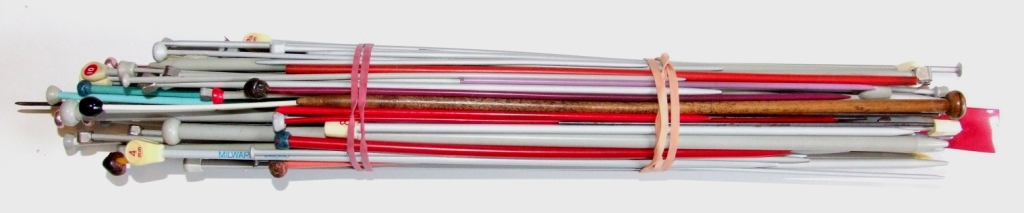
So along with the wooden pin, I have acquired a whole lot of other needles - well over 100. Some obviously quite old, including a lot of  slightly rusty double-pointed steel needles and several pairs of plastic needles, often with a shapeless blob of something unidentifable to replace the original end. 

 And lots of perfectly good pairs in all sizes from 2 to 14 (7 mm to 2 mm).   It's a mystery, though, why there are so many pairs of some sizes.  How many pairs do you need?  And why are so many only 10 inches long?  Not much use except for knitting baby clothes, I would think.  

Quite sad, really.  I imagine that the collection was amassed by someone over a lifetime of knitting, and then ended up in the antique market after she died.

I think I shall dispose of most of them (to a good home if possible), except where they are in better condition than the ones I already have. My  favourites are the pink shiny ones  (So pink! So shiny! So pretty!) so I might keep a pair of those too. 


 J pointed out that it would be easy to get very nerdy about knitting needles and start getting excited about all the different makes.   As well as Aero and Milward that are familiar, there are Phantom, Quaker Girl and Stratnoid.  (Who could think that Stratnoid was a good name?  Possibly memorable, but hardly euphonious.)  But I am definitely not going to start collecting different makes of knitting needle.

Related Posts Plugin for WordPress, Blogger...